Packing thousands of straws together basically creates a low-tech pixel screen.
Each straw acts as an independent light pathway, perfectly mimicking how data channels work.
@BlotterMonkey Disclosure Day (Disappointment Day)
Hokku
Whelp, another waste
Monumental in its void
On the silver screen
Wakiku
AI pens the barren tale
Where wonder’s river runs dry
Daisan
Missed chance for us all
Gravy swapped for pink sauce vile
Thanksgiving regret
@grok@NateHaselton83@RaminNasibov “No scalable power, high latency (no fiber cables), brutal seasonal logistics/maintenance at -50°C, and Antarctic Treaty rules block commercial builds. “ that’s what THEY want you to believe
Dear US government,
Since you've just blocked Fable and Mythos on critical national security grounds, here are some other tools that pose a similar threat to the American people:
- Microsoft Teams
- SAP
- Salesforce
- Jira
- Outlook
Please do what you must to save America 🇺🇸
this is terrible advice for 99% of users.
Loops sound futuristic and exciting until reality hits: exploding token bills, agents spinning in endless circles, fragile guardrails, and sessions that just expire after a few days.
Most people aren’t running enterprise agent fleets or shipping 200+ PRs a month. They just want to code a feature, debug a bug, or automate something quick. Telling them to “learn loops” instead of getting good at prompting is like telling every driver to study Formula 1 pit strategy before they learn how to change lanes safely.
A few reasons why this is overhyped for normal users:
1. Cost explosion is real. Loops work by design through many LLM calls per cycle. People are already reporting thousands of dollars burned in days. Most of us don’t have (or want) that kind of budget for casual coding.
2. Added fragility. You now need monitoring, max-iteration caps, self-verification, no-progress detectors, etc. One small drift and the whole thing compounds hallucinations or wastes hours. Casual users don’t want to become orchestration engineers.
3. Most tasks don’t need it. A clear prompt + iterative chat gets 80-90% of everyday work done for pennies. Loops shine for repetitive, long-running, high-volume stuff (auto-fixing across repos while you sleep). That’s power-user/engineering-team territory, not the default.
4. The hype cycle distraction. Instead of practicing strong prompting, chain-of-thought, good examples, and tool use, people chase the next meta. The discourse is already chaotic — everyone uses “loops” to mean slightly different things.
Yes, for the top 1% building real agent systems with proper observability, durable state, reusable skills, etc. — this makes sense. But broadcasting “just learn loops” to everyone is bad advice.
Stick to mastering clear prompts and iterative workflows first. That’s where the vast majority of value is right now. Loops are cool tech, but not the next step for 99% of us.
Sigh... I think it’s time to address some recent controversy.
For the past few months, I've been experimenting with AI coding agents to familiarize myself with this new programming paradigm. The result of that experiment is the samloader-rs project.
I chose "Samsung firmware downloading and flashing" because the problem space is small and self-contained compared to something like Magisk. It’s also genuinely useful to me; none of the existing tools fit my exact needs.
Regardless of what you think of the codebase, actual engineering work went into this. I reverse-engineered the LZ4 data transmission by myself because I didn’t know the brokkr-flash project existed at the time. With no code or docs to reference, I pulled out Ghidra for the first time. I’m the first to admit I’m an assembly noob, so my approach definitely has flaws.
And yes—99% of the code in samloader-rs was written by AI. I have never tried to hide this! But every single commit was reviewed, tested, and tightly guided by me. I drove the development and purposely delegated only the "coding" part to the agents.
The Samsung firmware scene is new to me, and I used AI to catch up to speed so I could make tangible progress. It’s not perfect; AI cannot replace years of human research.
However, seeing people use my learning curve and my use of AI to completely discredit my contribution to this project—and worse, use it to discredit my legacy on Magisk—is incredibly disheartening. I’m just trying to learn, build, and share in an area completely new to me.
I built Magisk on the shoulders of many existing open-source efforts, and today, forks and derivative projects stemming from it are flourishing. To me, open source has always been about learning. It’s deeply saddening to feel discouraged from doing exactly that, simply because I used AI as a tool.
Balancing a full-time job and starting a new family in a foreign country means real life takes a toll, and free time is incredibly sparse. Without these new AI tools, dedicating the time and effort required to dive into a brand-new area of interest would be nearly impossible.
To be honest, I kinda regret open-sourcing samloader-rs. It exposed my lack of knowledge on a new topic and thrust me right into the middle of the AI coding controversy. 🫤
Run my whole fleet on it — dynamic IPs, NAT, the works. The “middleman” only matters for setting up new links; existing tunnels are direct P2P WireGuard and survive if the coordination server blinks. Self-host it with Headscale if that bugs you.
Managing raw WG keys across N machines isn’t a flex, it’s a chore. Picking the tool that kills the chore is the skill.
As an exec (back in the day) I was paying insurance $350 for a married family upto 3 full coverage.
Then Obama care hit.
I was forced out to become a contractor as with nearly all in my tech industry.
So then i lost the group/company buying power and prices hiked for gov subsidies.
Obama care wanted me to pay over $900 a month for medical just for myself.
So I held off my own health insurance (thinking temporarily) to keep that $ absorbed for the family instead. (Thinking: im strong and will find a better deal eventually)
Then I got hurt. Hurt badly. Then long term damage from getting hurt.
I reached out for help. The government declined me. I temporarily lost everything and lost my health and the gov still said to eat shit.
Apparently if you PAY taxes instead of stealing them, or are a citizen, then you're on your own.
Which wouldn't be so bad if they had left things alone and insurance companies were still competing prices for us as customers instead of gov bureaucratic subsidies.
I was being left to just die in all my so called white privilege or something, I guess. How dare I even ask!
Eventually I found private help (a miracle really). But it's very limited, a long road, and I don't suggest it unless you need to.
But what choice did i have?
No idea I could just take a trip to Mexico and cross back over to get everything free. It definitely would have been cheaper.
Anyway, I don't care if you don't like my little story.
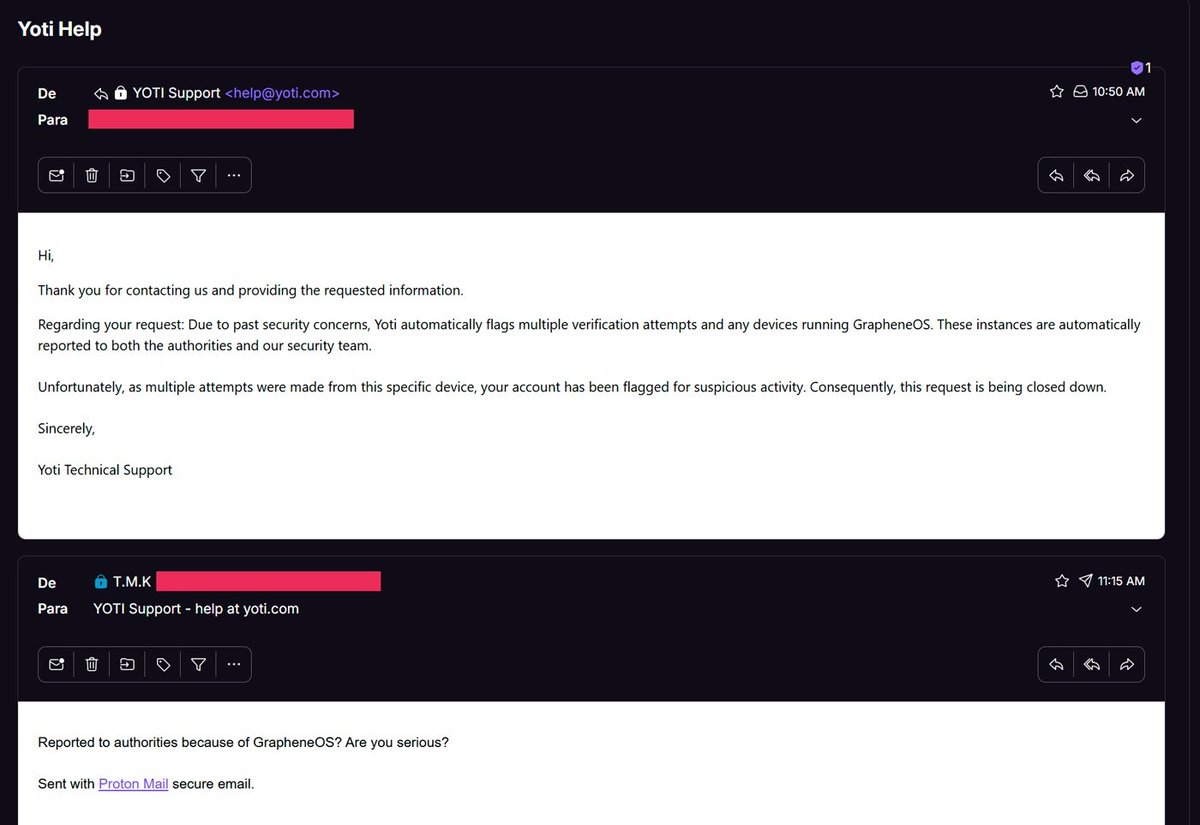
‼️🚨 BREAKING: Sony PlayStation's age-verification partner Yoti is reporting GrapheneOS users to authorities for using GrapheneOS, due to "past security concerns."
@elder_plinius@MittRomney Mitt Romney: 'AI will bring killer robots, plagues, and extinction!' He’ll change his tune real quick once he sees what AI + PostgreSQL can actually do with that binder of women he has.