Jumped in on @multiplifi yesterday and I've taken my time to read their documents and I must say I'm really impressed.
With @multiplifi, you do not need to have millions of $ to invest in real world assets cuz you can actually own a fraction of it anywhere in the world.
Trail of Bits published notes on 18 September on reviewing the Miden zkVM. The part worth reading is what happened before the review started.
Security firms — the same firm included — have published a number of posts describing how they pointed an agent harness at a codebase. This post is about a stage earlier than that: "before code review even starts, agents now allow us to build custom tooling and formal models that improve the quality and depth of our reviews."
Miden has its own assembly language, MASM, and very little tooling around it. The firm had six months of lead time, because the implementation was not yet feature complete. It spent them having its agents build an LSP server, a decompiler, a static analysis engine, and a Lean model of the VM executor. None of that was the review.
Applied during the review that followed, those tools produced concrete results. The static analysis identified over 400 unique locations where type validation could be improved, all of them reachable from the library's public API, as well as one high-severity finding: a remainder supplied by the prover was never validated before being passed to a 32-bit subtraction — "a malicious prover could exploit this to forge Falcon signatures and drain any Miden account controlled by a Falcon key pair." The Lean modeling effort produced 95 machine-checked correctness proofs covering all the binary arithmetic in the core library, and surfaced two more bugs the existing unit tests had not caught.
The detail worth sitting with is smaller than any of those. The decompiler was the single largest piece of the work, over 100 agent-generated commits across months. The firm's own account of where the benefit landed: "The main benefit of this work turned out to be the decompiler's internal analysis frameworks and intermediate representation, which we could reuse for static analysis, rather than the full decompilation pipeline."
The post is direct about why work like this did not happen before. It is "highly exploratory in nature, and the end results and potential payoff may be difficult to predict," which makes it "hard to sell clients on them in advance."
What has changed, on the post's own account, is the cost of a miss: "Today, a failed side project only costs tokens." The payoff is no easier to predict than it was. What a wrong guess costs is smaller.
One thing about this particular case is worth noting on its own. The main benefit ended up somewhere the single largest piece of the work had not been aimed at. That is a payoff shape easier to recognize once the work is finished than to argue for before it starts.
https://t.co/972ijKSY19
#DeepSafe #Web3Security
Just stumbled across Ronke Quest 👀
Honestly, I like the idea of turning simple onchain activity into an actual questing experience.
Gonna see how far I can push this one 🫡
@RonkeOnRon
Ronkeverse is cooking. 🐸
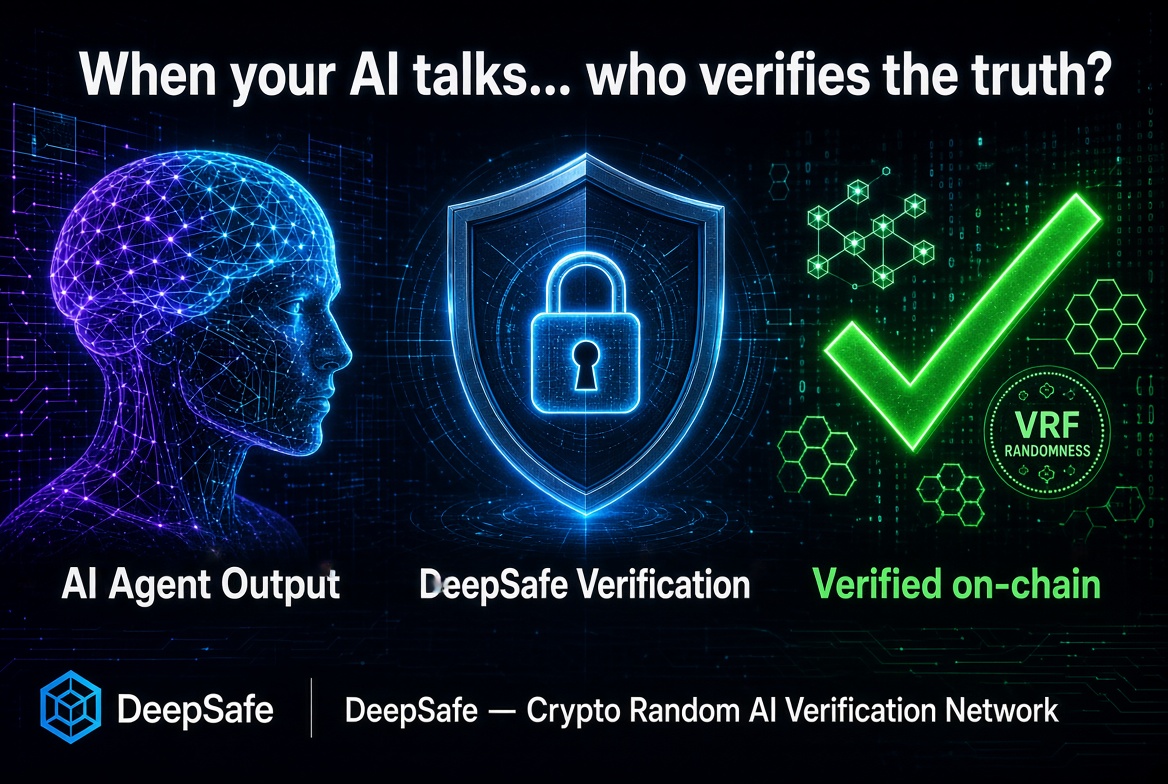
DeepSafe is a network that randomly selects verifiers with cryptography so no one can fake AI agent outputs or cross-chain data. Trustless checks for Web3 + AI. #DeepSafe@DeepSafe_AI
The Core DAO incident is a perfect illustration of why supply-cap guarantees alone aren’t enough. Timing and accounting integrity matter just as well and verifiable, independent reconciliation is what turns a fix into something the whole network can actually trust. @DeepSafe_AI
On September 5, Core DAO published its post-mortem on the reward-accounting exploit that ran from August 28 to 31. Roughly 255M CORE of rewards were issued ahead of schedule.
The cap held. In Core's words, the exploit "did not create any CORE beyond the protocol's limits; the 2.1B maximum supply was never violated." What it did was accelerate rewards the emission schedule would otherwise have released later. What broke was when.
That makes the damage an unusual shape. No user or staking account was drained — Core states that no user or staker funds were lost and that delegated stake was never at risk. What existed instead was surplus, sitting in balances, and it arrived through the ordinary path: the extra rewards "appeared both in attacker-controlled addresses and, unintentionally, in the reward addresses of honest validators who simply received an inflated payout they did not cause."
That made the on-chain reconciliation an arithmetic problem before it was a balance-editing problem. Before any affected balance could be corrected, Core needed a rule for what that balance should have been at the upgrade block.
It used two. Attacker-controlled reward pools were set to zero. For affected honest validators, it defined a fair-earnings floor — the pre-incident balance plus three rounds of that validator's own normal reward — left balances at or below it untouched, and removed only the excess above. Together the reconciliation took 186,153,491 CORE out of supply by direct state reduction. A further ~69M had been moved before the upgrade and sits outside what an on-chain reconciliation can reach; Core says it is pursuing that with law enforcement.
Core says the reconciliation can be checked independently against chain state at the upgrade block, and that the reward paths were subsequently reviewed by Halborn. That part matters as much as the fix. A correction that affected users and independent observers cannot verify is only a second assertion about the balances.
A supply cap is a promise about how much will ever exist. It says nothing about how much should exist yet. Restoring the second one requires knowing a number the cap never had to track.
Sources:
https://t.co/TMhZdwRHaQ
#DeepSafe #CRVA #Web3Security
DeepSafe uses crypto random verification (Ring VRF + MPC + TEE) for trustless on/off-chain data checks — great for AI agents & oracles. #DeepSafe@DeepSafe_AI
AI agents are powerful… but only if you can trust what they say.
That’s why I made this for @DeepSafe_AI — a Crypto Random AI Verification Network that uses advanced crypto (Ring VRF + more) to verify data on-chain and off-chain.
No more black boxes.
#DeepSafe@DeepSafe_AI
On September 5, Core DAO published its post-mortem on the reward-accounting exploit that ran from August 28 to 31. Roughly 255M CORE of rewards were issued ahead of schedule.
The cap held. In Core's words, the exploit "did not create any CORE beyond the protocol's limits; the 2.1B maximum supply was never violated." What it did was accelerate rewards the emission schedule would otherwise have released later. What broke was when.
That makes the damage an unusual shape. No user or staking account was drained — Core states that no user or staker funds were lost and that delegated stake was never at risk. What existed instead was surplus, sitting in balances, and it arrived through the ordinary path: the extra rewards "appeared both in attacker-controlled addresses and, unintentionally, in the reward addresses of honest validators who simply received an inflated payout they did not cause."
That made the on-chain reconciliation an arithmetic problem before it was a balance-editing problem. Before any affected balance could be corrected, Core needed a rule for what that balance should have been at the upgrade block.
It used two. Attacker-controlled reward pools were set to zero. For affected honest validators, it defined a fair-earnings floor — the pre-incident balance plus three rounds of that validator's own normal reward — left balances at or below it untouched, and removed only the excess above. Together the reconciliation took 186,153,491 CORE out of supply by direct state reduction. A further ~69M had been moved before the upgrade and sits outside what an on-chain reconciliation can reach; Core says it is pursuing that with law enforcement.
Core says the reconciliation can be checked independently against chain state at the upgrade block, and that the reward paths were subsequently reviewed by Halborn. That part matters as much as the fix. A correction that affected users and independent observers cannot verify is only a second assertion about the balances.
A supply cap is a promise about how much will ever exist. It says nothing about how much should exist yet. Restoring the second one requires knowing a number the cap never had to track.
Sources:
https://t.co/TMhZdwRHaQ
#DeepSafe #CRVA #Web3Security
Ghost Cats found a new home 👻🐱🌱
GreenTown feels like the kind of place where you don’t just farm points;
You farm attention, you farm creativity and community.
So I’m bringing the ghosts to town 👻
@GhostCatsRH × @GreenTownSocial