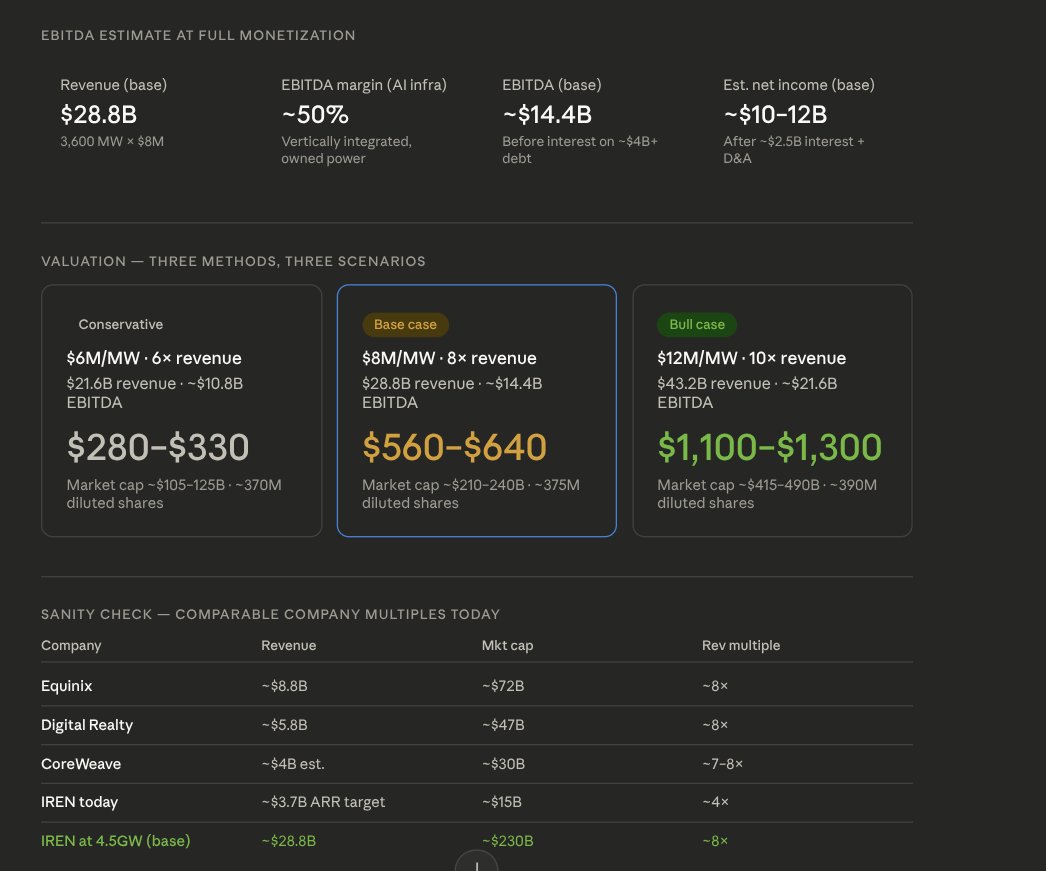
Once again, a really good article on how Iren’s share price could be four or five times higher by the end of 2027 compared to the current level. @franklee6924T@IREN_Ltd
The Key Takeaways from IREN’s Earnings Report
There are several key takeaways from IREN’s latest earnings report:
New vs. Old, Fast vs. Slow
The AI business has begun to grow substantially, but its base is still very small. For the first time, it has surpassed the mining business, and IREN explicitly stated that it will completely exit Bitcoin mining by the end of December 2026. Most of the relevant assets associated with the former mining business have already been written down. The remaining losses will depend on how the mining machines perform in the secondary market, but the additional losses that could arise are already very limited. This marks a critical turning point in the transition from the old business to the new one.
IREN has adopted a slow-ramp strategy for its AI business. Signing contracts is not the bottleneck; actually bringing the GPUs online is the bottleneck. If the goal were to “turn compute into revenue as quickly as NBIS,” IREN would absolutely have the conditions to pursue a path of rapid deployment using air-cooled, quick-install facilities, pre-purchasing large quantities of Hopper-generation GPUs, signing contracts quickly, and billing customers quickly.
But they did not choose that path.
They have their own plans and their own sequence of steps. They are betting on liquid cooling and higher-performance GPUs. Even Canal Flats in Canada, which originally could have been brought online quickly, has now been converted entirely to liquid cooling. As a result, the monetization of compute capacity has been pushed back by roughly a year.
I do not intend to conduct a comprehensive, long-form analysis of this earnings report. I will simply highlight a few key points.
For example, the complete conversion of Canal Flats to liquid cooling is highly representative. The reason IREN’s stock price is currently unable to move higher is that its AI revenue base is still too small. But does IREN have the ability to make that number substantially larger? Absolutely.
If that had been the objective from the beginning, IREN’s AI sales would not be far behind NBIS. IREN had already been operating H100/H200 GPUs several years ago and already had cloud-business revenue. If it had simply sold bare-metal compute, accepted hyperscalers’ demands at relatively low prices, and consumed its MW capacity in advance, rapidly scaling AI compute revenue in the short term would not have been difficult.
Compared with CRWV and NBIS, IREN’s software capabilities are somewhat weaker. But when it comes to selling bare-metal compute, there is no fundamental difference among the three. NBIS’s transactions with hyperscalers are essentially pure bare-metal arrangements.
IREN did not choose this model.
Instead, it is betting on the future, while building several important capabilities along the way:
First is software capability.
The defining event was the acquisition of Mirantis.
Second is liquid-cooling capability.
The defining event was the delivery of 50MW Horizon 1, together with its achievement of high-level performance certification. By the end of this year, IREN is expected to have 200MW of liquid-cooled data centers delivered. This will be a remarkable event for the entire industry.
Third is the AI Factory.
The defining event is that SW1 will become a flagship AI factory under NVIDIA’s DSX system.
Fourth is financial capability.
The defining event is the continued recruitment of senior financing talent from KKR. IREN is preparing extensively to turn its wholly owned, fully vertically integrated data-center assets into a new type of financial asset.
This is an advantage that only IREN possesses, and it will be one of the most important pieces of the growth flywheel that is about to emerge.
IREN has been slow in growing AI sales—almost a year behind.
But now I can basically confirm that, going forward, it will rapidly catch up. At some point, it will completely surpass NBIS and CRWV.
You only need to look at how much performance Vera Rubin delivers compared with the previous generation of chips to make a rough judgment.
What matters most right now is absolutely not selling relatively inefficient compute converted from electricity as quickly as possible, and then using temporarily attractive numbers to exchange for temporary stock-market glamour.
That is a huge trap.
What matters most now is patience: carefully building infrastructure capable of converting electricity into compute efficiently and at high quality.
AI compute revenue at the Canal Flats site has been delayed by a year, but once it goes live, one month of revenue could potentially make up for the entire year of revenue generated by lower-end GPUs.
And as subsequent GPU generations iterate, the marginal cost will be extremely low.
Meanwhile, CRWV and NBIS, which are running faster today, will gradually begin to run out of momentum.
Even if they manage to maintain their lead in obtaining GB300 and Vera Rubin GPUs, it will be extremely difficult for them to move as quickly as before. The reason is that the supply of liquid-cooled data centers has become a massive bottleneck.
It is more complex and difficult than any individual bottleneck we are seeing today.
The TIME TO COMPUTER that IREN has repeatedly emphasized—where the bottleneck is actually bringing the GPUs online—is specifically referring to this.
Gaining an advantage here is extremely difficult.
The first and foremost challenge is capital investment. This is a problem everyone faces. There is no way around it. It must be confronted directly, and it is the most important issue that has to be addressed.
In this earnings report, IREN did not even provide guidance for 2027. But it clearly provided its capital expenditure outlook: $2.5–3.0 billion.
This is the investment required to solve the bottleneck.
The market therefore became concerned about dilution, and the stock declined.
But in reality, IREN’s dilution pressure is approaching a major inflection point.
There will still be some dilution, but compared with the past, this pressure will become increasingly lighter, and eventually could disappear altogether.
I analyzed this in detail in my long-form article last week. IREN possesses unique advantages that others do not have. These advantages come from vertical integration, and their various benefits will continue to emerge in the future.
The speed of CRWV and NBIS today has been achieved by sacrificing a great deal of future decision-making autonomy.
They will become increasingly passive.
They constantly have to fulfill orders that have already been signed, leaving them little room to develop many of the capabilities that could improve their pricing power.
If IREN has 1.2GW of compute online by the end of next year, while CRWV and NBIS each have perhaps 2GW, it is entirely possible that IREN could match them in terms of compute sales.
Why?
Because IREN’s GPU mix is primarily high-end chips, while CRWV and NBIS are primarily using mid- and lower-end chips.
Even if you have the ability to obtain high-end GPUs from NVIDIA, if your data-center capabilities are not capable of supporting them, that advantage is meaningless.
It is almost impossible for CRWV and NBIS to retrofit those air-cooled data centers to significantly improve their efficiency.
First, most of them are leased, so they do not have full decision-making authority.
Second, the capital investment required is enormous.
Third, the pressure to fulfill existing orders leaves them no time to wait.
They have no choice but to operate at full capacity whenever even a single unit of electricity becomes available. Otherwise, the pressure from potential contract breaches would be enormous.
Two weeks ago, when I watched the VINELAND hearing, I genuinely felt the enormous pressure.
Although the project was eventually approved and can proceed normally, thinking about it afterward made me realize something:
What was fought so hard for was simply the basic protection that a normal construction project should have in the first place.
For such a complex liquid-cooled data center, even when all parties are cooperating, there will still be all kinds of problems.
In the future, the emergence of one problem after another is virtually inevitable.
Pushing yourself into such a constrained and involuntary position through competition, in exchange for a temporarily soaring stock price, is actually a sign of a lack of long-term judgment.
The model of signing contracts early and accumulating a large backlog of orders is fundamentally problematic.
Emerging industries are inherently characterized by rapid change, high risk, and little room for error.
Using this model to force yourself into a constantly spinning bellows is simply unwise.
You do not need complicated data to prove it. The state of being trapped in such a position is itself sufficient evidence of how passive you have become.
Indeed, IREN has not yet received market recognition.
But it is extremely proactive.
It is proceeding methodically, calmly, and according to its own predetermined plan, without allowing the market to dictate its actions.
That is the standard of an excellent management team and an excellent board of directors:
Stay committed to doing what you believe needs to be done.
IREN’s technical strength has several important endorsements.
Some of the top liquid-cooling experts in the United States have been brought into IREN. This year, IREN has attracted cloud-technology executives from multiple companies with hundreds of billions or even trillions of dollars in market capitalization.
At the same time, IREN is working with NVIDIA to jointly build an AI Factory under the DSX architecture.
All of these efforts are focused on the next generation of the AI compute industry.
And the Horizon 1, which comprehensively demonstrates IREN’s technical capabilities, has already been certified and placed into operation.
Horizon 2–4 will follow soon.
The change in scale will bring about a massive qualitative transformation.
IREN is becoming an important core player in the infrastructure of the next generation.
Customer Quality and Diversity
IREN announced a multi-year contract with a frontier AI laboratory.
Other than that, it said nothing.
It did not even provide ARR guidance for 2027.
I believe this must be related to this contract.
Moreover, both the total contract value and the price per MW in this agreement are historically the best IREN has ever achieved.
As for who this frontier AI laboratory actually is, I wrote four long-form articles on this subject several months ago, so I will not elaborate here.
The probability that it is Anthropic is extremely high.
The key point is the quality and diversity of IREN’s customers:
NVIDIA, Microsoft, Cohere, Prometheus, Perplexity, Figure AI, Fal AI, Higgsfield AI, Firework AI, Together AI.
This list is exceptional.
There is an enormous amount that can be analyzed here, and it is more than enough to demonstrate that IREN possessed tremendous differentiation from the very beginning.
Its future potential is off the charts.
I have also analyzed these issues in dedicated articles before, so I will not repeat them here.
Finally, I want to say this:
IREN’s problem is fundamentally not a communication problem. It is a problem of understanding.
Professional institutions are buying in heavily and in large quantities.
As long as those short-sighted investors who do not understand what they are looking at continue to leave, the question for us as investors is very simple:
Are you investing in the future, or are you investing in the present?
The Life-or-Death Red Line of the Neo-Cloud Industry — The Most Important Thing $IREN Is Doing
The neo-cloud industry is one of the most promising sectors today, while at the same time imposing extremely demanding requirements on the financial quality of the companies involved. To remain competitive in the coming boom of the AI industry, companies must directly confront the unavoidable problem of heavy capital investment. Faced with this choice, emerging companies and established companies with strong resources are confronted with essentially the same dilemma. This is also why the industry presents investors with such a significant opportunity. AI's appetite for compute is almost unlimited. There are very few industries in which companies can remain unconcerned about demand over such a long period of time. The real challenge is to continuously provide high-quality compute while simultaneously making the company's financial condition increasingly healthy.
The balance between capital expenditure and revenue is a red line. Although there are many ways to assess the quality and development of the AI infrastructure industry, this red line is a matter of survival and is therefore critically important. More specifically, it is the question of establishing a positive return loop between capital investment and cash flow. It can be said that whoever gains an early advantage on this front is the one most likely to truly own the future.
At present, CoreWeave is performing the worst when it comes to this red line. Its enormous business is built on an expensive debt foundation. Although its backlog continues to rise and it is making active efforts in other areas, its ability to withstand risk is extremely fragile. So far, there has been no clear sign of a fundamental reversal.
Oracle originally had a very healthy business. However, because it has expanded too aggressively, its free cash flow has been negative by more than $20 billion over the past four quarters, and this shortfall could potentially widen to $42 billion in the next fiscal year. Although it has healthy cash-flow-generating businesses to support it, the direction of development is dangerous, resulting in a deterioration in its credit rating. Its rating is now only one notch above junk status.
Nebius appears to be in a much more comfortable position on this issue. The market believes that it has limited dilution and strong execution. In reality, however, its difficulties are only just beginning. It has effectively sold off most of the compute capacity it can control at low prices. Its revenue visibility over the next two years is essentially locked in, but the uncertainty surrounding its expenditures has increased substantially.
First, this comes from its positioning as a full-stack technology company. In order to remain competitive, it has recently acquired two software technology companies. Both are positioned to be unable to contribute meaningful revenue for a considerable period of time, while continuing to require substantial funding to develop. It is also reportedly considering the acquisition of an Israeli unicorn, which would represent another major expenditure. These companies are certainly promising, imaginative, and positioned at the technological frontier, but they are all still at stages where they require sustained financial support.
Even more concerning is that the compute supply underlying NBIS's contracted commitments is itself subject to a much greater degree of uncertainty: opposition from residents and communities, increasingly stringent regulation, the execution capabilities of third parties, an increasingly complex supply chain, the maturity of new technologies, and so on. Uncertainty surrounding these factors is inevitable. The market is currently significantly underestimating these multiple sources of uncertainty. The execution discount they create is multiplicative, and ultimately, a grand and enormous set of future expectations can be continuously fragmented and dismantled by all kinds of seemingly minor execution problems.
This week's Nebius convertible bond issuance served as a wake-up call for the market. Within less than a year, the company has issued convertible bonds three times, totaling $9.7 billion, all based on expectations of extremely strong execution. The coupon has increased with each issuance. In the latest convertible issuance, $2 billion carries a maturity coupon of as much as 4.5%, while also carrying an additional 125% maturity accreted principal. This indicates that the bond market's confidence in the company's ability to execute successfully is continuing to decline. Across the $9.7 billion of convertible bonds, maturity coupons range from 0.5% to 4.5%, with the trend clearly moving upward.
An even bigger issue is that all three rounds, covering four separate notes, include maturity accreted principal provisions, without exception. The only difference is the percentage, ranging from 110% to 125%. In other words, every NBIS convertible bond contains a form of tail liability under which, if the bonds are not converted at maturity, the company must repay an additional 10%–25% in cash.
Overall, Nebius has better financing terms than CoreWeave. CoreWeave's borrowing costs can reach as high as 9%. However, compared with the top student in the class, Nebius still has a very large gap. Nebius's biggest risk is that it has created a chain-reaction architecture that demands an extremely high level of execution, leaving virtually no room for error. If any key element encounters a problem, it could trigger a chain reaction throughout the entire structure.
From this perspective, Nebius may actually be more dangerous than CoreWeave. CoreWeave's allocation of resources is relatively concentrated, and it has also made corresponding financial preparations, such as securing relatively broad access to capital-market financing. At worst, its share price performs poorly and dilution becomes severe. In my personal view, Nebius's risk-management preparations are not yet sufficiently secure.
The top student is $IREN.
Over the past year or so, IREN has issued a total of $6.05 billion in convertible bonds. There have been no exchange agreements and no high-interest compensation provisions. Approximately 96% of its convertible bonds carry coupons largely within the 0.25%–1.00% range. Only about $233 million of the convertible debt carries a 3.5% coupon, and even that resulted from IREN's proactive decision to use equity financing to repurchase higher-cost legacy debt. This was an active compensation measure, demonstrating that IREN has considerable control over the cost of its convertible financing.
At the same time, the bond market's confidence in IREN's execution certainty is extremely high. Several tranches of its convertibles even carry a 0% coupon and do not require maturity accreted principal compensation. In effect, the money is being borrowed for almost nothing, with investors primarily receiving the right to convert into equity. Compared with NBIS, ORCL, and CRWV, the nature of the risk is simply not on the same level.
Over the past year or so, IREN's extensive use of ATM offerings has attracted emotionally charged criticism, with some arguing that these transactions placed the company's survival and debt reduction ahead of long-term shareholder value. But this is precisely one of IREN's most important initiatives for building a high-quality credit system and establishing a high-growth flywheel between capital investment and cash generation.
When evaluating the trade-off between financing methods and dilution, the key issue is the quality and structure of the assets corresponding to those financing methods.
The differences among Nebius, Oracle, CoreWeave, and IREN can ultimately be traced back to how they convert capital into sustainable assets, and whether those assets can continue to support lower capital costs in the next round of financing.
Nebius is positioned as a full-stack technology company, which is an extremely competitive field with a very high risk of commoditization. It wants to strengthen its capabilities in infrastructure and heavy assets, but in practice it has discovered that this window of opportunity has already closed, forcing it to turn toward a lighter-asset horizontal alliance model. The assets it is building cannot themselves form a collateralizable, compounding financial structure. Using GPUs as collateral is far from sufficient, and the credit trend associated with GPU collateral is gradually deteriorating.
Oracle relies on pure credit financing to support enormous capital expenditures. It has healthy cash-flow-generating businesses, but these capital expenditures are highly concentrated around a single customer, OpenAI, which accounts for nearly half of its remaining performance obligations. Its collateral is entirely dependent on the market's pricing of the company's historical creditworthiness. When the substitutability of the underlying assets is constrained by customer concentration, credit spreads will continue to widen.
Oracle's asset structure is therefore becoming increasingly "customer-defined": its capacity is customized, its cash flows are tied to a specific customer, and its bargaining power is one-sided. It is not building collateralizable assets; it is building long-term dependence on a single customer. That dependence continuously dilutes its credit quality.
CoreWeave's situation is even more awkward. Forget about establishing a growth flywheel—if its 9% borrowing costs are not fundamentally improved, even the sustainability of its growth becomes questionable. The probability of such a company delivering high and attractive long-term returns is very low.
Finally, let's focus on IREN and examine what IREN believes is most important—and what it has done about it.
IREN's capital structure has been built in the opposite direction. In its early stages, before it had collateralizable assets, it repeatedly used ATM equity offerings as a bridging tool, obtaining the capital required for expansion at the lowest-friction cost.
The marginal cost of ATM financing is dilution alone. There is no interest, no conversion provision, and no fixed repayment obligation. It is therefore a form of "pure equity" transitional financing.
The key point is that IREN used this capital not to purchase short-term capacity, but to acquire fully owned physical assets such as power, land, and liquid-cooled data centers. These assets possess natural financial characteristics: they can enter the ABF market and be recognized by rating agencies as collateralizable infrastructure assets, thereby gaining access to investment-grade ratings and extremely low capital costs.
Once ABF is in place, the balance sheet gains operating, cash-flow-generating physical assets. Those assets can then support the next round of refinancing at a lower cost.
In this process, ATM is the bridge; ABF is the flywheel.
The ultimate purpose of issuing ATM shares is to completely close off the path toward future dilution. Over the past several years, IREN has used continuous ATM financing to build a large base of fully owned physical assets, giving IREN strategic options for its commercialization path.
With the delivery of Horizon 1, the nature of these assets is undergoing a qualitative transformation. Relatively simple physical assets are evolving into highly valuable compute infrastructure assets. The driving force behind this entire process is IREN, together with a group of the most important players in the AI industry.
IREN owns the entire asset base. It has already earned its place in the ABF flywheel. The next step is simply to make it bigger, stronger, and more tangible.
IREN is currently the only company in the neo-cloud industry to have successfully issued ABF financing. On June 1, 2026, IREN officially announced the completion of $3.65 billion in investment-grade GPU financing to support the delivery of its AI cloud contract with Microsoft.
In its public materials, the company repeatedly emphasized two points: this was the first transaction of its kind in the U.S. private placement market, and it was the highest-rated investment-grade GPU financing publicly disclosed at the time.
Structurally, the financing consists of $2.1 billion of U.S. private-placement fixed-rate notes and $1.55 billion of delayed-draw term loans. The former carries an interest rate of SOFR + 2.13%, while the latter carries SOFR + 2.25%. Interest-rate hedges have been used to lock in the cost, keeping the overall debt cost at 6.00%.
When the $1.94 billion upfront payment provided by Microsoft under the five-year contract is taken into account, the all-in financing cost falls further to 3.31%. The financing and upfront payment together cover approximately 96% of the $5.81 billion of GPU capital expenditures required under the contract.
On the ratings side, Fitch assigned an A rating, while DBRS assigned A (low). There are other GPU-backed loans or ABS transactions in the market from other cloud providers, but none simultaneously carry both an investment-grade rating and the distinction of being the first transaction of its kind in the private-placement market. This demonstrates the scarcity value of IREN's financing structure.
From a strategic perspective, the value of this transaction goes far beyond the financing amount itself.
First, it represents a structural breakthrough in the cost of capital. An all-in cost of 3.31% is far below the industry's generally observed 8%–12% range for GPU financing. This means IREN has successfully converted customer credit into a balance-sheet advantage, and that advantage is supported by the quality of the contract and IREN's owned data-center assets rather than by a leasing model.
Second, the signaling value is extremely high. For potential large customers in the future, IREN has now received the backing of major rating agencies as well as major banks such as Goldman Sachs and JPMorgan. This demonstrates that IREN has the ability to raise inexpensive capital and deliver on time, significantly reducing due-diligence friction for future large contracts.
One point should be emphasized, however: the credit foundation of this structure exists because it is tied to the Microsoft contract. The anchoring effect of Microsoft's AAA-rated contractual cash flows provides the credit support. As a growth company, IREN is not yet capable of independently obtaining this level of rating.
This is therefore not an improvement in IREN's standalone credit quality, but rather a single-customer-driven leverage amplifier.
Nevertheless, it opens the door to a very powerful approach and demonstrates that IREN deeply understands both the importance of establishing high-grade credit and the mechanics required to do so. In the future, this structure can certainly be replicated across contracts with other customers.
The immediate priority is to execute the Microsoft contract exceptionally well. Once that happens, the quality of the next contract and the underlying asset structure will have a foundation capable of satisfying rating-agency requirements again. Once there is a first transaction, there can be a second, then a third. At that point, this extremely important flywheel will have been established.
It requires patience—and flawless execution.
The value of this approach is enormous because it can evolve into a variety of powerful financial instruments with strong credit characteristics, such as selling future compute capacity with the underlying compute infrastructure serving as the "physical anchor."
Driving this structured-finance capability is IREN's management team, with its deep financial background, together with a growing number of senior professionals specializing in financial structuring.
The arrival of talent from KKR will play an important role in helping IREN transform physical assets into financial instruments that institutional capital can purchase. Through securitization and layered financing structures, these assets can obtain high ratings and gain access, under the right conditions, to long-term institutional capital.
At the same time, as IREN's integration with NVIDIA's business continues to deepen—from flagship AI factories built around the DSX architecture, to Exemplar Cloud qualification, to Microsoft's acceptance and prepayment structure—the assets become not only collateralizable, but also sustainable.
Its credit quality continues to improve, ultimately creating a high-quality growth flywheel capable of supporting the massive build-out of AI infrastructure.
This is the most important thing IREN is doing right now.
HORIZON 1 — The Game-Changing Weight on the Scale Between Speed and Slowness
This week marks a major milestone for $IREN. Horizon 1 was officially delivered nine months after the contract was signed, while also receiving dual validation from Microsoft and NVIDIA. For $IREN, this represents the transition from 0 to 1—the most difficult stage, with the greatest uncertainty and the largest number of components requiring validation. The workload involved in modularization and standardization is also at its highest at this stage. Very soon, Horizon 2–4 will follow in succession, continuing to refine and complete the work of moving from 0 to 1. Once IREN reaches Horizon 5–6, however, it will take on a special significance and could have a powerful impact across the entire AI industry.
The reason is that, as a standalone 50MW data center, the technical difficulty, complexity, and moat effect are relatively limited. But as the total scale continues to increase—especially when moving toward GW-scale AI factories—the technical difficulty and complexity do not simply increase as 1+1; in many areas, they rise exponentially. This is why IREN needs Dell and Lenovo to participate in the design and construction: to overcome technical challenges together through extensive practical experience. This will be highly significant for the next-stage SW1 DSX flagship AI factory. At present, the market is paying very little attention to the technical capabilities required to build AI factories, but very soon this will become a key factor determining the winners and losers. In particular, the technological leap that could result from combining modular liquid-cooling systems with systems such as the 750-mile fiber network deployed across the Childress campus is something that is extremely worth watching—and something the market has so far paid far too little attention to.
In the design and construction of AI factories, IREN is not fighting alone; it is working collaboratively, partnering with multiple top-tier technology companies. NVIDIA, Dell, and Lenovo are working together with IREN to overcome these challenges. IREN is doing this work on physical hardware assets that it owns outright, and the long-term benefits could be enormous. @jimjiahualiu argued in a recent excellent analysis that NVIDIA is taking on the most difficult work. I do not completely agree. From an engineering perspective, IREN is responsible for the systemic engineering integration, and the difficulty of actually executing this work is extremely high. The two sides have different areas of emphasis when it comes to overcoming technical challenges within their respective roles. IREN COO KENT addressed this issue in an interview in June. IREN has taken control of all operational links through vertical integration, while strengthening cooperation wherever specialized expertise is required. In engineering, IREN plays the role of overall coordinator and operator. Through this model, cooperation with leading mainstream technology companies will ultimately produce a flagship technology platform that balances applicability, efficiency, and room for future development.
$IREN possesses multiple unique advantages, which is why it has become the sole underlying physical-asset partner for this undertaking. Given that it has now been three months since this collaboration was announced, and NVIDIA has not said that it will work with a second new cloud company to build another DSX-based AI factory, it is essentially safe to conclude that there will not be a second one. Otherwise, the meaning of the word “flagship” itself would have to be rewritten. A flagship is, by definition, independent and unique.
The biggest development in the AI industry recently has been NVIDIA’s proactive transformation. It is beginning to explicitly position itself as an infrastructure provider rather than simply the chip manufacturer it was in the past. I wonder if everyone has noticed that during every major discussion at IREN’s RAISE SUMMIT, NVIDIA participated alongside IREN, and each time it emphasized its new positioning. This new positioning has also been repeatedly confirmed in Jensen Huang’s recent speeches. He has said that the AI era is shifting from the software industry toward heavy industry, and that the traditional asset-light model is no longer sufficient. AI operations are constrained by the laws of physics. Every Token is the physical output of resources such as electricity, chips, and data centers. Compute demand is growing exponentially while supply remains structurally constrained. Therefore, companies must build powerful, scalable, asset-heavy foundations and invest enormous amounts of capital to construct a new type of industrial facility—the “AI factory”—otherwise they will be unable to participate in the next round of competition.
Put simply: if you want to establish a lasting position in the AI industry of the future, your assets must become increasingly heavy.
IREN is already moving along this path. It is one of the most central players in enabling NVIDIA’s broader transformation, and how IREN shapes itself through this process will become increasingly visible over the next 12 months.
Over the past ten months, IREN has devoted its full attention to TIME TO COMPUTER, while NBIS has focused on TIME TO REVENUE. Supported by its sales data, NBIS’s strategy has been recognized by the market, and both its share price and market capitalization have risen substantially, demonstrating a significant advantage in speed. By comparison, IREN’s share price has largely remained range-bound, making it appear significantly slower.
For IREN, there are three major things that need to be accomplished in TIME TO COMPUTER.
The first is the continued growth of secured and connected power. IREN has executed exceptionally well on this front, with nearly 3GW of secured power added within just six months.
The second is the quality and speed of liquid-cooled data-center construction. Horizon 1’s delivery, together with its dual validation from Microsoft and NVIDIA, has now confirmed this milestone.
The third is IREN’s ability to turn capital investment into a flywheel. This is where IREN’s advantages are strongest. First, IREN’s core team has particularly strong financial expertise. Second, vertical integration gives its assets a high degree of financialization potential. Third, its deep partnerships with leading AI companies provide credibility. Fourth, IREN is the only AI-factory designer and builder that independently controls the entire EPC process from beginning to end. Fifth, IREN continues to make its own financial moves, including hiring two senior experts from KKR. Sixth, NVIDIA itself stepped forward to bring together six major financial institutions to finance infrastructure construction.
These are the equally important three pillars for advancing IREN’s TIME TO COMPUTER. Over the past ten months, NBIS’s TIME TO REVENUE clearly had the upper hand and attracted sufficient market attention. But this week’s launch of Horizon 1 is a heavyweight counterbalance that could shift the balance between these two stage-based models. Although NBIS continues to surge in terms of share-price performance, while IREN has even experienced a “SELL ON THE NEWS” reaction, the real dividing line begins from this point forward.
$IREN believes that TIME TO REVENUE is not the priority. Especially when compute prices continue to rise and market enthusiasm remains high, selling expectations amounts to selling your assets too cheaply. The focus should instead be on executing TIME TO COMPUTER properly. Ultimately, the winner will be the company capable of continuously and reliably delivering high-quality compute capacity. This is a complex systems-engineering undertaking, and it requires comprehensive preparation across many dimensions.
There is currently a view that the window created by the scarcity of power will last only one or two years, and that IREN’s advantage will soon be challenged. This view is far too simplistic. It is not like that at all—not even close.
TIME TO REVENUE is much easier. CoreWeave is a prime example in this respect, but it has built an extremely risky corporate operating structure. Nebius is the second example: it has continually met the market’s short-term demands and has executed accordingly. Most importantly, NVIDIA also needs executors like these to ensure the strength of its GPU ecosystem. But ultimately, the fundamental factor that truly ensures continuously growing REVENUE is still TIME TO COMPUTER. From this point forward, the companies that genuinely execute well on the three core elements of TIME TO COMPUTER will gradually begin to demonstrate their power.
IREN experienced a similar situation during its Bitcoin-mining phase. Compared with that period, getting reliable compute capacity online rapidly is far more difficult and requires much greater patience and much more work. Even though GPU depreciation is extending, and H100s can still command good prices and enjoy longer service lives, IREN will nevertheless patiently wait for GPUs with the optimal price-to-performance ratio rather than allowing the short- and medium-term demands of TIME TO REVENUE to constrain its decisions.
I also came to understand the reason why NBIS’s VINELAND project was halted. The entire process consisted of a series of forced compromises and reactive adjustments, inadvertently creating a drama that carried an element of dishonesty. Across the nine batches of the project, the first two were approved based on relatively safe and environmentally acceptable power arrangements, allowing construction to begin. Later, because the environmental requirements associated with gas turbines could not gain community acceptance, the project was forced to switch to BE fuel-cell technology. However, this technology required LNG storage tanks to provide redundant safety, and these changes triggered renewed anxiety and questions within the community.
Even worse, the project contractor, DATAONE, jumped the gun and began construction without obtaining the necessary approvals, effectively starting work in secret. This provoked anger among local residents and further intensified the conflict, ultimately leading municipal regulators to forcefully halt the project while awaiting a new ruling.
Whatever the final outcome, even if the project eventually manages to complete the intended construction through a difficult and stumbling process, similar conflicts will continue to arise, because these projects genuinely have significant impacts on many aspects of residents’ daily lives.
Therefore, TIME TO COMPUTER is absolutely not simple. If there are long-term and persistent concerns around laws and regulations that conflict with residents’ daily lives, these risks accumulate over time and can become enormous. So, despite NBIS’s impressive financial results, it still has not convinced me to lower my risk assessment of its business model. In this respect, its uncertainty risk is actually becoming increasingly significant.
Among the three key elements required to achieve TIME TO COMPUTER, IREN has just cracked the biggest source of uncertainty. After Horizon 1, the pace of construction will increasingly accelerate. We will also see financial support join the process and help increase the speed of this flywheel. After some more time, IREN’s ability to supply compute capacity will increase significantly, ultimately enabling it to generate high-quality REVENUE. Over the medium to long term, IREN has the potential to surpass both NBIS and CRWV.
I know Daniel Roberts well. In January 2020, IREN merged with my company, PodTech. It remains the single best business decision of my career.
In my many years in the technology industry I have worked alongside and observed many talented CEOs. The truly exceptional ones are rare. They are the visionaries who recognize exponential change years before the market and steadily guide their organizations toward that future.
Very few possess that foresight the way he does. He recognized this reality long before most. As he stated clearly in 2021: “The real world can’t continue to scale exponentially forever. The laws of physics preclude it. The real world (data centers, chips, power) is already struggling to keep pace with the growth of this digital network.”
Today he is delivering a significantly sharper and more precise version of the same insight: “Every new AI data center creates more demand for AI, not less. Demand grows at the speed of software, but supply cannot. The real world can’t build fast enough to keep up.”
Listen this time.
If you have not yet positioned in $IREN, the signal is as clear as it has ever been. The vision Daniel has held for years is now unfolding in plain sight. Those still fighting it are on the wrong side of a losing battle.
So $IREN the full picture in the last 30 days:
🤝 NVIDIA 5GW strategic partnership
💰 NVIDIA $2.1B investment at $70
📄 NVIDIA $3.4B 5yr AI cloud contract
🖥️ DSX digital twin with BE Networks
🖥️ Dell Blackwell $1.6B deal
🇦🇺 Australia 800MW
🇪🇸 Spain 490MW
📈 ARR raised to $4.4B
📊 Every analyst repricing up
💸 GB300 financing secured
🪩 Mirantis
Stock at $62 😐
The market is handing you a gift and calling it a meme stock 😂
From DGX to DSX — NVIDIA’s Secret Weapon Is $IREN
DGX was the pivotal turning point that transformed NVIDIA from a chip company into a systems company. From the original ambition of creating a “unified data center standard,” DGX encountered resistance from the hyperscalers. They refused to adopt NVIDIA’s unified standard and instead developed their own chips, frustrating NVIDIA’s vision of becoming the dominant systems platform of the AI era. Google is perhaps the most notable example: after initially falling out of the core AI race, it rapidly recovered and mounted a full-scale counterattack, at one point nearly matching NVIDIA’s market capitalization and challenging NVIDIA’s status as the “godfather” of AI.
DGX failed to conquer the cloud giants’ strongholds. NVIDIA’s massive sales still primarily came from individual GPU chips, while its plan to establish DGX as a new systems standard combining GPUs and software did not succeed. However, strategically, DGX laid an extremely important foundation for NVIDIA. Customers could reject the complete DGX system, but they still had to remain compatible with NVIDIA’s software management stack, otherwise GPU performance could not be fully utilized. As a result, technologies such as NVLink, NVSwitch, and Base Command matured alongside the market, enabling NVIDIA to evolve from simply selling GPUs into a company with full-stack platform control capabilities, while solidifying its dominance in scientific computing and private cloud markets.
Entering the Blackwell era, the physical limits of power consumption, interconnect complexity, and liquid cooling made it impossible for the industry to continue operating independently. NVIDIA formally introduced the standardized AI factory architecture known as DSX, positioning it as the optimal path for building large-scale AI data centers.
From this point onward, DGX evolved into DSX.
In other words, it evolved from a “single-machine AI supercomputer” into a “data-center-scale AI factory standard,” completing the transition from standardizing one machine to standardizing an entire factory.
During the Blackwell generation, AI training systems pushed power consumption, interconnect complexity, and thermal management close to physical limits: single rack power draw surpassed hundreds of kilowatts, NVLink/NVSwitch topologies became dramatically more complex, and liquid cooling shifted from optional to mandatory. In theory, this generation already required a standardized architecture like DSX. However, the supply chain ecosystem was not yet mature, and no partner possessed the full engineering capability necessary to build a true “system-level AI factory.” As a result, DSX remained only a concept and reference design.
By the Vera Rubin era, NVLink 6, NVSwitch 6, and NVL72 rack systems formed a scalable, reproducible interconnect foundation, finally giving DSX the conditions necessary for practical deployment using NVIDIA’s full-stack technology. But that alone was still insufficient. To fully realize DSX, the industry also required:
High-density interconnected rack architecture capabilities
Large-scale liquid cooling expertise and construction experience
GW-scale single-site campuses with stable long-term power supply
These became the necessary conditions for constructing a flagship DSX factory.
And only one company in the world possesses all three simultaneously.
At this point, IREN enters the stage.
Beyond those three core requirements, IREN possesses several additional strategic characteristics:
Grid-based power supply.
First, grid power solves the stability problem. To become a flagship DSX standard site, power interruptions and voltage fluctuations are unacceptable. Large-scale grid infrastructure provides industrial-grade voltage stability guarantees. Second, relying on the grid offers superior cost economics. Third, it provides regulatory compliance as public infrastructure, removing the unpredictable risks often associated with behind-the-meter (BTM) power systems, which frequently carry “gray-area” or temporary characteristics and therefore lack sufficient long-term reliability.
GW-scale infrastructure.
This enables the creation of multiple DSX modular standards. Small and medium-sized data centers become trivial by comparison — deployments from 10MW to over 1GW can all be standardized. This makes IREN the ideal flagship demonstration platform. We already know there will likely be SW2 and potentially additional nearby expansion sites. The total power capacity is enormous. DSX only truly begins with Rubin, and the upgrade path beyond that will continue for many years.
Therefore, possessing ultra-large campus-scale sites within a single region is critically important. This advantage makes IREN the one unavoidable choice for NVIDIA. No other company possesses such massive strategic power infrastructure concentrated within a single region.
The long-term significance and moat of such infrastructure can hardly be overstated. Small scattered sites stitched together — even if they collectively total several GW — are simply incomparable to IREN’s grid-connected GW-scale campuses concentrated in single regions.
Green energy.
As global concern over AI energy consumption rises, future “carbon footprint” metrics will become core evaluation standards for sovereign AI procurement. IREN’s long-term commitment to renewable energy allows NVIDIA’s DSX standard to become not only “the most powerful,” but also “the greenest.” This is critically important for attracting national-level infrastructure customers.
Owned land and expansion capability.
DSX requires data centers to be constructed from the ground up, including specialized transformers, ultra-heavy rack support systems, and complex liquid cooling pipelines. Only companies with full ownership of their land can customize AI factories entirely according to NVIDIA’s blueprint without facing endless approval bottlenecks or third-party building restrictions.
Vertical integration and data center engineering expertise.
IREN is not merely a data center operator. It is one of the only vertically integrated companies in the industry that owns everything from greenfield development, site development, power procurement, to operations and maintenance. For a DSX flagship factory, NVIDIA needs a partner capable of rapidly executing its “reference designs.” IREN’s model of “designing, building, and operating everything itself” dramatically shortens the timeline from blueprint to first deployed GPU.
Liquid cooling capability.
DSX is fundamentally a liquid-cooled era architecture. Liquid cooling becomes a central requirement. IREN already possesses high-density rack deployment experience through the Horizon project. Its Chief Innovation Officer is one of the most influential and experienced engineering experts in the United States in data center liquid cooling, high-density thermal architecture, and ASHRAE standards systems. He joined IREN specifically to help establish standards.
Long-term operational data accumulation.
IREN has years of operational experience managing large-scale, high-heat-density facilities running at full load. The physical environment of Bitcoin mining is remarkably similar to AI inference: both involve 24/7 full-load operations with extreme thermal output. This long-term expertise in managing massive electrical and thermal loads is, in reality, an extremely competitive advantage within the industry.
From the analysis above, one can understand why IREN possesses such uniqueness and strategic importance in NVIDIA’s DSX ecosystem, while also inferring the likely development path of DSX itself:
DSX will likely follow a “top-down” design philosophy.
Using IREN’s massively scalable GW-scale sites and specialized engineering capabilities, NVIDIA can define a flagship standard that is “multi-scale, most advanced, most efficient, and greenest,” then deconstruct that blueprint into modular, reproducible AI factory units. In the future, whether it is a GW-scale campus or merely a company operating a single row of racks, as long as they purchase NVIDIA’s “DSX-certified package,” they could theoretically produce tokens with the same efficiency as IREN.
This strategy of “defining the upper limit, then distributing the standard downward” reflects NVIDIA’s true ambition to control the global AI infrastructure ecosystem.
IREN’s Sweetwater site — along with future surrounding expansion campuses — could become the incubation base for future AI intelligence factories. The scale of this project may become one of the largest engineering undertakings in human industrial history:
“Intelligent factories produce intelligence, and DSX defines how those factories are built and run.”
This concept has already moved beyond theoretical logic into actual execution. The reason I am able to describe this vision is because I have been observing this direction consistently for a long time. In reality, developments do appear to be moving this way.
The broader historical backdrop behind the emergence of the DSX system comes primarily from three major forces:
First, the rapid development of the AI industry has positioned DSX at the center of a major inflection point in compute infrastructure. DSX is a natural product of the industry reaching a new stage of maturity. AI is no longer confined to internal model training inside a few hyperscalers. The entire world now requires AI compute — including sovereign AI, enterprise private AI, neo-clouds, AI inference platforms, agent networks, token factories, vertical-specific models, and national AI infrastructure.
Many countries — particularly in the Middle East, Europe, and Southeast Asia — are unwilling to place core AI workloads inside the public clouds of U.S. tech giants due to data sovereignty concerns. Through DSX templates, NVIDIA can help these nations rapidly build their own “national AI factories.” Hyperscalers can no longer monopolize AI infrastructure. This has become one of the most important changes of the past two years, and it forms the foundational soil for DSX to grow.
Second, hyperscalers themselves are now constrained by power, land, permitting, transformers, and cooling systems. They are no longer in a state of unlimited expansion. AI inference also requires broader distributed deployment. In the future, there will be large numbers of regional AI factories, national AI nodes, and enterprise private clusters whose operators do not want to rely entirely on hyperscalers. Meanwhile, Google TPU, Amazon Trainium, and Microsoft Maia are all rapidly advancing. Over time, they may reduce GPU purchases, form closed ecosystems, and sell their own AI services externally — creating a strategic threat to NVIDIA. Therefore, NVIDIA must cultivate a “non-hyperscaler AI ecosystem.”
Third, by the Blackwell and Vera Rubin eras, single-rack power consumption has already reached the 100kW–200kW range. Traditional air cooling, cabling, and power topology can no longer support these systems. This means that if data centers are not built according to NVIDIA’s DSX standards — system-level liquid cooling, GB200 NVL72 architecture, and related infrastructure — they simply will not be able to run the highest-efficiency compute systems. In other words, physical laws themselves are forcing the market to adopt NVIDIA’s standards. DSX effectively becomes the “entry ticket” to the AI era.
Under this backdrop, DSX attempting to define the entire AI factory standard becomes a completely natural progression. It encompasses GPU architecture, network topology, liquid cooling standards, power design, rack standards, software orchestration, inference optimization, and token factory production pipelines — reflecting an ambition to turn AI compute into something like an “industrial iPhone operating system.”
After understanding the broader context, one can then better appreciate the deeper strategic meaning behind IREN’s acquisition of Mirantis.
To build a standardized flagship DSX factory, IREN already possesses massive GW-scale physical infrastructure, liquid cooling capability, and engineering expertise, but it still lacked the software layer needed to bridge “hardware” and “cloud services.” Mirantis perfectly fills this gap. Its deep experience in OpenStack, Kubernetes, and bare-metal management enables IREN to transform DSX into a directly usable cloud platform, allowing customers to immediately deploy AI workloads out of the box.
For NVIDIA, this acquisition enables its key partner IREN to free DSX from dependence on AWS, Google, and other cloud giant software ecosystems, establishing an independent vertically integrated stack. For IREN, the acquisition elevates it from a power and infrastructure supplier into a true “neo-cloud” platform capable of delivering sovereign AI and national-scale AI infrastructure.
Mirantis will also integrate NVLink topologies and DSX-specific features directly into software orchestration, enabling AI factories to achieve automated scheduling and token-level operational stability.
Although CRWV and NBIS also possess software with somewhat similar functionality, their stacks are largely designed for internal use and are difficult to standardize for export. Mirantis, by contrast, is inherently a cloud-native software company serving global customers. This allows IREN to transform DSX into an exportable “software-defined AI factory” template.
Its core product, k0rdent, can unify bare metal, virtual machines, and Kubernetes management while deeply optimizing for NVIDIA GPUs — a capability IREN could not realistically develop internally.
One could speculate that NVIDIA itself encouraged this acquisition (especially given how inexpensive the deal appeared, with IREN seemingly receiving extraordinary value). The ultimate objective may be to give DSX an independent software control layer outside AWS and Google while creating a sovereign AI solution deliverable globally. Mirantis upgrades IREN from a hardware host into the software brain of DSX, while giving NVIDIA a strategic ally in global AI infrastructure that is open-source-oriented, conflict-free, economically aligned, and technologically synchronized.
NVIDIA choosing not to acquire Mirantis directly — instead allowing IREN to do so — likely centers on avoiding antitrust concerns, maintaining delicate relationships with hyperscalers, and ensuring the software layer remains closely aligned with practical AI factory operations. An IREN acquisition appears as ecosystem collaboration rather than market domination.
At the same time, Mirantis software must deeply integrate with IREN’s GW-scale power, liquid cooling, and operations systems, making IREN the more efficient owner.
Financially, NVIDIA benefits through warrants tied to IREN’s growth without needing to bear integration costs itself. Through this strategy, NVIDIA effectively supports the emergence of a fully aligned DSX flagship manufacturing partner while preserving its own asset-light structure and strategic control position.
A full-scale DSX rollout would potentially:
Form the foundation for NVIDIA reaching a $10–15 trillion valuation
Become the inevitable path for NVIDIA’s vision of AI intelligence factories and operational control
Represent the most economical and efficient path for AI industry development
Solve the post–Vera Rubin scaling direction for compute growth
Become NVIDIA’s only viable method for breaking out of hyperscaler encirclement
IREN becoming the sole top-level collaborator in such a massive project could not have happened spontaneously. Planning something of this scale would likely require at least a year or more of preparation. Ever since interactions between NVIDIA and IREN began to appear unusually secretive, I have noticed multiple examples suggesting unusual behavior between the two companies — almost like two people who already know each other pretending not to in public.
Overall, they likely did not want the industry to speculate too early about their true intentions, while also minimizing regulatory attention. Even IREN, once an unusually transparent Bitcoin mining company, has become more guarded. In that sense, the limited interaction between IREN’s investor relations team and the market may actually make sense.
At this point, IREN has already completed the most difficult parts of its AI industrial expansion:
High-quality, massive-scale, long-term stable power supply, still growing further
Secured supply access to the latest GPUs
Developed engineering teams and supply chain maintenance capabilities
Obtained status as a flagship manufacturing partner for next-generation AI intelligence factories
The next inevitable step is filling IREN’s enormous power capacity with high-quality customer contracts. Unlike before, however, IREN may no longer need to build a traditional sales force or aggressively market its software capabilities. NVIDIA itself would likely help facilitate customer adoption while emphasizing the superior token-generation efficiency of the DSX system, because the economic interests of both companies are now deeply aligned.
Under the DSX standard, NVIDIA could gradually evolve from a “supplier” into a “global orchestrator.” Securing partnerships with companies like Anthropic would no longer be solely IREN’s concern. NVIDIA itself has strong incentives to push major AI companies already experimenting with TPU systems toward using more NVIDIA-based infrastructure.
Second, NVIDIA holds massive warrants in IREN. Every major contract signed by IREN potentially increases its stock price, allowing NVIDIA not only to profit from GPU sales but also from appreciation in IREN’s equity value. Jokingly speaking, one could say IREN “used warrants to buy itself a world-class salesman.”
Third, the emergence of sovereign AI has opened an entirely new market. Since IREN acquired Mirantis, the term “sovereign AI” has appeared increasingly frequently. In fact, when evaluating IREN’s sites originally, many observers already noted their suitability for sovereign AI deployments. The strategic quality of IREN’s sites is fundamentally incomparable to the fragmented infrastructure assembled by many competitors.
For NVIDIA, it needs a GW-scale “pure-blood” flagship to demonstrate to sovereign AI customers globally that NVIDIA’s DSX architecture can achieve superior token efficiency.
Sovereign AI customers may not want to hand their compute, data, models, or orchestration layers to the three major U.S. hyperscalers, but they may still accept supplier sovereignty. The distinction is subtle but important. IREN’s careful positioning and boundary management become critical here. Even the Mirantis acquisition did not overextend into hyperscaler territory; in fact, sovereign AI is already one of Mirantis’ core areas. From this perspective, NBIS may actually be poorly positioned for sovereign AI because its full-stack platform structure is precisely what sovereign AI customers are attempting to avoid.
Overall, IREN appears to be positioning itself at a point that maximizes strategic optionality and economic upside. If it attempted to define itself as a fully integrated hyperscaler-like platform, cooperation with a company at NVIDIA’s level would likely become far more difficult. This partnership with NVIDIA may sacrifice some of IREN’s historical emphasis on flexibility and optionality, but technological evolution tends to follow efficiency. The emergence of the “Magnificent Seven” itself demonstrates that antitrust frameworks increasingly must adapt to technological realities.
For IREN, the most important objective during this enormous capital expenditure cycle is rapidly establishing scale advantages. These data center assets ultimately become long-term hard assets fully owned by the company. The more infrastructure accumulated now, the greater IREN’s strategic flexibility becomes in the future. From that perspective, this is an extremely rational strategy.
As IREN gradually becomes one of the standard-setters for the next-generation compute ecosystem, it could eventually open additional monetization paths such as standardized AI factory design fees, consulting and licensing revenue, and software licensing income. Compared to its core business, these may remain relatively small, but the strategic value of occupying the top layer of the ecosystem could become nearly limitless.
Many people — especially institutions — already seem to recognize these dynamics. IREN’s stock price may not have risen dramatically yet, but its trading volume appears to reveal something unusual. The volume itself has become almost phenomenon-level behavior. Meanwhile, IREN’s $6 billion ATM facility has remained active, and immediately after earnings the company issued a $2 billion convertible bond deal, later increased to $3 billion due to overwhelming demand. The intensity of demand, favorable interest rates, and high conversion prices were genuinely surprising.
If the narrative described above is even partially correct, such investor enthusiasm becomes entirely understandable. Furthermore, the remaining $5 billion of ATM financing demand will likely be sold at significantly higher prices.
At this point, CRWV, NBIS, NSCALE, and LAMBADA increasingly appear to function as alliance members within NVIDIA’s broader ecosystem. Capital markets have seen constant fighting among supporters of the three neo-cloud stocks, especially between NBIS and IREN supporters — almost to the point of ideological warfare. But IREN may ultimately represent NVIDIA’s final and most important strategic move: the piece that controls the overall board.
Importantly, IREN achieved this position through its own decisions and execution. It was not merely “chosen” or artificially supported. Yet at the same time, NVIDIA likely must publicly deny any direct support relationship — readers can think carefully about the reasons themselves.
NVIDIA’s earlier strategic investments were designed primarily to secure the GPU deployment ecosystem. As the DSX system matures, companies like CRWV, NBIS, NSCALE, and LAMBADA may increasingly become deployment and implementation partners.
Interestingly, during the earlier NBIS-versus-IREN debates, some NBIS supporters argued that the two companies did not need to be adversaries and might eventually cooperate — for example, IREN leasing power capacity to NBIS. Looking at things now, cooperation indeed seems possible, but perhaps in the opposite direction: IREN may ultimately become the holder of the standard itself, licensing intellectual property outward.
Finally, this article is ultimately just speculative corporate-strategy fiction — written mainly for entertainment purposes, not investment advice.
$IREN
I want to clear something up about IREN's financing position because I don't think enough people understand how well structured this actually is.
IREN has already deployed ~$2.9B of the $5.8B $MSFT GPU buildout — roughly half — with the remaining Dell tranches scheduled to ship in H2 2026. Per the original 8-K: "GPUs and ancillary products and services, scheduled to be delivered in several tranches from March 2026, for an aggregate purchase price of approximately $5.8 billion payable in installments within 30 days of each tranche shipping." The remaining ~$2.9B will almost certainly come from the $3.6B Goldman Sachs & JPMorgan delayed-draw facility at <6% — secured by the GPUs and Microsoft's own contracted cash flows. Their financing, combined with Microsoft's $1.94B prepayment, covers roughly 95% of GPU-related capex. The balance sheet cash barely needs to be touched.
The $NVDA deal ($3.4B over 5 years) will likely follow the exact same playbook — GPU-backed financing plus a potential NVIDIA prepayment mirroring what Microsoft did. And NVIDIA isn't just a customer here. They hold investment rights to purchase up to 30M IREN shares at $70 — a potential $2.1B investment — with those rights vesting per 100K GPUs deployed through 2031. They don't get the equity until they deliver. That's the kind of alignment you want to see.
Now let's talk about the cash pile because this is where it gets interesting. Audited cash as of March 31 was $2.213B. Unaudited preliminary cash as of April 30 grew to $2.6B — IREN's own words from the Q3 business update. Then on May 11 they priced an upsized $2.6B convertible at 1.00% coupon with a $400M overallotment option. If fully exercised, after estimated underwriting fees, net proceeds would likely be ~$2.925B — potentially putting total cash at roughly $5.5B.
And the ATM tells the same story. The original $1B ATM? Completely exhausted. Replaced in March 2026 with a $6B facility. Just over $1B has already been drawn from the new facility to date. The stock components of Mirantis (~$562M) and Nostrum (~$63M) will likely be sourced from ATM-registered shares — meaning zero additional cash drain. If so, after existing draws and both acquisitions close, the ATM would still have approximately ~$4.4B in remaining capacity.
I've said it before — dilution is accretive if used right. The combined actual cash outflow from both acquisitions is only ~$107M. That barely registers against a potential $5.5B cash position.
So ask yourself — why is a company whose current buildouts are essentially self-financing sitting on $5.5B in cash and ~$4.6B in ATM capacity? I don't think management is hoarding capital for fun. You don't load up like this unless something bigger is coming. Another hyperscaler, a sovereign AI deal, a transformational acquisition — I don't know what it is but the setup is clear. IREN is loading the chamber.
If more people could only see what I see in my mind. $IREN + Mirantis + Nvidia = AI Sovereign Super Factories—think gigawatt-scale data centers strategically located globally that manufacture intelligence at giga-scale, like an industrial factory turning raw data into trained models and inferences.
$IREN We are excited to announce the release of our full analysis on the $IREN Prince George, BC Data center.
Check out our full deep dive in the first comment 🔽
The Prince George campus operates with 50 megawatts of power capacity sourced from the renewable hydroelectric grid.
This twelve acre property at 1022 Pickering Road provides a stable base for high density compute clusters.
Specialized infrastructure designs targets a PUE of 1.1 by leveraging the cold northern climate.
The facility supports next generation NVIDIA Blackwell systems with liquid cooling technology to handle 80 kilowatts per rack.
IREN controls the entire power delivery process through its ownership of the land and the on site electrical substation.
ok so $NBIS is up 16% today on the Nvidia $2B deal and my timeline is acting like Jensen just proposed
let me ruin the mood with some math
$IREN was up 10%+ today. On zero news. No $2B announcement. No partnership reveal. Just the market slowly waking up to what's sitting right in front of it. And this is WITH the $6B ATM boogeyman hanging over the stock.
About that ATM — bears love screaming "160 million shares of dilution incoming!" like IREN is printing shares tomorrow morning. It's a shelf registration. It's OPTIONAL. They don't have to use a single share. And with $2.8B cash on hand, $1.9B MSFT prepay received, $3.6B GPU financing locked at <6%, and 95% of GPU capex already covered — why would they? The ATM is insurance, not a plan. Meanwhile NBIS has a $6-8B ACTUAL funding gap they HAVE to fill somehow. Which one should you be worried about?
Now the numbers.
$IREN — $14B market cap. 4.5 GW of power locked down. 810 MW running. 150K GPUs on order. $9.7B MSFT contract. $1.9B prepaid.
$NBIS — $28B market cap. 170 MW actually running. Rest is vibes and a PowerPoint.
$17M per operating MW vs $165M per operating MW. 10x premium for "trust me bro we'll build it."
Forward P/E: IREN ~46x. NBIS ~98x.
Trailing P/E: IREN ~23x (actual profits). NBIS ~170x.
Half the forward multiple. Twice the operating capacity. Already profitable.
About that Nvidia deal — Jensen also dropped $2B on CoreWeave in January. $2B on Lumentum. $2B on Coherent. $30B on OpenAI. The man hands out $2B like Halloween candy. It's not a ring, it's a participation trophy.
MSFT didn't invest in IREN — they PREPAID $1.9B. The buyer putting cash down hits different than the supplier spreading chips around the table.
Timelines.
IREN Sweetwater: 1,400 MW energizing next month. April. ERCOT grid already there.
NBIS Independence MO: first 250 MW from a power plant that hasn't been rebuilt yet? October 2027. Campus opens 2028. Full 1.1 GW by 2029.
18 months later. 5.6x less power. From a plant that is currently a pile of dirt in Missouri.
Now here's what nobody on CT is talking about.
IREN just ordered 50,000+ B300 GPUs. Deploying air-cooled in a light retrofit across existing infrastructure at Childress and BC sites in Canada (Mackenzie, Canal Flats). Speed-to-compute play. No waiting for new liquid-cooled builds. Light retrofit, rack them, revenue online fast.
The Microsoft Horizon 1-4 deal uses ~200 MW of liquid-cooled IT load at Childress with ~77K GB300 GPUs. That's the anchor. But the rest of that 750 MW campus? Available for additional deals. Zero construction risk.
So IREN has 50,000+ air-cooled B300s deploying into existing sites RIGHT NOW plus remaining Childress capacity ready for a second anchor tenant. Total fleet scaling to 150K GPUs. While NBIS is still pouring foundations.
Capex math.
NBIS: $16-20B this year. 60% funded. $6-8B gap. On $3B revenue. Negative EBIT. That gap is real dilution risk — not a shelf filing they don't need to touch.
IREN: 95% funded. Zero gap. And the ATM they probably won't need? Optional.
Which stock has a dilution problem again?
IREN needs ~460 MW out of 4.5 GW to hit $3.4B ARR. 10% utilization.
Remaining Childress capacity beyond Microsoft? Unpriced.
Sweetwater 1.4 GW? Just starting.
Sweetwater 2 at 600 MW? Coming 2027.
Oklahoma 1.6 GW? Ramping 2028.
50K+ air-cooled B300s into existing sites? Revenue starting now.
90%+ of the portfolio is free upside nobody's pricing because "lol Bitcoin miner."
Analysts: IREN avg target $80 = 94% upside. NBIS $147 = 32% upside.
Forward P/E: IREN ~46x. NBIS ~98x.
Trailing P/E: IREN ~23x. NBIS ~170x.
IREN ran 10% today on nothing.
NBIS needed Jensen's checkbook to run 16%.
Which one has more room to move when an actual catalyst drops?
Sweetwater energization is next month. Tick tock. $IREN
After many $IREN requests, we are excited to announce a new data center deep dive series breaking down all of Iren's data centers across the US and Canada.
Our first full overview of the $IREN portfolio can be found in the first comment ⬇️
After extensive $NBIS research, we believe its time to expand Northwise coverage to the greater AI infrastructure buildout.
Our $IREN deep dive covers:
Power as AI's Core Bottleneck:
We dive deep into why power, not GPUs, is the primary scaling constraint for AI infrastructure, scaling like energy rather than software.
Phased Pipeline Breakdown:
Mapping IREN's 4.5 GW AI power pipeline site-by-site, distinguishing secured, energized, and monetized MW for accurate revenue forecasting.
Site Archetypes & Global Map:
Classifying campuses into Hyperscale Growth Valves (e.g., Sweetwater, Oklahoma), AI Factory Flagships (Childress), and Efficiency Anchors (BC sites) with timelines through 2030.
Energization Calendar:
Key milestones from 2025-2028, including Childress ramp in 2026 and Oklahoma inflection in 2028, driving ARR slope.
Bottlenecks & Strategic Insights: Analyzing transformer leads, transmission risks, and realistic conversion, turning 4.5 GW from optionality into executed earnings power.
This series will lead to a full ground up modeling of IREN energization and ARR targets over its buildout.
Expect a lot more research breaking down the key difference between $NBIS and $IREN and where each's advantages and risks lie.
We believe this series will help us challenge our massive conviction in $NBIS from a new angle, and to analyze $IREN from an impartial viewpoint.
A couple of questions we are looking to answer through this research:
1. How will $IREN fund their buildout without assets on their balance sheet like $NBIS has with Avride, Clickhouse, etc
2. Is IREN's energy moat enough to make it investable?
3. Will Iren's strategy of "come to where the power already exists" work out? or does the $NBIS view of building power where the demand exists win out?
4. Without an end goal of enterprise cloud, does $IREN's model leave it more open to demand slowdowns and potential GPU depreciation risks?
Thank you for your overwhelming support throughout our NBIS deep dive series! More locations are still on time and on the way.
We hope this expanded coverage will help investors better understand the neocloud sector as a whole, rather than just through the eyes of a single promising name.