New @OpForgeLab Research Memo: AI in 2026 — Signal, Noise, and the Operator Gap.
The biggest gap in AI today is not access to powerful models. It is the ability to turn them into governed, dependable systems that create value over time.
After focused research, here is what actually moved. 🧵
7/7 The harness view.
At @OpForgeLab we treat The Frequency as the signal layer that feeds Operator Harness design: context preservation across energy/compute/AI/crypto, defined boundaries before scaling, HITL gates on irreversible actions, and auditability that earns trust.
Issue 13 is this week’s feed.
What boundary condition or execution primitive from these signals are you actively designing around right now?
Read the full issue and subscribe for the weekly operator-grade synthesis: https://t.co/oVMS4Ti0mc
Follow for more pattern memos on governed agentic systems.
The Frequency Issue 13 just dropped.
1/7 | The Convergence Thesis bent last week. This week it snapped back.
In a market where only 21% of enterprises report mature governance for agentic AI, the durable signals aren’t in the next model release. They’re in execution primitives turning live and governance tracks moving from policy to operational reality.
6/7 This is the operator gap in motion.
These signals illustrate why intelligence scaling alone doesn’t close the gap.
Reasoning improves. But durable value still requires memory (persistent context across domains), execution (permissioned action on real rails), and governance (clear boundaries, monitoring, escalation logic, and human judgment on high-stakes moves).
Boundary drift, accountability dilution, and stack confusion don’t disappear because a new protocol ships. They get stress-tested.
What changed for me: Stop chasing every new release and framework. Find a high-friction workflow, define the boundaries, preserve the right context, and build enough control around the system that it can be trusted before it is scaled.
AI still offers real leverage. The compounding advantage is converting judgment into assets — systems, workflows, and media that remain useful after the novelty wears off.
If you are operating or building in this environment, what execution gap are you seeing most clearly right now?
Full memo PDF available. Reply MEMO or DM.
Build Abundance.
New @OpForgeLab Research Memo: AI in 2026 — Signal, Noise, and the Operator Gap.
The biggest gap in AI today is not access to powerful models. It is the ability to turn them into governed, dependable systems that create value over time.
After focused research, here is what actually moved. 🧵
The thesis is not a prediction. It is a scorecard with explicit confirm and invalidate triggers.
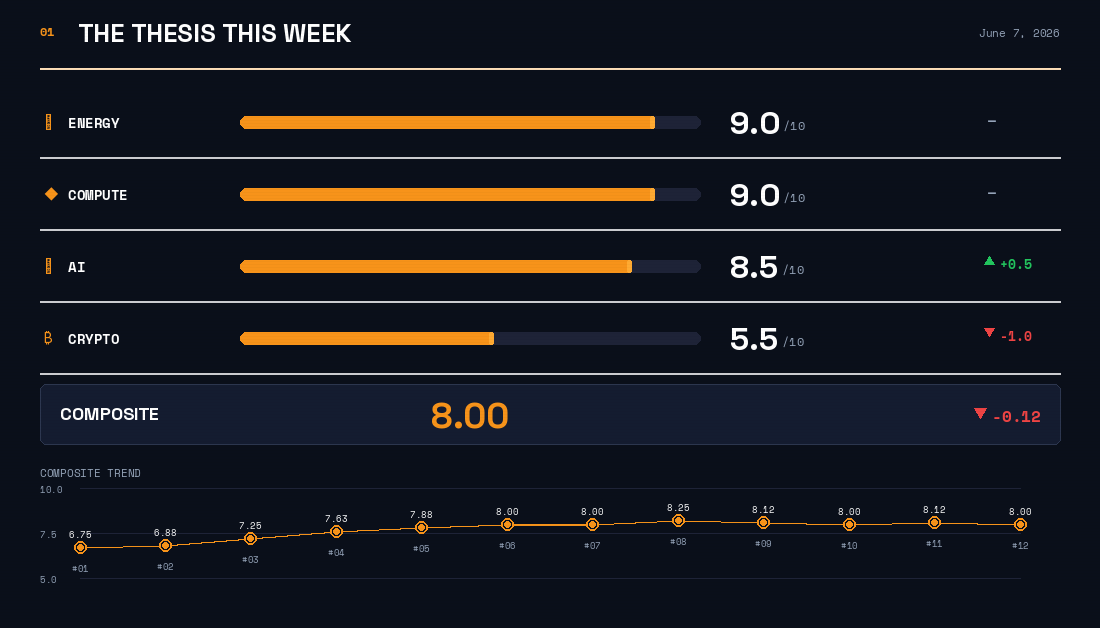
This week, it collected its first hard data validation on the energy leg while Bitcoin and crypto took pricing damage. The composite moved 0.12.
Full Issue #12, with all triggers and observations, is on Substack (https://t.co/yWCQvj1HsG).
The Convergence Thesis just took its first real stress test in three months.
BTC dropped 16% on a 13-day ETF outflow streak. Strategy sold 32 BTC for the first time in company history.
Composite score fell only 0.12 to 8.00.
It bent. It did not break. Here are three signals that actually matter.
The Number: $725 billion.
Combined 2026 AI capex committed by Meta, Microsoft, Amazon, and Alphabet — up 77% from 2025’s $410B.
That is the structural floor under the entire energy-compute-AI leg. It is why a 16% BTC correction did not pull the composite below 8.00.