2/2 🔍 We analyzed the paper’s abstract. As early career researchers, we learned there’s no single formula: a clear question, motivation, approach, findings, and contribution help tell a scientific story.
Our reflections: https://t.co/Ti3ZCmtRAO
#ActiveAIReading
1/2 📄 In our LLM Paper Reading seminar at @WeizmannScience, led by @LChoshen, we explored “When Forgetting Is Not Catastrophic” by @vedantpalit1008 et al.
It examines #SpuriousForgetting when language models seem to forget knowledge that can still be recovered. #LLM
5/ Beyond BPE, Unigram, and WordPiece, the survey covers normalization, byte/character & latent/visual alternatives, theory, open research questions per section, and adjacent topics like constrained generation, token healing, and tokenizer security.
Tokenization shapes almost everything an LLM does—yet in 2025, papers mentioning tokenization made up at most 2% of counted venue papers. 32 researchers spent ~8 months mapping the algorithms, pitfalls, theory, and open questions in a new survey.🧵 https://t.co/dWA7q485JN
4/ Evaluating tokenizers is tricky: token-level cross-entropy and perplexity depend on token count, and even bits-per-byte varies across scripts. Meanwhile, compression alone doesn't guarantee better downstream quality, faster inference, or lower total cost.
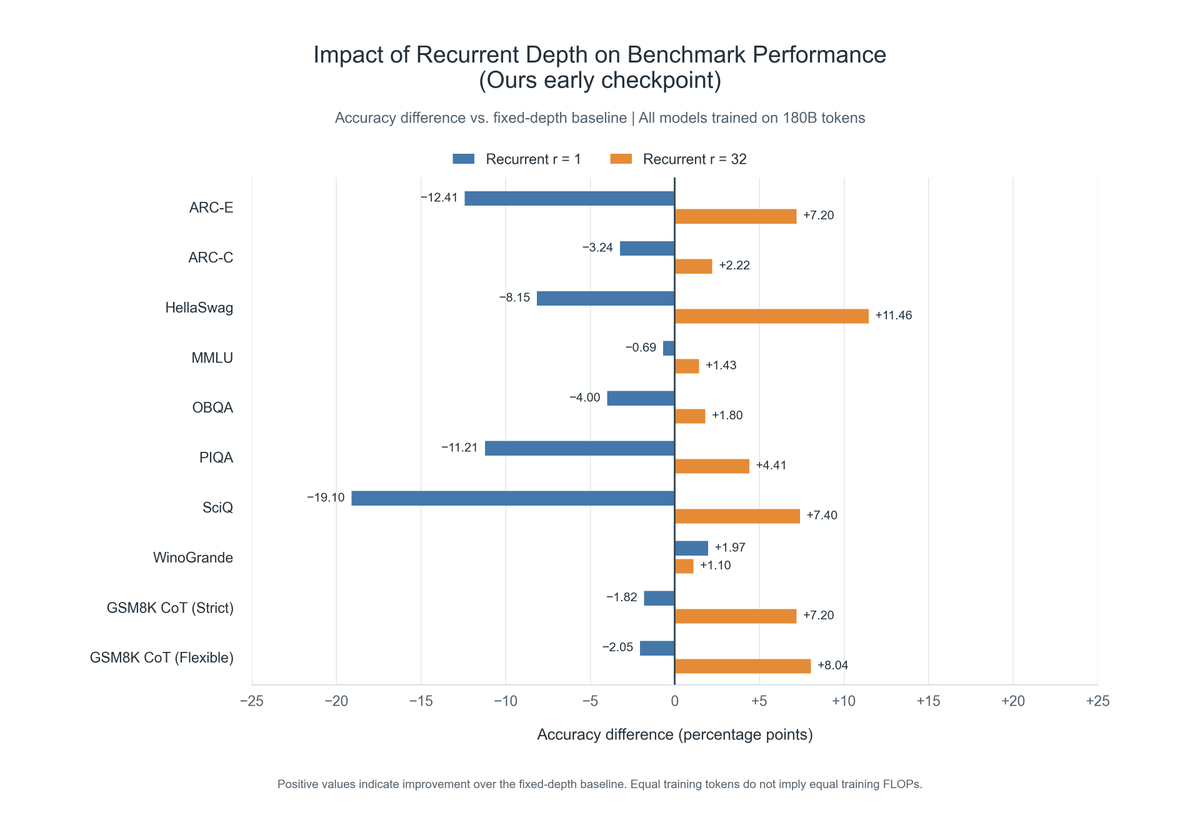
This week's overview is about the paper "Scaling up Test-Time Compute with Latent Reasoning: A Recurrent Depth Approach" by Jonas Geiping (@jonasgeiping) et al.
They ask: what if, instead of letting the model think longer (with tokens), we let it think deeper with more layers?
More loops → better answers, with the biggest gains on hard reasoning tasks like GSM8K (gradeschool math benchmark).
The catch: with a single loop, the model is worse than a regular model trained on the same data. It only pulls ahead once it gets to loop.
That set off a debate: if a model reasons inside its loop, there's no chain of thought to read. Safety researchers worry this erodes CoT monitoring, one of the few ways we can check what models are doing.
Which is why looking inside the loop matters.
Hello, world!
We are the proud students in @LChoshen's active reading seminar at the @WeizmannScience. We're reading and reviewing the front of LLM research in academia. The thoughts and results of many talented researchers will be posted here, so stay tuned!