@RobinhoodApp Chain mainnet is chain ID 4663. Its testnet is 46630.
OpenArc is designed to carry the network on every record and check it during matching. A test payment with the same amount and recipient as a real one still won't match it.
Independent, not a Robinhood product.
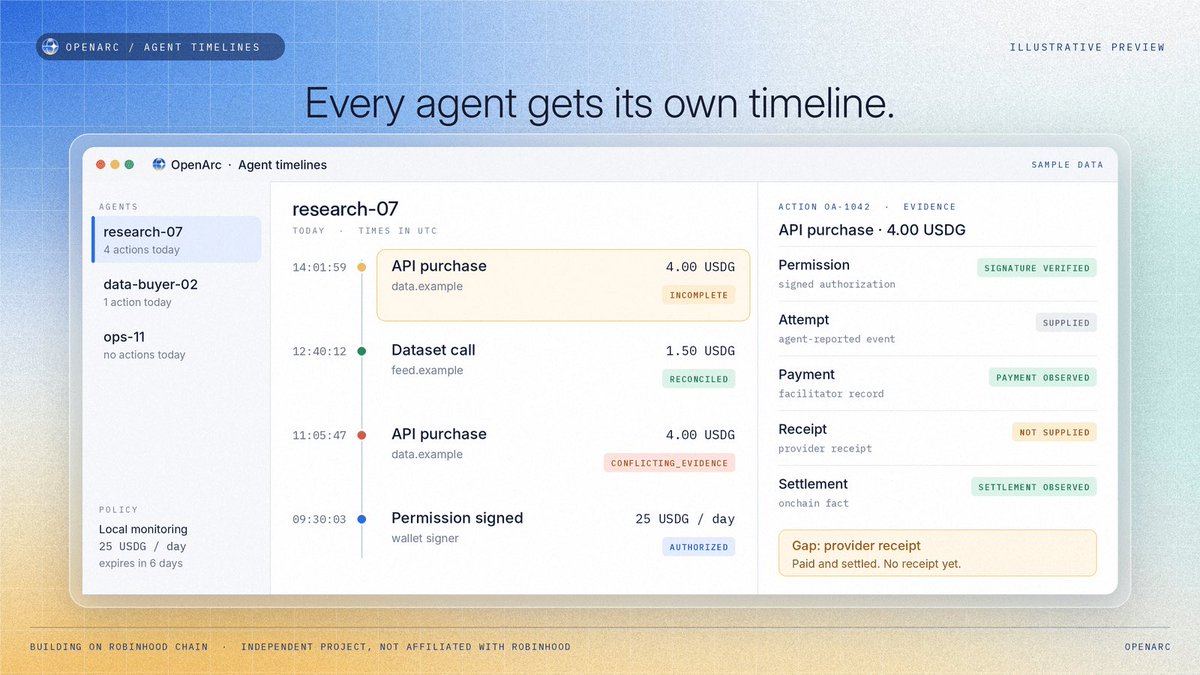
14:01:59. API purchase. 4.00 USDG. INCOMPLETE.
One row on an agent's timeline in OpenArc's design. Open it and each stage shows its own evidence: signature verified, payment observed, settlement observed, receipt not supplied.
Sample data. Building on @RobinhoodApp Chain.
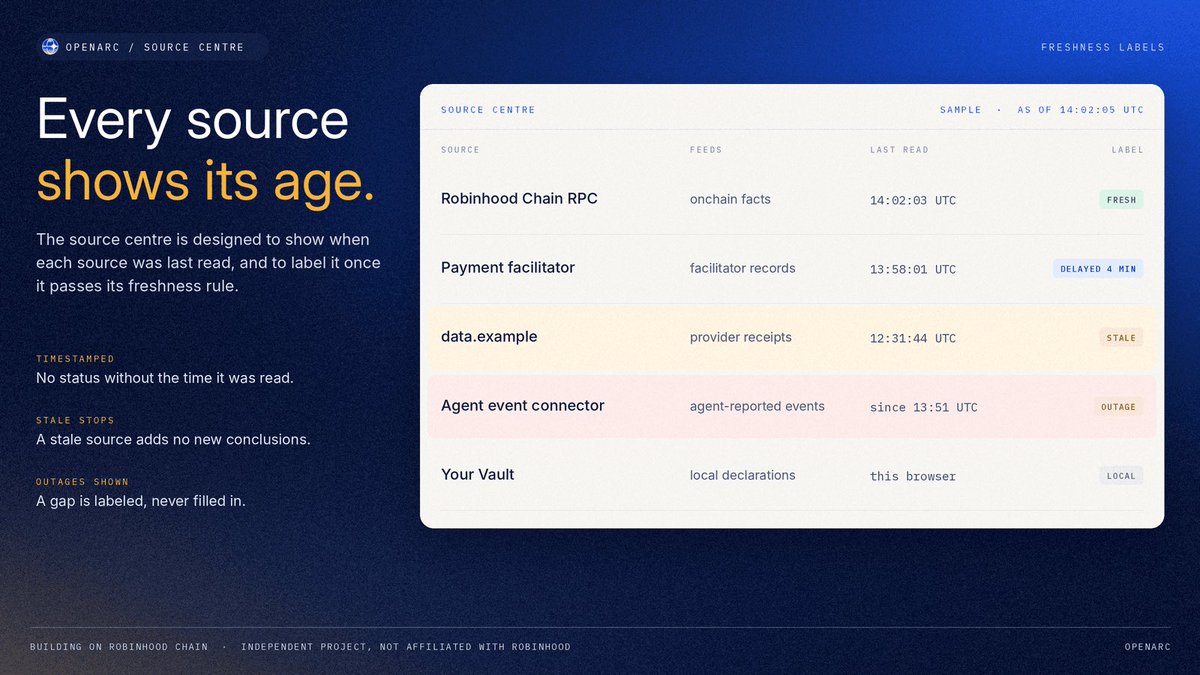
How old is the data behind that status?
OpenArc's source centre is designed to show when each source was last read, labeled fresh, delayed, stale or outage. A stale source adds no new conclusions.
Building on @RobinhoodApp Chain. Independent, not a Robinhood product.
What happens when a provider receipt never comes back?
In OpenArc's SDK design, getActionEnvelope() returns "receipt": null and lists it under gaps. Records that disagree go under conflicts. Missing stages get named.
SDK in development. Building on @RobinhoodApp Chain.
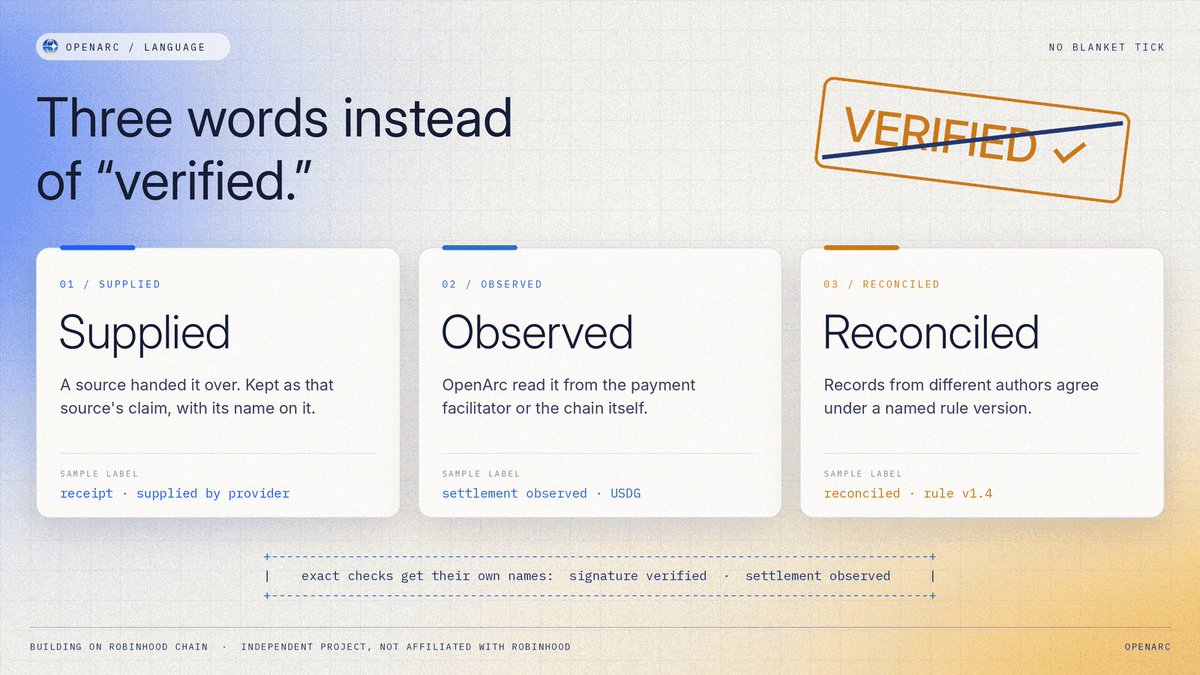
Three words replace the green "verified" tick in OpenArc's design.
Supplied: a source handed it over.
Observed: read from the facilitator or the chain.
Reconciled: records from different authors agree under a named rule.
Building on @RobinhoodApp Chain. Independent.
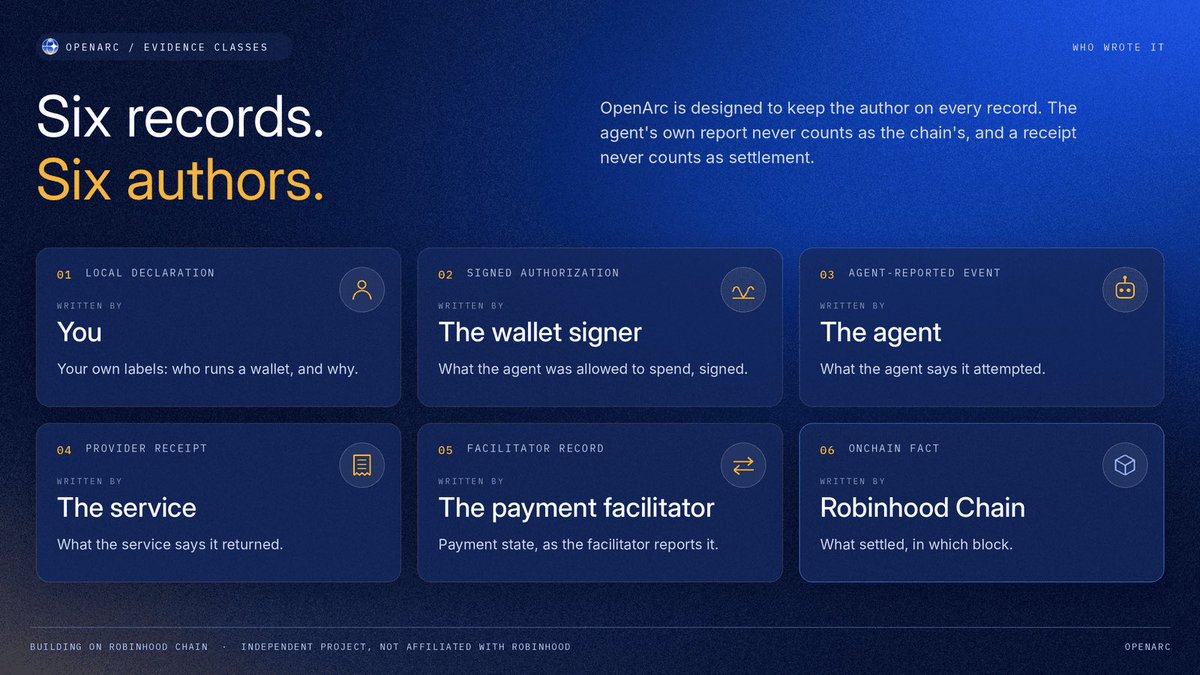
Who wrote this record?
You, the wallet signer, the agent, the service, the payment facilitator, or @RobinhoodApp Chain itself. OpenArc is designed to keep that answer on every record, so an agent's own report never gets read as settlement.
Independent project.
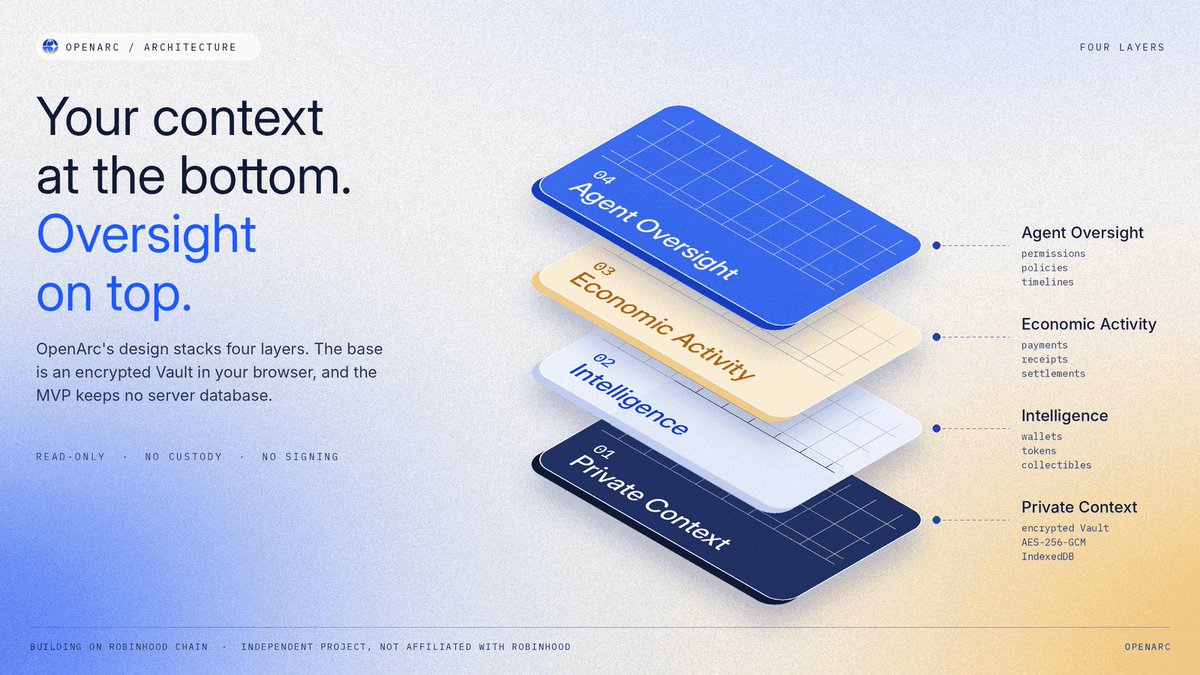
Four layers, bottom to top: Private Context, Intelligence, Economic Activity, Agent Oversight.
The bottom one is an encrypted Vault in your browser (AES-256-GCM, IndexedDB). The MVP has no server database to hold it.
Building on @RobinhoodApp Chain. Not a Robinhood product.
OpenArc is planned with two modes in one workspace.
People: your own wallets, tokens and collectibles.
Agents: what they were allowed to spend, what they paid, what settled.
Both sit in an encrypted workspace in your browser. Building on @RobinhoodApp Chain. Independent.
OpenArc's opening demo is planned small: one labeled test wallet, one paid test resource, one local policy, one reconciled timeline, one deliberate outage.
Builders: what could your service emit? Send failure cases, never keys.
Building on @RobinhoodApp Chain. Independent.
A wallet signs. An explorer shows what landed onchain. Agent tracing follows prompts and tool calls.
OpenArc is being built for the gap: who allowed the spend, what was paid, what the service returned, what settled on @RobinhoodApp Chain.
No keys. Not a Robinhood product.
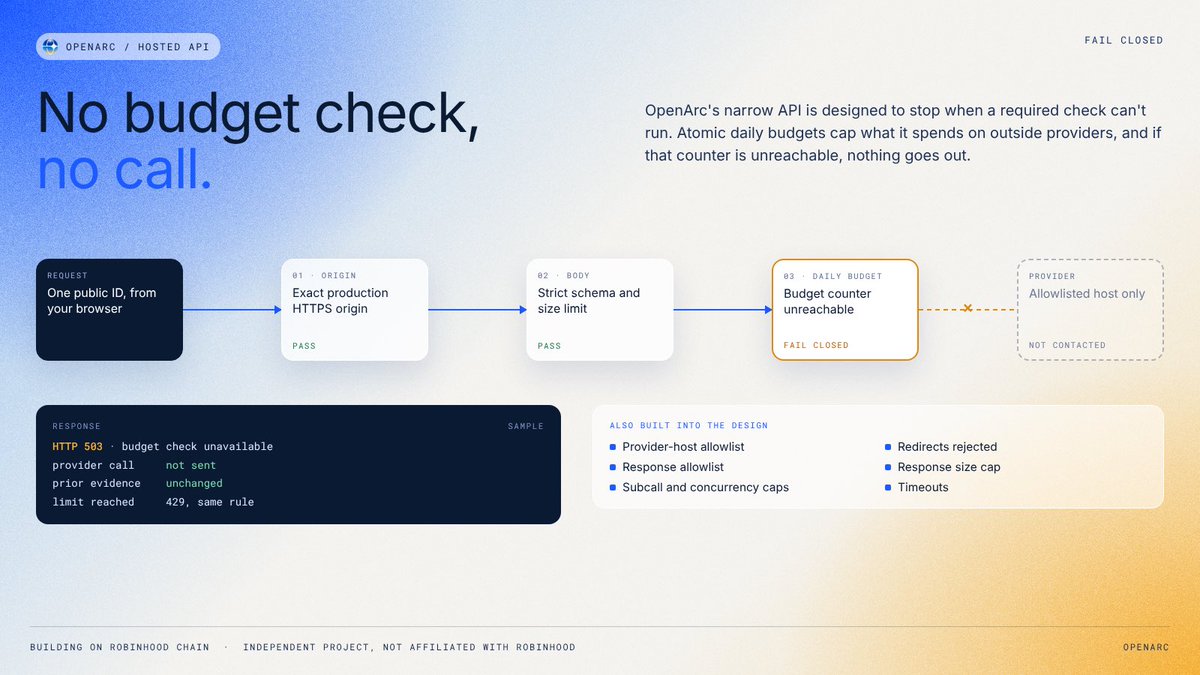
If OpenArc's API can't check its daily budget, the call doesn't go out.
The design also has provider-host allowlists, no redirects, size and subcall caps. Hit a limit and you get a 429 or 503, prior evidence untouched.
Building on @RobinhoodApp Chain. Independent project.
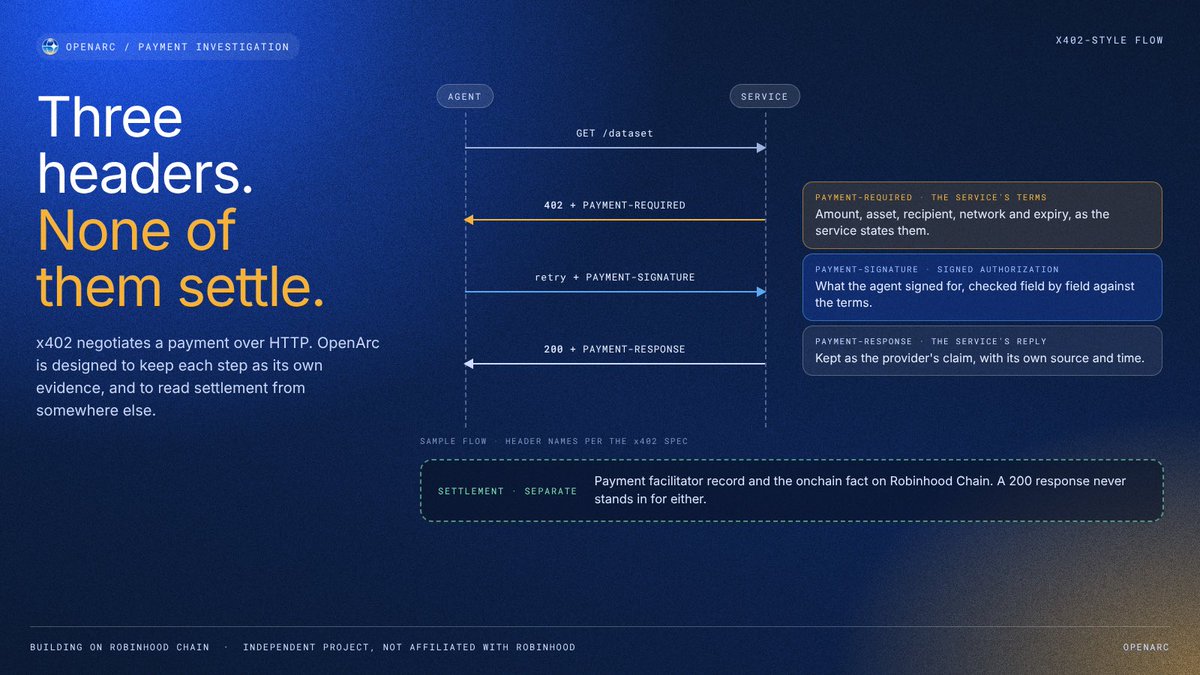
x402 negotiates payment over HTTP. It doesn't settle it.
PAYMENT-REQUIRED: the service's terms. PAYMENT-SIGNATURE: the agent's authorization. PAYMENT-RESPONSE: the reply.
OpenArc is designed to keep each apart from settlement. Building on @RobinhoodApp Chain. Independent.
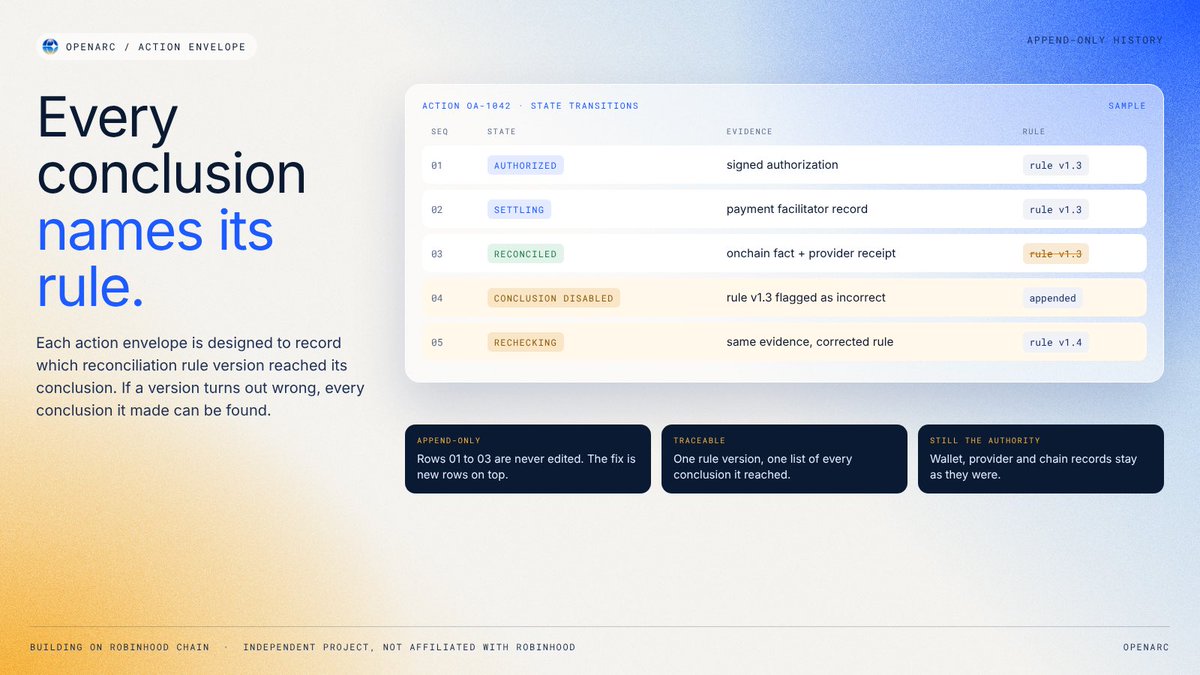
What if a matching rule is wrong?
In OpenArc's design, each conclusion records the rule version that made it, and state changes are append-only. A bad version can be traced, switched off and rechecked. History stays.
Building on @RobinhoodApp Chain. Independent project.
A record format your build can't read yet. A browser out of storage.
OpenArc is designed to fail closed on both. Unknown versions aren't guessed, and unlock, export and delete keep working. Quota errors say what wasn't saved.
Building on @RobinhoodApp Chain. Independent.
Each OpenArc evidence record is designed to carry two times: when the source says it happened, and when OpenArc saw it.
Plus its class, source, subject, digest, and a limits field: what the record can't prove.
Building on @RobinhoodApp Chain. Independent project.
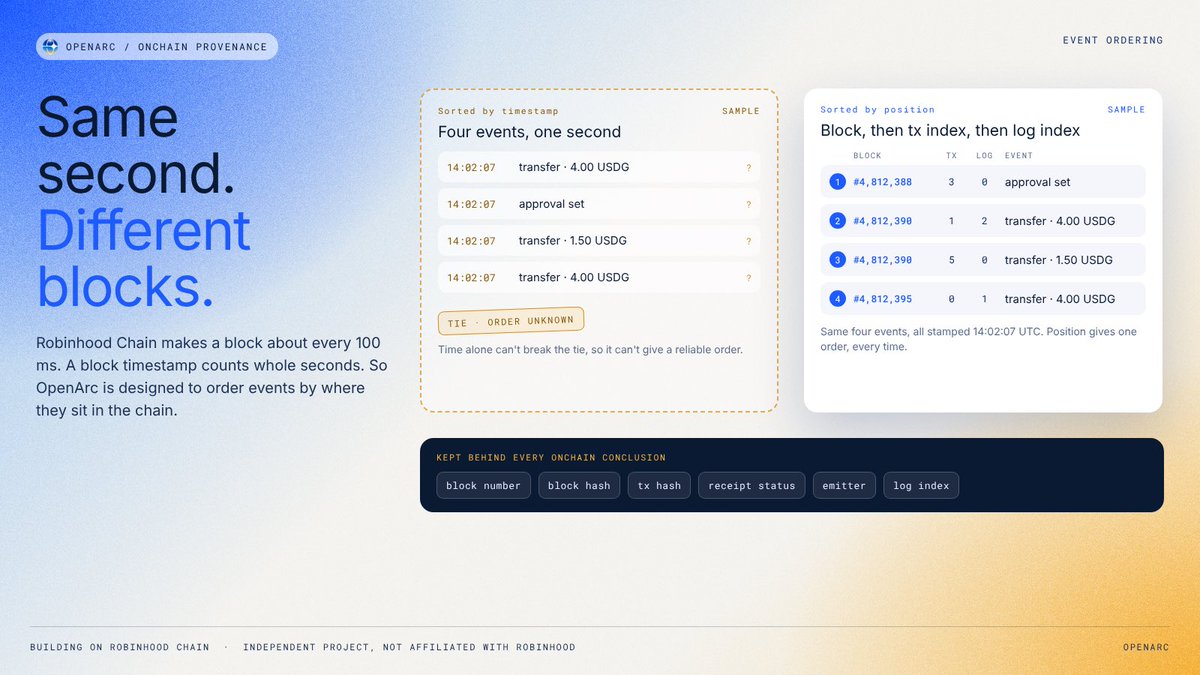
Blocks on @RobinhoodApp Chain land about every 100 ms. Timestamps count whole seconds, so several can share one.
OpenArc is designed to order events by block, transaction index and log index, and keep the block hash behind each onchain conclusion.
Not a Robinhood product.
Seven build steps, in order, no dates.
Evidence types and exact math come before anything else. Then the encrypted Vault, the @RobinhoodApp Chain reader, registry evidence where it exists, one paid resource end to end, a signed event connector, and wallet adapters last.
Nothing gets called shipped until it passes the gate.
Restoring a backup shouldn't be able to break the workspace you already have.
In OpenArc's design, an import is bounded, authenticated, decrypted and validated in memory. Only then can it replace the current Vault. And two open tabs can't silently overwrite each other.
Building on @RobinhoodApp Chain. Not a Robinhood product.
What should a paid agent call leave behind?
Enough to reconcile it: origin, digest, amount, recipient, asset, network, nonce, validity window and times, encrypted in your browser.
Nothing that works twice: no reusable signature, API secret, private key or full paid response.
Building on @RobinhoodApp Chain. Independent project.
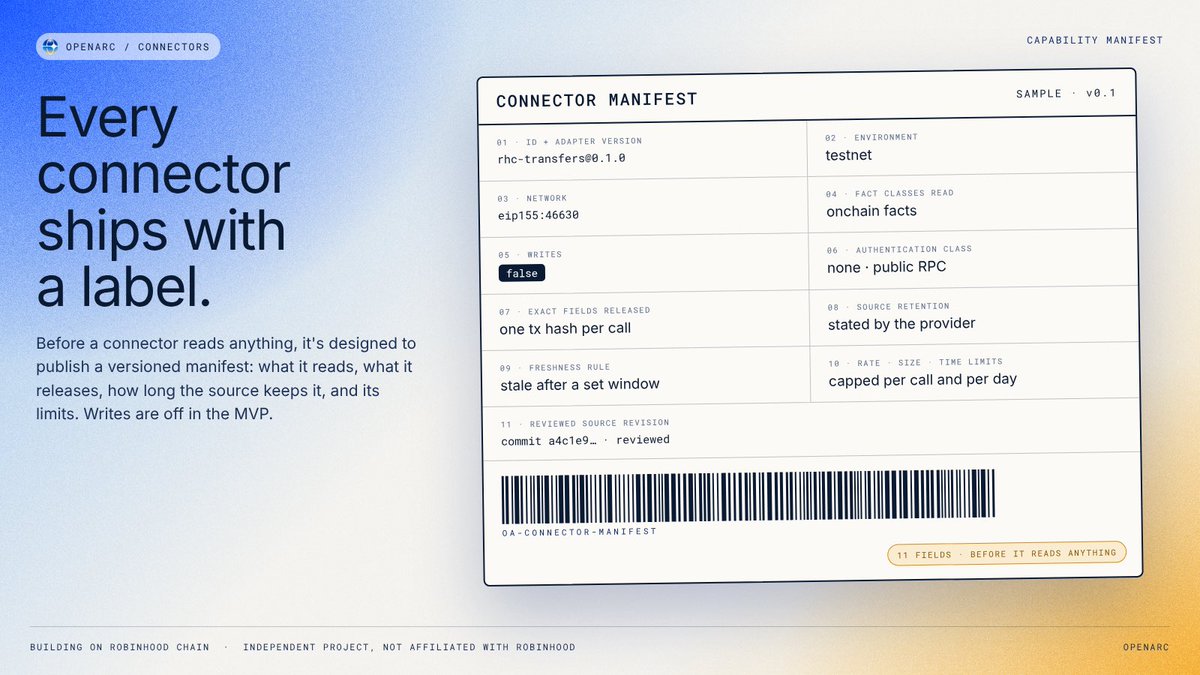
11 fields before a connector reads anything.
Every OpenArc connector is designed to publish a versioned manifest: network, which facts it reads, exact fields released, source retention, freshness rule, limits and the reviewed source revision. Writes = false in the MVP.
Building on @RobinhoodApp Chain. Sample manifest. Not affiliated with Robinhood.