Introducing fairchem - our revamped codebase consolidating our AI modeling efforts in chemistry and materials science. fairchem makes it easy to interface with our data, models, demos, and applications - including an easy to use ASE calculator:
https://t.co/VGKb5OcTvV
The Open Molecules 2025 dataset is out! With >100M gold-standard ωB97M-V/def2-TZVPD calcs of biomolecules, electrolytes, metal complexes, and small molecules, OMol is by far the largest, most diverse, and highest quality molecular DFT dataset for training MLIPs ever made 1/N
Excited to share our latest releases to the FAIR Chemistry’s family of open datasets and models: OMol25 and UMA! @AIatMeta@OpenCatalyst
OMol25: https://t.co/UhIDiFFzzN
UMA: https://t.co/eQ2wPIxbxY
Blog: https://t.co/VFaeynyZN7
Demo: https://t.co/Dj29ZfhBRO
For existing MLIPs, lower test errors do not always translate to better performance in downstream tasks. We bridge this gap by proposing eSEN -- SOTA performance on compliant Matbench-Discovery (F1 0.831, κSRME 0.321) and phonon prediction.
https://t.co/rzpjGm32QL
1/6
Today we're excited to introduce OCx24 - an experimental catalyst dataset aimed to help bridge the gap between computational and experimental results. Read more below!
Paper: https://t.co/UsVWpS01lr
Dataset: https://t.co/NyXVBMgznn
Blogpost: https://t.co/extRxI6zC5
Excited to unveil OCx24, a two-year effort with @UofT and @VSParticle! We've synthesized and tested in the lab hundreds of metal alloys for catalysis. With 685 million AI-accelerated simulations, we analyzed 20,000 materials to try and bridge simulation and reality.
Paper: https://t.co/t3OcNvx1OH
Dataset: https://t.co/GMnJLzcsSh
Blogpost: https://t.co/vSHDQEJvNK
I’m excited to share our latest work on generative models for materials called FlowLLM.
FlowLLM combines Large Language Models and Riemannian Flow Matching in a simple, yet surprisingly effective way for generating materials.
https://t.co/xQ2TJnpusA
@bkmi13@RickyTQChen@bwood_m
Our team at FAIR is looking for research interns in 2025. We work on a range of AI for chemistry topics from applied projects to machine learning potentials and generative models.
If you are interested please apply and don’t hesitate to reach out!
https://t.co/dSSM8wHPK5
Introducing Meta’s Open Materials 2024 (OMat24) Dataset and Models! All under permissive open licenses for commercial and non-commercial use!
Paper: https://t.co/vYSutPJT7L
Dataset: https://t.co/nDZUnSiwL6
Models: https://t.co/MMPq0zKeGi
🧵1/x
Come work with us on the FAIR Chemistry team!
Roles:
- Postdoc: https://t.co/eU3YpvUCB1
- Research interns: https://t.co/N0YLMXE5Br
Reach out if you have any questions and help spread the word!
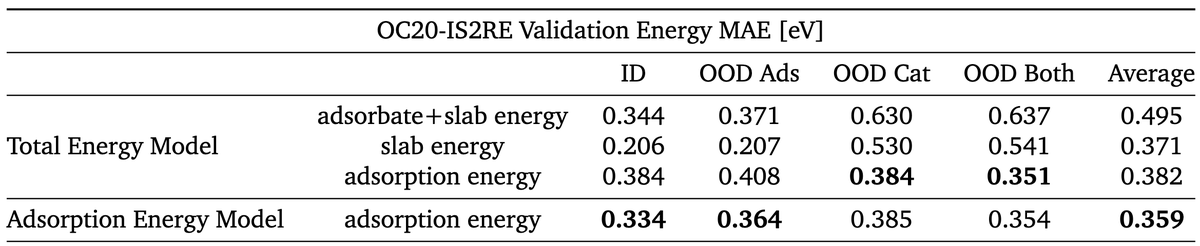
Before using an adsorption energy model, one should be aware of surface reconstructions that can impact results.
Alternatively, total energy models are more robust models to surface reconstructions that still work on par with existing adsorption energy models