How Wole Soyinka Inherited the Drama of the Gods — and Shadowed the Nigerian Tragedy
Since the 1950s, the Nobel laureate has worked in rebellion, carving out a complex, fecund torque of an oeuvre. But as his plays of mythic vigor and Yoruba impulse revitalized Anglophone theatre, raising an art form to ritualistic heights, his force of personality kept him in the political arena, a close witness of an African affliction. Few artists have lived like him. Yet at 91, carrying the mantle of “greatest living writer,” he has one more great battle on his hands — with generations who once deified him.
https://t.co/MmfBGVeAbI
Name Redacted (@NameRedactedPod) is among the five recipients of the inaugural Open Country Mag Curatorial Fellowship, sponsored by Africa No Filter. Their proposal was to record Season 2 of One Foot in the Closet, a podcast on LGBTQI+ experiences. The initiative supported One Foot in the Closet with $1,000 and mentorship by Open Country Mag editor Otosirieze (@Otosirieze), Lumen Prize winning artist Minne Atairu, and A Nasty Boy founder Innanoshe Akuson (@InnanosheA).
Name Redacted is a queer, polygender East African podcaster. They are the creator and host of One Foot in the Closet. Season 1 of the podcast was funded by a Queering Encounters in African Feminisms Grant from The House of African Feminisms, a project by the Goethe-Institut Kigali, Goethe-Institut Lagos, and Goethe-Institut Johannesburg.
The first two episodes of Season 2, “Angry Baby” and “Mugarura: Part 1,” appear at the end of this interview.
Read here: https://t.co/PPPEI5HQrf
The organization (@Tech4HerAfrica) is taking a multi-sectoral approach with timeline-based goals. Its Girls Slay Code Academy, started in 2017, aims to launch 10,000 female developers by 2025.
Read more: https://t.co/dls5UCc8UM
Adedayo Agarau (@adedayoagarau) pushed back against the idea that writing produced outside Nigeria was less Nigerian. “You know, I always say that when someone is writing about living in the U.S. or in Los Angeles, they are writing that experience as a Black man, as someone with different roots. So the poetry is very Nigerian, because that is where it’s coming from.”
His first chapbook, "For Boys Who Went," published in 2016, echoes the inherited burdens of masculinity, the violences boys learn to carry early on. In the then small but growing Nigerian online poetry scene, it became one of the most-read chapbooks, with over a thousand downloads on Arthorpedia, a platform owned by Kukogho Iruesiri Samson, who was also responsible for launching several other notable poetry careers. “I became that guy,” he chuckled, “the one who would write a poem, and suddenly everyone was writing their own version with the same title.” His uncles, uninterested in literature, began calling him For Boys Who Went.
Read more: https://t.co/RxAUVHcOau
OPPORTUNITY FOR WRITERS!📣
The Sabi Arts Playwrights Prize (@sabiartsprize) is an annual award for Nigerian playwrights aged 18 and above, residing in Nigeria or the diaspora. The prize is open to original, previously unpublished, and unproduced plays.
The inaugural edition features a total cash prize pool of ₦1,400,000 alongside residency, production, and
publication opportunities structured into three winning categories.
-TIMELINE & SELECTION PROCESS-
Submissions Window: 1st October 2026-20th December 2026
Longlist Announcement: 31st January 2027
Shortlist Announcement: 28th February 2027
Winners Announcement: 31st March 2027
Eligible entries will undergo a three-stage blind review process:
1. An initial reading stage by an anonymous readers’ group to determine the longlist.
2. A second reading stage to select the shortlist.
3. Final jury deliberations to determine the winners.
The inaugural jury consists of renowned theatre and literary practitioners across dramatic writing, directing,
production, and artistic leadership, including Farah Lawal Harris, Kelvin Mary Ndukwe, Rufus Nwoko, and Kesiena C. Obue.
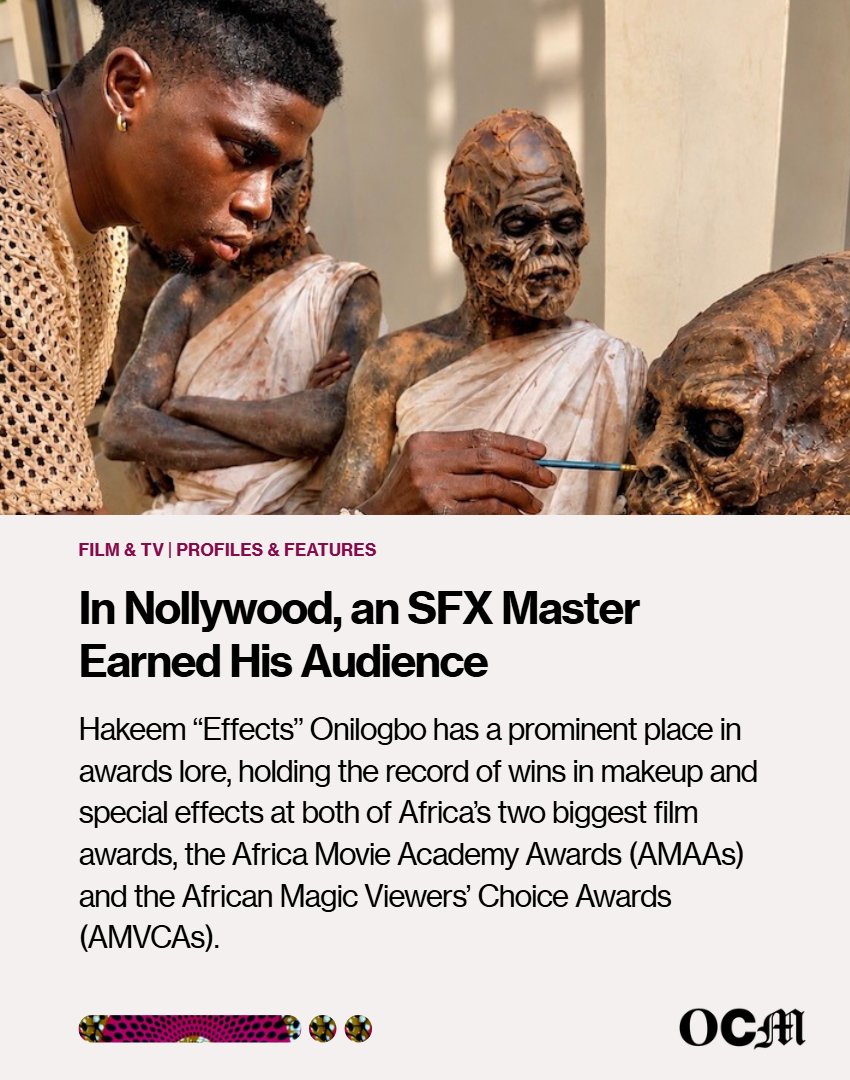
Working behind the scenes has not made Hakeem "Effects" Onilogbo (@Hakeem_effect) a self-effacing artist. He speaks declaratively, without irony. His speech is halting, punctuated with little pauses, fillers, and drags, the phrases and clauses often ending in a rising tone, loud and assured.
“I can readily say I’m the one that changed special effects in the whole of West Africa,” he said in our first interview on Google Meet. I weighed the claim in my head, tempted to ask for elaboration, but also conscious to not disrupt his train of thought. I reached out on Instagram days later and he sent a confirmatory voice note.
“Not just in Nigeria, but West Africa,” he repeated. “Because the way special effects were being done [in the past] is so different from [the way it now is since] when I stepped in. Kudos to the legends that took the baton to that stage before handing it over to me. [But] ever since I started doing special effects, everything [has] changed. People, they had not been doing prosthetics; I am the one that started it. The pyrotechnics — using elements of fire, explosions, and all that — Hakeem Effects started it. [And] a whole lot of things, realistic make-up. So I’m the one that transformed the face [of SFX] before people now started watching what I’ve done, building on the foundation.”
Read more: https://t.co/wFnnveMwfK
Between Aisha Ahmad and horses, it was love at first sight. At the Kaduna Polo Club, where she had gone with friends to watch a tournament for the first time, she was fascinated by the animals. She knew immediately, as she watched the horse-riders gallop in their helmets and boots, chasing the ball around, that she wanted to work with the horses, to be a polo player.
Read more: https://t.co/slAQyM9hpp
"There are people in this world who have a distaste for poetry. Not long ago someone almost beat me on Twitter because I told them they could actually enjoy poetry; they did not care, they said. But you have to care for beauty, I wanted to shout back.
Actually, it’s fine if you don’t care for beauty by way of poetry, but at least care about the beauty of watching a mallam peel an orange—a kind of poetry. But it’s not that people do not care for poetry; it’s that they feel like they don’t get it. If you are one of those who don’t get poetry, I have a song for you."
Read more: https://t.co/5Li8AwuKzb
Rather than a “renaissance,” Atemnkeng argues that “what is happening now is that there is a new wave of emerging and mid-career writers from the English-speaking region who are getting acclaim that their predecessors didn’t achieve.” He pointed out that since the publication of Limbe to Lagos, five of its 10 contributors have gotten into MFA programmes in the U.S. and the U.K.
“Talented young writers are getting the recognition they deserve, writing books that are urgent, playful, and experimental, winning awards and getting good agents,” MacViban said. “I see Cameroonians reading more home-based writers, I see more translations across the official languages and local languages. There are already signs that the future we dreamed of is here.”
Continue reading: https://t.co/zMZCn1AS1I
I was surprised when the first reaction to my Profile of Wole Soyinka came not from a Nigerian or African publication but from an Indian one.
It was a pleasant discovery but also a big tell.
@OpenCountryMag has always had readers in India, but that was a tell.
When Afabwaje Kurian began writing her 2024 novel Before the Mango Ripens, titled after that Gbagyi proverb, she initially alluded to that displacement. That draft of the novel was set in a longer timeline, from 1970 to 1976. She cut it because it wasn’t central to the story of Christianity that she was uncovering, and the published version plays out over the course of four months in 1971. In it, Zanya, a popular young missionary who believes that he has been called to lead the flock in the fictional town of Rabata, faces the reluctance of Reverend Jim, his mentor. They are at a crossroads, and other dichotomies are at play: the indigene converts and the foreign missionaries, the labourers and the church that underpays them.
Continue reading on our website: https://t.co/Mvov7Tn06g
Working behind the scenes has not made Onilogbo (@Hakeem_effect) a self-effacing artist. He speaks declaratively, without irony. His speech is halting, punctuated with little pauses, fillers, and drags, the phrases and clauses often ending in a rising tone, loud and assured.
“I can readily say I’m the one that changed special effects in the whole of West Africa,” he said in our first interview on Google Meet. I weighed the claim in my head, tempted to ask for elaboration, but also conscious to not disrupt his train of thought. I reached out on Instagram days later and he sent a confirmatory voice note.
https://t.co/wFnnveMwfK
One of the many viral stories was by a young woman named Obianuju Iloanya. She detailed how, in 2012, when she was 17, her brother, Chijioke, was arrested by SARS; their family traveled to the SARS base in Awkuzu where they saw him but were not allowed to reach him; when they returned, the head officer told them, “I have killed your son and there’s nothing you can do about it.”
The SARS officer who made this comment, Obianuju said, was called James Nwafor. The moment she named him as her brother’s killer, many more people began to share their stories of the man, reputed to be reckless with human lives, a Chief Superintendent of Police said to have overseen the dumping of dead bodies in Ezu River in 2013, bodies believed to be victims of Awkuzu SARS. CSP James Nwafor became one of the faces of the murders of unarmed young Nigerians.
End SARS ended on a fatal note, on October 20, 2020, with the Lekki Massacre, where the Nigerian military opened fire on unarmed protesters, and later denied it, despite video evidence. The government, meanwhile, made a show of listening, convening panels across the country to hear survivors of SARS and families of victims, and to recommend terms of justice. Out of the estimated over 100 hearings at the Anambra State panel, a reported 90 indicted CSP Nwafor, but, as the man had told the families beforehand, nothing happened to him.
The stories of the families of four young men murdered by SARS officials form the core of Awaiting Trail, a new documentary by the media entrepreneur and journalist Chude Jideonwo.
#ENDSARS #October20
https://t.co/B55E0eZUP6
“@OpenCountryMag’s work carries a symbolic and practical significance. It shows what is possible when African publications commit to longform storytelling: that the continent’s cultural figures can be chronicled with nuance, rigour, and ambition. . .
https://t.co/GG9kwkHrM3
yes, the news is out. i am excited to begin work in my new role with @Sarabamag, we have so many projects in the works already, digging through the treasure troves of our archives & curating new ones. many thanks to the team for the trust!
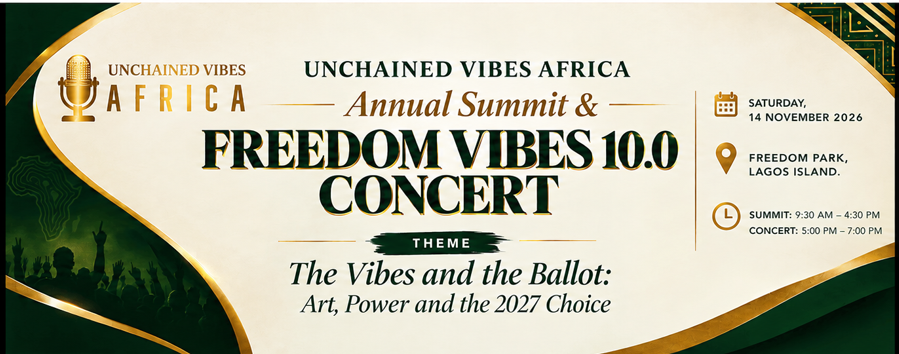
Cultural organization Unchained Vibes Africa (UVA) (@UvAfrica) will host its flagship two-part civic-creative event, the 4th Freedom Vibes Summit and Freedom Vibes 10.0 Concert, on Saturday, 14 November 2026, at Freedom Park, Lagos Island. Operating under the central theme, "The Vibes and the Ballot: Art, Power and the 2027 Choice," the initiative will bring together artists, skit makers, content creators, legal experts, media executives, civil society leaders, traditional rulers, government officials and state regulatory authorities to protect artistic integrity, promote creative freedom and peaceful civic participation ahead of Nigeria's 2027 general elections.
The 4th Freedom Vibes Summit will be convened from 9:30 AM to 4:30 PM (WAT) at Kongi's Harvest Gallery in a hybrid format, accommodating in-person delegates alongside virtual participants. Structured to move beyond conventional discourse, the summit brings together key creative industry bodies, alongside statutory regulators.
In this role, Tolu Daniel (@iamToluDaniel) will help shape Saraba’s (@Sarabamag) nonfiction publishing, working with writers and commissioning work across the breadth of the form – from essays and criticism to memoir, cultural writing and more experimental approaches to nonfiction.
His appointment comes as Saraba Magazine continues to build on its long history of publishing ambitious writing from Africa and its diasporas. Since its founding in 2009, the magazine has been a space for emerging and established writers to experiment, take risks and produce work attentive to both literary craft and the world around us.
As Editor-at-Large, Tolu Daniel will bring his editorial perspective to Saraba’s nonfiction while contributing more broadly to the magazine’s evolving editorial vision.
Read more: https://t.co/bly55dlfCF
Off the page, different concerns plague our livelihood. Sometimes, they present as ordinary and inconsequential, and other times, as global and moral. All of these are nonetheless existential. They shape our being, the way we navigate and make meaning of the world. Writers go to the page to tell the troubled stories that animate their ways into their lives, countries, and continents. These poets in 20.35 Africa (@20_35Africa) Volume IX show the range of the existential crises faced in the world they live in, and they paint all the filth, beauty, and joy of it.
This anthology is concerned with the body, the land, the harm and damage done to their soft expressions of life. In a time when the machine and industrial complex numb our relationship to the body and the earth, how do we as writers respond to the spiritual disconnection that ensues?
20.35 Africa Volume IX, guest-edited by Akosua Zimba Afiriyie-Hwedie and Antony Fangary, is published online by 20.35 Africa.
https://t.co/x3rdijTDwg
As the crisis in Sudan continues, millions of Sudanese people remain in urgent need of food, healthcare, shelter, and protection.
Watch. Share. Speak up. And if you’re able, donate.
Trusted ways to support:
Sudanese American Physicians Association (SAPA): https://t.co/Vcqzt1GUaM
International Rescue Committee: https://t.co/0qmdtxlGbv
UN World Food Programme: https://t.co/02uPTSHovO
🎥: @MuzlimsPostingW