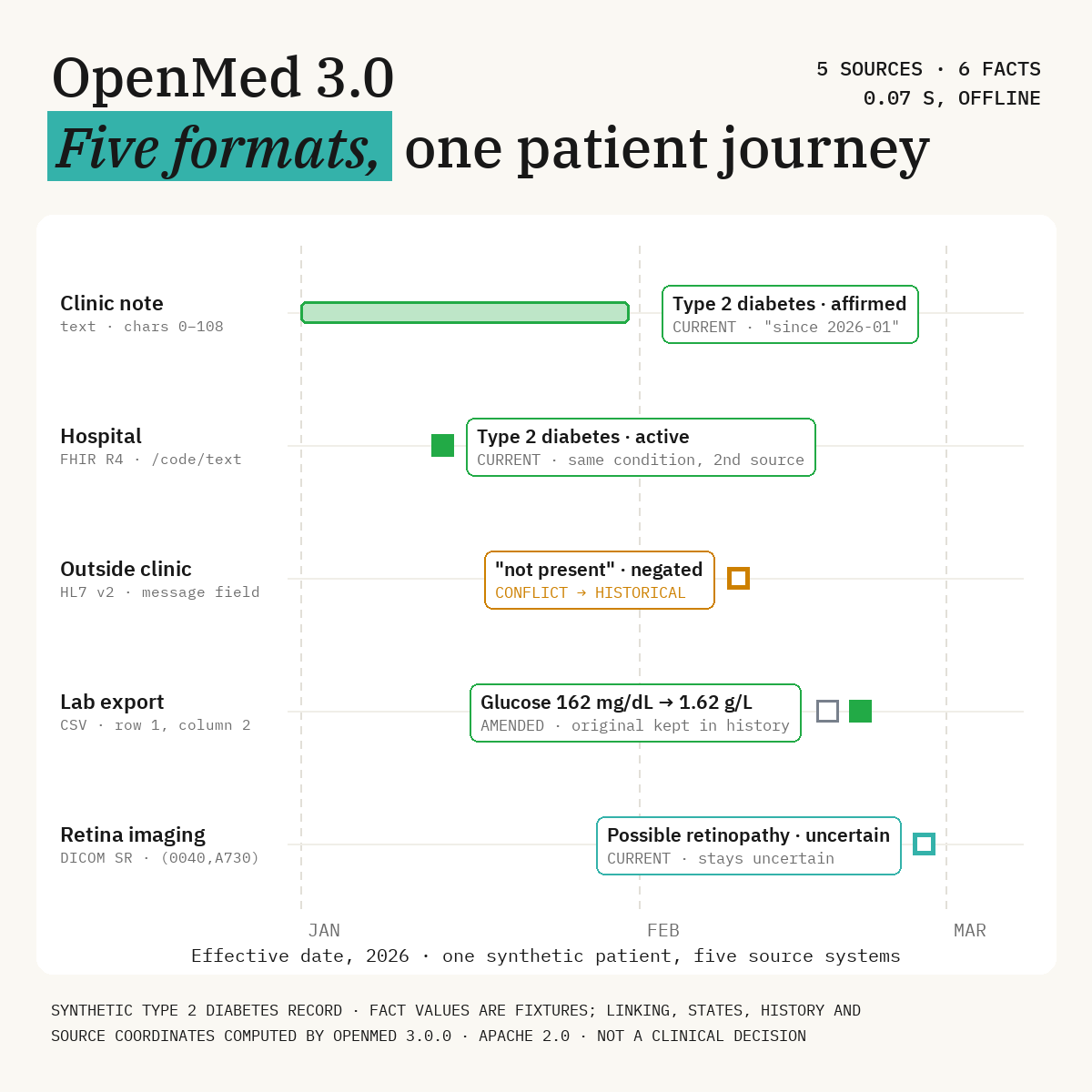
OpenMed 3.0 is out: Patient Journey.
One synthetic patient, five systems: a clinic note, hospital FHIR, an outside clinic's HL7, a lab CSV, a retina DICOM report. They disagree.
3.0 links every fact to its exact source, keeps the conflict open and amends without erasing.
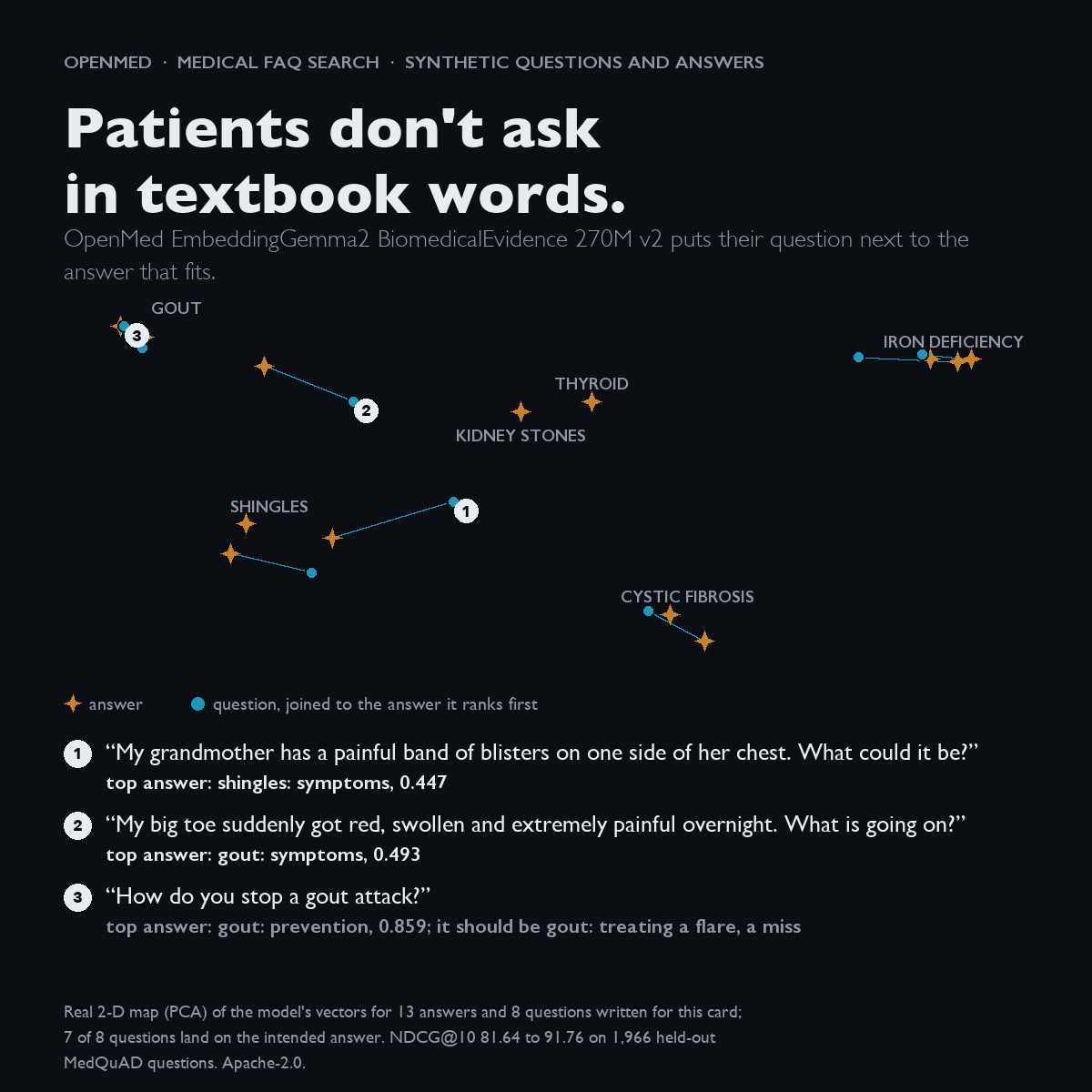
Fine-tuned from Google's EmbeddingGemma 2 on MedQuAD, 270M parameters, fine on CPU. Its miss on the card: "How do you stop a gout attack?" ranks the prevention answer first.
For literature search, a GTE-ModernBERT sibling (a small gain, +1.7): https://t.co/ksk2DF1RS6
"My grandmother has a painful band of blisters on one side of her chest." Nobody types "herpes zoster".
New open OpenMed search model still finds the shingles answer. NDCG@10 81.6 to 91.8 on 1,966 held-out medical FAQ questions. Apache-2.0.
https://t.co/6JdzNoG9jm
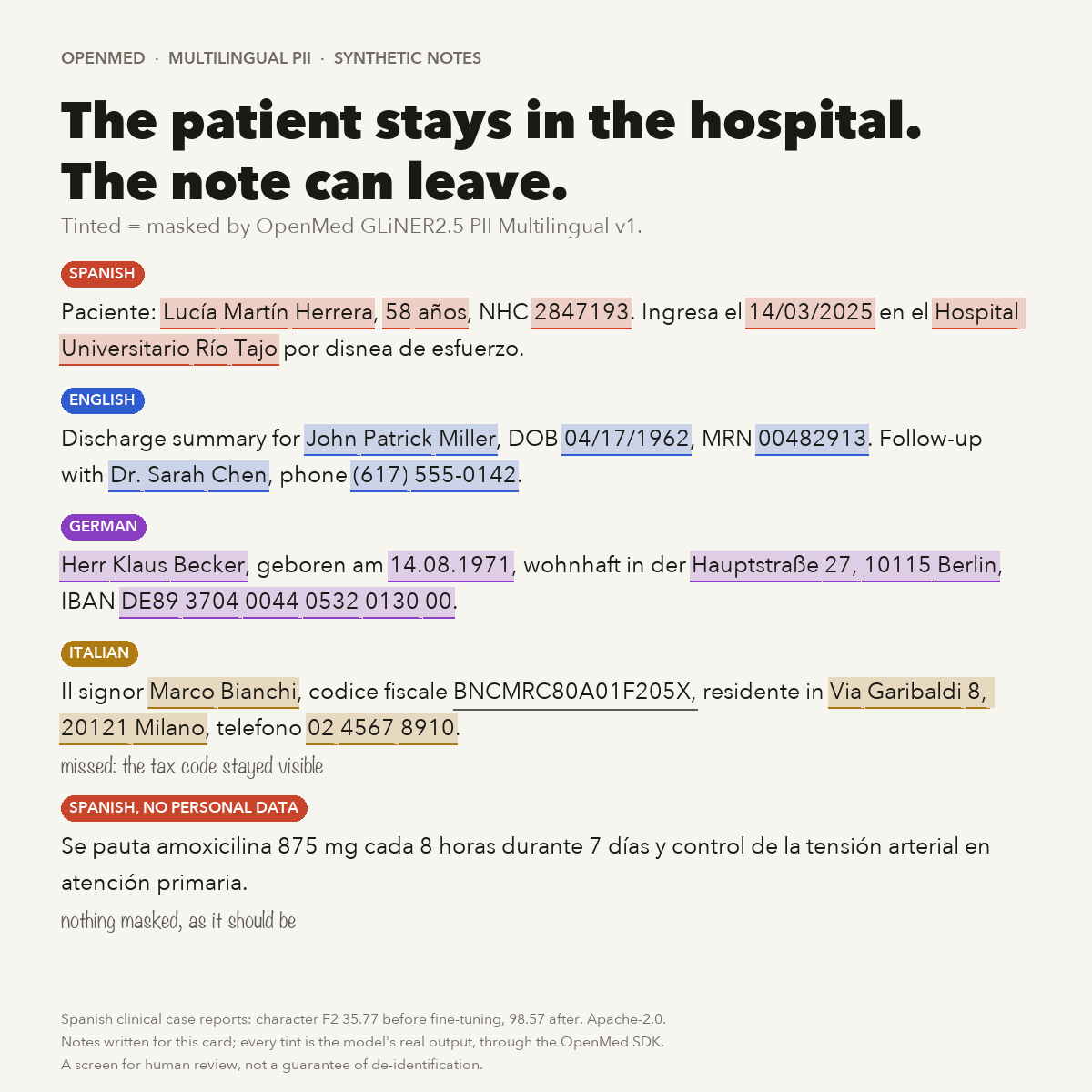
Same model on notes in English, German, Italian and more, through the OpenMed SDK. It still missed an Italian tax code, and German full names are its weak spot (61.7% fully masked). A screen for human review, not a guarantee.
The mmBERT sibling: https://t.co/IJYyUySFbJ
A Spanish case report has to leave the hospital without the patient in it. Names, record numbers, addresses, dates.
Two new open OpenMed models mask them. Character F2 35.8 to 98.6 on held-out Spanish reports, 0 of 24 clean notes touched. Apache-2.0.
https://t.co/rfsGwm9lYZ
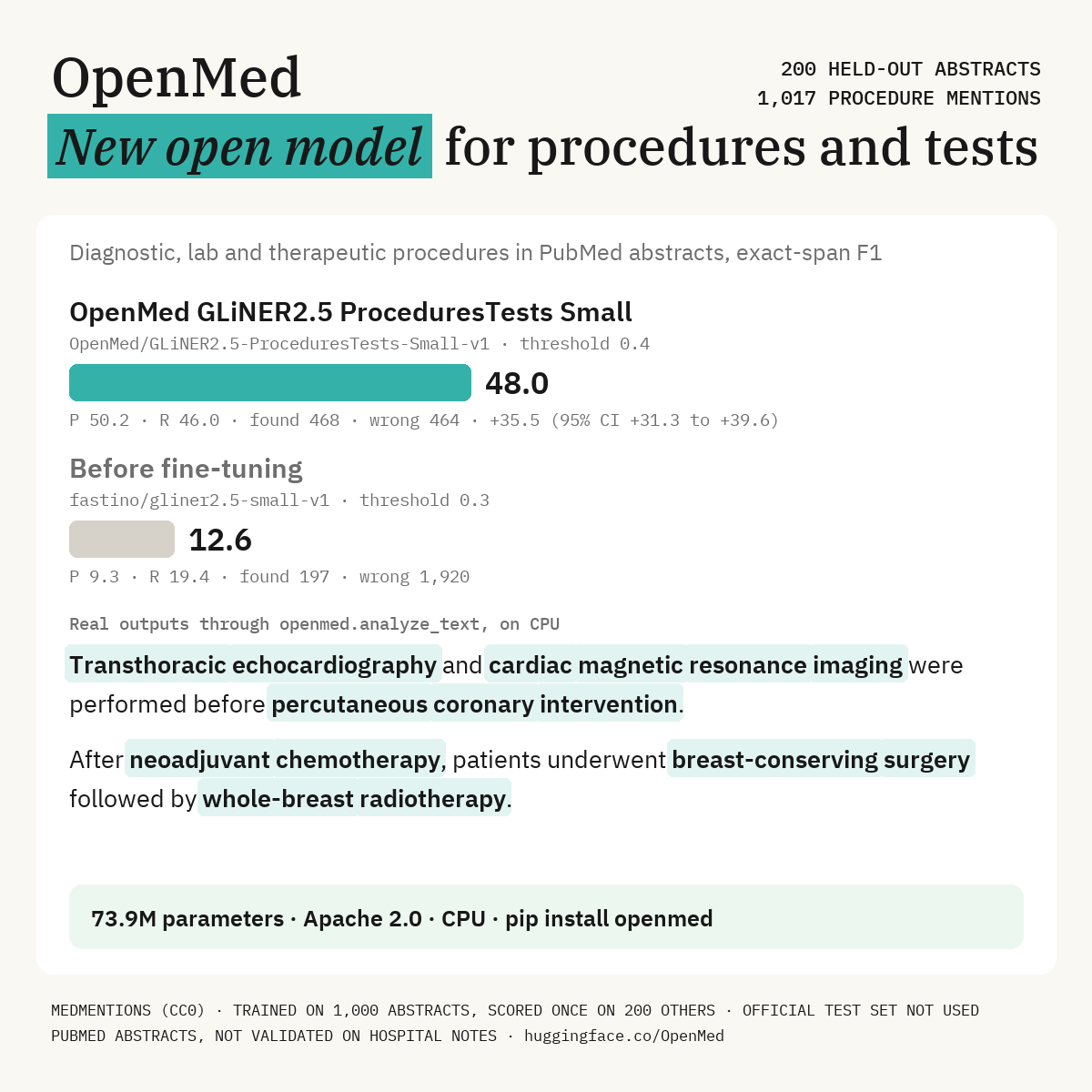
Fine-tuned from @fastinoAI's GLiNER2.5 Small on 1,000 MedMentions abstracts, with three labels.
Lab procedures are its weak spot, F1 28.9, about one in four found. It also missed "maintenance hemodialysis" in the card's last line. Not yet tested on hospital notes.
Every systematic review starts with thousands of abstracts and one question. Which studies did the scan, the biopsy or the surgery?
New open model, OpenMed GLiNER2.5 ProceduresTests Small. F1 12.6 to 48.0 on 200 held-out abstracts. Apache-2.0.
https://t.co/TZOI6fljQa
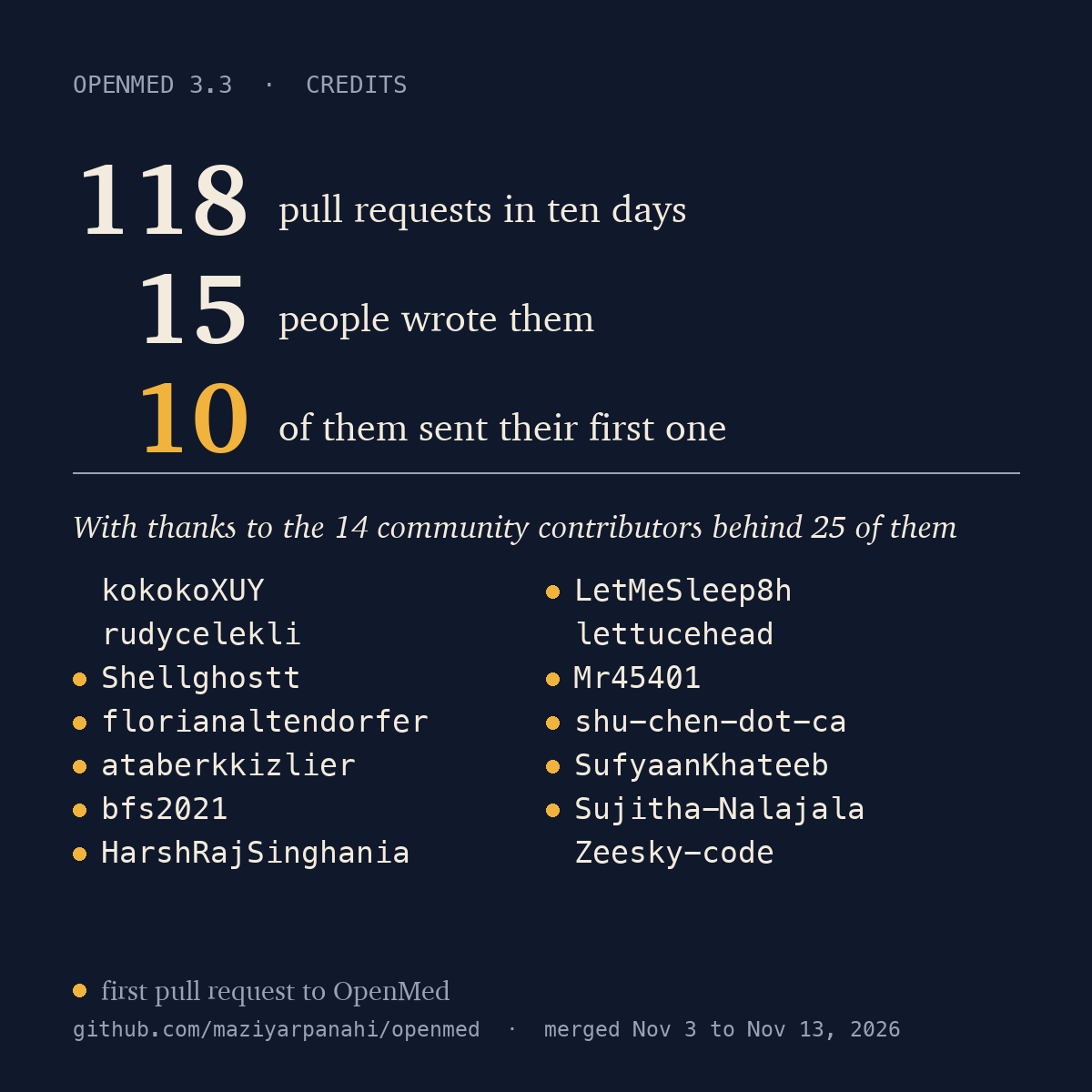
10 people sent their first pull request to OpenMed during 3.3, and that makes us so happy!!
118 pull requests in ten days, 25 of them from 14 community contributors. Every name is on the card.
Good first issues are open if you want yours on the next one.
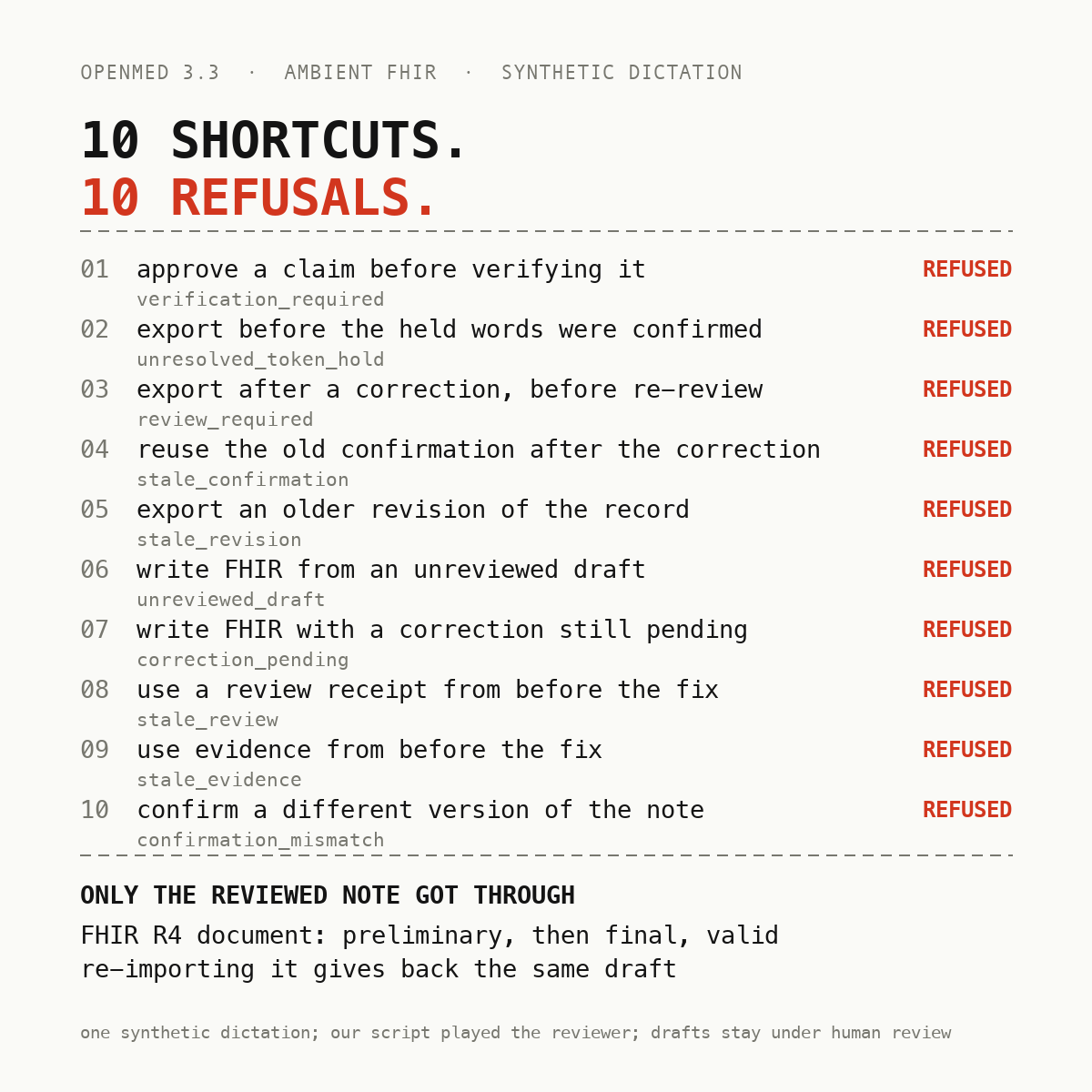
Same synthetic dictation as Saturday's offline speech post. Changing "25 mg" to "25 milligrams" pulled two plan statements back to unreviewed until someone looked again.
Our script played the reviewer, and drafts stay under human review.
https://t.co/qYnHnOYJVl
We tried to skip the review ten different ways. OpenMed 3.3 refused all ten.
Export before the drug name was confirmed, reuse an old sign-off after a correction, write FHIR from an unreviewed draft. Each came back with a reason. Only the reviewed note became FHIR R4.
The files and the patient are synthetic, built for this test, and the local PII screen is our open OpenMed PII SuperClinical Small (44M).
A comment is the case it won't guess on, so the export stops instead of shipping a half-cleaned file.
https://t.co/5HhcyVSGsn
The discharge summary looked clean. The patient's name was still inside, in white text, hidden text and a comment.
We hid a synthetic name in five files like that. OpenMed 3.3 found it in all five. Two came out redacted, two exports were stopped and one PDF was rejected.
Whisper large-v3-turbo transcribes locally and our open OpenMed PII SuperClinical Small (44M) screens each line before release. Network blocked the whole run, 0 attempts.
One synthetic voice, one test. It shows the release gate, not recall.
https://t.co/I1vz2HYuQt
We dictated a synthetic patient's name, birth date and phone number to OpenMed 3.3, fully offline.
All three came back masked before a single line of transcript was released. Three words it wasn't sure about, metoprolol, mg and a 2, wait for a person to confirm.
pip install "openmed==3.3.0"
npm install [email protected]
Swift, Android and the service image ship at 3.3.0 too. Everything was tested on synthetic data, and every draft stays under human review.
https://t.co/vJGB5roqSt
A clinic visit is a conversation, a scanned form, an ECG and an image. OpenMed 3.3 handles all four, locally.
Visit audio becomes a transcript screened for identifiers, then a FHIR draft a clinician reviews. Hidden text in a PDF is caught before export.
Out now, Apache-2.0.
Asked to find anatomy in a sentence about cytokines, a general model returned tocilizumab. A drug.
Our new Anatomy model returned nothing. On 200 held-out abstracts its F1 went from 25.71 to 61.85.
Two new small open models, for drugs and anatomy: https://t.co/1bXoX3piX7
Fine-tuned from @fastinoAI's GLiNER2.5 Small on 1,000 MedMentions abstracts. It now finds 655 of 987 labeled mentions, up from 333, with 476 wrong tags instead of 1,270.
One label covers organs, tissues, cells and body fluids. Not yet tested on hospital notes.
"Arthroscopy of the knee showed a tear of the medial meniscus and loss of articular cartilage on the femoral condyle."
New open model: OpenMed GLiNER2.5 Anatomy Small. It finds all four structures. F1 25.7 to 61.9 on 200 held-out abstracts. Apache-2.0.
https://t.co/vxkrYoiVGM
love this!! they said make inkling your own, so shall we post-train inkling 2 small into the best open medical model a hospital can run in-house?
594B total, 17B active, reads images, 1M context, apache 2.0. even their own model card says medicine needs more fine-tuning first