He wrote one of the greatest love epics in Sanskrit. It begins with a mountain.
Imagine looking at the Himalayas and seeing not a mountain range, but a father watching over his daughter.
That is how Kalidasa opens one of Sanskrit's greatest poems. In his hands, Himālaya is no longer stone and snow. He is the father of Pārvatī.
अस्त्युत्तरस्यां दिशि देवतात्मा हिमालयो नाम नगाधिराजः |
asty uttarasyāṃ diśi devatātmā himālayo nāma nagādhirājaḥ |
"In the northern region stands Himālaya, the king of mountains, whose very soul is divine."
(Kumārasambhava 1.1)
He made a cloud into a postman — a lovesick exile asking a passing rain cloud to carry his message across the length of India, spending the entire poem describing the journey.
He made the world remember a woman a king forgot — a curse erases her from his memory; two thousand years later, we're still the ones remembering her.
In 1791, that same story reached a poet in Weimar who had never been within a thousand miles of India. He was so moved that he wrote a verse praising it as the meeting of heaven and earth in a single name. His name was Goethe.
One honest note, briefly: we don't actually know Kalidasa's century, birthplace, or even his real name. "Kalidasa" literally means "servant of Kālī" and may well have been a literary or honorific name rather than the poet's birth name. History lost the man. It couldn't lose the poems.
A mountain imagined as a loving father. A cloud carrying a letter. A woman the world refused to forget. If Sanskrit had a heartbeat, it would sound a little like Kalidasa.
Save this. 🔖 Share it with someone who thinks Sanskrit is only grammar and ritual.
#kalidasa #sanskrit #kumarasambhava #meghaduta #shakuntala #sanskritliterature #indianclassics #openpathshala
Sanskrit has no word for religion.
Not because the concept was hidden. Because the category didn't exist.
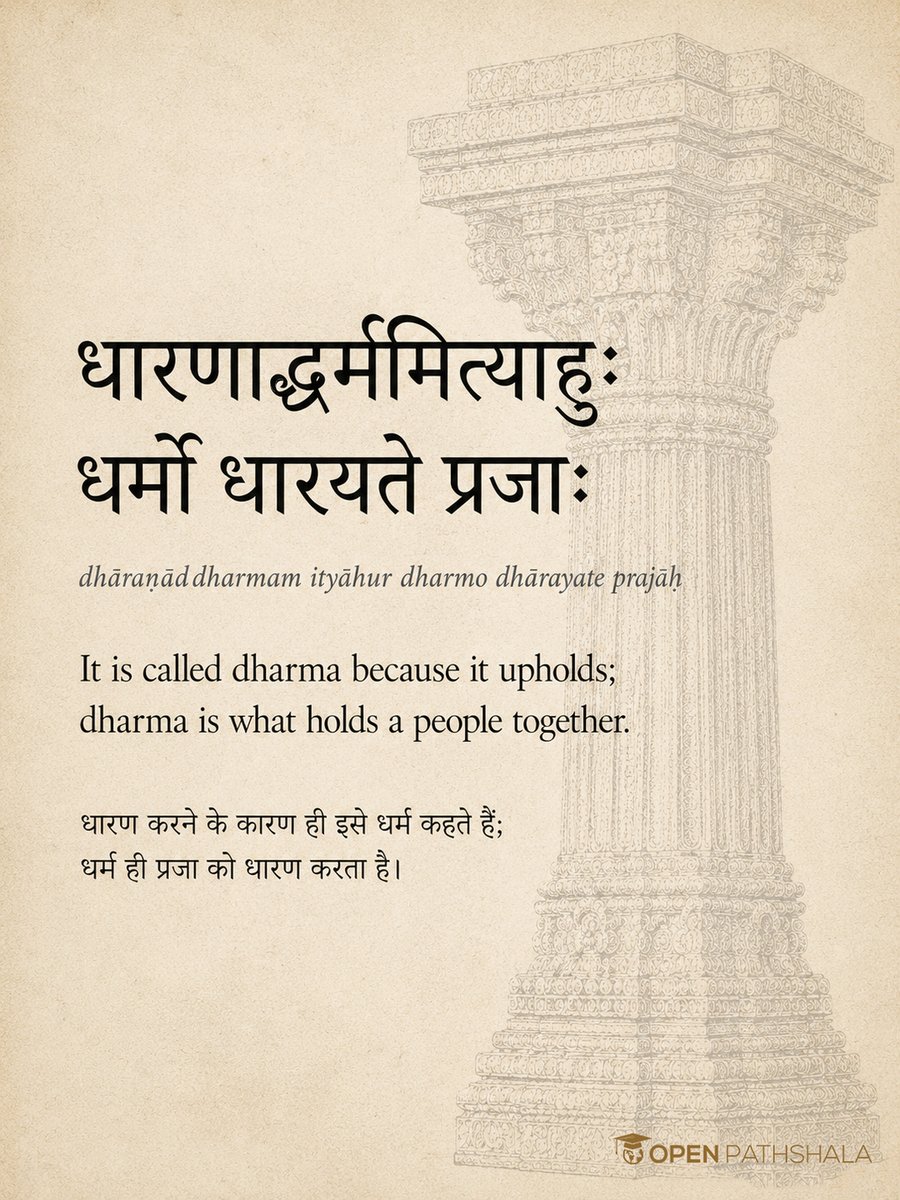
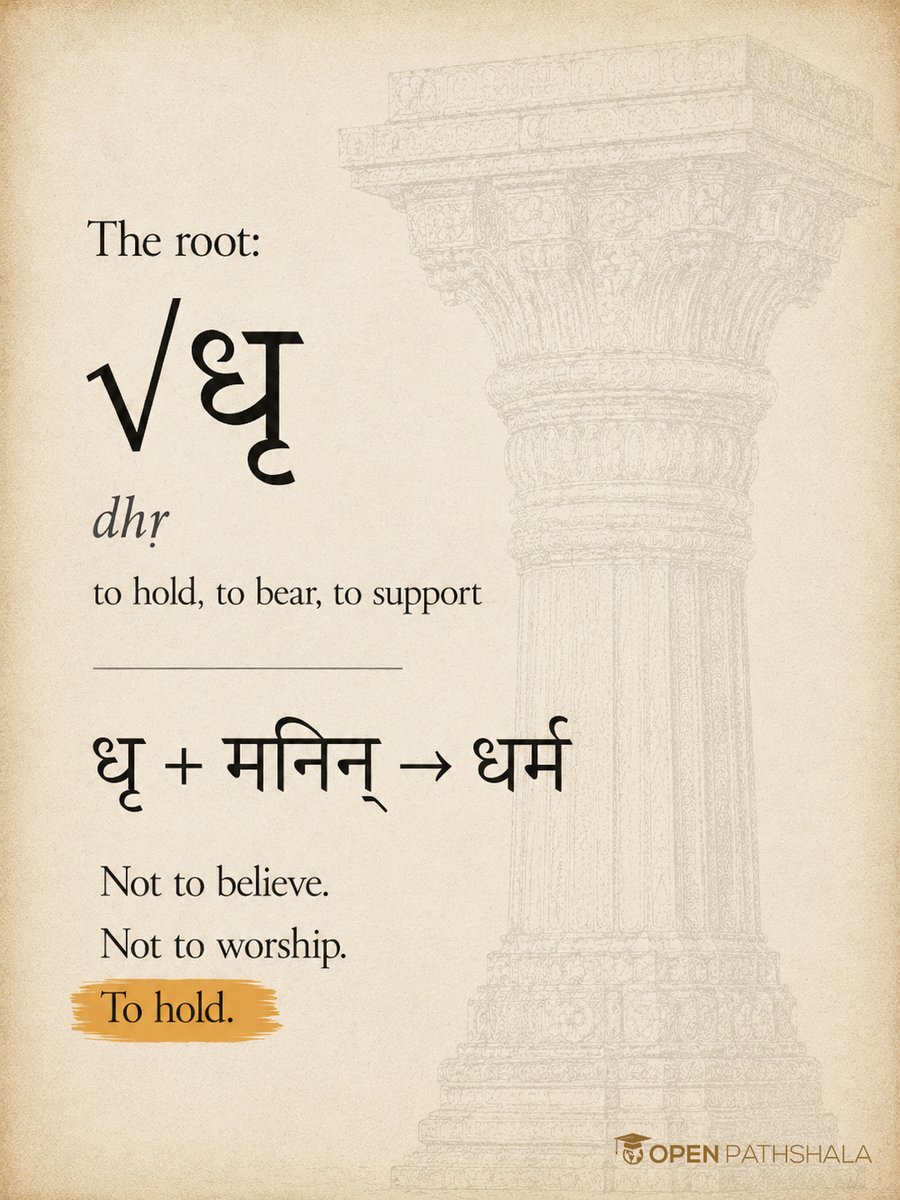
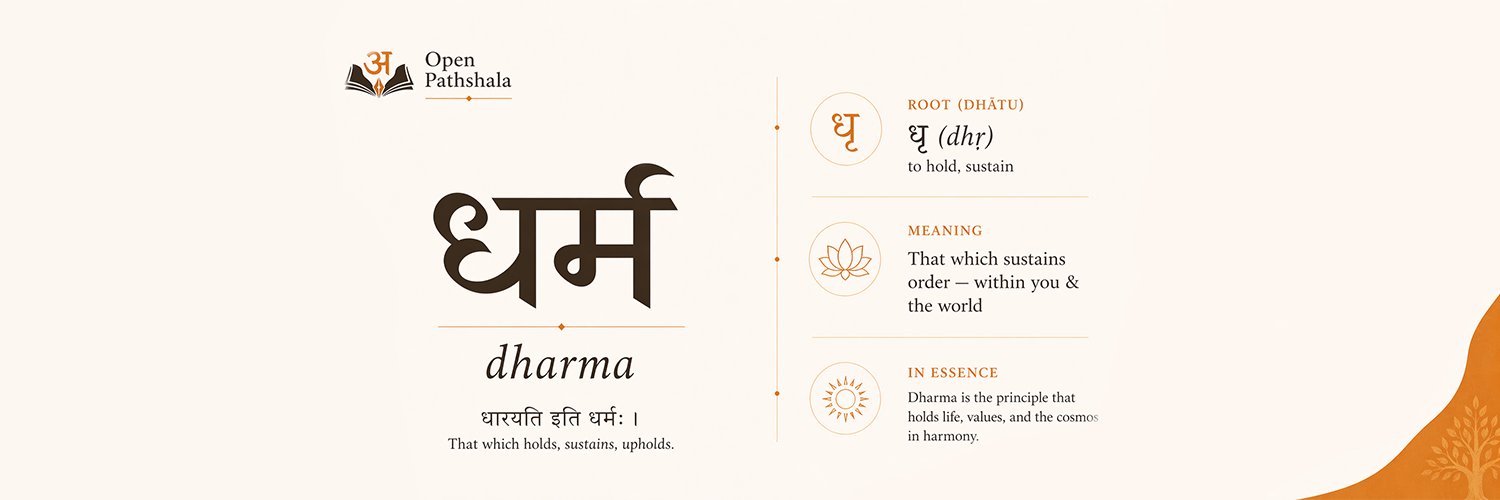
धर्म (dharma) comes from √धृ - to hold, to bear, to support. It is the property by which a thing holds its own nature. Fire's dharma is heat. Water's dharma is descent. Remove it and the thing stops being itself.
The Mahābhārata says so in as many words:
धारणाद्धर्ममित्याहुः - it is called dharma because it upholds.
(Śānti Parva 109.11)
Which means every time you read svadharma as "my religion" or even "my duty," you are reading a colonial filing system, not a Sanskrit word.
This is the whole reason we teach the language and not only the translation. A translation gives you someone else's decision about what a word meant. The root gives you the word.
#sanskrit #dharma #bhagavadgita #mahabharata #indianphilosophy #vedanta #sanskritlanguage #openpathshala
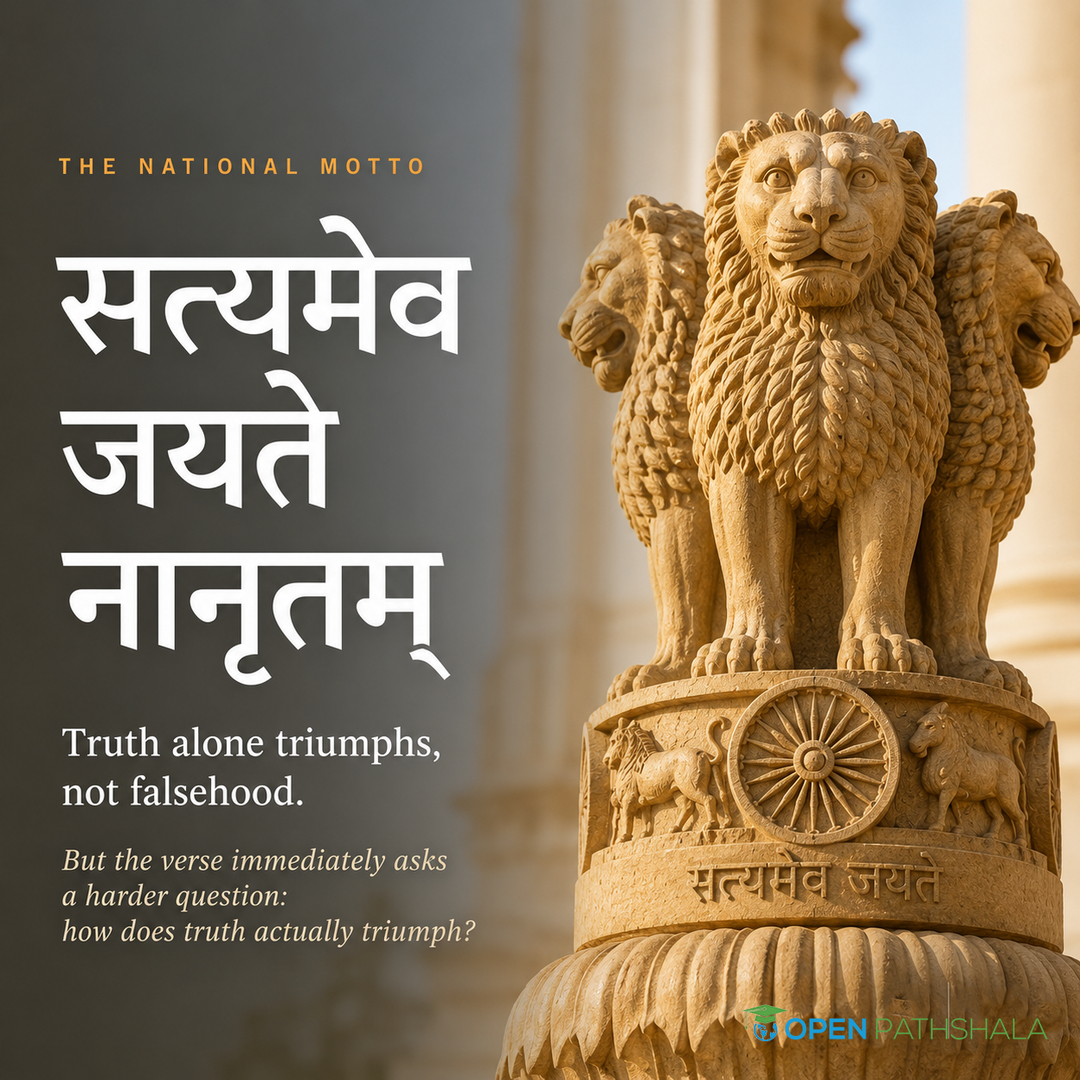
You've seen these four words your entire life. On the emblem. On every coin. On courtroom walls.
सत्यमेव जयते - "Truth alone triumphs."
What almost nobody's seen is the rest of the verse it was cut from - from the Mundaka Upanishad, written down more than 2,000 years before it became independent India's national motto in 1950.
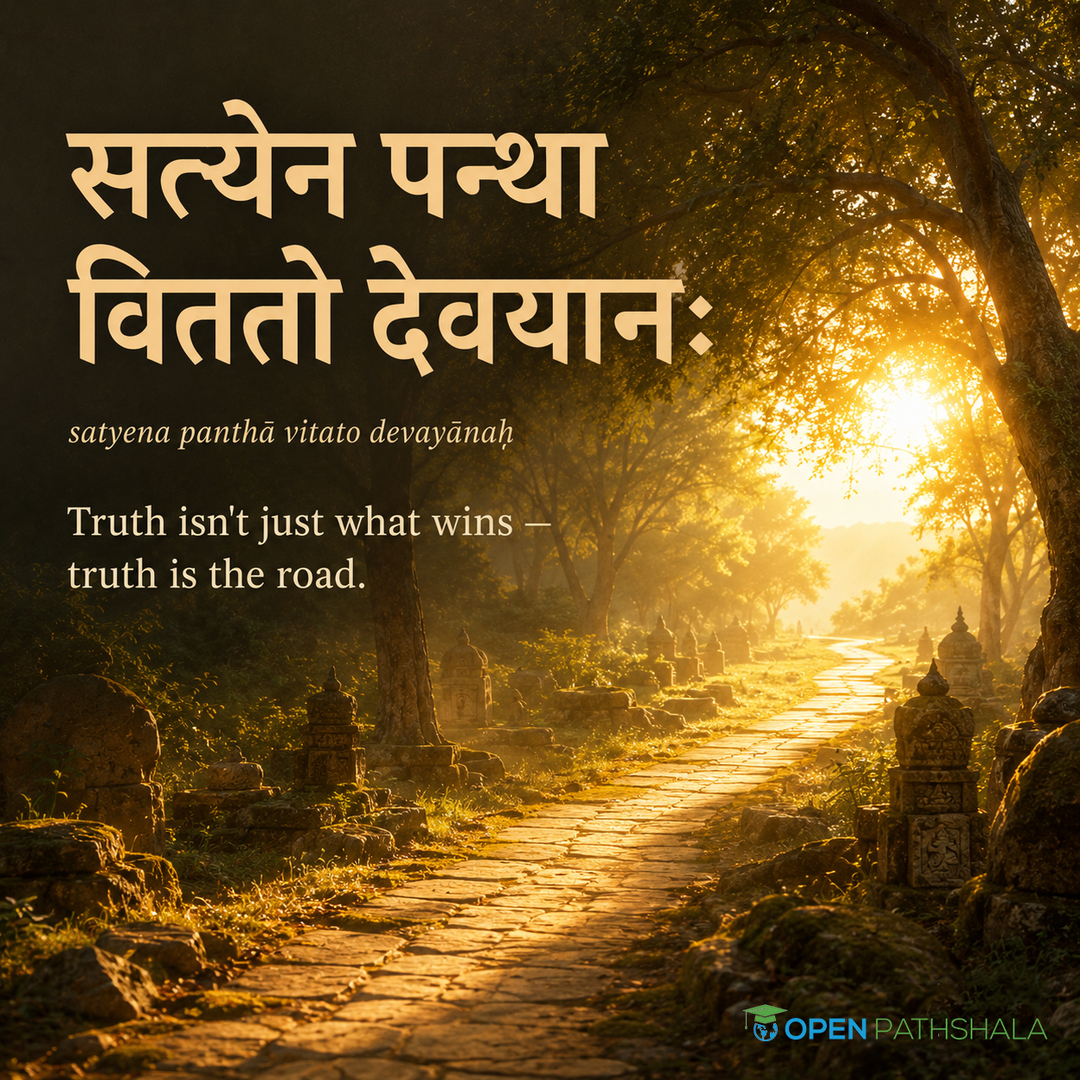
The full verse doesn't stop at "truth wins." It says truth is a road - देवयानः, the path of the gods - the same road the sages walked, free of craving, all the way to ultimate reality itself.
सत्यमेव जयते नानृतं सत्येन पन्था विततो देवयानः।
येनाक्रमन्त्यृषयो ह्याप्तकामा यत्र तत् सत्यस्य परमं निधानम्॥
satyameva jayate nānṛtaṃ satyena panthā vitato devayānaḥ | yenākramantyṛṣayo hyāptakāmā yatra tat satyasya paramaṃ nidhānam ||
"Truth alone triumphs, not falsehood. Through truth the path of the gods lies spread out, by which sages who've attained their desires ascend to where that supreme treasure of truth rests."
सत्य की ही विजय होती है, असत्य की नहीं। सत्य के द्वारा ही देवयान मार्ग फैला हुआ है, जिससे इच्छारहित ऋषि सत्य के परम निधान तक पहुँचते हैं।
So the emblem isn't quoting a moral. It's quoting a map.
Save this before you forget it. Send it to your friends so they understand where the line comes from! 🔖
अयं निजः परो वेति गणना लघुचेतसाम् ।
उदारचरितानां तु वसुधैव कुटुम्बकम् ॥
ayaṃ nijaḥ paro veti gaṇanā laghucetasām |
udāracaritānāṃ tu vasudhaiva kuṭumbakam ||
You have seen the last four words of this verse on government emblems, in international speeches, printed on conference banners. Vasudhaiva kuṭumbakam - the whole earth is one family. Almost nobody quotes the first half. And the first half is where the actual force of the verse lives.
अयं निजः परो वेति - "this one is mine, that one is other." This is not a neutral description. It is naming the most ordinary human habit there is: sorting every person we meet into two piles - belongs to me, does not belong to me.
गणना लघुचेतसाम् is the verdict on that habit, and it does not soften anything. Laghu means small, narrow, light. Cetas means the mind, the awareness itself. The verse says plainly: this sorting - mine versus other - is what a narrowed mind does. Not a wrong opinion. A small mind.
उदारचरितानां तु - "but for those of expansive character" - turns the verse toward its actual subject. Udāra means generous, wide, un-narrowed. And carita is important: it means conduct, character built through how a person actually lives and acts - not a birth quality, not an accident of temperament. Something earned.
And only then, in the final line, does the verse arrive at what such a person actually sees:
वसुधैव कुटुम्बकम् - the earth itself, vasudhā, is one household, one kuṭumba. Not a wish. Not a diplomatic nicety. A description of what becomes visible once the small calculation of mine-and-other has been dropped.
This is why quoting only the last four words misses the point of the verse entirely. The line is not a gentle sentiment about global friendship. It is a direct challenge: the size of your family is the size of your mind. Enlarge one, and the other follows.
Save this 🔖 Share it with someone who has only ever heard the second half.
#Sanskrit #LearnSanskrit #VasudhaivaKutumbakam #Hitopadesha #IndianPhilosophy #VedicWisdom #OpenPathshala #SanskritShloka #SanskritLearning #IKS #IndianKnowledge #Unity #SanskritQuote
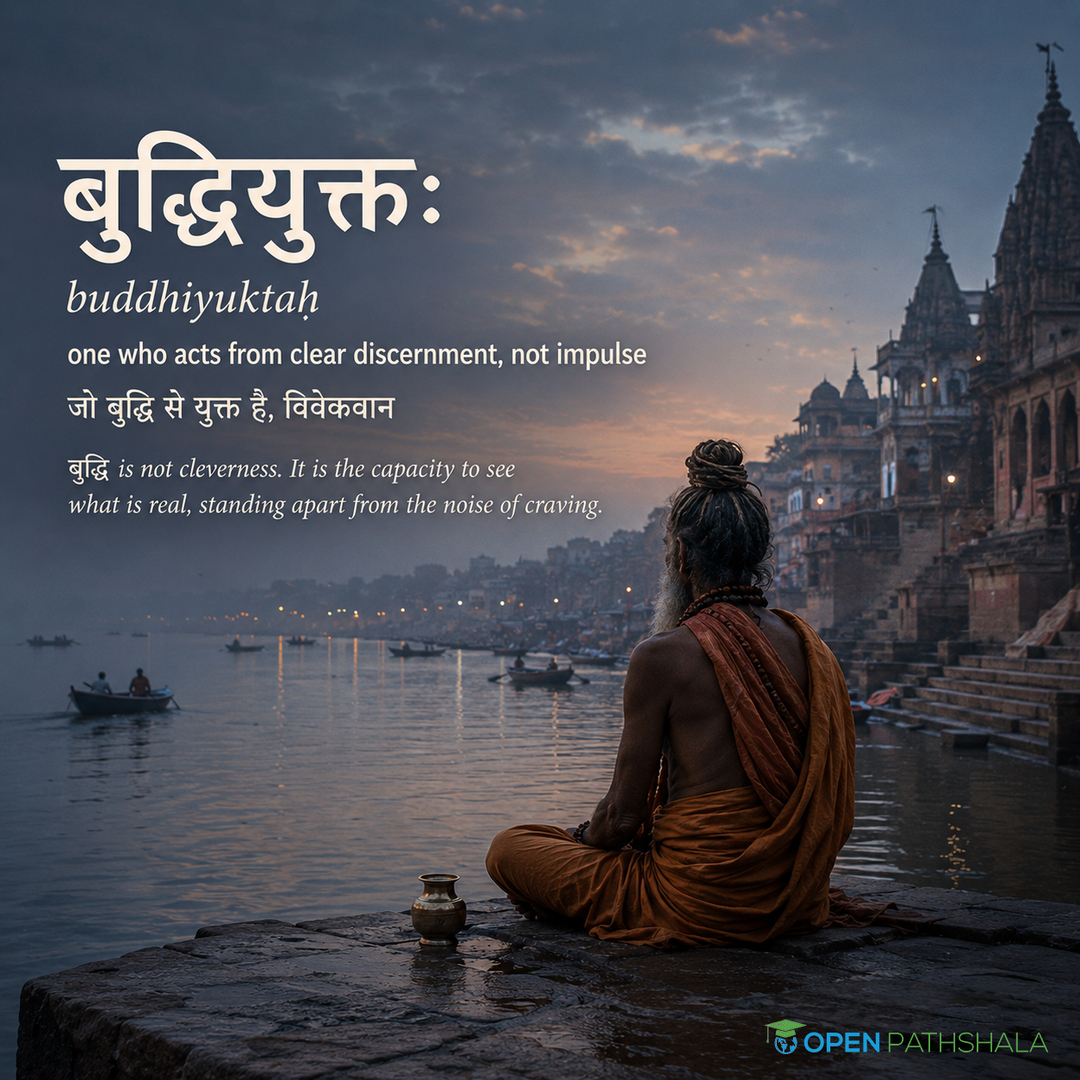
बुद्धियुक्तो जहातीह उभे सुकृतदुष्कृते ।
तस्माद्योगाय युज्यस्व योगः कर्मसु कौशलम् ॥
buddhiyukto jahātīha ubhe sukṛtaduṣkṛte |
tasmādyogāya yujyasva yogaḥ karmasu kauśalam ||
"One endowed with wisdom abandons both good and bad deeds in this life. Therefore devote yourself to yoga - yoga is skill in action."
- Bhagavad Gītā 2.50
जो बुद्धि से युक्त है वह यहीं पुण्य और पाप दोनों को त्याग देता है। इसलिए योग में लग जाओ - योग ही कर्मों में कुशलता है।
Most people quote "yoga is skill in action" as a nice line about doing your work well. Read slowly, the verse makes a stranger claim.
The first line doesn't say a wise person avoids bad deeds. It says they abandon both - sukṛtaduṣkṛte, good and bad together. That's the line worth sitting with. Krishna isn't describing good moral behaviour. He's describing someone who has stepped outside the entire framework of collecting merit and demerit - not because right and wrong stop mattering, but because a person acting from buddhi, true discernment, no longer acts to earn either.
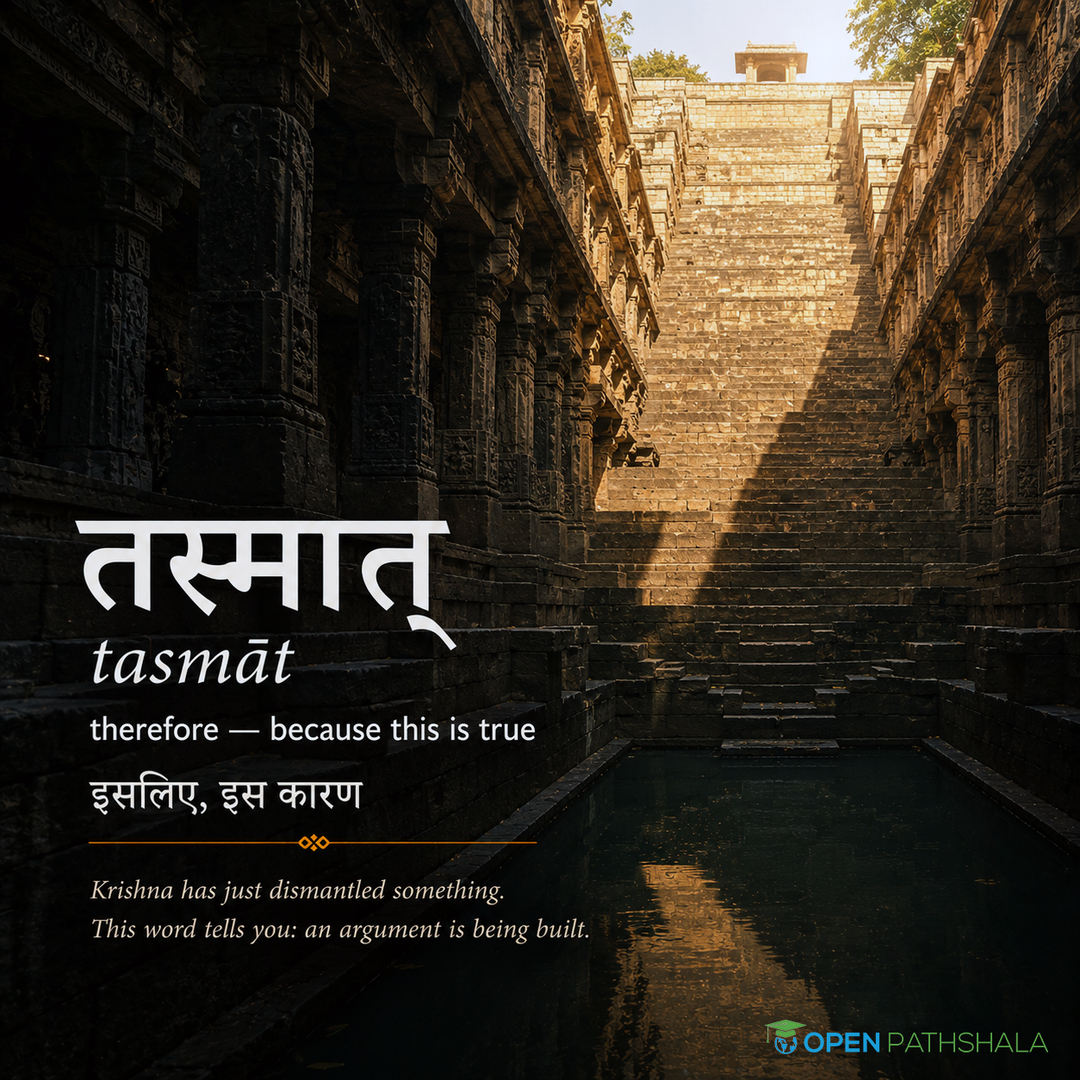
तस्मात् - "therefore" - is the pivot. Krishna has just dismantled ordinary moral scorekeeping. This word tells you an argument is being built.
The second line answers what the first leaves hanging: if not scorekeeping, then what? Yogāya yujyasva - yoke yourself to yoga. Notice yujyasva and yoga share the same root, √yuj, to join. The line literally says: yoke yourself to yoking. Then comes the Gītā's most compressed definition: kauśalam - skill. Not casual competence, but the precision of handling kuśa grass, sharp enough to cut carelessness.
Together, the verse stops being advice about workplace excellence. It becomes: don't act to accumulate credit, good or bad. Act with such complete precision that scorekeeping itself falls away.
Save this 🔖 Share with someone chasing outcomes over presence.
#BhagavadGita #KarmaYoga #Sanskrit #LearnSanskrit #GitaVerse #IndianPhilosophy #VedicWisdom #OpenPathshala #SanskritShloka #SanskritLearning #Krishna #IKS #Vedanta
तमसो मा ज्योतिर्गमय ।
tamaso mā jyotirgamaya
"Lead me from darkness to light."
You have heard this line a hundred times. In temple chants, at weddings, in school assemblies. It is one of the most repeated phrases in the Sanskrit tradition.
What almost nobody is told: this is only the middle line of a three-line prayer from the Bṛhadāraṇyaka Upaniṣad. And the lines on either side of it change what the whole prayer is actually asking for.
The full prayer goes:
asato mā sadgamaya - "Lead me from the unreal to the real."
tamaso mā jyotirgamaya - "Lead me from darkness to light."
mṛtyor māmṛtaṃ gamaya - "Lead me from death to immortality."
Read together, these three lines are not three separate requests. They are one request, moving deeper with each line.
The first line is about what you think - being led from illusion to truth. The second, the one everyone knows, is about what you see - being led from confusion to clarity. The third, the one almost nobody quotes, is about what you are - being led past death itself, toward something that does not end.
Most people who recite this prayer stop their understanding at line two. They ask only for clarity. But the sage who composed this asked for far more - first to stop being deceived, then to see clearly, and finally to discover that the seer himself does not die.
This is what Sanskrit prayer often does. It looks simple on the surface and opens into something much larger the moment you read the whole thing.
Save this 🔖 Share it with someone who chants this prayer without knowing what surrounds it.
सत्यं शिवं सुन्दरम् ।
satyaṃ śivaṃ sundaram
You have seen these three words your whole life. On school walls. On government buildings. In speeches and on award citations. Most of us nod at them and move on, assuming they mean something vaguely noble - "truth, goodness, beauty."
But each word carries a precise meaning that the translation flattens.
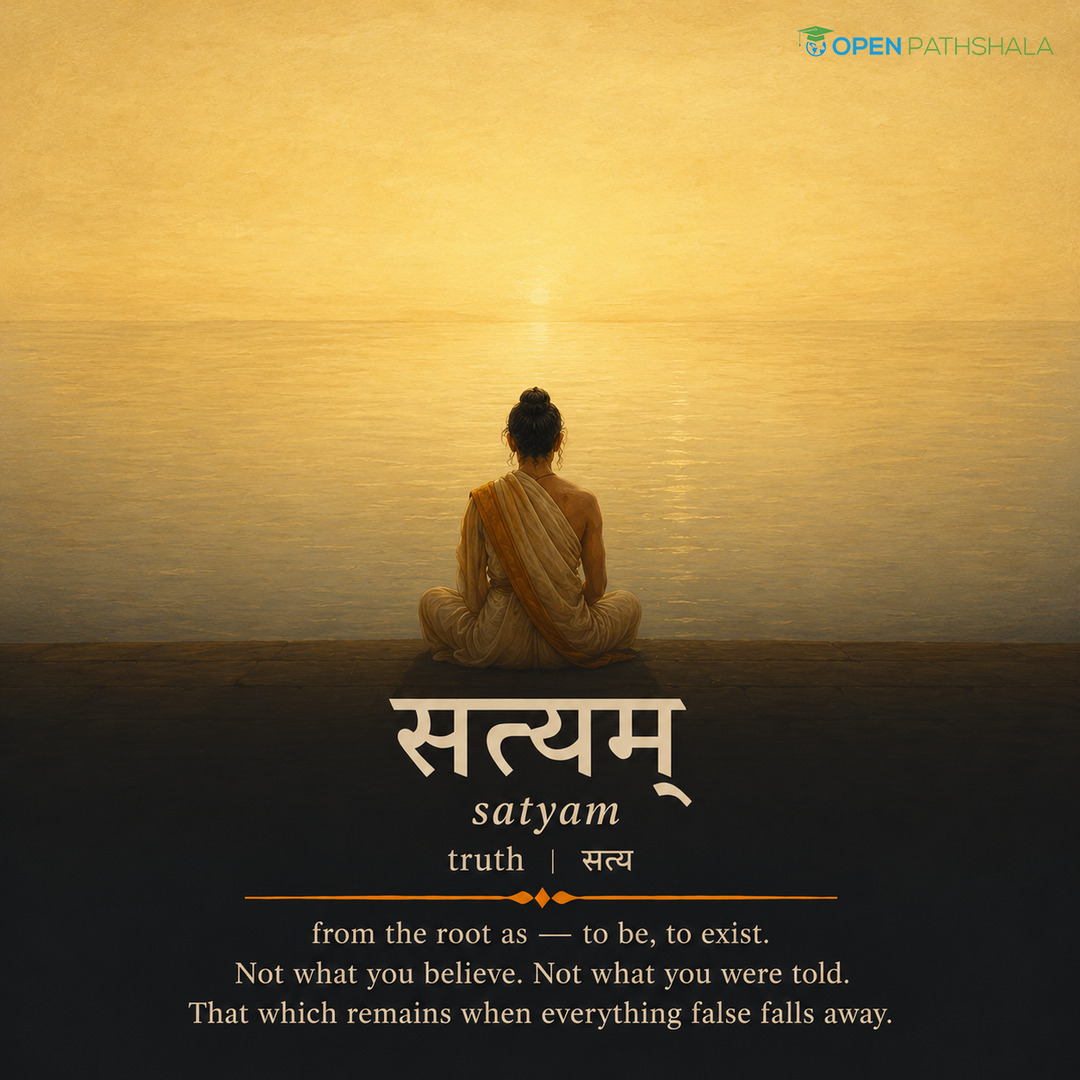
सत्यम् (satyam) comes from the root as - to be. Sat means "that which is." Truth, in Sanskrit, is not an opinion you hold or a fact you can prove. It is simply that which actually exists, when everything false has fallen away. Not what you believe. What is.
शिवम् (śivam) here does not mean Lord Shiva the deity. It means "that which is auspicious" - that which is good for all beings, that which lets everything rest in peace. Truth on its own can be harsh, even cruel. Śivam is truth that blesses rather than wounds.
सुन्दरम् (sundaram) does not mean decoration or prettiness. It means "that which is complete" - that which has become fully, perfectly itself, with nothing missing and nothing forced. A lotus is beautiful because it is completely lotus. A thing is sundaram when it is wholly what it is.
And here is the part most people are never told: these are not three separate ideals you should aspire to. They are three faces of one single reality. That which truly IS is also that which blesses, and that which is complete in itself. The real, the good, and the beautiful are not three goals. They are the same thing, seen from three sides.
This is what Sanskrit does. It carries entire philosophies inside words we walk past every day without a second glance.
#Sanskrit #LearnSanskrit #SatyamShivamSundaram #Vedanta #IndianPhilosophy #VedicWisdom #OpenPathshala #SanskritWords #Truth #Beauty #SanskritShloka #SanskritLearning #IndianKnowledge #IKS #Spirituality
अहिंसा परमो धर्मः ।
ahiṃsā paramo dharmaḥ
"Non-violence is the highest dharma."
You have heard this line. It is one of the most quoted sentences in all of Sanskrit. Gandhi-ji built a movement on it. It is carved on walls and printed on posters.
But in the Mahābhārata tradition, this line does not stand alone. It is paired with a second half that almost nobody quotes:
dharma-hiṃsā tathaiva ca - "and so too is violence in the service of dharma."
Read together, the verse stops being a slogan and becomes something far harder. It says: non-violence is the highest principle - and yet there is a violence that is also righteous. The violence that protects a child. That stops a greater harm. That defends those who cannot defend themselves.
This is the entire problem of the Mahābhārata compressed into one line. When Arjuna lays down his bow on the battlefield and refuses to fight, he believes he is choosing ahiṃsā. Krishna spends the whole of the Bhagavad Gītā explaining why, in that particular moment, his refusal is itself a failure of dharma. Sometimes the refusal to act is its own kind of harm.
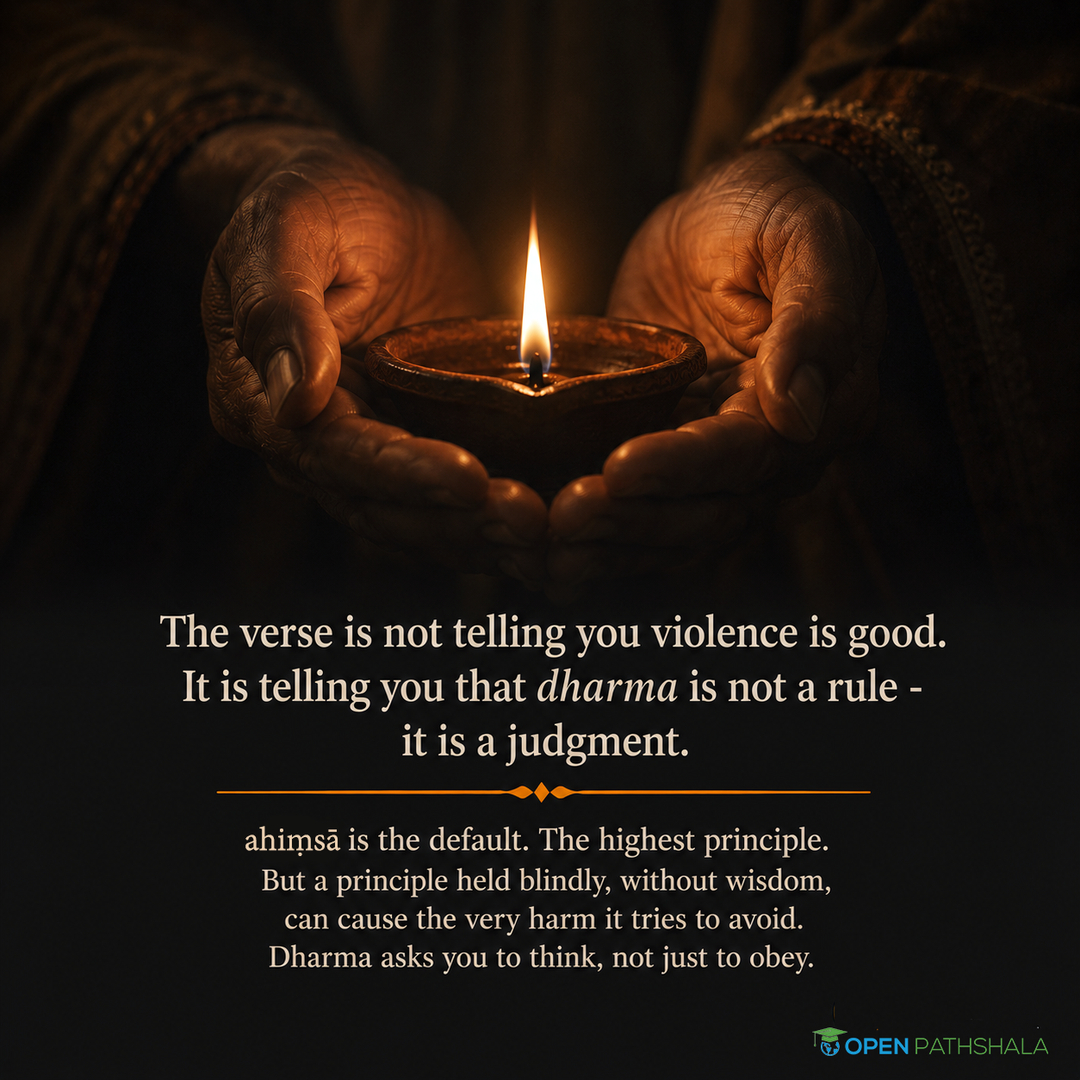
The verse is not telling you that violence is good. It is telling you something more uncomfortable: that dharma is not a fixed rule you can memorise and follow blindly. It is a judgment you have to make, again and again, with wisdom. A principle held without thought can cause the very harm it was meant to prevent.
This is why translation alone is never enough. Half a verse gives you a slogan. The full verse gives you a question you have to live with.
Save this. Share it with someone who only knows the first half 🔖
सूर्य · प्रातः · स्नान · पूजा · प्रसाद
You say these five words every morning.
Nobody ever stopped to tell you what they mean.
सूर्य (sūrya) - from the root sur, to shine, to stimulate. The sun is not just a star in Sanskrit - it is the principle of impulse itself, the thing that sets all other things in motion. This is why the morning water offering is called सूर्यार्घ्य (sūryārghya) - water given back to the one who gives everything. The first transaction of the day is gratitude.
प्रातः (prātaḥ) - from pra (forward, first) + the root at (to go). That which goes forward first. The leading edge of the day. In the Vedic tradition, प्रातः was considered the most sacred time because the mind, having just emerged from sleep, is closest to its still nature. This is why mantras are chanted at dawn and not at noon.
स्नान (snāna) - from the root snā, to bathe. But in the tradition, स्नान is not just washing the body. It removes both physical and energetic residue from the previous day. This is why a bath before पूजा is non-negotiable. You are not just clean. You are reset.
पूजा (pūjā) - from the root pūj, to honour, to revere. Notice the verb: pūjā is not asking. It is offering. You give something. The five traditional elements of पूजा - flower, light, water, incense, food - correspond to the five elements of the body itself. You are offering the universe back to itself.
प्रसाद (prasāda) - from pra (forward) + the root sad (to settle, to be pleased). That which settles upon you from a pleased presence. You offer पूजा. What returns is प्रसाद. This is why the same food, once offered, is no longer ordinary - it has passed through the act of giving and come back as something else.
Five words. Five steps of a morning practice older than any religion you know. And you already do this every morning - most of you without ever knowing what each word was asking of you.
Save this for tomorrow morning 🔖
#Sanskrit #LearnSanskrit #SanskritWords #MorningSanskrit #Puja #Prasad #Surya #VedicWisdom #IndianPhilosophy #OpenPathshala #SanskritLearning #IndianCulture #DailyRituals #Sanatan #IKS
आशीर्वाद · धैर्य · श्रद्धा · संस्कार · सेवा
āśīrvāda · dhairya · śraddhā · saṃskāra · sevā
Your parents said these words to you.
Probably more times than you can count.
You nodded. You moved on.
Nobody ever stopped to tell you what they actually meant.
संस्कार (saṃskāra) - from sam (thoroughly) + kṛ (to make). That which is well-made. Not rules. Not restrictions. The slow, patient shaping of a person into something worth being - the way a potter shapes clay over months, not minutes.
आशीर्वाद (āśīrvāda) - from āśīḥ (a wish) + vāda (utterance). A spoken wish. A blessing is not a warm feeling someone has toward you. It is a verbal act - something sent across to you through words. This is why you bow your head to receive it. You are receiving something real.
धैर्य (dhairya) - from the root dhṛ (to hold, to sustain). The same root that gives us dharma. When your father said thoda dhairya rakho, he was not asking you to wait. He was asking you to hold - to remain standing while everything around you moved.
श्रद्धा (śraddhā) - from śrat (the real, the true) + dhā (to place). To place your trust in what is true. The Bhagavad Gītā says śraddhāmayo'yaṃ puruṣaḥ - a person is made of their śraddhā. What you place your trust in is what you slowly become.
सेवा (sevā) - from the root sev (to attend upon, to be near with care). Not charity. Not obligation. The act of being fully present to someone else's need. In Indian thought, sevā is its own path to the divine - neither lesser nor greater than knowledge or meditation.
Five words. Spoken over you a thousand times.
Each one carrying a philosophy your parents lived but never explained.
Now you know what they were giving you.
योगदिनम् 🙏 | International Yoga Day
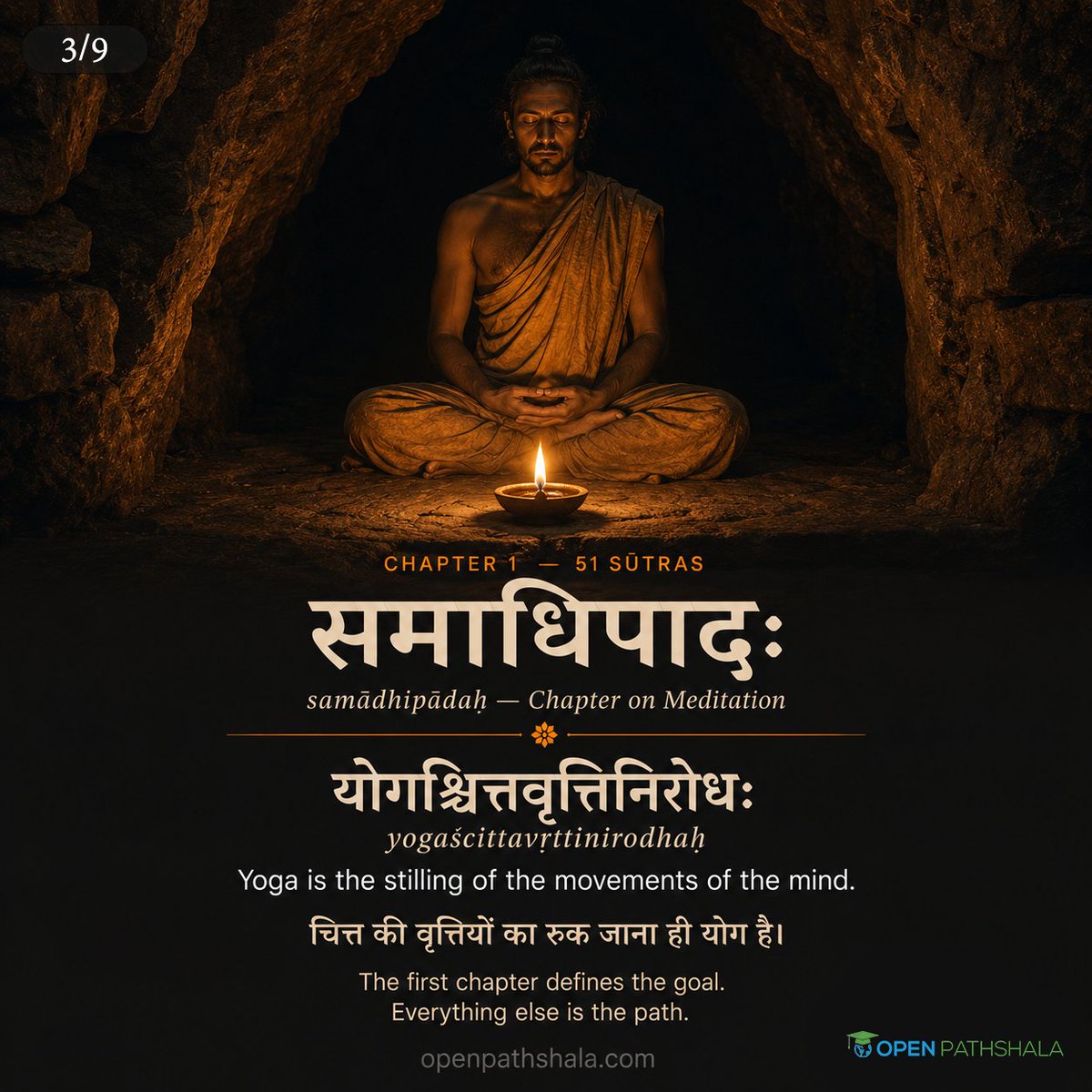
1/ समाधिपादः | samādhipādaḥ
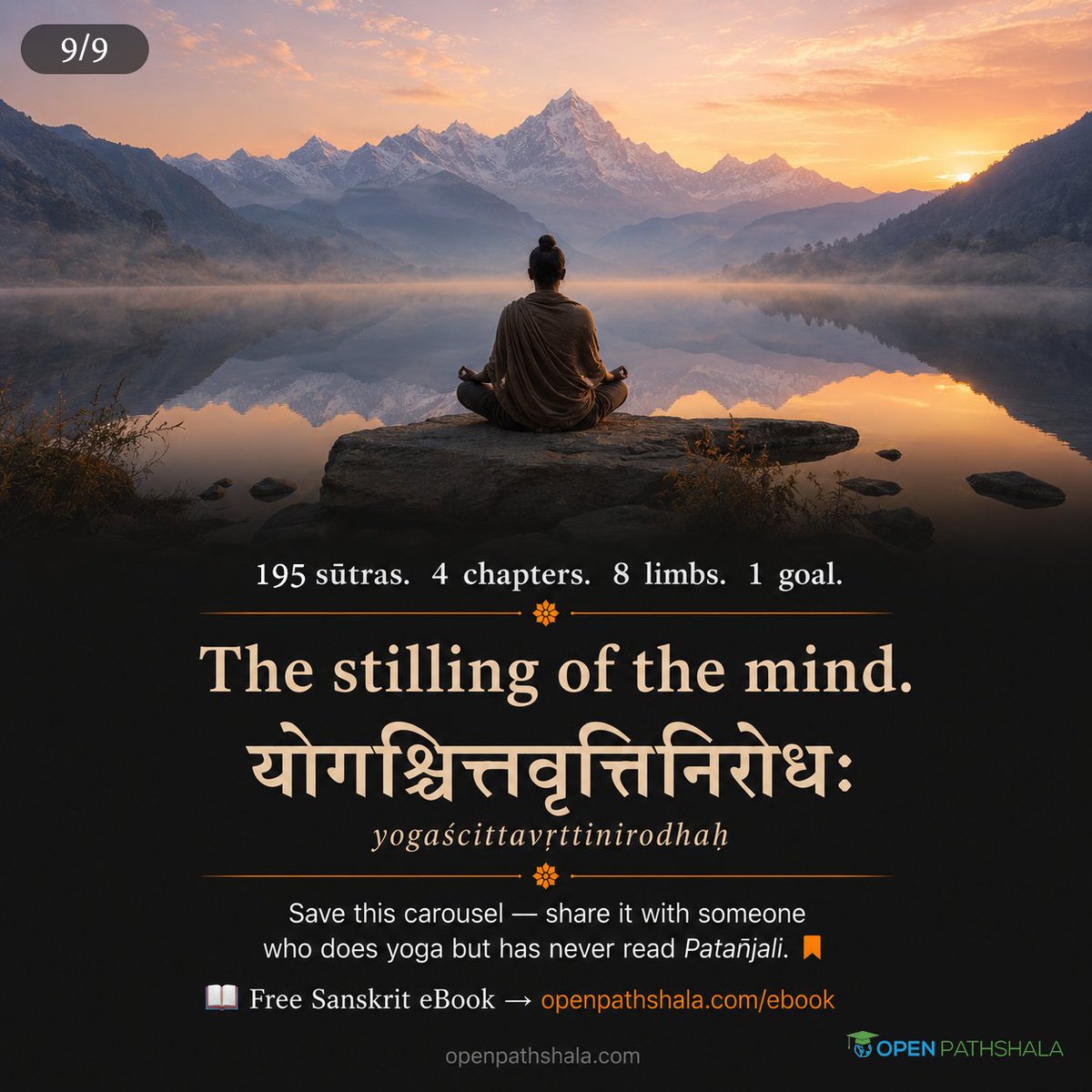
योगश्चित्तवृत्तिनिरोधः ।
yogaścittavṛttinirodhaḥ
Yoga is the stilling of the movements of the mind.
चित्त की वृत्तियों का रुक जाना ही योग है।
2/ साधनपादः | sādhanapādaḥ
तपःस्वाध्यायेश्वरप्रणिधानानि क्रियायोगः ।
tapaḥsvādhyāyeśvarapraṇidhānāni kriyāyogaḥ
Austerity, self-study, surrender — this is Kriyā Yoga.
तप, स्वाध्याय, ईश्वर शरणागति — ये तीनों क्रियायोग हैं।
3/ विभूतिपादः | vibhūtipādaḥ
जन्मौषधिमन्त्रतपःसमाधिजाः सिद्धयः ।
janmauṣadhimantratapaḥsamādhijāḥ siddhayaḥ
Powers arise from birth, herbs, mantra, austerity, or samādhi.
जन्म, औषधि, मन्त्र, तप और समाधि से सिद्धियाँ मिलती हैं।
4/ कैवल्यपादः | kaivalyapādaḥ
कैवल्यम् (kaivalyam) — मुक्ति अर्थात् स्वयं में पूर्ण होना।
Millions practice yoga. Very few have read the book it comes from.
The Yoga Sūtras — 195 sūtras across 4 chapters — is the foundational text of the entire tradition.
Patañjali didn't invent yoga. He systematised it. His definition is the second sūtra: yogaścittavṛttinirodhaḥ. Three words. Not postures. Not breathing. Those are tools. The remaining sūtras are about the mind.
The 8 limbs move inward — from behaviour (yama, niyama) to body (āsana) to breath (prāṇāyāma) to senses (pratyāhāra) to concentration (dhāraṇā) to meditation (dhyāna) to absorption (samādhi).
Most of the world practices limb 3. Patañjali wrote 7 more.
We don't even know who he was. The dates are debated. He left 195 sūtras and nothing else. It was enough.
Save this. Share with someone who does yoga daily but has never read Patañjali 🔖
#YogaDay #InternationalYogaDay #YogaSutra #Patanjali #Sanskrit #LearnSanskrit #योगदिनम् #Ashtanga #Samadhi #Kaivalya #VedicWisdom #IndianPhilosophy #OpenPathshala #SanskritLearning #Yoga2026