OpenSeesWiki is a Wiki creation.The goal is simple:to provide information about OpenSees.Please explore the site and see what a great resource OpenSees can be..
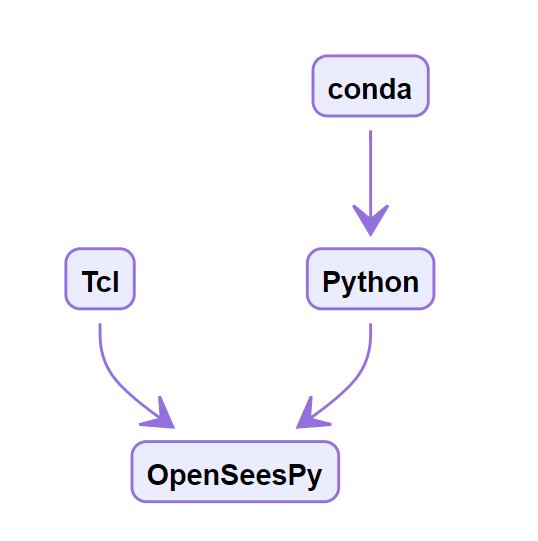
The Python interpreter of OpenSees i.e. OpenSeesPy has several advantages over its Tcl counterpart in terms of plotting and visualization. In January 2020, visualization functions were first added to OpenSeesPy to visualize model and mode-shapes by using only a command.
Civil Engineering Graduate Student Organization (CEGSA) has invited Dr. Michael H Scott to share his expertise on Nov 4 at 6pm ET. Dr. Scott is a Professor of Structural Engineering at Oregon State University and a developer of the OpenSees finite element software framework.
Local and non-local formulations available in #OpenSees for overcoming localization issues in frame elements. Including a new non-local formulation developed by @Sideris_P
https://t.co/K7lBloYK72
New paper: Time history analysis-based nonlinear finite element model updating for a long-span cable-stayed bridge, Structural Health Monitoring, 2020.
https://t.co/IrRVskmYw2
Version 3.2.2.6 of #OpenSeesPy is now available via pip install. Now includes the Mac version! @gasfermandois@vjagodnik let us know if 'pip install openseespy' works on your Mac with homebrew.
Thank you @MinjieZhuOS for your work on the #OpenSees#Python package.
The model or domain in OpenSees is a collection (an aggregation in object-oriented terms) of elements, nodes, single- and multi-point constraints and load patterns. It is the aggregation of these components which define the type of model that is being analyzed.
The analysis can look like plain text input files or they can be complex programs. It's up to the skills of the user. These applications are covered in the users section.
A number of simple applications are provided to introduce new users and non-programmers to the OpenSees framework.
All these applications are interpreters and they allow users to perform finite element analysis using a simple yet powerful scripting language.