We’re building AI that remembers more.
I think that’s the wrong goal.
• The goal isn’t to make AI remember everything. It’s to make it know what’s still true.
• Your company already has a memory. It’s just fragmented across founders’ heads, calls, emails, CRM, docs and decisions.
• We’ve spent decades building systems of record. Now we need systems of understanding.
• A failed experiment shouldn’t disappear. AI should remember why it failed, then stop acting on it.
• Every company writes its operating manual every day, then shreds it across tools and people.
• Models will change every six months. Your company’s verified operating history survives every model upgrade.
The companies whose AI knows what to forget are the ones it will actually run.
Curious which of these feels most important to you?
https://t.co/6Yma1c6dFl
try a practical test for AI that “learns your business”: you run a campaign. it fails, you learn why.
does that change what the agent does next week?
at https://t.co/b8TluklGhp, we’re building that feedback loop into growth: results become memory that informs the next action.
try it too and share your results! I’ll build a custom growth workflow for whoever shares the most interesting use case 😎
what does self-made actually mean in business? it definitely doesn’t mean doing everything alone.
for me, it means the responsibility is still yours.
• you go to bed thinking about the product and wake up thinking about sales
• you open your laptop on a Saturday not because you “have to work,” but because you genuinely want to test one more hypothesis
• you suddenly become an expert in things you didn’t even know existed a year ago
• you launch a product you’re proud of, knowing how many decisions, mistakes, rewrites and sleepless nights are behind it
and then a user writes: “there’s a bug.”
that’s it.
they don’t know what it took to build it. and honestly, they shouldn’t care. they care whether it works.
sometimes being a founder feels like being the captain of a ship when nobody ever taught you how to navigate the ocean. but the team is still looking at you. so you decide where to go next.
that’s probably what self-made means to me.
not that you did everything yourself.
but that nobody can make those decisions for you. Nobody can go through this part for you.
and every time something finally works, instead of slowing down, you somehow start thinking about what’s next 🚀
your turn. self-made is when…
95% of enterprise pilots show no P&L impact. MIT calls it the learning gap.
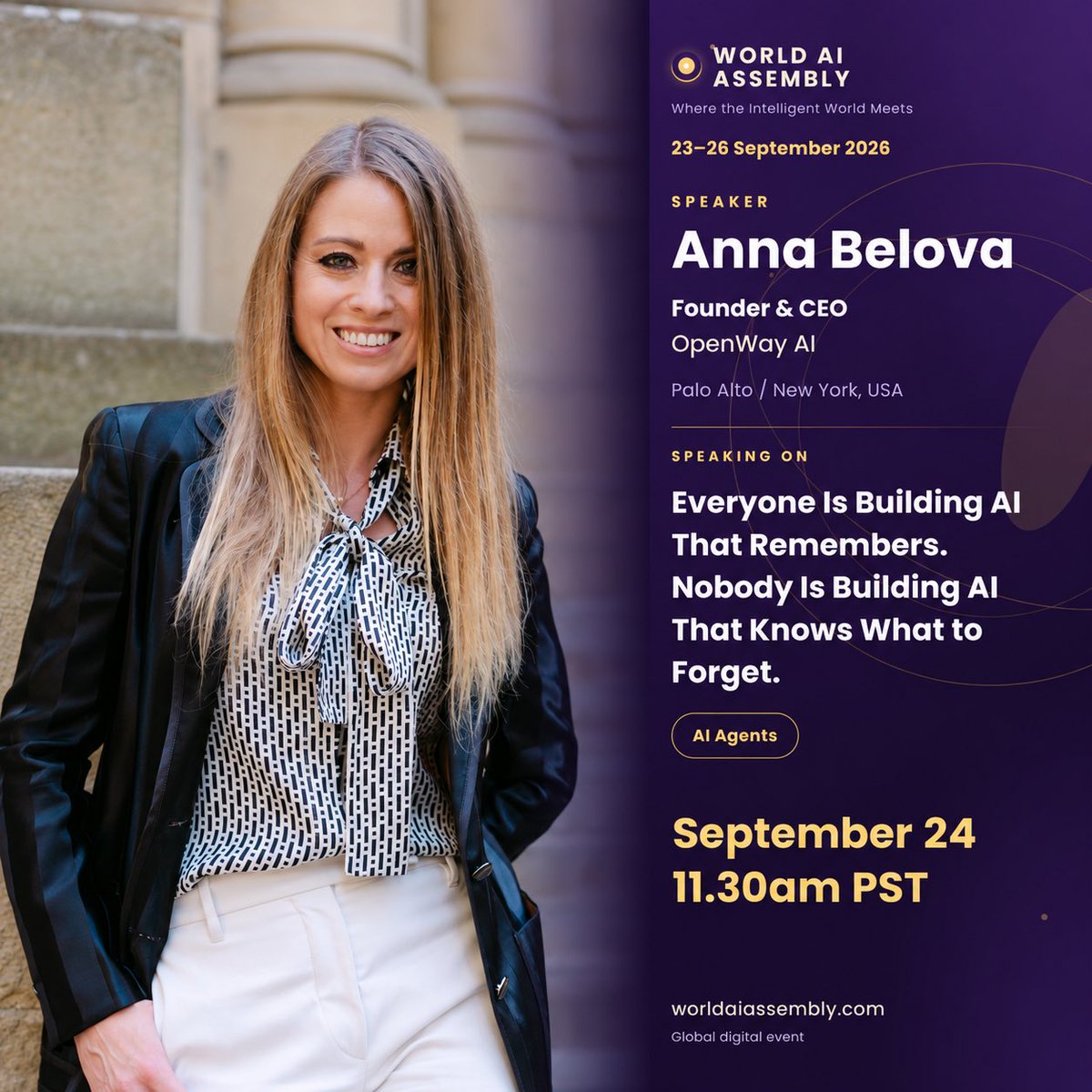
Tomorrow I'm speaking at the World AI Assembly session. I’ll explore why business context and feedback don’t reliably carry over into AI’s next action and what it takes to change that.
Can we close this gap? What do businesses actually need when adopting AI? What happens behind a simple question-and-answer exchange, and can AI move beyond that format to learn and act?
These are the questions I’ll tackle in my talk:
Everyone Is Building AI That Remembers. Nobody Is Building AI That Knows What to Forget.
🗓 Tomorrow, Sept 24, 11.30am PST
📍 Online · https://t.co/qCgLd1CLYr
Save the date and time. Let’s talk! 🚀
Bonus: https://t.co/b8TluklGhp - capture your business history → turn it into memory → power your growth with it
My previous B2B SaaS reached 2,000 new users a day. I needed a way to talk to them. My founder friends: “We should all have your problems.”Fair enough 😅
We built an AI agent. Every founder I told wanted one too. That was the beginning of https://t.co/b8TluklGhp
Full story here https://t.co/ti7mQJlsBo
you learn why customers buy, which message works, and why you stopped targeting a particular segment.
then you explain it all again to a new hire or an agency, or (much worst) another AI tool.
as a founder, you end up carrying so much of the company’s understanding yourself. sounds familiar?
part of why I built https://t.co/b8Tlukl8rR was very personal: I wanted that experience to keep working without me having to reconstruct it every time.
Ever switched to a new phone and thought:
“Great. But how do I move everything over without losing anything?”
That was basically the problem one OpenWay AI customer was hearing from buyers.
The product itself looked easy to use.
The scary part was getting there.
So the company added a clear migration timeline, explained what happens to existing data, and answered the questions buyers kept repeating.
Then they tested the new page.
On the old version, 3.4% of visitors requested a demo.
On the new one, 4.6% did.
https://t.co/b8TluklGhp turns a company’s operating history into trusted memory, then executes on top of it. we started with growth.
it learns your product, market, segments, objections, the language customers use, what has already been tested, and what happened as a result. then it runs the growth loop:
insight → hypothesis → materials → test → measured result → next action.
This is the part we care about most:
AI is more useful when it remembers why something happened, not just that it happened.
We’ve started publishing real OpenWay AI customer cases in the blog.
What happens to all the people who almost bought from you?
Not the ones who said “no.”
The ones who said “later,” “not now,” “need approval,” or just disappeared.
One of our customers had 286 of those sitting in the CRM.
Over the next six weeks:
19 replied
7 returned to active pipeline
2 signed
Combined annual contract value: $31,000
No new leads had to be bought to create those two conversations.