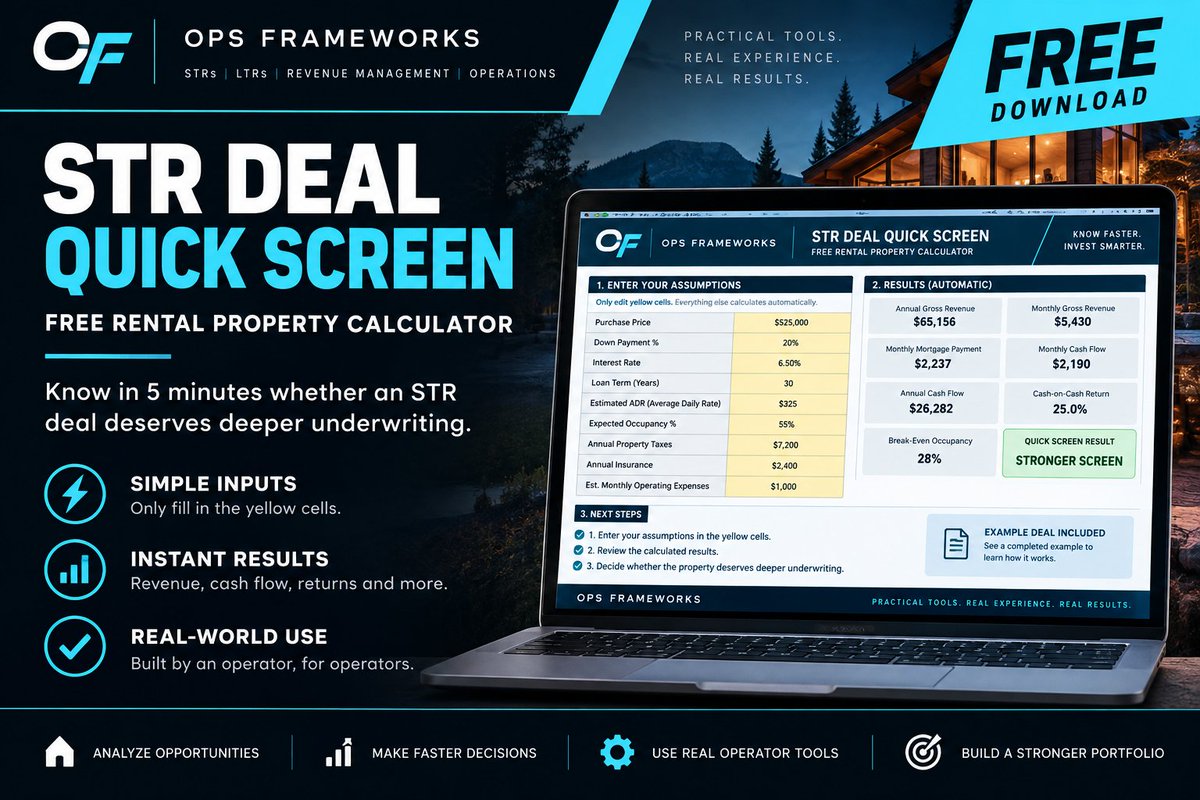
I built a free tool to answer one question:
“Is this STR deal even worth analyzing?”
Enter 9 assumptions. Get estimated revenue, cash flow, cash-on-cash return & break-even occupancy.
Free STR Deal Quick Screen ↓
https://t.co/kN0ZpsMavI
No complicated underwriting model. No 40 inputs.
Just fill in the yellow cells and let the calculator do the first-pass math.
A completed example deal is included so you can see exactly how it works before analyzing your own property.
Airbnb’s 15.5% fee isn’t the part I’d worry about most on Oct. 13.
The dangerous part is three systems trying to “fix” it at once.
If Airbnb, your PMS, and your pricing tool all compensate independently, you can quietly create a double adjustment or wreck your payout.
One source of truth.
One adjustment.
Then verify the guest total, discounts, promotions, and host payout.
Visible fees are manageable.
Hidden double adjustments are expensive.
One thing remote STR management has taught me:
“Done” is not the same as “guest-ready.”
A cleaner can finish the turnover.
A lock can report online.
The thermostat can be connected.
And the property can still fail the next guest.
What matters is verification:
Access works.
The temperature is right.
Supplies are stocked.
Damage is documented.
Anything abnormal has an owner.
Remote hosting gets easier when “ready” has a definition.
That’s the value proposition direct booking gets right.
The part I’d be careful with is lead source.
If the guest found you through an OTA first, the platform may still have rules around off-platform booking or commission exposure.
Owned demand is the real win: repeat guests, referrals, email, Google, and direct search.
Direct booking isn’t automatically direct revenue.
Vrbo’s Oct. 29 terms say a booking can still be attributable to Vrbo if the guest first contacts you there and books directly within 30 days.
That makes lead-source tracking a financial control.
At minimum track:
• source
• first-contact date
• booking date
• checkout channel
• commission exposure
Own the demand you generated.
Don’t accidentally relabel OTA-sourced demand.
https://t.co/B1kg7Zlrfk
I get why hosts are furious.
The 12% headline is obvious. What worries me more is the stack around it: commission, guest-facing fees, host-funded promotions, and less flexibility to price around all of it.
At that point it stops being just a fee increase and starts becoming a pricing-control problem.
I’d want to track actual guest price and net payout by channel, not just the listed nightly rate.
STR operators: your OTA settings are part of your P&L.
Vrbo’s Members Only Deals can apply host-funded discounts of 12–20%, and those discounts can stack with weekly or monthly promotions.
That means an unattended setting can blow straight through your minimum-rate floor.
I’d include this in a regular channel audit:
• Active promotions
• Length-of-stay discounts
• PMS vs OTA source of truth
• Guest-facing total
• Net payout after the worst-case discount stack
If a platform setting can change your effective rate, it deserves the same attention as pricing itself.
https://t.co/WT9kMCbrOI
@dilligaf101@MrPitbull07 That’s what makes this maddening. “Just raise your rate” isn’t much of an answer if Airbnb is already 25% above Vrbo.
I’d compare the all-in guest price and net payout by channel before moving anything. The channel has to earn the spread, not just tell the host to create it.
Direct booking isn’t just “cheaper than the OTA.”
Vrbo’s Oct. 29 terms require content and host ancillaries to be at least as favorable as what you offer elsewhere, including your own site.
Before you undercut an OTA, audit the terms. Own the demand, not just the discount.
https://t.co/QJHqq9rQQQ
Yeah, that’s the frustrating part.
Hosts get squeezed from both sides: absorb the fee and lose margin, or raise rates and risk losing the booking.
I’d want to compare net revenue by channel after the change, not just the commission rate:
• host fee
• guest-facing total
• conversion
• booking pace
• net payout
Sometimes passing the fee through works.
Sometimes it just makes another channel more competitive.
OTA fees should be part of the underwriting, not an afterthought.
Vrbo is moving hosts and property managers to a flat 12% commission starting October 29.
For some PMS-connected operators, that means going from 5% to 12%.
That’s a good reminder:
If a deal only works because one booking channel keeps its current fee structure, the margin is more fragile than it looks.
I want to know net revenue by channel after:
• OTA fees
• payment costs
• PMS/software
• cleaning
• management
• taxes
Gross booking revenue is useful.
What actually survives the distribution stack matters more.
https://t.co/KpAkGlsyOT
Exactly. Once one property serves nightly, midterm, and long-term demand, calendar control becomes the real system.
I’d want one source of truth for availability, clear turnover buffers, and rules for which channel can open which dates.
Mixed-stay revenue is great. Double-booked transitions are not.
Vrbo same-day booking is live, but I wouldn’t turn it on just because it can fill an empty night.
If Airbnb + Vrbo are connected by iCal, a Vrbo booking can take up to 3 hours to block the date on Airbnb.
That creates a real double-booking window.
Before enabling same-day:
• know whether your channels sync by iCal or API
• if you use iCal, choose one same-day channel
• if you want both, use a PMS/channel manager with direct connections
• have a double-booking playbook
Same-day demand is useful.
The ops system has to be ready for it.
https://t.co/ohFGPeQX8S
STR cybersecurity is becoming an operations problem, not just an IT problem.
One compromised login can touch:
• reservations
• guest information
• payouts
• smart-home access
• PMS connections
• channel accounts
At minimum, I want:
• unique passwords
• MFA everywhere available
• a password manager
• separate business logins
• periodic device/session reviews
Automation makes operating remotely easier.
It also makes protecting the control layer more important.
https://t.co/8eYC6DV5j1
@EdgeOfDeCliff2@Luciebunbun@One_BCHQ This is why I’d underwrite the fallback before buying.
If STR rules tighten, what does the property do as a mid-term or long-term rental?
The best deal isn’t just one that works under today’s rules. It’s one that still has a viable use if the rules change..
A lot of STR underwriting still treats regulation like a footnote.
It should be a line item.
This week alone, one city stopped issuing new whole-home STR licenses for single-family houses, while another is considering requiring booking platforms to verify licenses before accepting reservations.
Before I underwrite an STR now, I want to know:
• Is the use legal today?
• Is the permit transferable?
• Can new permits still be issued?
• Is there a cap or waitlist?
• What would the property earn as an LTR if the rules change?
Revenue projections matter.
So does knowing whether you will still be allowed to operate.
https://t.co/iPEHmfmJNO
Cleanliness isn’t just a housekeeping issue, it shows up in property performance.
A 2026 study of 42k+ Airbnb listings found cleanliness ratings strongly correlated with occupancy, revenue and overall review scores.
That’s why I wouldn’t manage cleaners with just a contact list.
Track:
• on-time completion
• rework
• issue severity
• response time
• guest-review mentions
You want to spot performance drift before the reviews do.
https://t.co/thJsFyH0p1
@host_planet_ This is an underrated ops problem.
Review impact is useful, but I’d pair it with on-time completion, rework, issue severity and response time.
The goal is to know a cleaner’s performance is drifting before the review score tells you.
@ikeCT_001@airdna Curious how this performs at 88+ properties.
At that scale the value isn’t just better rate suggestions, it’s whether the tool reduces manual pricing work without creating bad exceptions around events, minimum stays or low-demand dates.
@rajchudasama Same principle we’re seeing in STR ops.
AI is great at owning repeatable work as long as the operator still owns QC and exceptions.
For campaigns I’d keep source, spend, booked revenue and a kill switch visible.. then automate aggressively inside those guardrails.