Researchers find the first animal that does not have mitochondria and likely does not require oxygen.
A salmon parasite, related to jellyfish, that is about 10 cells in size & has no mitochondria!
Dayana Yahalomi, Stephen D. Atkinson, Moran Neuhof, E. Sally Chang, Hervé Philippe, Paulyn Cartwright, Jerri L. Bartholomew, Dorothée Huchon. A cnidarian parasite of salmon (Myxozoa: Henneguya) lacks a mitochondrial genome. Proceedings of the National Academy of Sciences, 2020;
The solution: use a PAR sensor in a feedback loop to always maintain the wanted PAR light level.
This capability is available in the OS1p and OS5p+ chlorophyll fluorometers.
The need for “stable” actinic light sources.
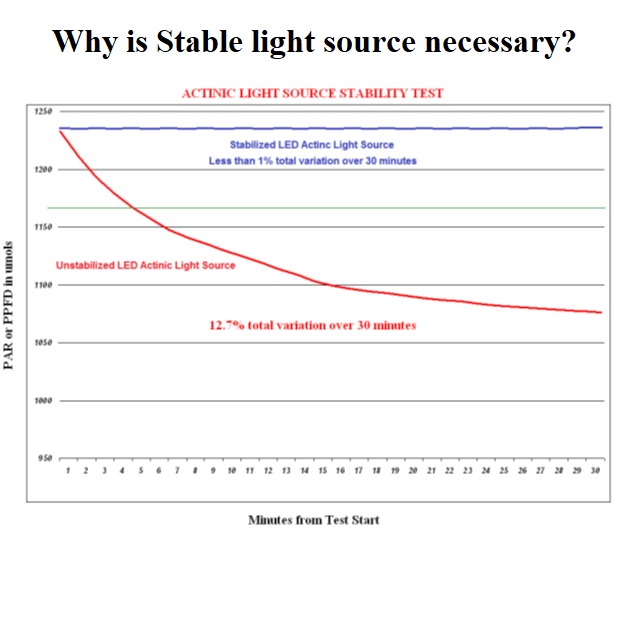
When using an artificial actinic light source to pre-illuminated leaf samples for either Y(II) & ETR measurements or for quenching measurements a stable light source is a requirement for reliable results.
Why? Because when a light source turns on, the heat of the light source decreases the output over time, according to the laws of physics.
The graph below shows how light output drops over time as a lamp heats up.
https://t.co/3djGdqyecd
Taewoo Kim, Jinyang Liang, Liren Zhu, Lihong V. Wang (2020) Picosecond-resolution phase-sensitive imaging of transparent objects in a single shot. Science Advances 17 Jan 2020: Vol. 6, no. 3, eaay6200
DOI: 10.1126/sciadv.aay6200
https://t.co/hc6W5Y2pnQ
Caltech develops a camera method for capturing 1 trillion frames per second with phase contrast microscopy.
It is so fast that it can capture light traveling in living cells. It is capable of high resolution imaging beyond diffraction limits and 3D imaging.
.
University of Cambridge. "Local water availability is permanently reduced after planting forests." ScienceDaily. ScienceDaily, 20 January 2020. <https://t.co/x3LdnR9iN9>.
River flow was reduced by about 25% five years after forest planting and about 40% after twenty-five years.
In a few cases flow dried up completely after forest planting.
A new study covered 43 sites around the world. The largest drops in flow were in Australia and South Africa
Journal reference:
F.M. Padilla, R. de Souza, M. T. Peña-Fleitas, M. Gallardo, C. Giménez & R. B. Thompson (2018) Different Responses of Various Chlorophyll Meters to Increasing Nitrogen Supply in Sweet Pepper. Front. Plant Sci., 27 November 2018 | https://t.co/jUaAWuTiQx
CCI found to be the best measurement for nitrogen and chlorophyll content measurement in Sweet pepper.
CCI is available on the Opti-Sciences CCM-200plus, and the Apogee Instruments MC-100.
NSF program analysts are waiting for 2018–19 data from the Paris-based Organisation for Economic Co-operation and Development before declaring a new global spending king."
https://t.co/bHxURQ6UuY
Report says that they think China’s spending on research passed the US sometime in 2019.
“We think that China may have overtaken the U.S. at some point in 2019,” "acknowledges Julia Phillips of the National Science Board, NSF’s presidentially appointed oversight body,
which officially issues Indicators. The board predicted in 2014 that the changing of the guard might occur in 2018, she notes, but surprisingly strong spending by U.S. industry allowed the country to stay in front a bit longer.
Scientists from Finland produce a protein food product feeding soil bacteria CO2 from the air, minerals and hydrogen from water split by electricity using solar power.
“It could mimic palm oil by reinforcing pies, ice cream, biscuits, pasta, noodles, sauces or bread. The inventors say it can be used as a medium for growing cultured meat or fish.”
“It could also nourish cattle to save them eating soya raised on rainforest land.”