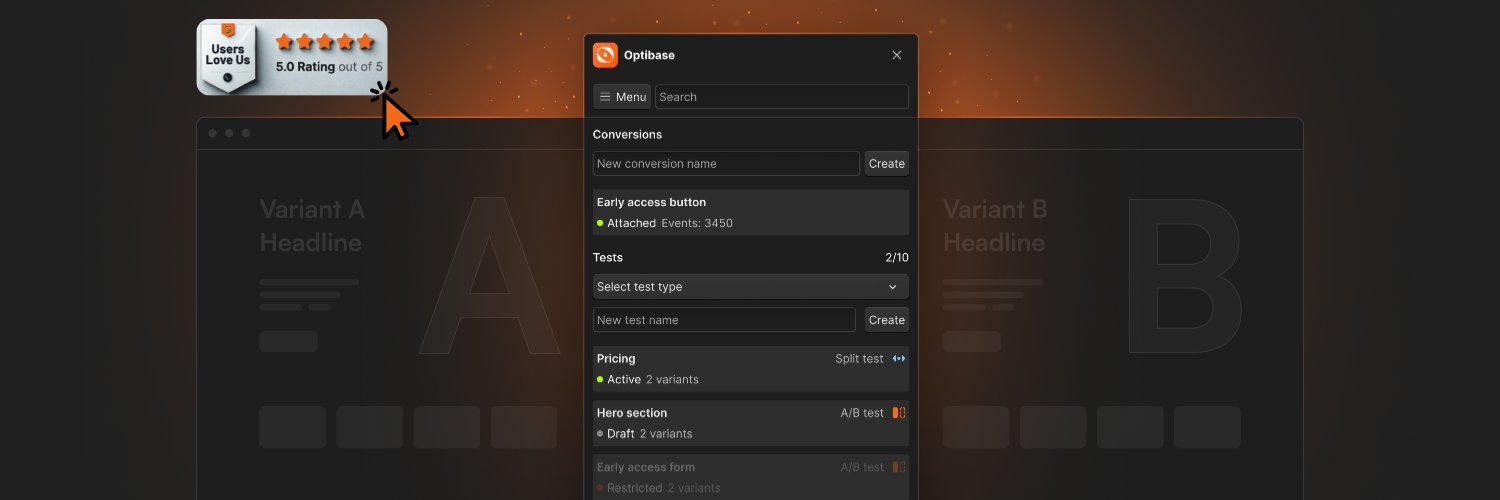
Most A/B tests don't increase revenue.
They just create noise.
After working with 3000+ teams, we turned everything into a practical A/B testing blueprint on what actually moves revenue.
Free access. No e-mail gate.
Live on @ProductHunt:
https://t.co/BKMUk3nPkA
Most websites launch once.
The best websites never stop changing.
Every page is a hypothesis.
Every click is feedback.
Every test is a chance to learn something new.
That's how optimization makes a difference.
Yeah history is mostly on the side of this argument.
Spreadsheets didn't eliminate accountants but they eliminated a lot if manual arithmetic.
The internet didn't eliminate accountants either, it changed how information moved and created new expectations around speed and accesibility.
@urko_garmendia@rork@daniel_dhawan Yeah spot on... Unfortunately the actual success itself isn't "unusual" anymore... Every day there's another "1M$ ARR in 3 months" post.
What makes it a lot better is someone showing the six years that came before it.
@PlotnikovDev Users never see your architecture diagram, code quality, or elegant abstractions... What they see is "Can I find this app" and "Do I understand what it does..."
What's interesting is that the value isn't really the individual agents.
We've had coding agents, design agents, and research agents for a while.
The interesting part is the orchestration layer.
When a system can decompose a goal, delegate work, maintain shared context, review outputs, and retry failures without constant human intervention, it starts looking like a generic chatbot and an actual operating system.
I really like the visual identity and retro-inspired design language, but I'm curious what others think.
What's the first thing that stands out to you?
And if you landed here for the first time, would you immediately understand what Mistral actually offers?