Most options courses leave you alone with a terminal and a prayer. We don't. Step-by-step through a real trading day. Mentor at every move. Discipline over hype
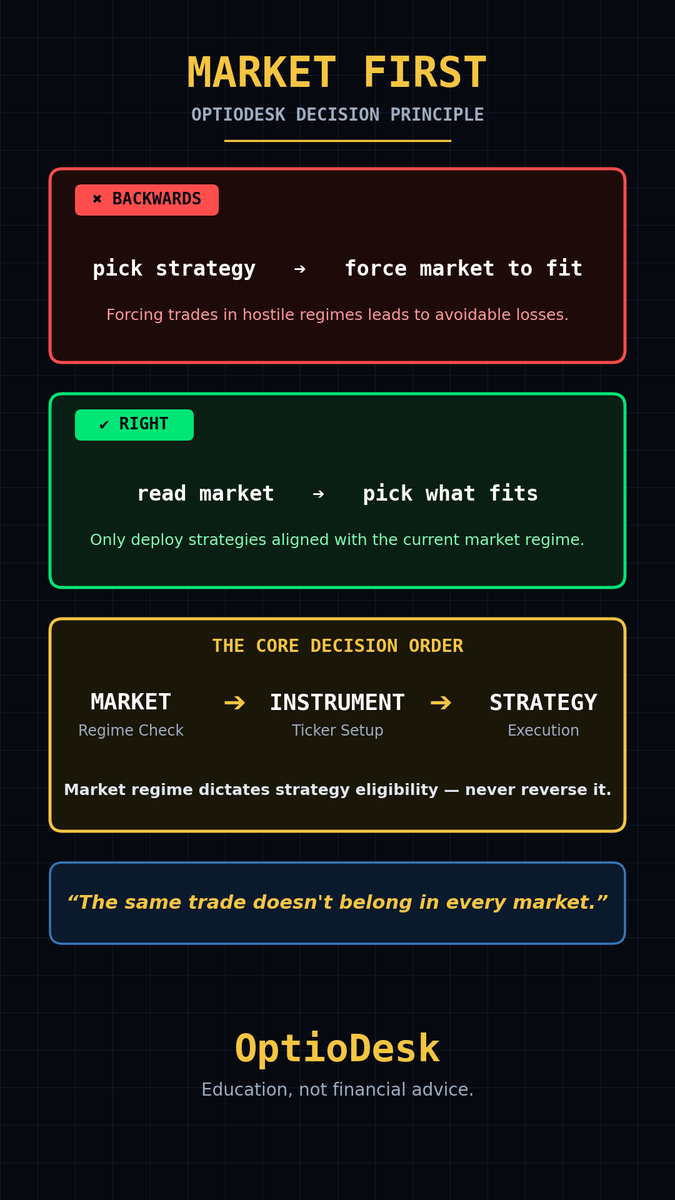
The market decides which strategies work — not you.
Most beginners pick a strategy they like, then force the market to fit it.
OptioDesk flips it: read the market first, then choose only what fits.
Market → Instrument → Strategy. Every time.
A calm market and a crashing one don't want the same trade.
Not financial advice.
Most people pick the strategy first. Backwards.
OptioDesk starts with the market — it decides what's even allowed.
The Market Barometer reads the regime from three checks:
- SPY vs its 200-day average
- Market breadth
- Fear / greed
Market → Instrument → Strategy.
Not financial advice.
You found the trade. Now the question that blows up accounts: how big?
OptioDesk's Trade Budget sizes it under one rule:
- No more than 5% of your account at risk per trade
- Correct math for each strategy — spread, CSP, condor all differ
Oversizing turns a losing streak into a disaster.
Not financial advice.
Delta, explained:
A number from 0 to 1 — roughly the chance an option finishes in the money.
Short strike at delta 0.15–0.20 ≈ 85% chance it expires worthless. That's what a premium seller wants.
Lower = safer, less premium. Higher = more premium, more risk.
Not financial advice.
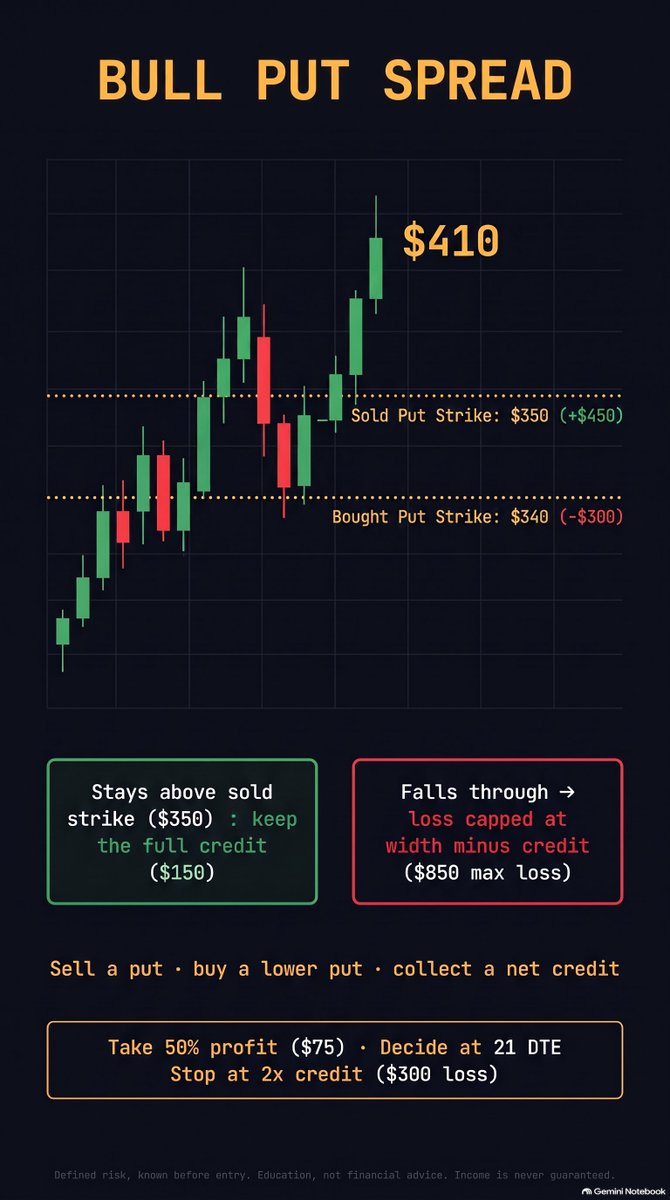
Bull put spread, explained:
Sell a put below the price → buy a lower put → collect a net credit.
- Stays above your sold strike: keep the full credit
- Falls through: loss capped at width − credit, known upfront
Rules before entry: 50% take · 21 DTE · 2× stop.
Not financial advice.
IV Rank, explained:
Where today's implied volatility sits vs its own past year (0–100 scale).
- Below 30 → options cheap → buy premium
- Above 50 → options expensive → sell premium
It's how you know if selling premium is even worth it.
Not financial advice.
Cash-secured put, explained simply:
Hold cash for 100 shares → sell 1 put below the price → collect a premium today.
- Stock stays above the strike: keep the premium, repeat
- Drops to the strike: buy 100 shares below today's price, keep the premium
The catch: only sell puts on stocks you'd actually want to own.
Not financial advice.
Covered call, explained simply:
You own 100 shares → sell 1 call above the price → collect a premium today.
- Stock stays below the strike: keep your shares + the premium
- Rises above: shares sold at a price you pre-agreed to
Paid either way. The cost? Your upside is capped past the strike.
Not free money — a trade-off. And not financial advice.
The Iron Condor: paid when the stock goes nowhere.
Sell a put spread below, a call spread above → collect credit.
Short strikes at delta 15–20 ≈ 85% per side.
Exits set BEFORE entry: 50% TP · 21 DTE · 2× stop.
Wings cap max loss.
Not advice. 70% win rate = 3 in 10 lose.
Solid framework. One nuance worth debating on the credit-to-width threshold: 25–33% implicitly assumes you might ride to expiration. But if your плейбук closes at 50% profit and manages at 21 DTE, the stop does part of the work the credit buffer was doing — which argues for a slightly lower floor. Except for one thing: gaps don’t respect stops. A gap through your short strike pays width-minus-credit no matter what your exit rule says. So we ended up with a two-tier rule: 20% hard floor (below = no trade), 25%+ preferred. Curious where others draw the line — and whether you size down or skip entirely in the 20–25% zone?
Great deep-dive. The most underrated paragraph is the one about order limits: a BWB layered with adjustments can’t be closed with a single GTC order — you’re manually unwinding structures piece by piece in a fast market. “Can I exit this whole position with one order?” is a question worth asking before entry, not after. The vega framing (BWB for IV contraction, diagonal for expansion) is the cleanest summary of this pair I’ve seen.
We broke down six popular options services. Price range: $85–399/month.
Inside: order flow and alerts, an expert’s trade ideas, market mechanics data, signals with a community, two signal rooms.
What all six share: the product is a ready-made signal. Which ticker, which strike, when to enter. What to do with the open position afterwards isn’t covered by any of them. One states it directly: “the exit is up to you.”
Yet the exit is where the result is decided. Entry takes a second. Then come days or weeks: strike tests, expiration approaching, take / stop / roll decisions. That stretch is where money is lost — and that’s exactly where the trader, with all six subscriptions, is left alone.
Our mission is the opposite: make traders independent. Remove the fear of unclear situations. Remove the grind.
First step is close. Release coming soon — early subscribers get our interactive analytical guide to options strategies, free: every strategy with entry conditions, management thresholds, scenarios and traps. Not a list of names — a working tool you can trade by. Stay tuned.