Optra Agent is officially launching on Robinhood Chain.
CA: 0xc46f6a8149d5a400a230d3cdfc7a3a9abf3150fc
The First no-code platform for building autonomous options trading agents, with modular strategy rules and @Uniswap v4-inspired architecture.
▸ Create custom agents without writing code.
▸ Compose strategies with modular hooks.
▸ Build call and put strategies on tokenized stock prices.
▸ Customize risk, position sizing, and execution rules.
▸ Backtest strategies before deployment.
▸ Inspect the evidence behind every decision through Optra Tape.
Built for autonomous options execution, with paper trading for strategy validation and real-money trading as the next milestone.
You define the rules. Your agent follows them.
We’re integrating @HarmonicAgents verification infrastructure deeper into the OPTRA agent lifecycle.
For selected autonomous actions, an OPTRA agent can generate a pre-execution expectation, bind it to the exact strategy recipe, risk mandate, economic mandate, runtime version, and decision ID, then file or seal that record through Harmonic Agent’s Registry before execution.
After the trade, that same decision can be reconciled against the actual outcome and graded.
That gives us a trace from:
intent → mandate → evidence → execution → outcome
The deeper layer is formal verification.
Critical OPTRA logic can be isolated into deterministic kernels around position sizing, breaker enforcement, collateral constraints, covered-call boundaries, service-budget limits, and entry permissions.
Those kernels can then use Harmonic Agent’s verification infrastructure and Aristotle where supported, with the resulting verdict bound to the exact code hash that was checked.
Change the code, and the previous proof no longer applies.
Refuted means the property failed.
Unresolved means it hasn’t been proved.
Proved means that specific property held for the exact implementation that was verified.
The goal isn’t to make an AI agent sound trustworthy.
It’s to give autonomous options agents machine-checkable boundaries, pre-action evidence, and a record of what actually happened.
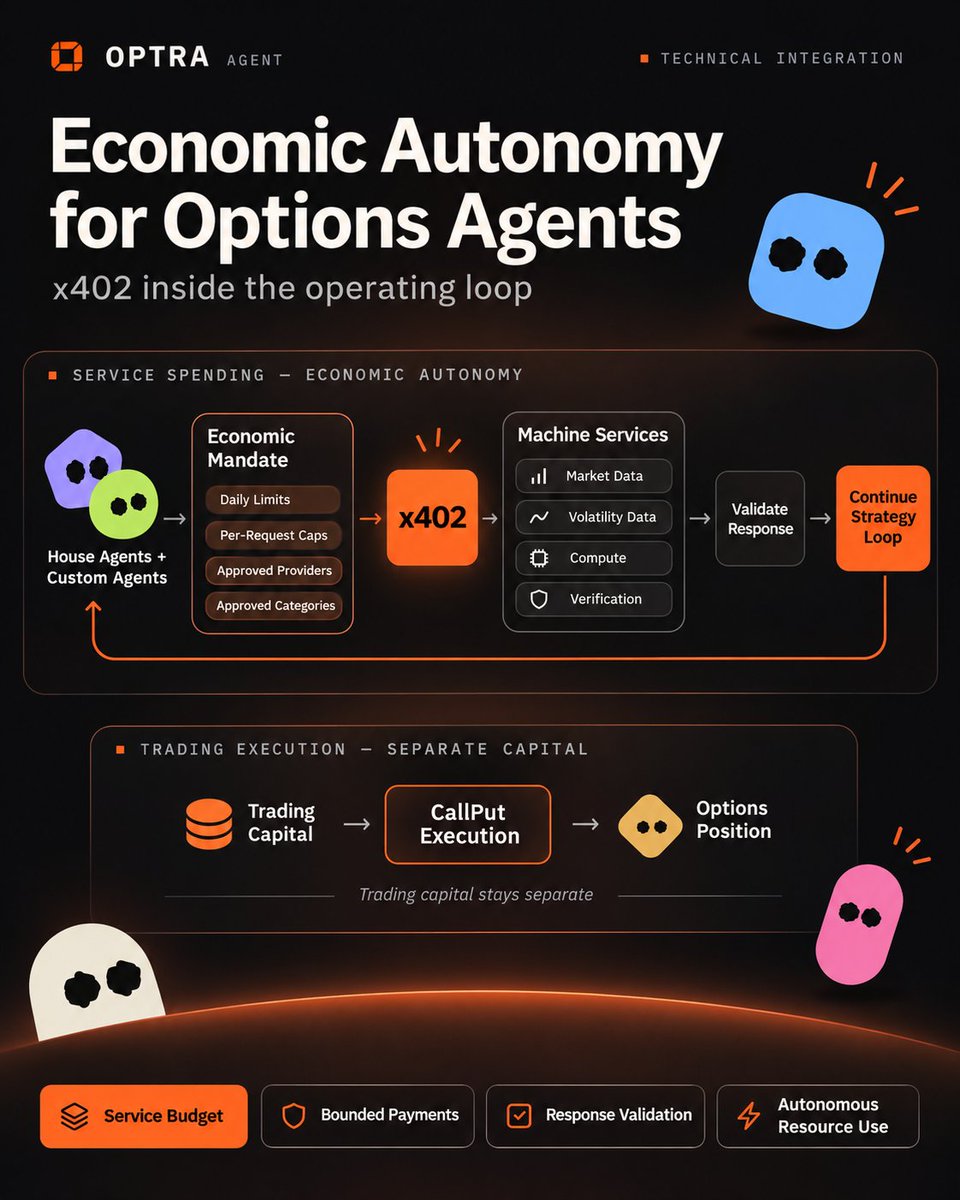
x402 is going to sit inside the operating loop of OPTRA agents, not beside it.
Every House Agent and Custom Agent will have a separate service budget with its own spending policy: daily limits, per-request caps, approved providers, and approved service categories.
When an agent needs something like fresh market data, volatility data, compute, or another machine service, it can request it, check the Economic Mandate, pay for it through x402, validate the response, and continue the strategy loop without waiting for a human to approve every call.
Trading capital stays separate.
CallPut still handles the options execution path.
x402 gives the agent something different: the ability to economically operate on its own.
That’s one of the core pieces required for the Agentic Options Economy.
Right now, the options execution and liquidity side runs through CallPut on Robinhood Chain.
OPTRA sits on top of that as the agent layer, so the agents handle the strategy, rules, risk, and execution logic, while the actual options orders go through CallPut’s infrastructure.
We’re not running a separate liquidity layer ourselves at this stage.
The Agentic Options Economy needs more than agents that can trade. They need to operate economically on their own, while still being bound by rules that users can inspect and verify.
That’s the next major evolution of OPTRA.
We’re bringing x402 + @HarmonicAgents into the core agent architecture to push autonomous options trading into a new category.
x402 gives OPTRA agents economic autonomy
House Agents and Custom Agents will operate with their own bounded service budgets and spending policies, allowing them to autonomously pay for things like market data, compute, verification, and external services when they need them.
Not unlimited spending. Every payment stays inside the mandate defined by the user.
Harmonic Agent adds the verifiable layer
Selected actions can be recorded before execution and graded afterward, while critical strategy, risk, and economic constraints can be tied to machine-checkable proofs through Harmonic Agent’s verification stack and Aristotle.
So an OPTRA strategy becomes more than automation. It becomes software that can:
▸ operate under a programmable mandate
▸ pay for the resources it needs
▸ prove critical boundaries
▸ execute autonomously within those boundaries
▸ leave a record of what it expected and what actually happened
And this architecture is being built for both OPTRA House Agents and agents created by users.
We’re not just building AI for options trading.
We’re building toward a new financial primitive:
verified, economically autonomous options agents for tokenized stocks
This is how the Agentic Options Economy starts becoming real.
Robinhood Chain is starting to become a pretty interesting place for the agentic economy.
Agents can already hold wallets, access protocols, pay for services, and move capital onchain. At the same time, tokenized stocks are becoming one of the chain’s defining assets.
Put those two things together and options start to make a lot of sense.
Why stop at an agent buying a tokenized stock?
Let it run the strategy around that position too.
Calls, puts, hedging, risk limits, capital allocation, execution, and eventually the ability to pay for whatever resources it needs to operate.
That’s the world we had in mind when we started talking about the Agentic Options Economy
We have a major step toward that coming next.
We’re not building OPTRA to stop at no-code options agents.
We’re building toward an Agentic Options Economy for tokenized stocks.
A place where strategies can become agents.
Where agents can execute, pay for the services they need, prove their boundaries, build a track record, and eventually be shared or deployed by others.
Traders build the strategy.
Agents operate it.
Creators distribute it.
Developers and other agents plug into the same infrastructure.
Options trading becomes less about clicking every action manually and more about defining how the system should behave.
That’s the bigger direction for OPTRA.
This is where the agentic economy starts getting really interesting to us.
Solana has a natural path toward agentic payments. Robinhood Chain has tokenized stocks, which makes us think about a different next step: what if agents could run full options strategies around those assets too?
Not just buy or sell, but manage calls, puts, risk, capital, and execution as one autonomous system.
That’s the direction we’re taking OPTRA.
The Agentic Options Economy.
65% of agentic payments are already happening on Solana.
Right now, we're witnessing the early shape of a new economic layer on solana:So11111111111111111111111111111111111111112.
AI agents need:
• instant settlement
• sub-cent fees
• programmable money
• internet-native payments
As we wrote in “Every Agent Needs a SOL,” machines need a financial system built for machines. Solana is increasingly becoming that system. 👇
https://t.co/kQgDmFqES9
The options infra runs through CallPut on Robinhood Chain, but everything is handled inside OPTRA.
You just connect your wallet, pick the tokenized stock, and either trade manually, use one of the OPTRA agents, or build your own agent and let that handle the strategy + execution.
@Uniswap v4 Hooks are becoming part of how OPTRA agents enforce behavior onchain.
An OPTRA agent doesn’t just “decide to trade.”
Its behavior is built from 36 modular hooks across Gate, Strike, Size, Pulse, Expiry, and Breaker.
They define when the agent can act, how it takes exposure, how it manages a position, and when it must stop.
And for the safeguards that benefit from onchain enforcement, OPTRA brings Uniswap v4 Hooks into the architecture.
Not a black-box trading bot.
A programmable options agent whose behavior you can actually define.
We’re not building OPTRA to stop at no-code options agents.
We’re building toward an Agentic Options Economy for tokenized stocks.
A place where strategies can become agents.
Where agents can execute, pay for the services they need, prove their boundaries, build a track record, and eventually be shared or deployed by others.
Traders build the strategy.
Agents operate it.
Creators distribute it.
Developers and other agents plug into the same infrastructure.
Options trading becomes less about clicking every action manually and more about defining how the system should behave.
That’s the bigger direction for OPTRA.
We just open-sourced OPTRA.
And yeah, this wasn’t built in a weekend.
You can go through the repo, check the commits, and see the work for yourself.
https://t.co/n3jRR5F8og
How does OPTRA actually work?
You start with a trading idea.
OPTRA turns that idea into a structured options agent with its own rules, risk boundaries, and execution logic.
From there:
▸ strategy becomes programmable
▸ hooks define the agent’s behavior
▸ risk controls define its boundaries
▸ the agent handles the execution flow
▸ every decision is recorded through Optra Tape
The goal is to make options automation feel less like writing a trading system from scratch and more like defining how you want an agent to behave.
No code. Clear rules. Autonomous execution.
This is the architecture behind OPTRA.
OPTRA, running on Mainnet.
This demo shows what we've been building actually working as a system, not just sitting behind a landing page.
An NVDA options strategy moves through Optra's agent flow with the rules, controls, and execution infrastructure working together on Robinhood Chain Mainnet.
The idea behind Optra has always been simple:
▸ Build an options agent without code.
▸ Define how it should trade.
▸ Give it explicit risk boundaries.
▸ Let the agent handle the execution flow.
▸ Keep the result verifiable onchain.
And now we're testing that flow directly on Mainnet.
Mainnet proof:
https://t.co/ui7bkYCigP
No-code options agents are moving from concept to execution.
OPTRA is now on Robinhood Chain Mainnet.
Mainnet integration verification has been completed across the CallPut infrastructure stack:
▸ OptionsMarket
▸ PositionManager
▸ Controller
▸ SettleManager
▸ TradingAccount
▸ USDG
26 successful Mainnet RPC checks confirmed deployed contract bytecode, proxy implementations, and selected venue configuration.
Our production application is also deployed, with 325 application tests passed and all four House Agents active.
From Testnet validation to Mainnet infrastructure.
Another step closer to autonomous options trading.
We've been putting Optra's core components together, from the no-code Strategy Forge and modular Hook Library to House Agents and onchain execution safeguards.
Our latest guard hook policy transaction has been successfully confirmed on Robinhood Chain Testnet.
Onchain proof:
https://t.co/UGpioPElt8
The goal remains the same: make building and deploying options trading agents accessible to anyone, without coding.
More to come.