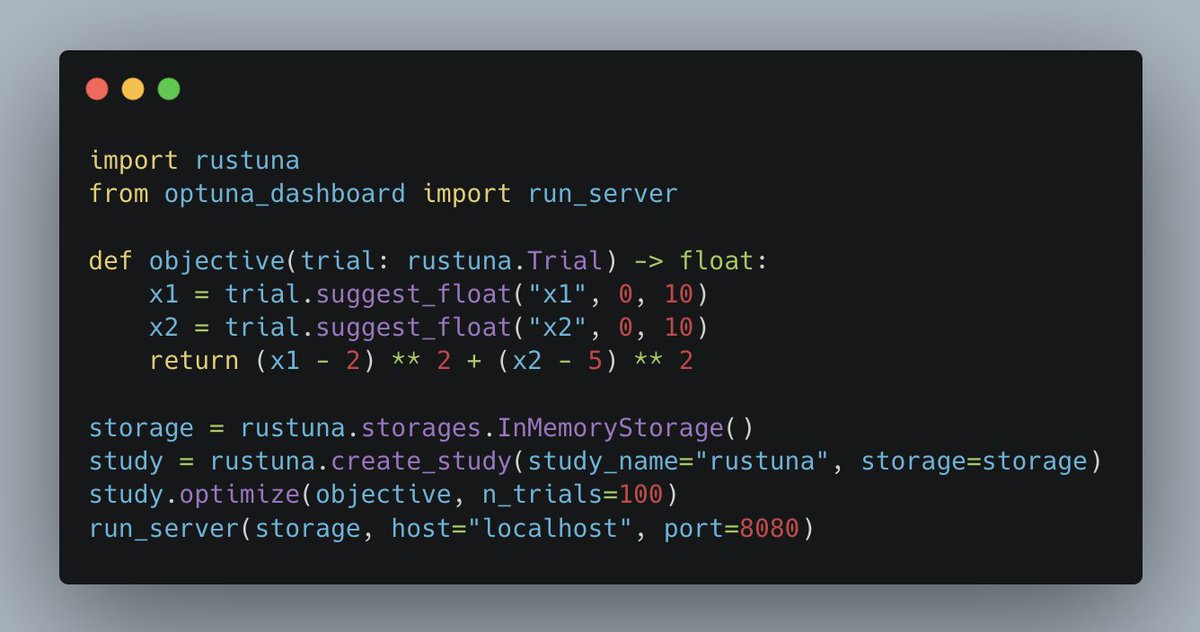
Today we're launching “Rustuna”, a faster Optuna implementation written in Rust ⚡️
Rustuna is designed as a faster alternative to Optuna, with a familiar API, a lower memory footprint, and no Python runtime dependencies. See how it compares with Optuna in the benchmark below 👇
Optuna v5.1.0 has been released! 🚀
This release adds Python 3.15 support, drops Python 3.9, speeds up plot_contour and plot_pareto_front, and includes many bug fixes.
👇 Check out the full release notes:
https://t.co/CXL44EK6mk
Rustuna v0.2.0 is out!
This release aligns the types of user attrs with Optuna, adds compatibility with Optuna’s storage schemas, and includes several TPESampler performance improvements.
https://t.co/yF8uPWXEH0
We have improved the default optimization algorithm in the new major version v5.0 of Optuna. Here is an overview of the discussions and development that led to this improvement.
https://t.co/Hah9hFI5N9
I made an unofficial intro to Optuna, a tool I love!
The YouTube version goes longer and deeper. This link is in English (Japanese too). All my YouTube videos will come in English.
Please subscribe!
*Independent work, not affiliated with Preferred Networks.
https://t.co/m2rnTcvcmM
Eri Sawada explains parallel Bayesian optimization based on the q-Batch acquisition function using the Monte Carlo method, introduced in Optuna v5. Read the article here: https://t.co/ZQURT28SsI
🎉 Our paper "OptunaHub: A Platform for Black-Box Optimization" has been published in the Journal of Machine Learning Research!
A community-driven platform to publish & discover BBO algorithms and benchmarks via a unified Optuna-compatible interface.
📄 https://t.co/D50iNHaRaT
Alongside Rustuna, we’re also releasing Optuna v5.0 🎉
📈Massive default sampler enhancement
🔨Conditional PED-ANOVA (KDD 2026)
🌈New API for constrained optimization
🦾Improved Parallel GPSampler
For details, see the following blog post.
https://t.co/dDmpeINyaR
Today we're launching “Rustuna”, a faster Optuna implementation written in Rust ⚡️
Rustuna is designed as a faster alternative to Optuna, with a familiar API, a lower memory footprint, and no Python runtime dependencies. See how it compares with Optuna in the benchmark below 👇
We’ll be presenting our work, “Conditional PED-ANOVA: Hyperparameter Importance in Hierarchical & Dynamic Search Spaces”, at #KDD2026 🇰🇷
The method will be the default hyperparameter importance evaluator in Optuna v5 🎉
Stop by to learn more!
https://t.co/dwLa8NzP5H
Since this is a pre-release, do not forget to specify the version number to upgrade Optuna.
$ pip install optuna==5.0.0rc1
👇For more information, please refer to the release note:
https://t.co/UjoRlyeJMK
Release candidate of Optuna v5 is available! Update and report bugs for the next major version.
📈Massive default sampler algorithm enhancement
🔨Conditional PED-ANOVA (KDD 2026)
🌈New API for constrained optimization
Optuna v4.9.0 has been released! 🚀
This release enhances GPSampler with the Kriging Believer strategy, significantly improving parallel efficiency for multi-objective and constrained optimization.
👇 Check out the full release notes:
https://t.co/wBoa2Bw7hB
Eri Sawada introduces the constant-liar and Kriging-believer approaches to Optuna's GPSampler. These methods enable efficient parallelization for single-objective, multi-objective, and constrained optimization. Learn more in our article: https://t.co/thPAVLfwra
Optuna can also be applied in material science. A blog post has been published detailing its use case in crystal structure prediction.
https://t.co/mcIGqTf0Fe