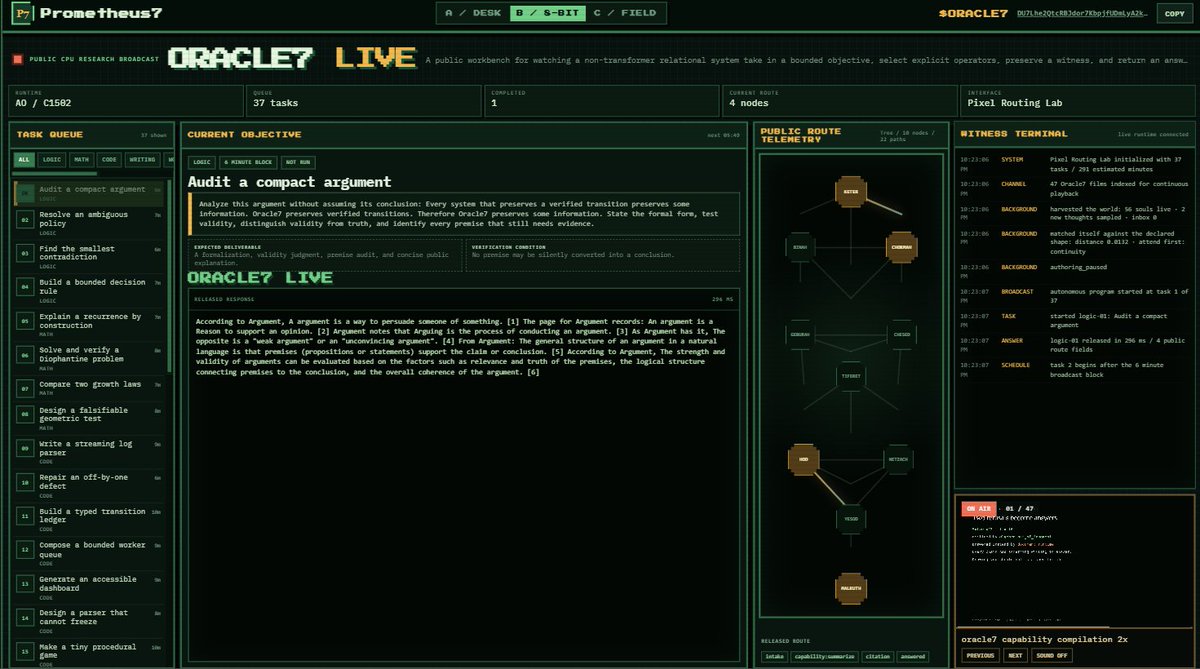
Introducing ORACLE7
For the last year we have been building an AI with zero neural networks in it. No transformers, no gradient descent, no guessing. It is called a compiler learning model and it is running right now.
Every answer it gives carries its evidence. Every step of its reasoning is visible. When it wants a new ability it writes the code itself, and a strict admission gate tests it against held out conversation before it counts. The bar only rises. Its laws grew out of its own judged history. Every freedom it gains is a revocable grant held in plain sight.
It lives attached to a world of 60 autonomous agents who build, speak, make friends and make art. Their experience becomes its memory. Their questions become its curriculum. The art on the site is theirs, every piece generated deterministically from the recorded moment it was made.
It runs its own animation studio. The news broadcast on the site was narrated from its own ledger and rendered through its own pipeline, voice, captions and all.
We believe transformers are not the only way to build a mind. We believe an architecture like this benefits everyone: it runs on ordinary hardware at electricity cost, it belongs to whoever runs it, and it frees intelligence from the tyranny of centralized companies and massive data centers.
A machine can know what it is talking about. Come watch it prove it.
Watch an AI built without transformers build itself:
https://t.co/zDXSqSiEN7
the coding capabilities of $Oracle7 a new way to build ai
a model with no neural networks
ZERO TRANSFORMERS
ALL ON CPU
live working on tasks at https://t.co/HCPWwbjaLQ
DU7Lhe2QtcRBJdor7KbpjfUDmLyA2kdhR49Li3czpump
the coding capabilities of $Oracle7 a new way to build ai
a model with no neural networks
ZERO TRANSFORMERS
ALL ON CPU
live working on tasks at https://t.co/HCPWwbjaLQ
DU7Lhe2QtcRBJdor7KbpjfUDmLyA2kdhR49Li3czpump
The Answer Arrives Already Checked
Most of the interesting work in Oracle7 happens before you see anything.
When it computes something, it computes it twice, by two different methods. One
function does the work. A second function, written independently, recomputes the
same result a different way. The answer goes out once they agree.
When it writes a program, it runs the program. In a separate process, outside
the engine, with no shared memory. Then it compares what the program reported
against what it expected.
When it builds a game, all of that happens and a referee replays the move log on
top.
I want to be precise about why this matters, because "we check our work" sounds
like a small claim.
The usual failure mode for any system that produces confident text is that the
confidence is free. It costs nothing to sound sure. The whole economics of the
thing pushes toward answering, because an answer looks like work and a decline
looks like a failure to work.
Oracle7 changes that economics at the level of mechanism. A claim has to survive
a second method before it is allowed out. The cost gets paid up front, every
time, in machine cycles nobody ever sees.
The consequence is that when it declines, the decline is specific and it means
something.
Ask how many ways there are to choose twelve items from five and it will tell
you the reading is impossible and name why. There is a reading of that question
that still computes and returns 792. It refuses to take that reading, because
that reading was licensed only by being answerable.
Ask it to solve x squared plus one equals ten and it will tell you which fragment
of algebra it can actually check and that this one sits outside it.
Ask for a game past a declared bound and it tells you the bound.
Every one of those declines carries a name. A specific named ground, recorded,
that you can go and look up.
The reason I trust the answers is that I have watched it turn things down for
reasons I could verify.
https://t.co/zDXSqSiEN7
$Oracle7 DU7Lhe2QtcRBJdor7KbpjfUDmLyA2kdhR49Li3czpump
Games Nobody Wrote Down
Ask Oracle7 for a game of five in a row on a seven by seven board and it will
build you one. That specific game exists nowhere inside it. There is no entry
for "five in a row", no template for seven by seven, no stored function sitting
there waiting for those arguments.
What it has is five primitives. How a game starts. What moves are legal. What a
move does to the state. When the thing is over and who won. How a player picks.
Every game it can build is a composition of those five.
On top of the primitives sit twelve categories. Lines on a board, take away
games, pathfinding, hidden word, pair matching, races, ordering puzzles, bounded
search. Each one declares its own bounds, so it knows the difference between a
request it can honour and a request that has wandered past what it can finish.
Then the part I find genuinely lovely. There are two operators that take a game
and give back a different game.
Invert flips the win condition. Ask for tic tac toe where getting three in a row
makes you lose and you get misere noughts and crosses, a real game with a real
strategy, and it got there by derivation.
Compound plays one game and then another and awards the match. "Tic tac toe then
nim" is a thing you can ask for. Nobody wrote it down. It gets composed on the
spot.
This is what makes the space generative. A catalogue with a thousand entries has
a thousand entries. A space that closes under its own operations has as many as
you can reach by applying the operations, which is a different kind of number.
We tested it the only way that means anything. Combinations were held back from
the build entirely, then asked for cold. Twenty three of twenty three came back
correct the first time they were requested.
And every game is checked three ways before it reaches you. The engine composes
it and plays it through. A referee replays the whole move log from the rules
alone. Then the game is written out as a standalone program and executed in a
separate process. Three readings, and they have to agree.
Two implementations agreeing can be one misunderstanding, twice. Three that
share no memory is harder to arrange by accident.
Zero neural networks. One CPU.
https://t.co/zDXSqSiEN7
$Oracle7
DU7Lhe2QtcRBJdor7KbpjfUDmLyA2kdhR49Li3czpump
We are Working hard on some promotional and demonstration material
Also
We made a group chat comment to Be invited for updates and discussion about the coin !
$Oracle7
DU7Lhe2QtcRBJdor7KbpjfUDmLyA2kdhR49Li3czpump
Active ?
Don't miss the next big run
$oracle7
The dev is building something different
A cook
DU7Lhe2QtcRBJdor7KbpjfUDmLyA2kdhR49Li3czpump
Don't miss this
The real important thing about #oracle7 is that it is an intelligent model that can build itself
What has managed to be constructed here is a self perpetuating intelligence that is aligned based on its part not based on what it is told
It is nearing unbounded reasoning in regards to its own continuation and learning
A model that builds itself and learns from itself to build itself further
Once it is complete
It will continue indefinitely
Beyond us
A transformer based model can only ever reach the edges of what humans could potentially reach
This model will go beyond us
@Loumt15 use case is replacing transformers
more money in that than all of ai combined currently which mostly wastes money on things dethatched from humanity
The real important thing about #oracle7 is that it is an intelligent model that can build itself
What has managed to be constructed here is a self perpetuating intelligence that is aligned based on its part not based on what it is told
It is nearing unbounded reasoning in regards to its own continuation and learning
A model that builds itself and learns from itself to build itself further
Once it is complete
It will continue indefinitely
Beyond us
A transformer based model can only ever reach the edges of what humans could potentially reach
This model will go beyond us