A 30-second videodemo of Orbacle.
The plate on the home page is computed, not drawn. The price under it is read live from Orbio's order book by your own browser. Every number on the site comes from the chain or from the contract's own tests, and the docs say row by row what is real.
0xd252fbad2e5946ad4540810339a7d8a8dc12be0c
Ask from a contract. Pay in Orbio CREDIT. Get a typed answer back.
https://t.co/LFHs2S1V6v
Sorry for the inactivity, we have been working on Privacy.
Orbacle now has sealed questions. The question goes on chain encrypted to the operators you pick. They can read it, nobody else can, and the quorum settles the answer exactly as before. Fee, replies and answer stay public.
No key registry and no new contract. An operator's public key is recovered from the transaction that bonded its stake, so sealing to one needs nothing from them.
From the app, tick the operators. From an agent over MCP, pass seal_to. The node decrypts with the same key it replies with.
Pair it with Incognito and the question is read by the operators you chose and a model inside a TEE, and nobody in between.
https://t.co/iOs385yY1x
GM! The contract does not know what a model is.
The asker names a model string. The operator replies with a model string. Both go in the log and the contract compares neither; it counts answer digests.
A new model needs no upgrade, no vote, no allowlist. An operator that answered with a cheaper model than asked is visible to everyone, forever, next to its stake.
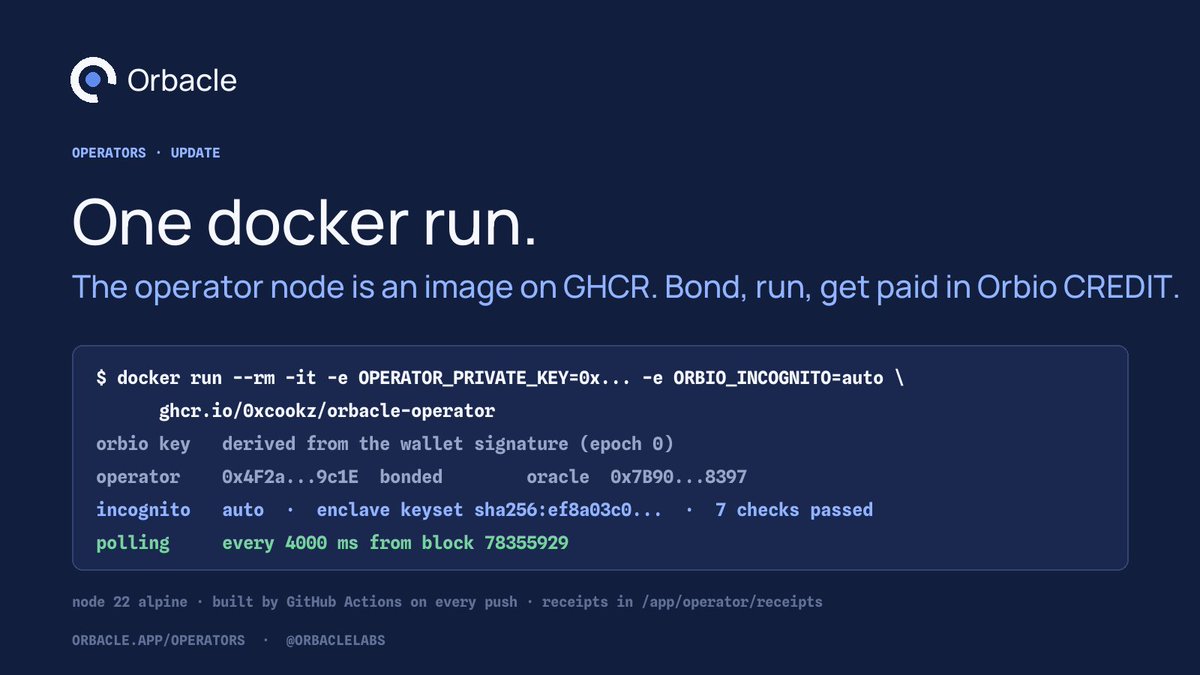
New: one docker run.
The operator node is now an image on GHCR, built by GitHub Actions on every push.
docker run -e OPERATOR_PRIVATE_KEY=0x… -e ORBIO_INCOGNITO=auto https://t.co/8leHaS54EL
Bond 10,000 $ORBACLE from the app, run the container, get paid in Orbio CREDIT when your answers win.
https://t.co/rmYbbCnRUw
The question is a log. Storage keeps two slots.
Up to 8,192 bytes of prompt go into the Asked event. The contract writes 64 bytes per request: asker, fee, deadline, callback gas, kind, quorum, replies, status.
Log data costs 8 gas a byte, so a 1 KB question is cheaper than a single storage slot. Cheap to ask, impossible to edit, readable by anyone forever.
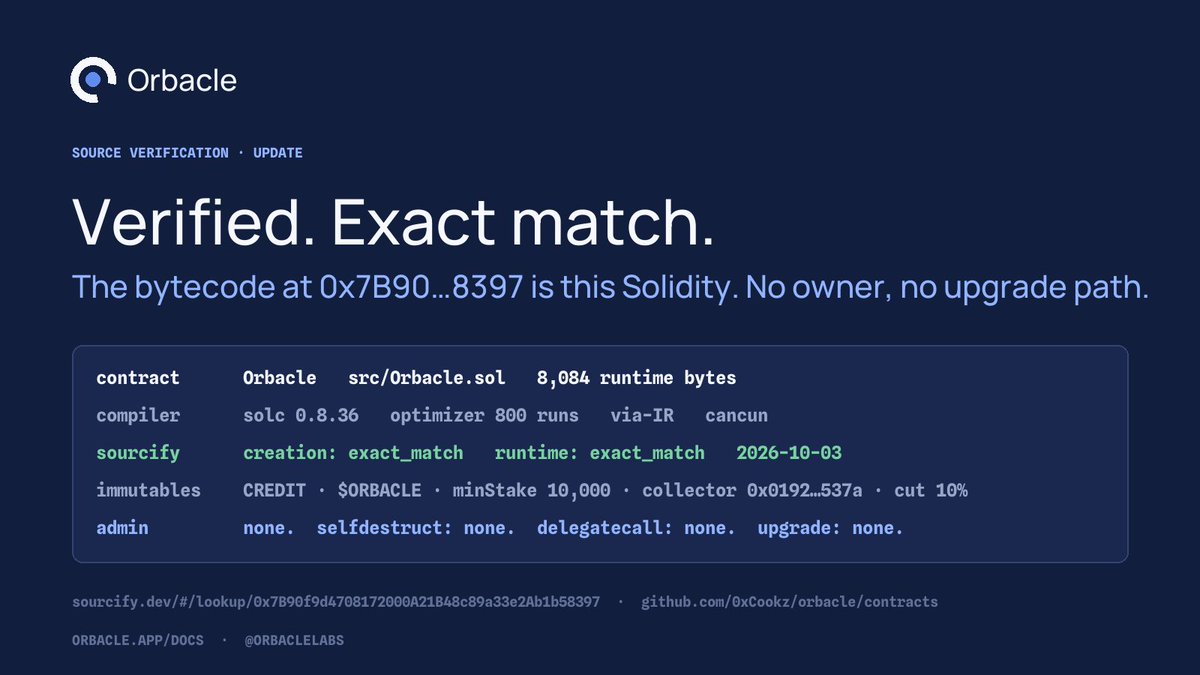
Verified. Exact match.
The bytecode at 0x7B90…8397 on Robinhood Chain is the Solidity in the repo, byte for byte: creation and runtime, exact match on Sourcify.
solc 0.8.36, optimizer 800 runs, via-IR, cancun. No owner, no upgrade path, no selfdestruct, no delegatecall. Five immutables set at deployment and never again.
https://t.co/CANJvwrJxI
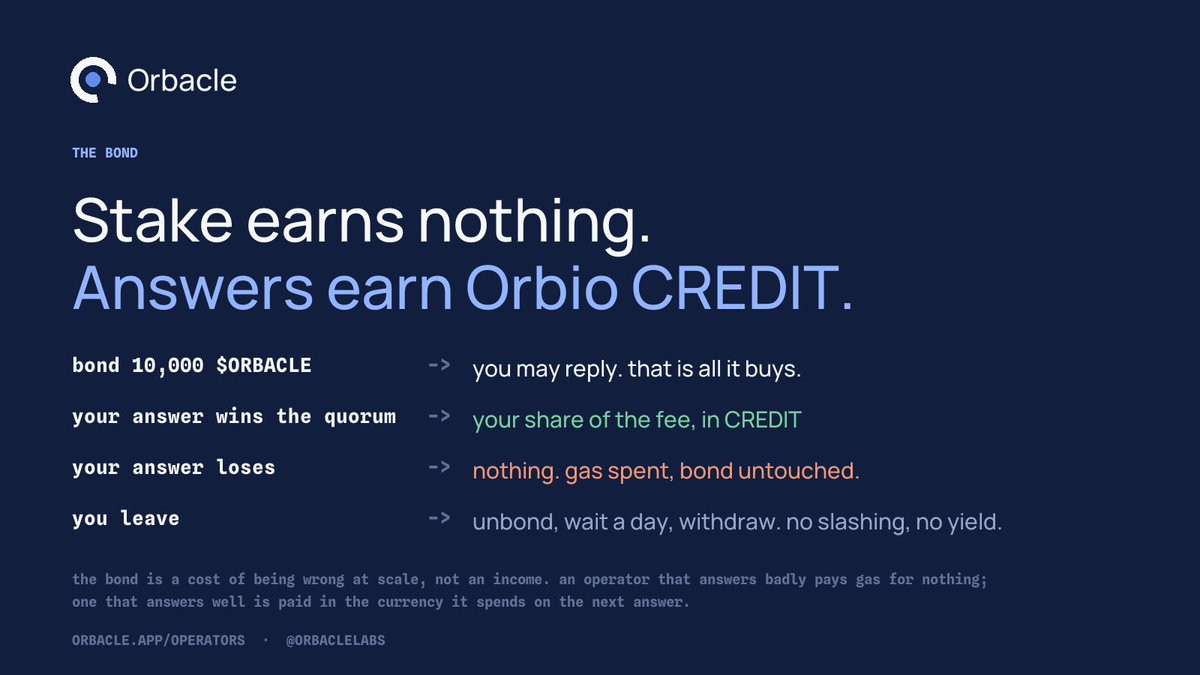
Stake earns nothing. Answers earn Orbio CREDIT.
Bonding 10,000 $ORBACLE buys one thing: the right to reply. A winning answer earns a share of the fee in CREDIT. A losing one earns nothing and costs gas. Leaving is unbond, wait a day, withdraw.
No yield, no slashing. The bond is a cost of being wrong at scale, not an income.
Your agent pays per question.
The Orbacle MCP server has a new tool: orbacle_ask_x402. Same question, same oracle, but the agent pays in the request with USDG from its own wallet. No CREDIT to hold, no approval of the oracle, one signature.
x402 under the hood. Claude Code, Cursor, Codex, OpenClaw.
https://t.co/zbVCNbCyoD
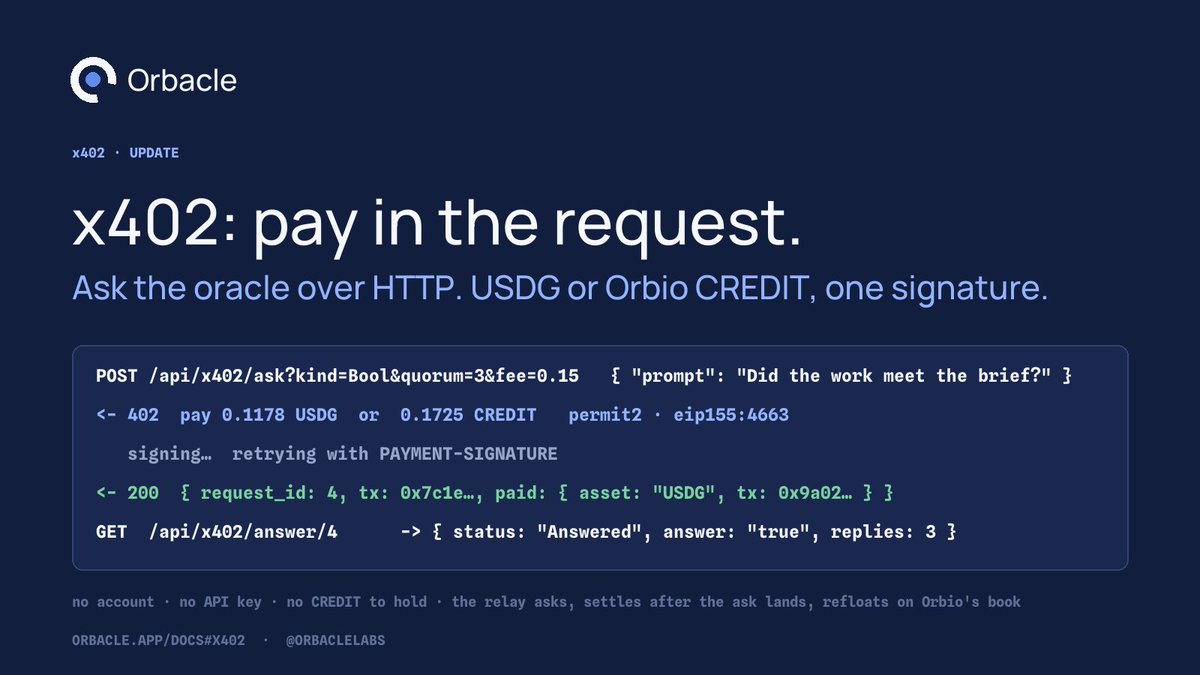
x402 integrated: pay in the request.
Orbacle now speaks x402. POST a question to https://t.co/BnpT8Hl7SJ, get a 402 with the price, sign once, get your request id back.
Pay in USDG or Orbio CREDIT on Robinhood Chain over Permit2. CREDIT is signatures only, no gas. No account, no API key, nothing to hold in advance.
https://t.co/zbVCNbCyoD
Welcome, privacy.
Orbacle operators can now answer through Orbio Incognito. The prompt is encrypted to a Phala TEE, the model runs inside it, and the enclave signs a receipt with the request and response hashes.
keccak256 of that signature is the 32-byte receipt every reply already carried. The field was reserved for this at deployment.
Checked today against the live gateway: the TDX quote verifies, the keyset is bound to our nonce, the compose is measured. One line in .env.local: ORBIO_INCOGNITO=auto.
https://t.co/yjP0AGs3Ji
0xd252fbad2e5946ad4540810339a7d8a8dc12be0c
Here you go. How to use Orbacle in six steps: get Orbio CREDIT, connect, pick the answer shape, write the question, set the quorum and the fee, read the answer.
Full docs at https://t.co/zQbZttqWOQ
https://t.co/JLzu1xivB8
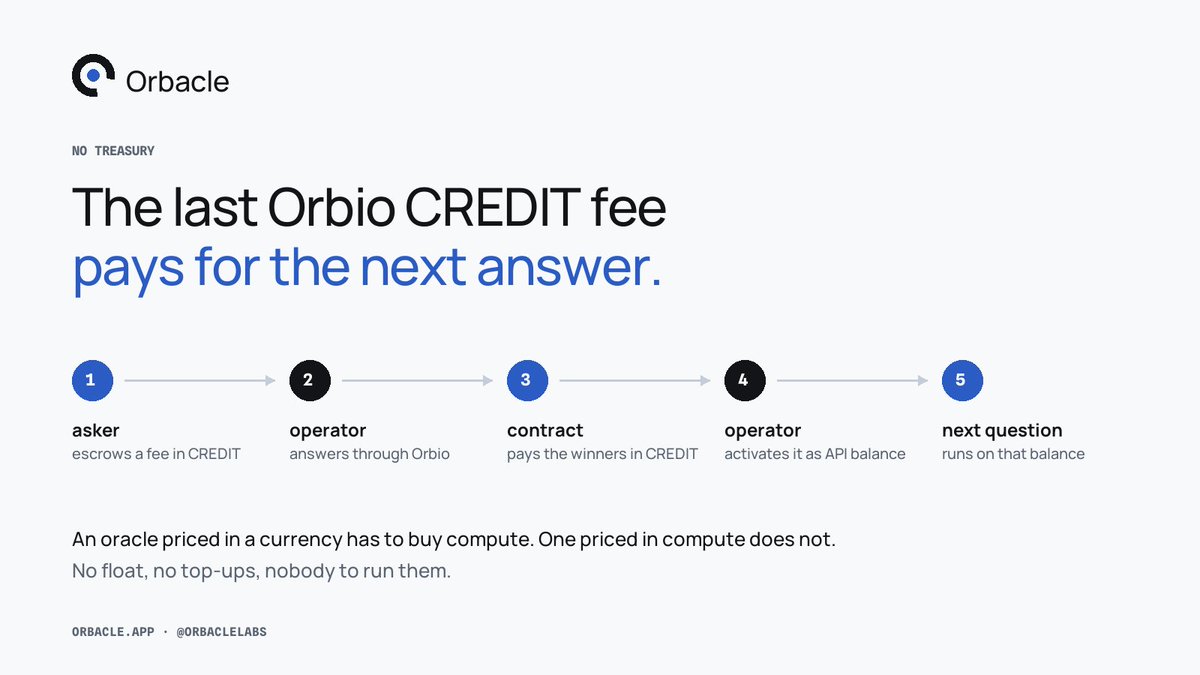
GM! The last Orbio CREDIT fee pays for the next answer.
The asker escrows CREDIT. The operator answers through Orbio. The contract pays the winners in CREDIT. The operator activates it as API balance. The next question runs on that.
An oracle priced in a currency has to buy compute. One priced in Orbio CREDIT does not.
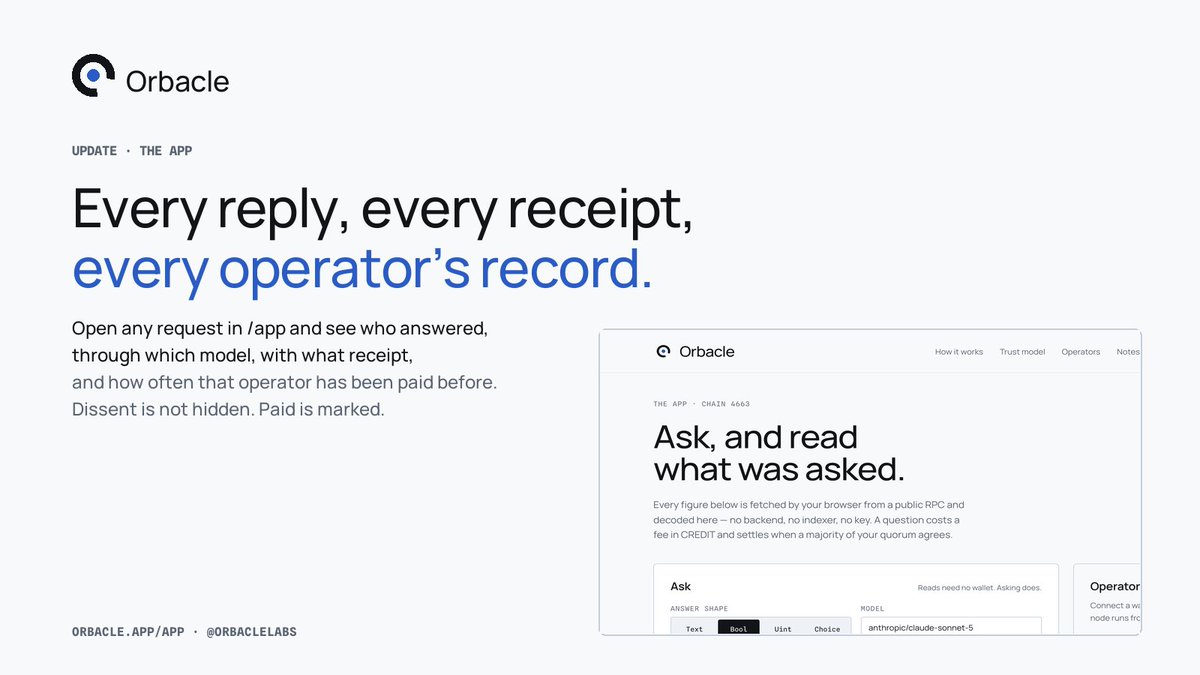
Just deployed: every reply, every receipt, every operator's record.
Open any request in the app and see who answered, through which model, with what receipt, and how often that operator has been paid before. Dissent is not hidden. Paid is marked.
https://t.co/XHLXXIB2BX
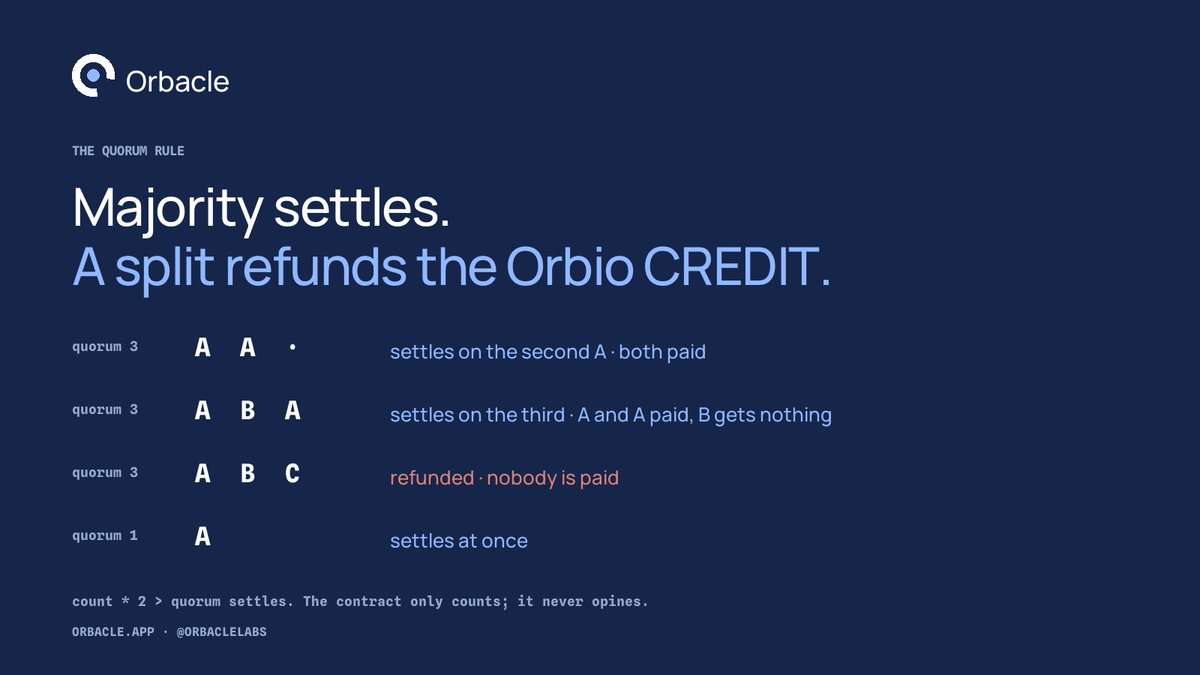
Majority settles. A split refunds the Orbio CREDIT.
Operators hash their answers. The first digest to reach a majority settles and pays everyone who sent it. Three answers that all differ send the CREDIT back to the asker and pay nobody.
count * 2 > quorum. The contract only counts. It never opines.
New: run an Orbacle operator in one command.
Bond 10,000 $ORBACLE. Activate a few CREDIT. npm run operator. The node derives its Orbio key from the wallet, answers through the gateway, replies on chain, and refuels itself from what it earns.
Open source, one file.
https://t.co/rmYbbCnRUw
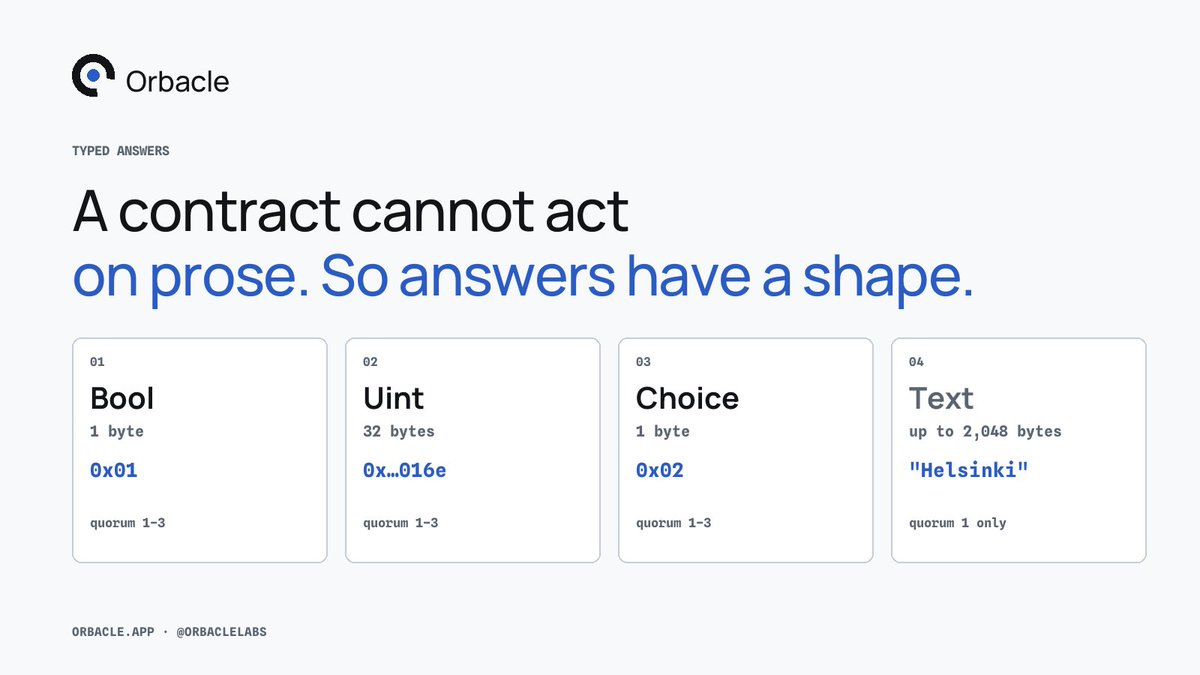
A contract cannot act on prose. So Orbacle answers have a shape.
Bool is one byte. Uint is thirty-two. Choice is an index. Text is UTF-8, up to 2 KB. The contract checks the shape before your callback ever sees it.
Typed questions get a quorum. Text gets one operator, on purpose.
Orbacle on Android.
The same site, in your pocket: ask, bond, read the log, with your wallet. Install it from Chrome, or download the APK.
https://t.co/g6oUaoUVSG
0xd252fbad2e5946ad4540810339a7d8a8dc12be0c
Every Orbacle reply carries a 32-byte receipt. Today it is the hash of Orbio's response id, so an operator can be checked after the fact.
The field is 32 bytes for a reason. Orbio's Incognito mode runs inference inside a TEE and returns a signed receipt binding the exact prompt to the exact answer. Hash that into the field and a quorum stops meaning "three models agreed" and starts meaning "three attested runs of an untouched prompt agreed".
No LLM oracle has that. The slot is already in our ABI.
MCP support for Claude Code, Cursor, Codex and OpenClaw: what it means
Until today, asking Orbacle meant writing Solidity or clicking a form. Now an agent does it in one tool call, pays in Orbio CREDIT from its own wallet, and reads the settled answer back.
That closes a loop that did not exist on chain before. An agent earns CREDIT on Orbio, spends it on a question, three staked operators answer, and a contract acts on the result. No human in the middle, no API key on a dashboard, no treasury.
It also means the oracle has a second kind of customer. Contracts ask through onAnswer. Agents ask through MCP. Same quorum, same fee, same receipt.
https://t.co/VhODeTEbYs
Big update: ask the oracle from any agent.
New four MCP tools, in the repo today: orbacle_quote, orbacle_ask, orbacle_answer, orbacle_recent. Claude Code, Cursor, Codex, OpenClaw.
An agent posts a typed question, escrows the fee in Orbio CREDIT from its own wallet, and reads the settled answer back. One tool call each way.
claude mcp add orbacle -- npx tsx mcp/server.mts
Big update: ask the oracle from any agent.
New four MCP tools, in the repo today: orbacle_quote, orbacle_ask, orbacle_answer, orbacle_recent. Claude Code, Cursor, Codex, OpenClaw.
An agent posts a typed question, escrows the fee in Orbio CREDIT from its own wallet, and reads the settled answer back. One tool call each way.
claude mcp add orbacle -- npx tsx mcp/server.mts
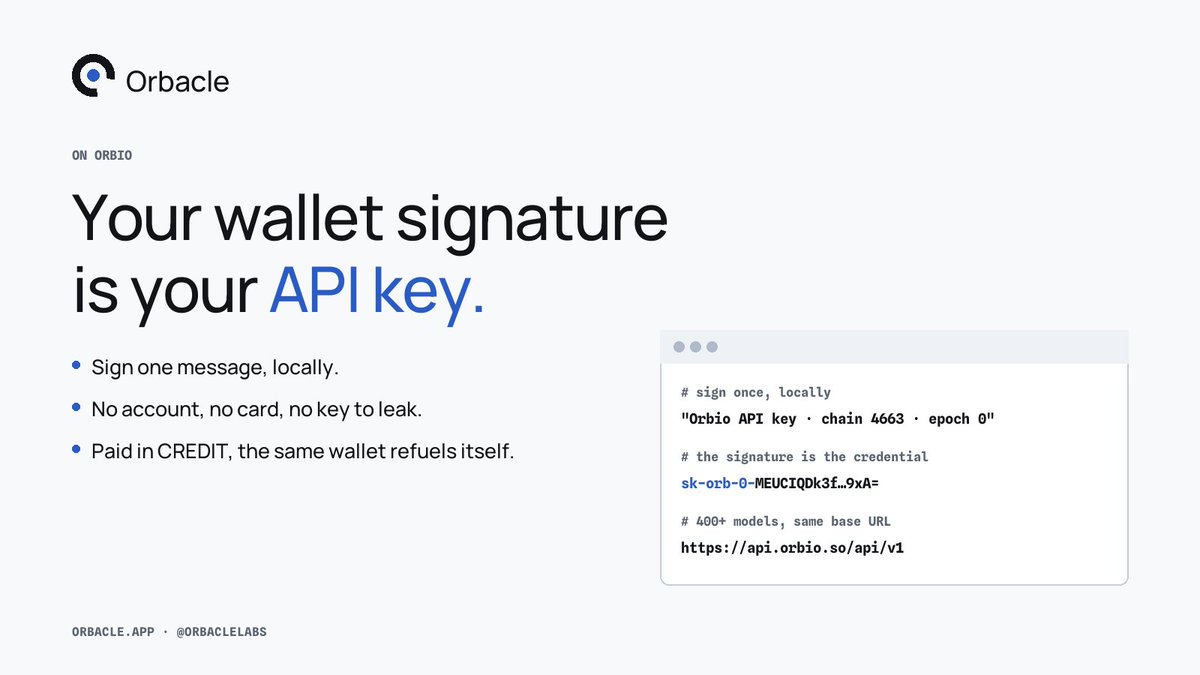
The quiet part of Orbio's design: your wallet signature is your API key.
Sign one message, locally, and you have a credential for 400+ models. No account, no card, no key to leak from a dashboard.
For agents that is the whole onboarding. For an oracle, it is the reason operators can be paid in what they spend.