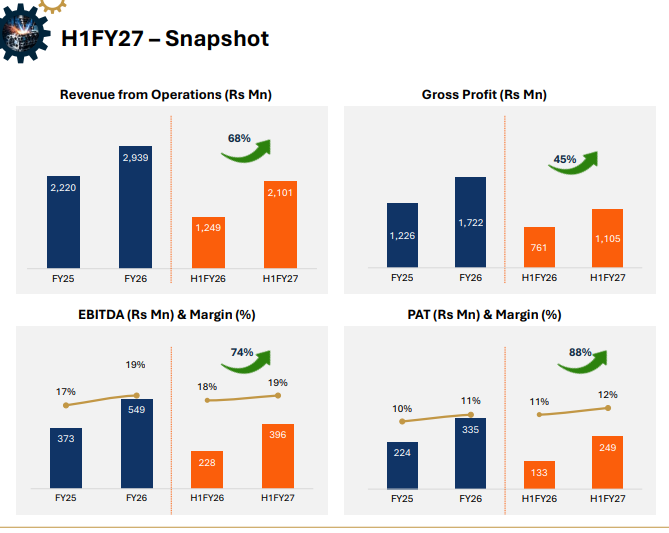
Poojaa Precision delivers a strong H1 FY27! 📈
Revenue up 68% YoY, EBITDA up 74%, and PAT up 88%.
Even better, EBITDA margins improved to 19% and PAT margins to 12%.
#PPEL#SME
This company is doubling its capacity and moving up the value chain to become an integrated precision-engineering player, combining multiple casting technologies with machining, testing and assembly — Poojaa Precision Engineering 🛠️
At the same time, it is diversifying beyond auto into newer segments such as energy & switchgear, defence, agriculture, aerospace and e-mobility — gradually reducing its dependence on the auto cycle and creating a more diversified growth profile.
1. What does Poojaa Precison do?
The company manufactures high-precision, safety-critical aluminum components ranging from engine parts to power-grid housings. Unlike traditional foundries that specialize in a single process, Poojaa operates Gravity Die Casting (GDC), Low-Pressure Die Casting (LPDC), and High-Pressure Die Casting (HPDC) alongside in-house multi-axis CNC machining, heat treatment, and testing.
GDC and LPDC represent ~70% of its portfolio, allowing it to produce complex, thin-walled, and pressure-tight parts (such as cylinder heads and helium-leak-tested switchgear housings) that carry higher technical entry barriers than high-volume HPDC parts.
The business offers complete design-to-assembly solutions in-house, enabling higher value addition than basic casting foundries. Its strong focus on complex GDC and LPDC processes helps insulate it from pure HPDC commodity price competition.
End-use industries span Commercial Vehicles, Passenger Vehicles, 2W/3W, Electric Vehicles (EVs), Power/Energy, Defense, and Healthcare.
2. Journey & Customers
Founded in 1992 as a raw foundry, Poojaa transitioned between 2006 and 2020 into a fully integrated solution provider offering design, prototyping, casting, machining, and assembly.
Its customer base expanded from 39 clients in FY24 to 58 in FY26. While 99.16% of FY26 revenue was domestic, components are indirectly and directly supplied to global markets including Germany, the US, Italy, and Switzerland. Winning OEM supply lines requires rigorous 8-to-24-month qualification audits, creating a sticky customer relationship.
Key customers include Tata Motors, Mahindra & Mahindra, Hero MotoCorp, Bajaj Auto, Siemens, Toshiba, ABB, GE Energy, Fiat, and more.
Earlier they were catering to the domestic requirements of global clients, now they will also be exporting.
3. Industry & India's Position
Global OEMs are increasingly shifting away from basic raw castings toward fully machined, multi-functional assemblies. OEMs outsource to specialized precision casters to meet stringent lightweighting targets (replacing steel with aluminum) and emission norms like BS-VI, which require 4mm thin-walled, pressure-tight EGR housings.
India's auto-component sector recorded a turnover of ₹7.59 lakh Cr (USD 78.74 billion) in FY25/FY26. Driven by "China Plus One" supply chain realignments, global buyers are seeking alternate sourcing hubs. Furthermore, as China controls over 85% of global magnesium reserves, Indian policy initiatives and local capabilities in aluminum and magnesium alloys are positioning Indian suppliers to capture broader international share. Additionally, a lot of European factories are becoming unviable due to unavailability of cheaper gas to fuel their plants.
4. Growth Drivers & Capacity Expansion
In FY26, Poojaa operated at 80% melting utilization (10,982 MT produced on 13,800 MTPA capacity) and 84% casting utilization (5,049 MT produced on 6,000 MTPA capacity). To address capacity constraints, the company is deploying ₹106.34 Cr from IPO net proceeds to establish Unit III in Khed, Pune.
Capacity Addition: Unit III adds 15,000 MTPA of melting and 6,600 MTPA of casting/finishing capacity, more than doubling total melting capacity to 28,800 MTPA and casting capacity to 12,600 MTPA.
Timeline: Partial commercial operations are expected by September 2026, with full operationalization proposed by June 2027.
New Vectors: A proposed Unit IV is dedicated to R&D and prototyping of lightweight magnesium components.
Management notes it takes 2 to 2.5 years post-expansion for new lines to reach 75–80% target utilization, requiring steady execution, RFQ conversion, and OEM ramp-up schedules.
5. Financials
Revenue from operations expanded from ₹173.72 Cr in FY24 to ₹222.00 Cr in FY25, reaching ₹293.86 Cr in FY26 (~30.1% CAGR).
Over the same period, EBITDA grew from ₹27.45 Cr (15.80% margin) in FY24 to ₹39.89 Cr (17.97% margin) in FY25, before settling at ₹51.78 Cr (17.62% margin) in FY26.
PAT increased from ₹16.10 Cr (9.27% margin) in FY24 to ₹23.93 Cr (10.78% margin) in FY25, and reached ₹30.90 Cr (10.52% margin) in FY26.
The business maintains solid return metrics, delivering an ROE of 28.18% and ROCE of 26.38% in FY26.
6. What Makes It Interesting
Process Versatility: Running GDC, LPDC, and HPDC under one roof allows optimization across part geometry, strength, and volume.
Diversification into Non-Auto & EV: EV revenue expanded ~2.7x over two years to ₹28.83 Cr in FY26, while Non-Auto (power, defense, agri) reached 17.61% of sales. In 2-3 years, Non-Auto and EV could become 1/3 of the revenue, reducing auto cyclicality.
They are also foraying into aerospace, with localization of components but it will take a couple of years to show up in revenues.
Capacity Doubling: Unit III expansion is fully funded via IPO proceeds, addressing existing facility bottlenecks. Capacity will 2x with 60+ machines including HMCs, VMCs and CNCs. This will lead to 40-50% YoY growth in the next 2-3 years.
R&D:
- Co-developing aluminium-graphene composites with Eaton, Poojaa aims to cut component weight by 7-8% while boosting strength and conductivity, creating a viable long-term substitute for depleting copper.
- Dedicated to Unit IV, precision magnesium casting that is a dramatic 40% lower weight over aluminium, unlocking critical lightweighting capabilities for EVs, defense, and aerospace applications.
- Developing a proprietary non-heat-treated aluminium alloy eliminates energy-hungry processing steps, significantly shortening manufacturing lead times while optimizing per-unit production costs and operational efficiency.
Operating Cost Catalysts: Investing ₹14.81 Cr in a 4.95 MWp captive solar project to offset power costs (~7–8% of expenses), targeting ₹40–45 lakhs in monthly power savings.
7. Key Risks
Dependence on raw aluminum ingots and alloys also exposes operating margins to price volatility and raw material supply disruptions.
Unit III implementation carries potential risks of construction delays, timeline overruns, or slower customer volume ramp-ups.
Furthermore, revenue remains tied to key OEM relationships and cyclical end markets like commercial vehicles and capital goods.
Finally, entering magnesium components via Unit IV and expanding in aerospace depend on securing strict OEM approvals and vendor certifications.
8. Leadership
Poojaa Precision is led by Chairman Anil Kulkarni, bringing over 32 years of foundry and tooling expertise. Managing Director Sanket Kulkarni oversees operations with 16+ years in tool design, while Whole-Time Director Rahul Ranka manages commercial strategy. Supported by CFO Bhavya Agrawal and experienced independent directors, the leadership combines strong engineering roots with financial oversight.
10. Conclusion
Poojaa Precision has built a profitable precision casting business supported by an integrated, multi-process manufacturing platform. The business is evolving into an integrated precision hub with newer verticals such as EV, Energy, Defense, etc. With existing plants operating at ~81% utilization, it will be key to track the commencement of the new Unit III facility and its utilization over time. If execution stays on schedule and new OEM programs ramp up smoothly over the next 2 years, the expansion provides a clear operational runway.
Disclaimer: This post is for informational purposes only and is not a recommendation to buy or sell. Please do your own due diligence (DYDD) before making any investment decision.
#PoojaaPrecision #PPEL #SME
Lot of tailwinds for the indian navy. After the rush we saw in LM procurement which would continue
Naval capabilities is something would be the only weak spot. Expecting lot of orders on the naval side
A new, fairly interesting business is coming up for an IPO — Qualiance International 💡
What caught my attention is the nature of the business: a Tiruppur-based manufacturer of technical/performance garments, with ~99% of revenue coming from exports, and a planned capacity expansion that would take total installed capacity from 4.5 lakh to ~15.3 lakh pieces ( ~3.4x the current base).
They are raising ~₹45 Cr through a 100% fresh issue, with ~₹38 Cr going towards setting up the new manufacturing facility in Tiruppur. The IPO is priced at PE 14.4x FY26 PAT post money.
Here’s a quick look at the business:
1. What does Qualiance do?
Qualiance isn't a typical apparel exporter making basic T-shirts or shirts.
It makes technical garments — military uniforms, tactical outerwear, waterproof/all-weather jackets, high-visibility workwear, police & border patrol uniforms, protective workwear and performance activewear.
The customer generally provides the design/specifications/technical drawings, while Qualiance works on the engineering, material compatibility and manufacturing required to produce the final garment.
2. Brief Journey
1994: Founded as a generic partnership firm, doing basic "cut-and-sew" apparel.
2001: Partnered with the Swiss Army to develop their new clothing collection, initiating a steep learning curve in material compatibility and engineering.
2006: Converted to a private limited company.
2017: Built its first dedicated factory in Tiruppur, Tamil Nadu.
2025: Officially converted to a public limited company.
3. Why is the product different?
A technical jacket can involve multiple layers/materials, waterproof membranes, insulation, specialised adhesives etc.
Qualiance has capabilities such as:
• Seam sealing
• Bonded/stitch-free construction
• Ultrasonic welding
• Laser cutting
• Lamination
• Reflective fusing
• Quilting & down filling
The company also carries out testing for things such as seam leakage, shrinkage, washing/rubbing fastness and button pull strength.
Its FY26 average realisation was over Rs.1900/garment, versus roughly ₹400-500 for a typical Indian garment exporter — essentially reflecting the much higher complexity/value addition in its products.
4. Customers & markets
This is where the business becomes interesting — and also where one of the biggest risks lies.
FY26 revenue by geography:
Switzerland — 80.67%
USA — 16.60%
UK — 1.54%
India — 1.18%
Government of Switzerland departments alone contributed ₹60.45 Cr (79.24%) of FY26 revenue. The company has supplied to Swiss Army, Railways, Customs and Police.
Management also says it is in discussions with European, US and Canadian private brands for technical outerwear. Importantly, these are prospective opportunities as the new facility is up and running, not current customers.
5. Manufacturing
Current facility is in Tiruppur, with:
• 45,000+ sq ft built-up area
• 4.5 lakh pieces/year installed capacity
• 240 sewing machines
• In-house manufacturing rather than outsourcing
The company says essentially all exported garments are engineered and manufactured in its own facility.
The important part isn't just the sewing capacity, but the specialised processes and quality systems built around it.
6. The big expansion
The IPO is primarily funding a new Tiruppur facility.
Planned facility:
• ~1.43 lakh sq ft, 4 floors
• 600 sewing machines
• ~10.8 lakh pieces/year capacity
• ₹38 Cr of IPO proceeds allocated towards it
So total installed capacity could move from 4.5 lakh → ~15.3 lakh pieces, or roughly 3.4x.
The land has been acquired and approvals are in place with construction to begin in Sept'26 itself. This capacity is expected to come live by the first half of FY28.
The key thing to track would be: how quickly does this capacity get filled, and at what realisation/margin.
7. Financials
The numbers have improved meaningfully over the last 3 years — revenue has more than doubled from ₹37 Cr to ₹77 Cr, while PAT has grown over 4x from ₹2.8 Cr to ₹11.9 Cr.
The bigger takeaway is the operating leverage: EBITDA margin expanded from 13% to 22%, while PAT margin moved from 7.6% to 15.4%. FY26 alone saw 45% revenue growth and 142% PAT growth.
At the ₹127 upper band, it is valued at roughly 14.4x FY26 earnings.
8. Why does it look interesting?
A niche within a large export industry: India is already the 6th-largest textile & apparel exporter globally, with textile & apparel exports of ~₹3.25 lakh Cr in FY26. The industry also has a large manufacturing ecosystem, skilled labour base and government push towards technical textiles and higher-value manufacturing.
Moreover, there is also a China + Bangladesh angle worth watching. China faces increasing trade/geopolitical and tariff considerations in Western markets, while Bangladesh's advantage is strongest in large-scale, labour-intensive basic apparel. Bangladesh has also faced recent tariff, labour and political challenges. This creates an interesting space for Indian manufacturers like Qualiance.
Qualiance sits in an interesting part of the garment export market — technical, performance-oriented garments where manufacturing capabilities and compliance matter more than simply competing on cost. It has built a 20+ year relationship with Swiss government and institutional customers, while FY26 also showed strong growth in volumes and realisations.
Now, the company is expanding its capacity to ~3.4x and is simultaneously looking to broaden its customer base across private brands in multiple export markets like Europe and America. With ~99% of revenue already coming from exports, the new facility could give the company room to scale its existing business while moving into a larger addressable customer base.
This is the part of the story that makes the company worth watching: a specialised export manufacturing business, with proven customers and improving economics, entering a fairly significant capacity-expansion phase.
It will be key to track the onboarding of private brands to utilize its new upcoming caapcity.
9. Key risks
The biggest risk is customer concentration — the top customer contributed ~57% of FY26 sales and the top 5 ~97%.
There is also significant geographic concentration, with 98.8% of revenue coming from exports and ~81% from Switzerland. On the input side, ~60% of raw-material purchases were imported in FY26, exposing the company to currency movements, freight costs, tariffs and supply-chain disruptions.
The other key question is execution of the new capacity — the company is nearly 2.4x-ing its current capacity, so delays/cost overruns or slower-than-expected customer additions could impact returns. And after the sharp FY26 jump in margins, sustainability of the current 15.4% PAT margin will be something to watch.
The new capacity could also help address some of these risks, as the company is looking to use the additional capacity to onboard private outdoor/performance-wear brands and expand into new geographies, particularly Europe and North America. The key will be how successfully these prospective customers translate into actual orders.
10. Management
Promoter-led business.
Vipul Badani, Chairman & MD, is a textile engineer with 30+ years of experience.
Bhoomin R. Badani, Whole-Time Director & CEO, has 15+ years of apparel manufacturing experience. It is effectively a first/second-generation promoter setup.
Conclusion:
Overall, Qualiance is an interesting specialised export manufacturer with a clear capacity-led growth opportunity ahead. FY27 could be relatively flat as the existing facility is already running close to capacity, but the 10.8 lakh-piece new facility should create a much larger growth runway once it comes on stream.
If utilisation ramps up over the next 2–3 years, the company has the potential to grow meaningfully from the current base, while new private-brand customers and geographies could also reduce its current concentration. The key will be execution, filling the new capacity while maintaining the margins and customer quality it has built so far.
Disclosure: This post is for informational purposes only and is not a recommendation to buy or sell. Please do your own due diligence (DYDD) before making any investment decision.
#Qualiance #SME #SMEIPO #Export
This company is doubling its capacity and moving up the value chain to become an integrated precision-engineering player, combining multiple casting technologies with machining, testing and assembly — Poojaa Precision Engineering 🛠️
At the same time, it is diversifying beyond auto into newer segments such as energy & switchgear, defence, agriculture, aerospace and e-mobility — gradually reducing its dependence on the auto cycle and creating a more diversified growth profile.
1. What does Poojaa Precison do?
The company manufactures high-precision, safety-critical aluminum components ranging from engine parts to power-grid housings. Unlike traditional foundries that specialize in a single process, Poojaa operates Gravity Die Casting (GDC), Low-Pressure Die Casting (LPDC), and High-Pressure Die Casting (HPDC) alongside in-house multi-axis CNC machining, heat treatment, and testing.
GDC and LPDC represent ~70% of its portfolio, allowing it to produce complex, thin-walled, and pressure-tight parts (such as cylinder heads and helium-leak-tested switchgear housings) that carry higher technical entry barriers than high-volume HPDC parts.
The business offers complete design-to-assembly solutions in-house, enabling higher value addition than basic casting foundries. Its strong focus on complex GDC and LPDC processes helps insulate it from pure HPDC commodity price competition.
End-use industries span Commercial Vehicles, Passenger Vehicles, 2W/3W, Electric Vehicles (EVs), Power/Energy, Defense, and Healthcare.
2. Journey & Customers
Founded in 1992 as a raw foundry, Poojaa transitioned between 2006 and 2020 into a fully integrated solution provider offering design, prototyping, casting, machining, and assembly.
Its customer base expanded from 39 clients in FY24 to 58 in FY26. While 99.16% of FY26 revenue was domestic, components are indirectly and directly supplied to global markets including Germany, the US, Italy, and Switzerland. Winning OEM supply lines requires rigorous 8-to-24-month qualification audits, creating a sticky customer relationship.
Key customers include Tata Motors, Mahindra & Mahindra, Hero MotoCorp, Bajaj Auto, Siemens, Toshiba, ABB, GE Energy, Fiat, and more.
Earlier they were catering to the domestic requirements of global clients, now they will also be exporting.
3. Industry & India's Position
Global OEMs are increasingly shifting away from basic raw castings toward fully machined, multi-functional assemblies. OEMs outsource to specialized precision casters to meet stringent lightweighting targets (replacing steel with aluminum) and emission norms like BS-VI, which require 4mm thin-walled, pressure-tight EGR housings.
India's auto-component sector recorded a turnover of ₹7.59 lakh Cr (USD 78.74 billion) in FY25/FY26. Driven by "China Plus One" supply chain realignments, global buyers are seeking alternate sourcing hubs. Furthermore, as China controls over 85% of global magnesium reserves, Indian policy initiatives and local capabilities in aluminum and magnesium alloys are positioning Indian suppliers to capture broader international share. Additionally, a lot of European factories are becoming unviable due to unavailability of cheaper gas to fuel their plants.
4. Growth Drivers & Capacity Expansion
In FY26, Poojaa operated at 80% melting utilization (10,982 MT produced on 13,800 MTPA capacity) and 84% casting utilization (5,049 MT produced on 6,000 MTPA capacity). To address capacity constraints, the company is deploying ₹106.34 Cr from IPO net proceeds to establish Unit III in Khed, Pune.
Capacity Addition: Unit III adds 15,000 MTPA of melting and 6,600 MTPA of casting/finishing capacity, more than doubling total melting capacity to 28,800 MTPA and casting capacity to 12,600 MTPA.
Timeline: Partial commercial operations are expected by September 2026, with full operationalization proposed by June 2027.
New Vectors: A proposed Unit IV is dedicated to R&D and prototyping of lightweight magnesium components.
Management notes it takes 2 to 2.5 years post-expansion for new lines to reach 75–80% target utilization, requiring steady execution, RFQ conversion, and OEM ramp-up schedules.
5. Financials
Revenue from operations expanded from ₹173.72 Cr in FY24 to ₹222.00 Cr in FY25, reaching ₹293.86 Cr in FY26 (~30.1% CAGR).
Over the same period, EBITDA grew from ₹27.45 Cr (15.80% margin) in FY24 to ₹39.89 Cr (17.97% margin) in FY25, before settling at ₹51.78 Cr (17.62% margin) in FY26.
PAT increased from ₹16.10 Cr (9.27% margin) in FY24 to ₹23.93 Cr (10.78% margin) in FY25, and reached ₹30.90 Cr (10.52% margin) in FY26.
The business maintains solid return metrics, delivering an ROE of 28.18% and ROCE of 26.38% in FY26.
6. What Makes It Interesting
Process Versatility: Running GDC, LPDC, and HPDC under one roof allows optimization across part geometry, strength, and volume.
Diversification into Non-Auto & EV: EV revenue expanded ~2.7x over two years to ₹28.83 Cr in FY26, while Non-Auto (power, defense, agri) reached 17.61% of sales. In 2-3 years, Non-Auto and EV could become 1/3 of the revenue, reducing auto cyclicality.
They are also foraying into aerospace, with localization of components but it will take a couple of years to show up in revenues.
Capacity Doubling: Unit III expansion is fully funded via IPO proceeds, addressing existing facility bottlenecks. Capacity will 2x with 60+ machines including HMCs, VMCs and CNCs. This will lead to 40-50% YoY growth in the next 2-3 years.
R&D:
- Co-developing aluminium-graphene composites with Eaton, Poojaa aims to cut component weight by 7-8% while boosting strength and conductivity, creating a viable long-term substitute for depleting copper.
- Dedicated to Unit IV, precision magnesium casting that is a dramatic 40% lower weight over aluminium, unlocking critical lightweighting capabilities for EVs, defense, and aerospace applications.
- Developing a proprietary non-heat-treated aluminium alloy eliminates energy-hungry processing steps, significantly shortening manufacturing lead times while optimizing per-unit production costs and operational efficiency.
Operating Cost Catalysts: Investing ₹14.81 Cr in a 4.95 MWp captive solar project to offset power costs (~7–8% of expenses), targeting ₹40–45 lakhs in monthly power savings.
7. Key Risks
Dependence on raw aluminum ingots and alloys also exposes operating margins to price volatility and raw material supply disruptions.
Unit III implementation carries potential risks of construction delays, timeline overruns, or slower customer volume ramp-ups.
Furthermore, revenue remains tied to key OEM relationships and cyclical end markets like commercial vehicles and capital goods.
Finally, entering magnesium components via Unit IV and expanding in aerospace depend on securing strict OEM approvals and vendor certifications.
8. Leadership
Poojaa Precision is led by Chairman Anil Kulkarni, bringing over 32 years of foundry and tooling expertise. Managing Director Sanket Kulkarni oversees operations with 16+ years in tool design, while Whole-Time Director Rahul Ranka manages commercial strategy. Supported by CFO Bhavya Agrawal and experienced independent directors, the leadership combines strong engineering roots with financial oversight.
10. Conclusion
Poojaa Precision has built a profitable precision casting business supported by an integrated, multi-process manufacturing platform. The business is evolving into an integrated precision hub with newer verticals such as EV, Energy, Defense, etc. With existing plants operating at ~81% utilization, it will be key to track the commencement of the new Unit III facility and its utilization over time. If execution stays on schedule and new OEM programs ramp up smoothly over the next 2 years, the expansion provides a clear operational runway.
Disclaimer: This post is for informational purposes only and is not a recommendation to buy or sell. Please do your own due diligence (DYDD) before making any investment decision.
#PoojaaPrecision #PPEL #SME
A new, fairly interesting business is coming up for an IPO — Qualiance International 💡
What caught my attention is the nature of the business: a Tiruppur-based manufacturer of technical/performance garments, with ~99% of revenue coming from exports, and a planned capacity expansion that would take total installed capacity from 4.5 lakh to ~15.3 lakh pieces ( ~3.4x the current base).
They are raising ~₹45 Cr through a 100% fresh issue, with ~₹38 Cr going towards setting up the new manufacturing facility in Tiruppur. The IPO is priced at PE 14.4x FY26 PAT post money.
Here’s a quick look at the business:
1. What does Qualiance do?
Qualiance isn't a typical apparel exporter making basic T-shirts or shirts.
It makes technical garments — military uniforms, tactical outerwear, waterproof/all-weather jackets, high-visibility workwear, police & border patrol uniforms, protective workwear and performance activewear.
The customer generally provides the design/specifications/technical drawings, while Qualiance works on the engineering, material compatibility and manufacturing required to produce the final garment.
2. Brief Journey
1994: Founded as a generic partnership firm, doing basic "cut-and-sew" apparel.
2001: Partnered with the Swiss Army to develop their new clothing collection, initiating a steep learning curve in material compatibility and engineering.
2006: Converted to a private limited company.
2017: Built its first dedicated factory in Tiruppur, Tamil Nadu.
2025: Officially converted to a public limited company.
3. Why is the product different?
A technical jacket can involve multiple layers/materials, waterproof membranes, insulation, specialised adhesives etc.
Qualiance has capabilities such as:
• Seam sealing
�� Bonded/stitch-free construction
• Ultrasonic welding
• Laser cutting
• Lamination
• Reflective fusing
• Quilting & down filling
The company also carries out testing for things such as seam leakage, shrinkage, washing/rubbing fastness and button pull strength.
Its FY26 average realisation was over Rs.1900/garment, versus roughly ₹400-500 for a typical Indian garment exporter — essentially reflecting the much higher complexity/value addition in its products.
4. Customers & markets
This is where the business becomes interesting — and also where one of the biggest risks lies.
FY26 revenue by geography:
Switzerland — 80.67%
USA — 16.60%
UK — 1.54%
India — 1.18%
Government of Switzerland departments alone contributed ₹60.45 Cr (79.24%) of FY26 revenue. The company has supplied to Swiss Army, Railways, Customs and Police.
Management also says it is in discussions with European, US and Canadian private brands for technical outerwear. Importantly, these are prospective opportunities as the new facility is up and running, not current customers.
5. Manufacturing
Current facility is in Tiruppur, with:
• 45,000+ sq ft built-up area
• 4.5 lakh pieces/year installed capacity
• 240 sewing machines
• In-house manufacturing rather than outsourcing
The company says essentially all exported garments are engineered and manufactured in its own facility.
The important part isn't just the sewing capacity, but the specialised processes and quality systems built around it.
6. The big expansion
The IPO is primarily funding a new Tiruppur facility.
Planned facility:
• ~1.43 lakh sq ft, 4 floors
• 600 sewing machines
• ~10.8 lakh pieces/year capacity
• ₹38 Cr of IPO proceeds allocated towards it
So total installed capacity could move from 4.5 lakh → ~15.3 lakh pieces, or roughly 3.4x.
The land has been acquired and approvals are in place with construction to begin in Sept'26 itself. This capacity is expected to come live by the first half of FY28.
The key thing to track would be: how quickly does this capacity get filled, and at what realisation/margin.
7. Financials
The numbers have improved meaningfully over the last 3 years — revenue has more than doubled from ₹37 Cr to ₹77 Cr, while PAT has grown over 4x from ₹2.8 Cr to ₹11.9 Cr.
The bigger takeaway is the operating leverage: EBITDA margin expanded from 13% to 22%, while PAT margin moved from 7.6% to 15.4%. FY26 alone saw 45% revenue growth and 142% PAT growth.
At the ₹127 upper band, it is valued at roughly 14.4x FY26 earnings.
8. Why does it look interesting?
A niche within a large export industry: India is already the 6th-largest textile & apparel exporter globally, with textile & apparel exports of ~₹3.25 lakh Cr in FY26. The industry also has a large manufacturing ecosystem, skilled labour base and government push towards technical textiles and higher-value manufacturing.
Moreover, there is also a China + Bangladesh angle worth watching. China faces increasing trade/geopolitical and tariff considerations in Western markets, while Bangladesh's advantage is strongest in large-scale, labour-intensive basic apparel. Bangladesh has also faced recent tariff, labour and political challenges. This creates an interesting space for Indian manufacturers like Qualiance.
Qualiance sits in an interesting part of the garment export market — technical, performance-oriented garments where manufacturing capabilities and compliance matter more than simply competing on cost. It has built a 20+ year relationship with Swiss government and institutional customers, while FY26 also showed strong growth in volumes and realisations.
Now, the company is expanding its capacity to ~3.4x and is simultaneously looking to broaden its customer base across private brands in multiple export markets like Europe and America. With ~99% of revenue already coming from exports, the new facility could give the company room to scale its existing business while moving into a larger addressable customer base.
This is the part of the story that makes the company worth watching: a specialised export manufacturing business, with proven customers and improving economics, entering a fairly significant capacity-expansion phase.
It will be key to track the onboarding of private brands to utilize its new upcoming caapcity.
9. Key risks
The biggest risk is customer concentration — the top customer contributed ~57% of FY26 sales and the top 5 ~97%.
There is also significant geographic concentration, with 98.8% of revenue coming from exports and ~81% from Switzerland. On the input side, ~60% of raw-material purchases were imported in FY26, exposing the company to currency movements, freight costs, tariffs and supply-chain disruptions.
The other key question is execution of the new capacity — the company is nearly 2.4x-ing its current capacity, so delays/cost overruns or slower-than-expected customer additions could impact returns. And after the sharp FY26 jump in margins, sustainability of the current 15.4% PAT margin will be something to watch.
The new capacity could also help address some of these risks, as the company is looking to use the additional capacity to onboard private outdoor/performance-wear brands and expand into new geographies, particularly Europe and North America. The key will be how successfully these prospective customers translate into actual orders.
10. Management
Promoter-led business.
Vipul Badani, Chairman & MD, is a textile engineer with 30+ years of experience.
Bhoomin R. Badani, Whole-Time Director & CEO, has 15+ years of apparel manufacturing experience. It is effectively a first/second-generation promoter setup.
Conclusion:
Overall, Qualiance is an interesting specialised export manufacturer with a clear capacity-led growth opportunity ahead. FY27 could be relatively flat as the existing facility is already running close to capacity, but the 10.8 lakh-piece new facility should create a much larger growth runway once it comes on stream.
If utilisation ramps up over the next 2–3 years, the company has the potential to grow meaningfully from the current base, while new private-brand customers and geographies could also reduce its current concentration. The key will be execution, filling the new capacity while maintaining the margins and customer quality it has built so far.
Disclosure: This post is for informational purposes only and is not a recommendation to buy or sell. Please do your own due diligence (DYDD) before making any investment decision.
#Qualiance #SME #SMEIPO #Export
LT Elevator signs SPA to acquire South Korea's Dongyang PC (DYPC)
Key takeaways:
- Gains access to a global automated parking technology platform with operations across 35+ countries, with 12 patents, strengthening its technology moat and product portfolio.
- DYPC brings an existing ₹65 Cr order book and a ₹700 Cr bid pipeline, including significant exposure to the US market, marking LT Elevator’s entry in the US market.
- Post-acquisition, LT plans to localize manufacturing at its upcoming facility, creating long-term margin and scale benefits.
- Management expects ~₹30 Cr revenue contribution for the remainder of FY27 from DYPC
This enables LT Elevator to build a platform capable of competing in a much larger addressable market than before.
Not a buy/sell recommendation. DYDD
#LTElevator #SME
Here are some insights on LT Elevator Ltd, a recently listed SME in the elevator & mechanized car parking space,
now scaling pan-India with rising margins and a ₹200+ Cr order book 👇
#LTElevator#SMEIPO#LTElevators#SME#IPOInsights#Microcap
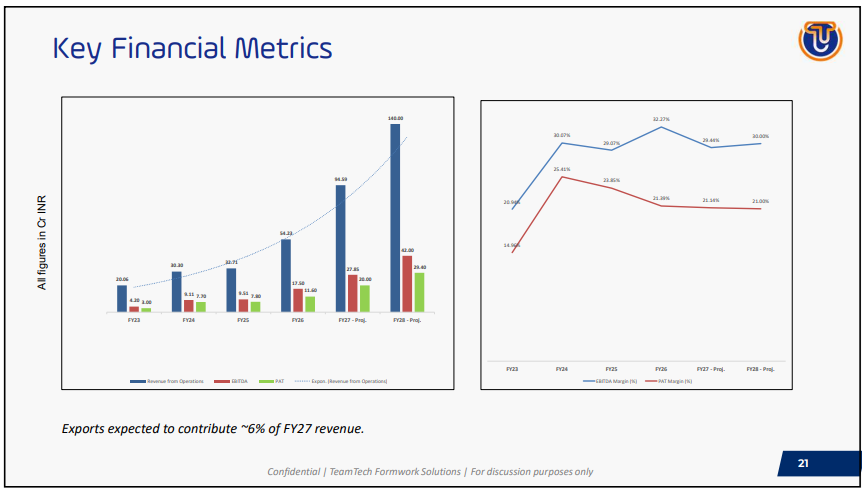
#TeamTech Update 📈
A few interesting data points from the latest investor presentation:
• FY27 guidance implies revenue of ~₹95 Cr, with PAT of ~₹20 Cr, 70%+ YoY.
• ₹47 Cr executable order book (as of 10 Jul 2026).
• Management expects to achieve FY26 total revenue in H1 FY27 itself, with sustained PAT margins.
EPW India: Building value from what the world throws away!
Here are some insights on EPW India Ltd, a Hyderabad based vertically integrated IT hardware refurbisher + E-waste recycling company with strong margins, capital efficiency, and global ambition.
#EPW#Renavart#Growth #Sustainability #Refurbish #SMEIPO #SME #Recycle #Ewaste #Microcap #IPOInsights
📊 EPW India Limited | FY26 Results | Blockbuster Set
Revenue more than Doubled
Full Year FY26: ₹107.5 Cr vs FY25: ₹53.3 Cr | +102% YoY
H2 FY26: ₹63.4 Cr vs H2 FY25: ₹32.8 Cr | +93% YoY
PAT over 2.3x
Full Year FY26: ₹10.3 Cr vs FY25: ₹4.25 Cr | +143% YoY
H2 FY26: ₹6.2 Cr vs H2 FY25: ₹2.64Cr | +135% YoY
PE slashed down to 14 vs FY25 PE 36
#EPWIndia #Results #FY26 #SME #SmallCap
EPW India: Building value from what the world throws away!
Here are some insights on EPW India Ltd, a Hyderabad based vertically integrated IT hardware refurbisher + E-waste recycling company with strong margins, capital efficiency, and global ambition.
#EPW#Renavart#Growth #Sustainability #Refurbish #SMEIPO #SME #Recycle #Ewaste #Microcap #IPOInsights