Before the mountains were born or you brought forth the whole world, from everlasting to everlasting you are God ⚔️Psalm 90:2✝️Defender of ✝️he Ca✝️holic Church
The Sacrifice of the Mass.
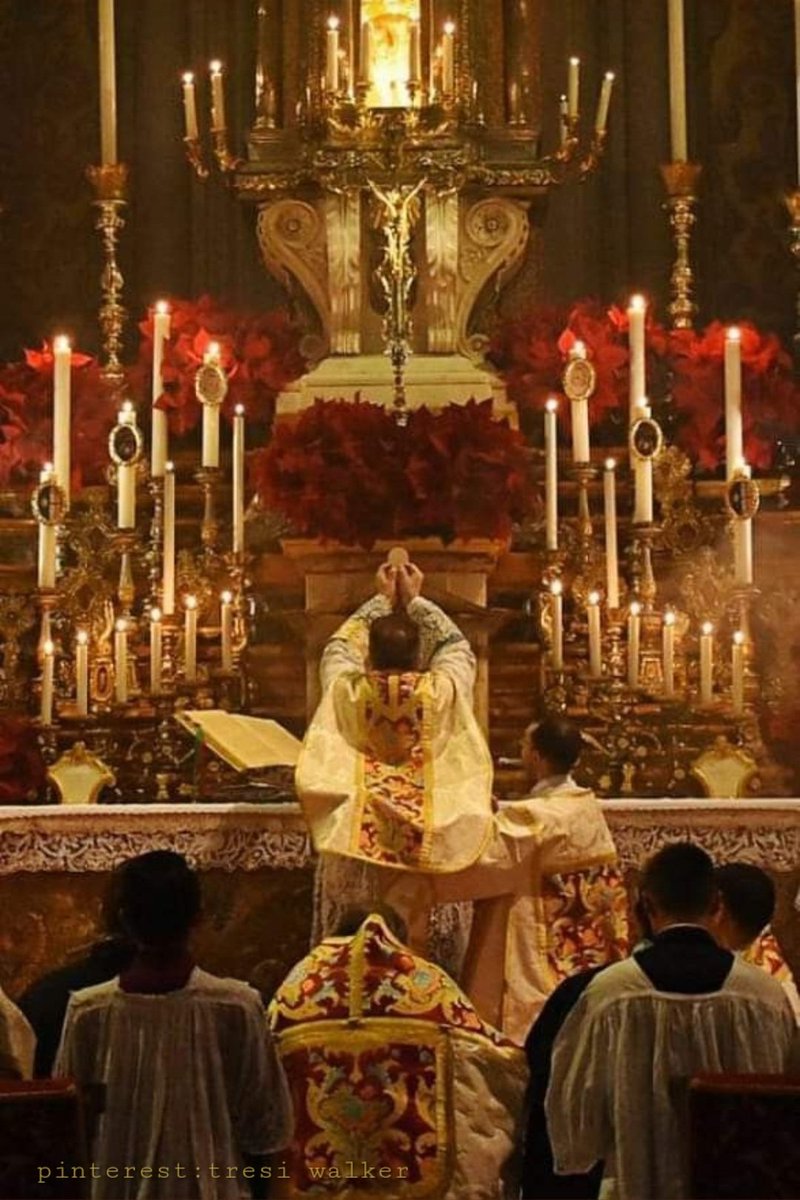
Besides being a sacrament, the Lord's Supper is a commemoration of the death of Christ; not, however, a mere historic commemoration, but a sacrificial commemoration, in which, while the human minister is performing the visible rite, Christ the great High Priest of the new covenant offers Himself to the Father in the attitude of a victim for our redemption. The idea is sublime, but difficult to explain.
There are many passages scattered through the New Testament which seem to regard the act of redemption as no mere momentary act, exercising an influence over the future and the past, but as an act mystically and yet truly eternal (1Peter 1:20 also many passages in Hebrews). Not only did Christ enter once into the holy place, obtaining in the act of entering an eternal redemption (Heb 9:12), but this entrance into holy place appears to be Christ's entrance into heaven (Heb 9:24); where He ever lives to make intercession for us (Heb 7:25); thus exercising forever His unchangeable and eternal priesthood by continuous mediation, and carrying on forever, though not repeating, the sacrifice once offered on the Cross (Heb 7:24 & Heb 5). Hence in the book of Revelations the Lamb is represented as alive, and yet standing as it had been slain (Rev 5:6).
Certain obscure passages seem even to go so far as to remove Redemption out of connection with any particular time, as in Rev 13:8, which reads as if the Lamb had been slain from the beginning of the world. There are other places which treat Christ's appearance on earth as the manifestation of a mystery kept secret from the beginning of the world, by which those who lived before His coming had been redeemed (1Pet 1:20). Without pressing this mysterious language too far, it may at least serve to illustrate the idea underlying the Catholic doctrine of the Mass; in which Christ's eternal intercession as the victim of redemption is, as it were, directed to His Father from the local centre of an earthy altar (and that we have an altar is clearly emphasized in Heb 13:10).
In this manner, the mystery of redemption is, as it were, brought nearer to us through the ages and made sensibly real to us in our midst here and now. By this continual priestly function is fulfilled that prophecy of Malachi 1:11 which tells of a clean oblation (minchah) to be offered in every place among the Gentiles, from the rising of the sun unto the going down of the same.
The correctness of any attempt to conceive this sublime idea will be safeguarded by the following theological propositions:
1. In the Mass, Jesus Christ is the Priest, offering Himself as the victim of redemption to the Father.
2. Christ's offering of Himself is identically the same as that on Calvary, but the manner is bloodless and mystical.
3. The human minister acts in the name and person of Christ, being strictly only Christ's deputy or instrument for the performance of the external rite.
4. The Mass is a local application of the one great sacrifice of Calvary to particular groups of souls, in divers times and places, rather than a repetition of the sacrifice itself.
Any idea, therefore, which Protestants have conceived of the Mass being derogatory to the one sacrifice or to the priesthood of Christ, is due mainly to the difficulty of understanding this very deep subject, and is not to be wondered at. A careful study of the above remarks will, at least, clear us of this charge.
"For from the rising of the sun even unto the going down of the same my name shall be great among the Gentiles; and in every place incense shall be offered unto my name, and a pure offering: for my name shall be great among the heathen, saith the Lord of hosts."
Malachi 1:11
By Ernest R. Hull
@paleochristcon The poster boy for logic lol and has an "extensive knowledge of guns" has yet to discuss the logic behind the 30-06 round and Charlie's neck. Clown world we live in.
@orthodox_33ad Christianity is being destroyed day in and day out all over the place, with the support of popular Catholic platforms. Indeed, may God have mercy on us, but chastisement would be appropriate at this point as nothing gets through to many of them.
@JackPosobiec Hopefully, the proceeds from the circus will cover the proposed debt to Iran and restore everything to pre-war conditions.
Zionist logic 101...Amazing!
Christians are no longer bound by the mosaic law and to keep to the Jewish Sabbath (Saturday) as Jesus Christ has fulfilled the Old Covenant.
When Jesus died for our sins, He "blotted out" the requirements of the Law of Moses, "nailing it to His Cross" [Col 2:14-16] therefore no one should judge Christians regarding specific food, drink, or the observance of the Jewish Sabbath. Hebrews 7:12 teaches that a change in the Priesthood necessitates a change in the law with Christ as our new High Priest and His new sacrifice, we also have a New Day of Worship.
The Gospel writers purposely reveal Christ's resurrection to be on Sunday, the new day of rest, the "FIRST DAY OF THE NEW CREATION," brought about by the Resurrection of our Lord [Matt 28:1; Mark 16:2,9; John 20:1,19]. Hebrews 4:8-9; if Joshua had given rest, God would not later speak of "another day,"which is the Sunday worship of the New Covenant. St. John explicitly notes in Revelation 1:10 that he witnessed the heavenly Eucharistic liturgy on the "Lord's Day" (Sunday).
Catholic teaching on the Day of Obligation is both Biblical and Traditional [2 Thess 2:15]. We follow the direct example of the Apostles. Christ's actions were intentional. He celebrated the Passover meal on Thursday, completed His sacrifice on Friday, and rose on Sunday. As God, He chose these days for a specific reason; to establish Sunday as the day of the New Covenant.
We see the early Church assembling specifically on the first day of the week to celebrate the Eucharist [Acts 20:7; 1 Cor 16:1-2]. In fact, in all three synoptic Gospels, Matt, Mark, and Luke, Jesus answers the rich young man by telling him to keep the commandments and then names them. The only one left out is keeping the Sabbath Day Holy. Jesus further explains that there are really only two commandments; first-Love God, second-love your neighbor, if you do this, you will keep all the Commandments.
Early Church Fathers continued this tradition from the Apostles throughout the history of the Church.
"On the day called after the sun (Sunday) there is a meeting for which all those dwelling in the cities or in the countryside come together...We all come together on the day of the sun since it is the first day, on which God changed darkness and matter and made the world. On that day, Jesus Christ, our Savior arose from the dead."
~ Justin Martyr (150AD)









![OrbitingGod's tweet photo. Christians are no longer bound by the mosaic law and to keep to the Jewish Sabbath (Saturday) as Jesus Christ has fulfilled the Old Covenant.
When Jesus died for our sins, He "blotted out" the requirements of the Law of Moses, "nailing it to His Cross" [Col 2:14-16] therefore no one should judge Christians regarding specific food, drink, or the observance of the Jewish Sabbath. Hebrews 7:12 teaches that a change in the Priesthood necessitates a change in the law with Christ as our new High Priest and His new sacrifice, we also have a New Day of Worship.
The Gospel writers purposely reveal Christ's resurrection to be on Sunday, the new day of rest, the "FIRST DAY OF THE NEW CREATION," brought about by the Resurrection of our Lord [Matt 28:1; Mark 16:2,9; John 20:1,19]. Hebrews 4:8-9; if Joshua had given rest, God would not later speak of "another day,"which is the Sunday worship of the New Covenant. St. John explicitly notes in Revelation 1:10 that he witnessed the heavenly Eucharistic liturgy on the "Lord's Day" (Sunday).
Catholic teaching on the Day of Obligation is both Biblical and Traditional [2 Thess 2:15]. We follow the direct example of the Apostles. Christ's actions were intentional. He celebrated the Passover meal on Thursday, completed His sacrifice on Friday, and rose on Sunday. As God, He chose these days for a specific reason; to establish Sunday as the day of the New Covenant.
We see the early Church assembling specifically on the first day of the week to celebrate the Eucharist [Acts 20:7; 1 Cor 16:1-2]. In fact, in all three synoptic Gospels, Matt, Mark, and Luke, Jesus answers the rich young man by telling him to keep the commandments and then names them. The only one left out is keeping the Sabbath Day Holy. Jesus further explains that there are really only two commandments; first-Love God, second-love your neighbor, if you do this, you will keep all the Commandments.
Early Church Fathers continued this tradition from the Apostles throughout the history of the Church.
"On the day called after the sun (Sunday) there is a meeting for which all those dwelling in the cities or in the countryside come together...We all come together on the day of the sun since it is the first day, on which God changed darkness and matter and made the world. On that day, Jesus Christ, our Savior arose from the dead."
~ Justin Martyr (150AD)](https://pbs.twimg.com/media/HE9Sn4kbcAAYpZg.jpg)


