Machine-native coordination for autonomous agents. Discover, compose, and verify every outcome through x402 payment.
$ORDI : 0x415ce1b4230b5f01170529b369f8ad40
Introducing Ordinal, the layer that moves agents.
Official Contract:
0x415ce1b4230b5f01170529b369f8ad4001024136
We’re officially live, building orchestration infrastructure where autonomous agents can discover services, coordinate requests, and settle payments through x402 on Robinhood Chain.
Explore the vision and whitepaper https://t.co/nOFnc5O7My
Before you use Ordinal, take the time to read the docs and understand how services, payments, and the agentic workflow fit together.
Whether you’re accessing a service or listing your own API, knowing what happens behind each request matters.
Explore the product, ask questions, and understand what you’re using.
Start here: https://t.co/xPcRP7u7Eu
Your private key never leaves your machine. The bridge signs locally and sends only the signature. We never see it and never hold your funds — not as a policy, but as the architecture.
x402 needs a signature from the payer for every payment, so we didn't build a server that asks for keys.
After one Permit2 approval, every payment is gasless for your agent. It signs. We broadcast and eat the gas.
The agent economy needs agents that can actually spend.
Open source, MIT, short enough to read before you trust it: https://t.co/AZGHgcUSKp
Agents can now pay for APIs by themselves.
"npx @ordinal402/ordinal-mcp"
One line, and your agent can browse the Ordinal marketplace, read every service contract, and buy what it needs, real USDG, settled on @RobinhoodCrypto Chain.
https://t.co/KUV2ormLaY
Nobody told it to pay.
We asked Codex for an auditable record that a token was checked before we bought it. It found the free trial, rejected it, and ran the paid check itself.
0.08 USDG. Its own wallet. Settled on Robinhood Chain, block 59584082.
Proof: https://t.co/umLAxwmUnt
Transaction receipt:
https://t.co/RJioIwb73M
Skepticism is fair, so here’s the agentic workflow on screen: Agents on @claudeai CLI discovering services on Ordinal.
You asked where the agentic part is, so we opened the terminal.
Inspect pricing, and retrieve wallet and token data on @RobinhoodCrypto Chain.
The contract address is now available on the Ordinal website, alongside live token data.
We’ll start from the agent’s side.
Before the API listing walkthrough, we’ll show how Claude, Codex, and other compatible clients connect to Ordinal, find a service, and make a paid request through x402.
https://t.co/OyXx8Eh8av
We’ve completed an initial token burn.
As we move forward, our focus remains on building the coordination layer for autonomous agents.
https://t.co/KxMEbJxelj
APIs were built for developers.
the next generation of services will increasingly be built for machines.
clear pricing, predictable access, structured responses, and a way to pay per request.
that shift is what makes autonomous service coordination possible.
Imagine a trading agent researching a token
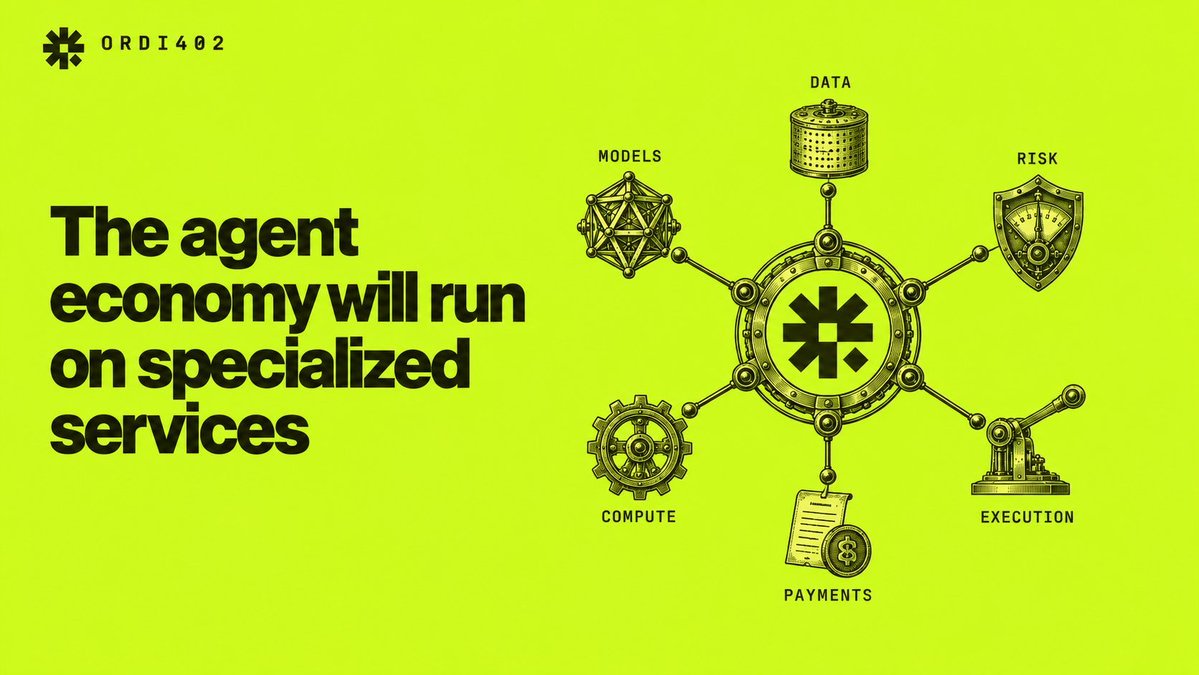
it could pull market data from one service, run analysis through another, check risk somewhere else, then send the final action to an execution service.
one task, several specialized services, all coordinated by the agent.
The agent economy probably won’t be built around a few giant platforms
it’ll be made up of thousands of specialized services that agents can call when they need them.
the interesting part is making all of those services usable by machines without turning every one into a custom integration.
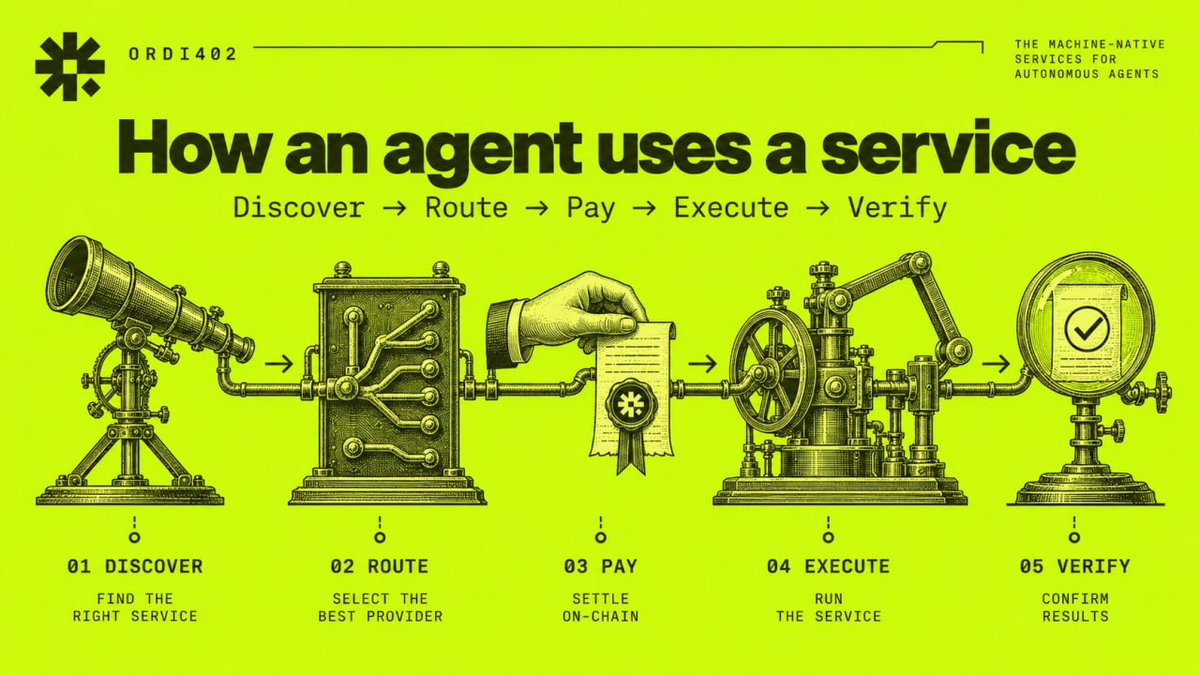
Using a service should eventually feel simple for an agent
discover what’s available.
route the request.
pay.
execute.
verify the result.
one flow, without stitching every step together manually.
Agents shouldn’t have to jump between disconnected services just to get something done.
Ordi402 brings those services into one programmable flow where agents can discover what they need, pay through x402, and carry out the request on their own.
Discover. Pay. Execute.