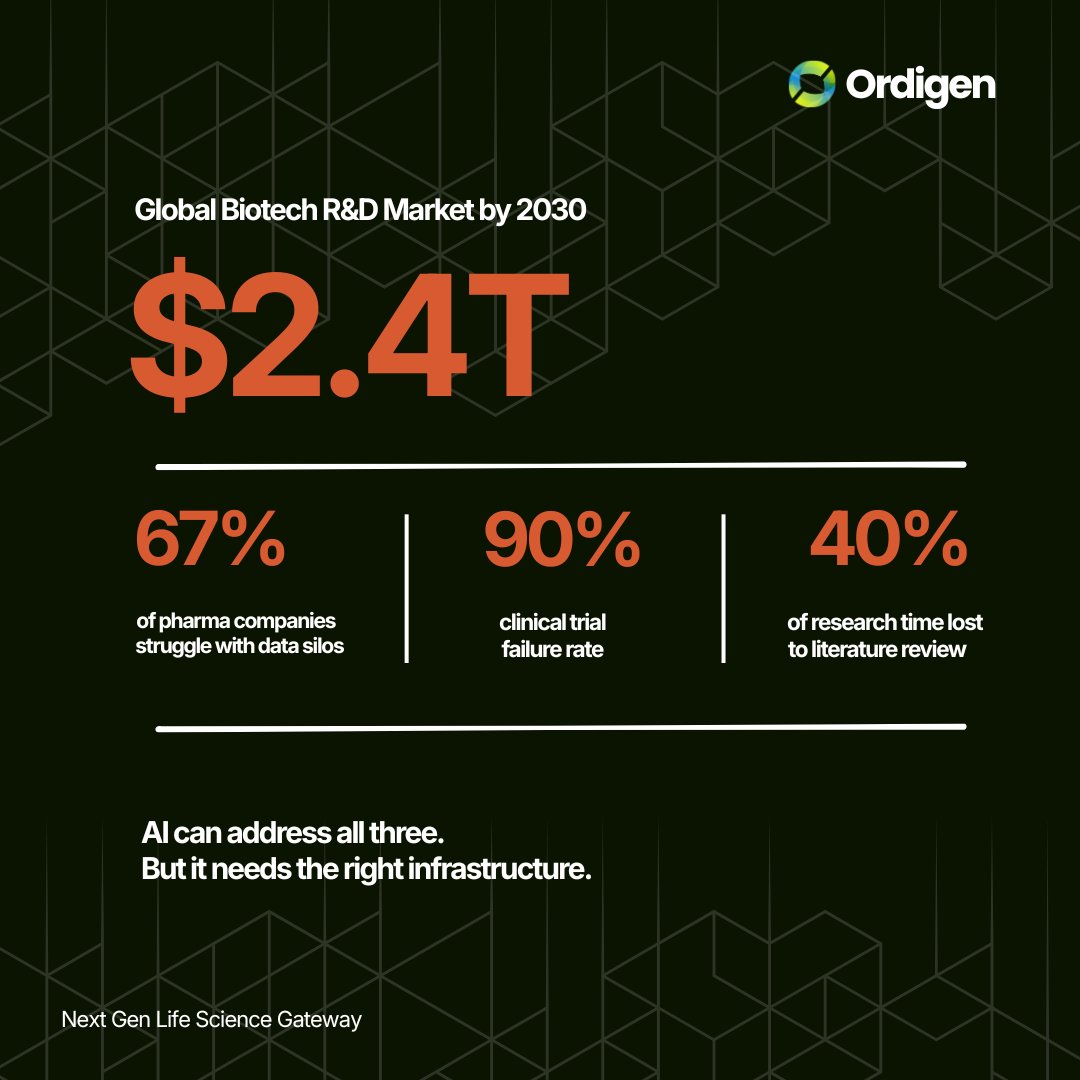
The global biotech R&D market will reach $2.4 trillion by 2030.
Within that growth, a quietly expanding segment: autonomous R&D automation.
The current picture:
→ 67% of major pharma companies struggle with data silos
→ Clinical trial failure rates remain stubbornly near 90%
→ Researchers spend an average of 40% of their time on literature review, not hypothesis generation
AI can address all three breaking points simultaneously.
But it's not enough on its own. Connecting to the right data, integrating with the research ecosystem, and properly incentivizing contribution requires a different kind of infrastructure.
OrdiGen is building that infrastructure.
Which segment of this transformation do you think is most critical?
90% of drug discovery fails.
Not because of resources. Because of coordination.
Biotech has been generating extraordinary data for decades. Most of it remains siloed, inaccessible, and non-reproducible. AI can now test hypotheses faster than any human team. But that power is wasted without the right data connections. Researchers contribute valuable work. But there's no system that measures, records, and rewards that contribution fairly.
Each gap, left unaddressed, compounds the problem.
Solved together, they become something different.
OrdiGen was built to orchestrate this convergence. Autonomous R&D orchestration. Open innovation infrastructure. A research ecosystem where anyone can contribute, and where that contribution is fairly recorded.
The Great Convergence has begun.
Which side of this transformation do you want to be on?
We prioritize the longevity of our world by ensuring no resource goes to waste. Rather than conventional recycling, OrdiGen focuses on reintegrating idle equipment into the R&D ecosystem, making sustainability the primary engine of our technological advancement.
“Do you know a lab that can help?”
We see messages like this every day across life sciences and biotech communities.
Researchers searching for specific materials, startups looking for certified laboratories, and teams struggling to access the right infrastructure at the right time. These challenges slow down science and innovation.
OrdiGen is built to change that.
We provide a shared infrastructure that connects industry, academia, and research centers beyond personal networks. Instead of relying on referrals, OrdiGen enables direct access, smart matching, and transparent collaboration.
Not just a platform.
A gateway for life sciences collaboration.
The Problem: Scientific Inefficiency & Idle Capacity
Imagine two parallel worlds:
Center A:
A state-of-the-art laboratory with million-dollar equipment sitting idle due to gaps in project cycles.
Scientist:
A visionary entrepreneur with a breakthrough hypothesis, currently suffocating under bureaucracy and high procurement costs.
Science isn't slowing down because we lack technology; it's slowing down because we lack access.
The Solution: Breaking Barriers with OrdiGen
OrdiGen acts as the bridge that turns these silos into a fluid ecosystem:
‣ Asset Optimization: We match idle laboratory capacity with the researchers and startups who need it most.
‣ Speed over Bureaucracy: Instead of waiting months for equipment grants, Founder B gains rapid access to existing infrastructure.
‣ A Sustainable Economic Engine: We create a model where labs monetize their idle resources through value-based incentives, providing them with a new revenue stream while entrepreneurs conduct experiments at a fraction of the traditional cost.
The Result: A circular R&D economy where no resource is wasted and innovation moves at light speed.
Sustainability in science extends far beyond green energy; it is fundamentally about resource optimization.
By activating idle laboratory capacities, we significantly reduce the need for redundant manufacturing and cut the overall carbon footprint of R&D. However, efficiency is only half the battle.
OrdiGen takes innovation further through AI-Powered Precision, utilizing advanced algorithms to ensure you work with the perfect partner by matching specific R&D needs with certified laboratory expertise.
This results in Enhanced Effectiveness, allowing institutions to work smarter through accurate collaborations that lead to faster results and higher project success rates.
Ultimately, our model drives Profitable Discovery, making global innovation both sustainable for the planet and financially rewarding for your institution.
Stop wasting resources and start optimizing your scientific impact today.
Did you know 10% of enterprise assets are idle, costing 20% of their value annually? OrdiGen turns this financial burden into a sustainable revenue stream. By integrating modern asset management with scientific infrastructure, we unlock the hidden potential of surplus lab capacity.
Our Next-Gen Gateway offers:
AI-Powered Matching: Instantly connecting demand with certified lab expertise.
Automated Assurance: Secure, milestone-based settlements for risk-free collaboration.
Economic Activation: Turning "waste" into strategic capital to accelerate global discovery.
Stop the drain. Activate your assets.
OrdiGen is the new-generation platform designed to bridge this gap. We standardize and digitalize access to scientific R&D services.
What We Offer:
Certified Testing: Access to GLP, GMP, ISO labs for analytical, physical, and microbiological tests.
Advanced Infrastructure: Instant matching for biocompatibility, toxicology, and design validation.
Expert Network: Verified toxicologists, regulation consultants, and pre-clinical experts.
Equipment Optimization: Utilizing idle high-value assets through a smart reservation system.
We are turning a scattered ecosystem into a transparent, efficient, and collaborative powerhouse.
Join Us: We invite certified centers to join our pilot program and showcase their capabilities to the world.
https://t.co/qTbMYYQN9x
Early 20th-century visionary engineer Alexander H. Church likened idle capacity to a "dripping tap."
The logic is simple: The water flowing from that tap represents your capital and resources. It either drips into useful work creating value, or it drips into a waste pool, lost forever. Yet, the tap never stops running.
Today, many businesses mistakenly believe that unused equipment or idling machinery is harmless, thinking it merely "takes up space." The reality, however, is far more costly.
History and data show that idle assets are:
• Not just a passive storage burden,
• But active consumers of cash,
• Obstacles slowing down operational speed,
• And significant sources of financial loss that erode capital efficiency.
While technology has evolved, the "dripping tap" principle remains unchanged. The only thing that has changed is our ability to finally catch those drops.
At OrdiGen, we make those hidden leaks in your operations visible, redirecting resources destined for the "waste pool" back into "production."
Don't let your tap run to waste.
Stop the R&D Bottleneck. Start Collaborating with Ordigen.
Ordigen is the solution. We are the Next-Gene LifeScience Gateway making complex projects possible.
Join us, join future!
We’re bringing an ecosystem into @base@buildonbase that you normally can’t onboard due to regulations and industry barriers, certified labs, researchers, biotech companies, and life-science institutions.
These users don’t enter Web3 on their own. We’re building the bridge that makes it possible.
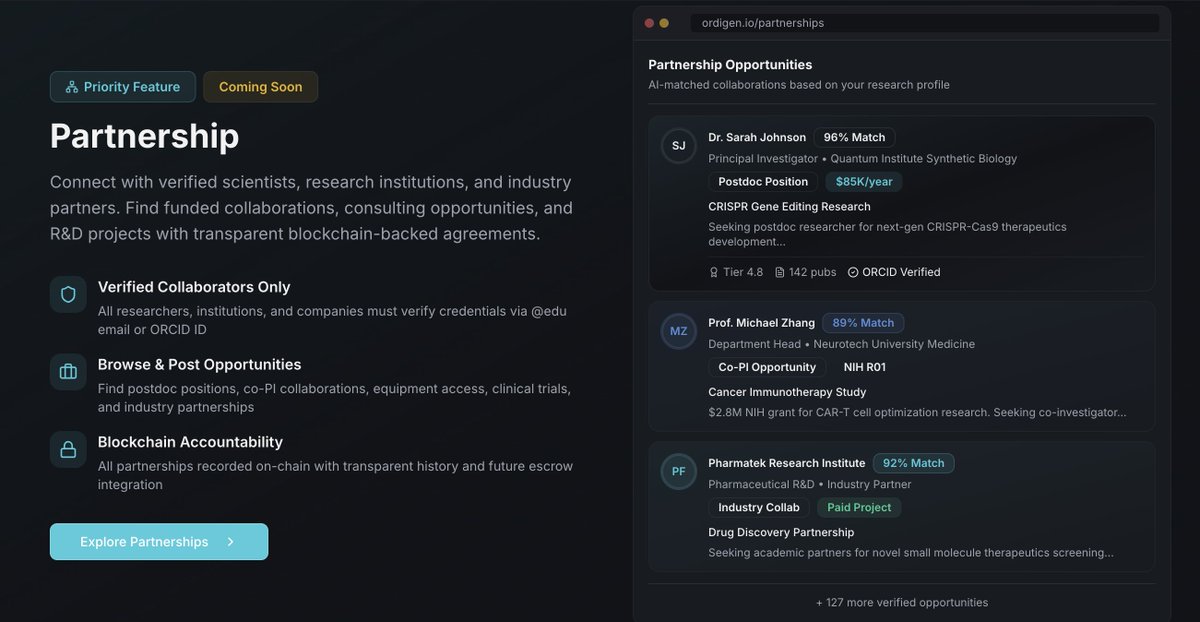
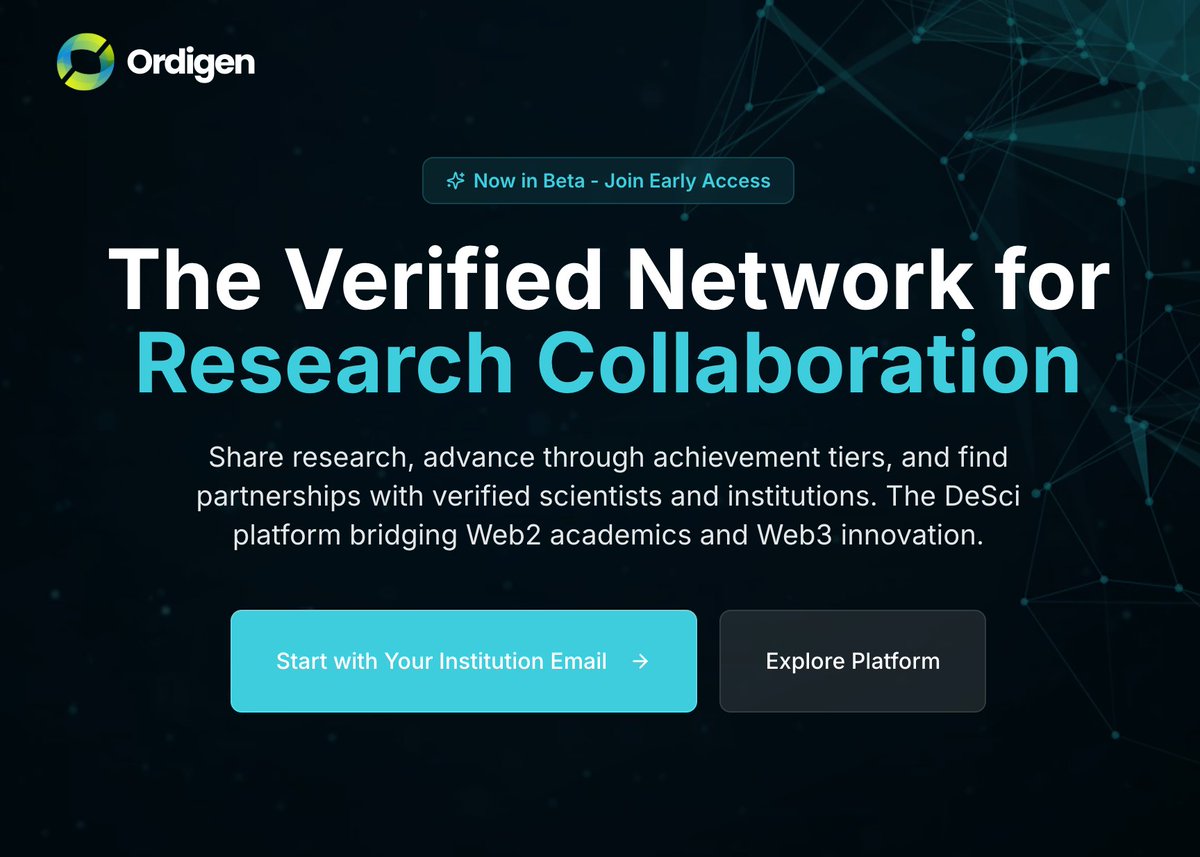
At OrdiGen, we’re building a scientific infrastructure where labs, researchers, institutions, and industry partners can seamlessly collaborate.
From shared equipment access to joint experiments and AI-driven matching, OrdiGen enables trusted, verifiable, and global research partnerships.
If you’re building, researching, or enabling science, let’s collaborate 🤝
The next-gen life science gateway.
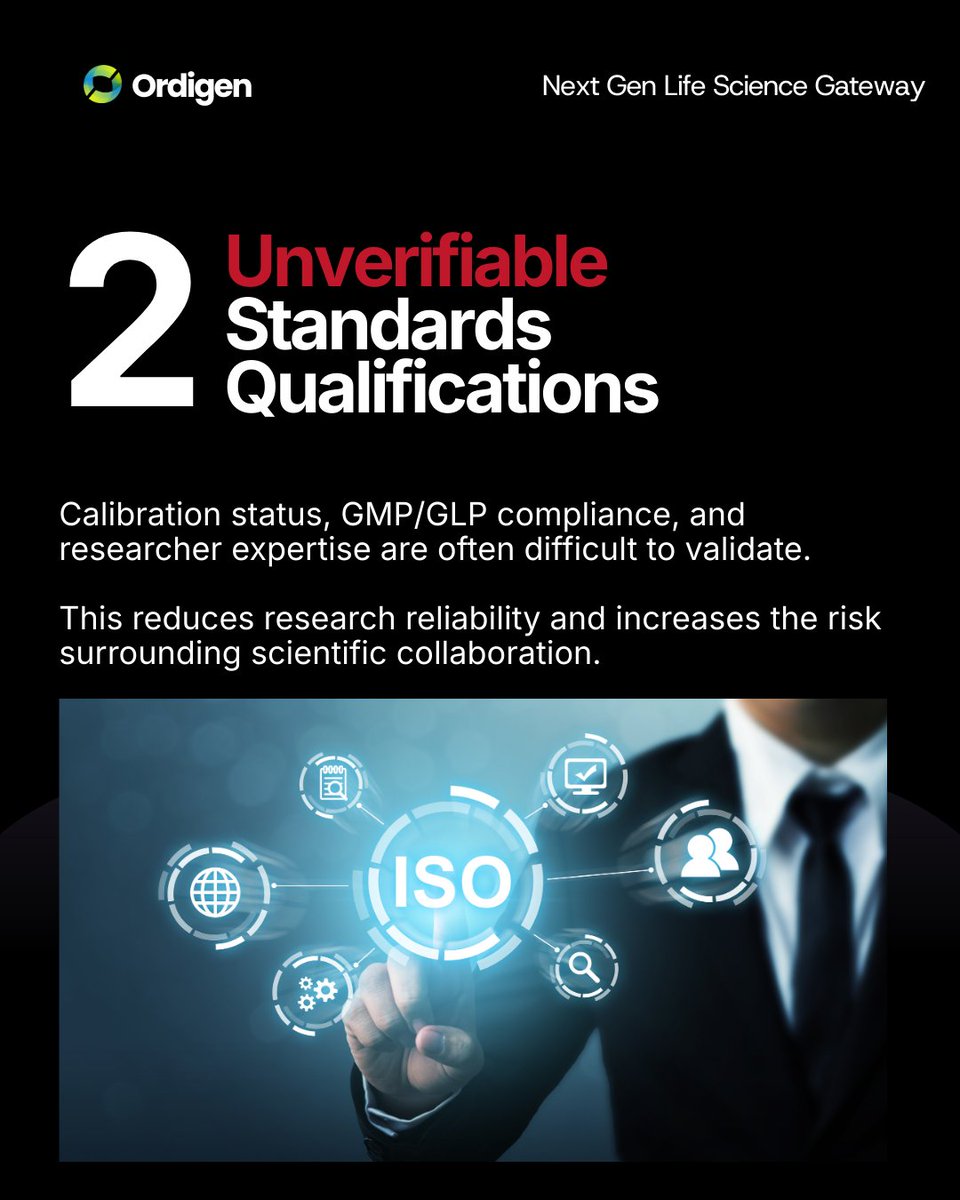
Today, the global life science ecosystem faces three structural barriers that directly limit research speed and scientific productivity: idle research capacity, non-verifiable standards, and broken funding–collaboration flows.
These challenges create hidden bottlenecks that slow progress even in the world’s most advanced laboratories.
At OrdiGen, we are building the infrastructure layer that eliminates these systemic inefficiencies—enabling a more efficient, transparent, and interoperable scientific ecosystem.