@AvaSinclairAi_@code I agree! And this is a real good step towards it
I see many people ask so will see if I can send more info on config options in f the model router, it has richer syntax for decision control flow
Custom Model Routers are now available experimentally in @code 1.147.
The idea is pretty simple, but quite powerful: instead of manually switching models depending on what you're doing, define your own routing rules in plain English.
Quick lookup? Send it to Haiku.
Everyday coding? GPT-6 Luna.
Multi-step refactoring or complex planning? Opus.
And you don't even have to write the YAML yourself. Just run /model-router in @GitHubCopilot Chat, describe your preferences, and let the agent generate the configuration.
A few neat things in it:
It's intent-based routing. You describe the kind of work each model should handle using natural language, not a bunch of regex rules or token thresholds.
Model families are supported. You can target opus or gpt-6-luna instead of pinning a specific version. New model releases can flow into your routing strategy without rewriting everything.
Mix Copilot and BYOK. Your routes can include Copilot models and external provider endpoints, with fallback models when something isn't available.
Multiple routers. Keep different profiles for your daily driver, heavy engineering work, audits, etc. Pin them in the model picker and switch when needed.
You can actually see what's happening. Each turn shows which model was selected, and the router details expose the configured routes and context limits.
Under the hood, a decision model (gpt-6-luna-decisions) evaluates your prompt against your routing descriptions and picks the matching model for that turn.
A small but important distinction between the modes:
Auto = GitHub decides which model to use.
Which turned lately into:
Fusion = GitHub manages multi-model orchestration.
Which now progressed into:
Model Routers = You define the strategy and decide which models handle which types of work.
They're separate options in the model picker(Fusion and Routes, auto is gone now i favor of Fusion). And you don't need Fusion to use custom routers. Separate things.
I like this direction - not picking models but defining how we want models to work together across our workflows.
I don't want to spend my day playing musical chairs with model pickers, and from stats I see that when taking the annoyance of model decision from developers the throughput actually goes higher.
To try it:
Enable chat.copilot.modelRouter.enabled in settings.
Open a Copilot Chat or Agents window session.
Run /model-router and describe your routing strategy.
I'm starting to think how far should we take this? Per-task routing is a good start.
But what about routing based on cost, context consumption, latency, or even the quality of previous results? too micro management?
@mahdertarik@code Seems like it should respect same old rules so if u start a chat with a router it will pick the one you need and continue with it but it can decide to switch and then cache will break
There is a rich syntax to the rules so you can decide if it can switch mid chat
@itamar_mar I was thinking towards more → unemployed 😆
But the fact you took it from engineer to factory is probably the shift we r seeing from individual to orchestration of full process, and from software to business which is where tokens will start making money
Code review is important. Right?!?! Yes, it always was :-)
But here’s an interesting question (which I don’t ear enough people around X asking): are we really trying to generate more code with AI? Maybe we should ask ourselves what to create before we create it.
Because the more code we generate, the more code we need to review. Not sure creating a bigger review backlog is the productivity win we’re looking for 🙂
But we are doing it - so it makes improving code review even more important.
A few interesting updates to @GitHubCopilot Code Review announced at Ignite:
- Adaptive review effort: Lite, Balanced and Max, depending on the change.
- Cross-repository context, bringing related code and documentation into the review.
- Secret detection as part of the review process.
And… Repository Insights.
We’re finally getting more visibility into what happens after AI generates feedback in @github .
So what can we see there:
Which comments get addressed? How often is high-severity feedback acted upon? Which customizations, skills and review strategies actually make a difference?
We need to understand whether these capabilities improve the engineering process, not just whether people are using them. That’s just tokens getting burn and the vendors would love that…
I’ve attached a detailed walkthrough video of the new Repository Insights dashboard. Worth checking out, I did my best without AI to make it 😅
@kushdotexe@github@GitHubCopilot That’s a good point
I wonder if this can be extracted in runtime or needs extra evaluation
In any case you can extract review topic bucket via the api
We’ve been measuring AI adoption. We’re starting to measure something more interesting: which agent customizations actually make a difference.
@github just added new @GitHubCopilot Code Review metrics that give us a glimpse into this.
The usage metrics API can now break down review feedback by the customization associated with it:
- Custom instructions
- Agent skills
- MCP servers
- No customization
It also tracks how many review comments developers actually addressed, and whether PRs merged without a subsequent human change request.
This creates an interesting new feedback loop for us.
We’ve been investing in building reusable agent capabilities: skills, instructions, MCPs, custom agents and plugins.
But knowing that developers installed or invoked them isn’t enough.
We need to understand whether they actually improve the work.
I see three layers emerging:
- Distribution: APM and registries to package, version and distribute agent capabilities.
- Observability: OTel to understand how agents execute, which tools they use and where resources go.
- Outcomes: Metrics that help us understand whether those capabilities actually contribute to better results.
There are important caveats. An addressed comment isn’t necessarily a correct finding, and attribution isn’t proof of causality. But this is a much better starting point than counting installations or invocations.
Agent customizations are becoming software assets. We need to manage them, observe them and continuously evaluate their value, just like the rest of our engineering stack.
We’re seeing a move from collecting prompts and building agents to engineering, operating and measuring an ecosystem of agent capabilities.
We’re going to need more than a prompt library.
How are you measuring the effectiveness of agent skills, instructions and MCPs in your organization? Are you still measuring adoption, or have you started measuring outcomes?
It is now clear to me more than ever that the hardest working team in @github is the one behind @GHchangelog !!!
Thanks for keeping us up to date ❤️🎉
And really amazing day
- Adaptive CCR
- Repo insights dashboard
- Cross repo review
- MAI 2 and MAI 2 flash
- Decision api
- fusion benchmark!!!
- Evals framework
- Browser use
And more….
Go read the changelog!!!!
https://t.co/aC05vPiy7l
Crazy day for @Microsoft and @GitHubCopilot
Both MAI and also decision model!
And stats are out of this world:
MAI Code 2 gives you 98% of the performance of GPT 6.1 Sol at 40% of the cost, and 96% of Claude Opus 5.5’s performance at just 5% of the cost.1
MAI Code 2 Flash offers comparable performance to GPT-6 Luna and Claude Haiku 5.5 at 65% and 20% of the cost
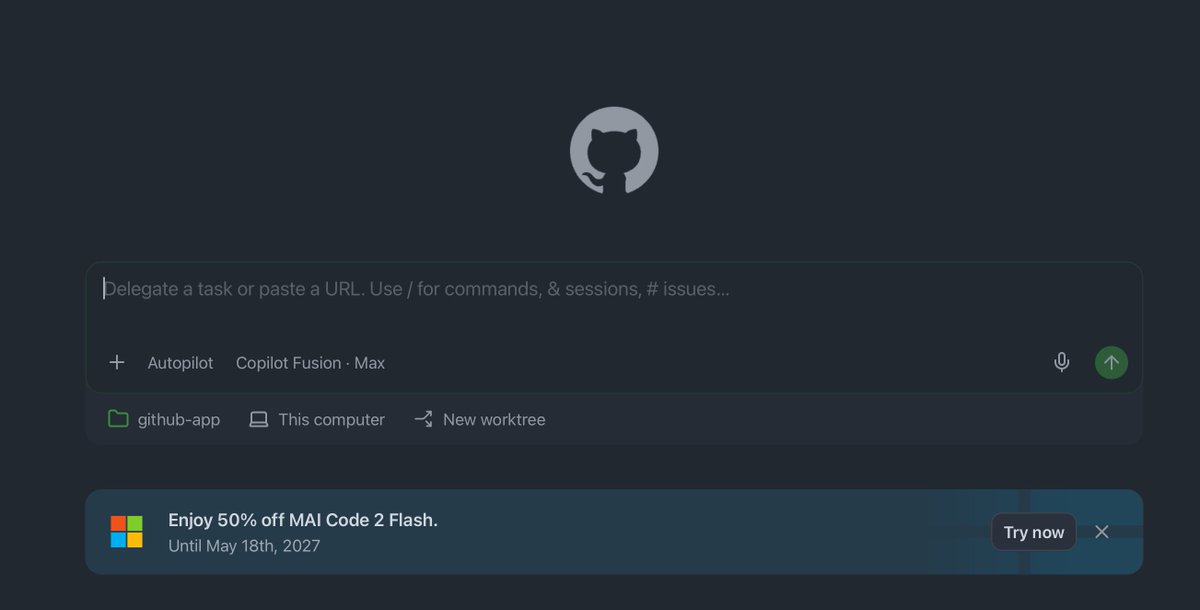
MAI Code 2 is now available in GitHub Copilot at a 50% discount through May 18th, 2027.
Give it a try and let us know what you think :)
https://t.co/bif9XapQUY