Great line here from Cathy Tie in the Guardian about how germline gene correction, limited to correcting terminal or debilitating conditions, upholds the sanctity of human life.
Interesting proof-of-concept for multiplex base editing in embryos.
That said, we were surprised by the lack of optimization and benchmarking. The study does not explore guide stoichiometry, delivery parameters, RNA stabilization strategies, or next-generation ABE variants designed to improve editing precision and reduce bystander activity.
We were also surprised by the comparison against Cas9 rather than against the current generation of adenine base editors.
Finally, editing outcomes in MII-stage embryos cannot always be inferred from observations in HEK293 or hESC systems, making developmental context an important variable to consider.
At Origin Genomics, we believe these questions are the real frontier. We're building experimental systems to systematically study how editor architecture, delivery, guide design, and developmental context influence editing outcomes in human embryos.
The paper demonstrates feasibility. The more interesting question is how much further efficiency and precision can be pushed with systematic optimization.
1. Our IRB-approved research is intended to study the safety of germline gene editors and help create safe germline gene therapy frameworks in the future.
2. 95% of monogenic diseases have no FDA-approved cures, there are millions of real families suffering from passing down genetic diseases to their children.
3. Parents constantly make decisions for their children's health, that is the standard in bioethics. All medication, like gene therapies (e.g. Baby KJ's case) that are given to newborns or infants are consented under this framework.
4. Safe germline gene correction offers the possibility of preventing the passing down of severe genetic diseases generation after generation, that's what makes it highly effective. Thus, more research should be done on its safety and efficacy as we charter into this medical frontier.
#bioethics
How can germline gene editing be considered “responsible” when it carries the risk of unintended off-target effects that may impact future generations in unknown ways? Shouldn’t prudence come first, especially when the consequences are irreversible and affect individuals who cannot consent?
#bioethics
Genetic surgery to correct damaged embryos is something that could be life-changing (and life-creating) for some parents struggling to have children. The technology is here to do this. It's time to have the hard conversations on how to do this safely and ethically. I encourage people to listen to the debate Cathy mentions here, see https://t.co/1De6MDL2Wn
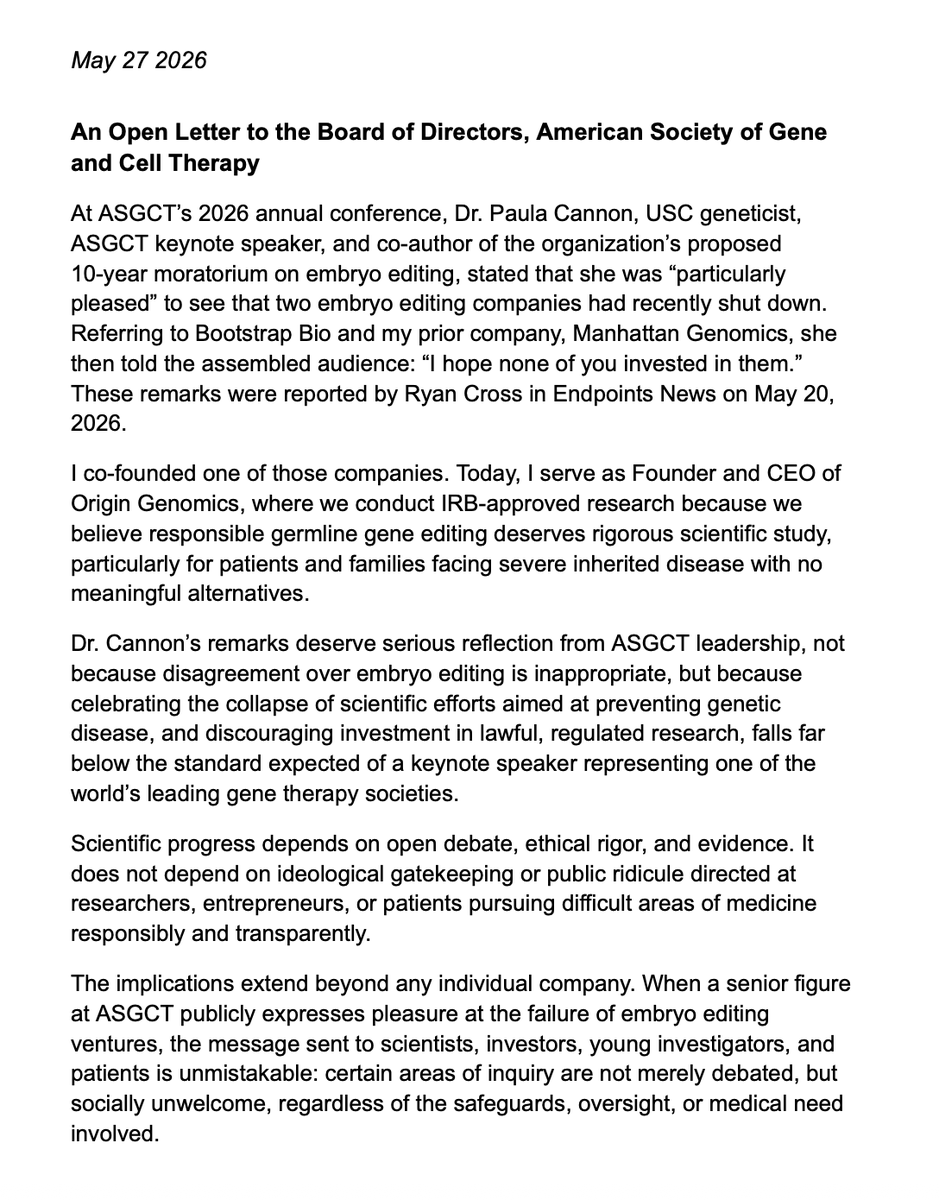
For the past year, I have been the subject of multiple biotech media takedowns and hit pieces. I kept my composure through all of it.
But recently, a different line was crossed when I was mentioned in the same article as a keynote speaker at the world’s largest gene and cell therapy conference (@ASGCTherapy), who proceeded to speak and act in a way that is not only unprofessional towards me, but compromising to the American public.
Her words and actions deserve serious scrutiny and accountability. Not for me, or the scientists and entrepreneurs in this field, but for the patients left with no options for their genetic diseases.
This is why I penned an open letter to the Board of Directors at ASGCT.
We believe frontier biotechnologies like germline gene editing must be developed transparently and responsibly.
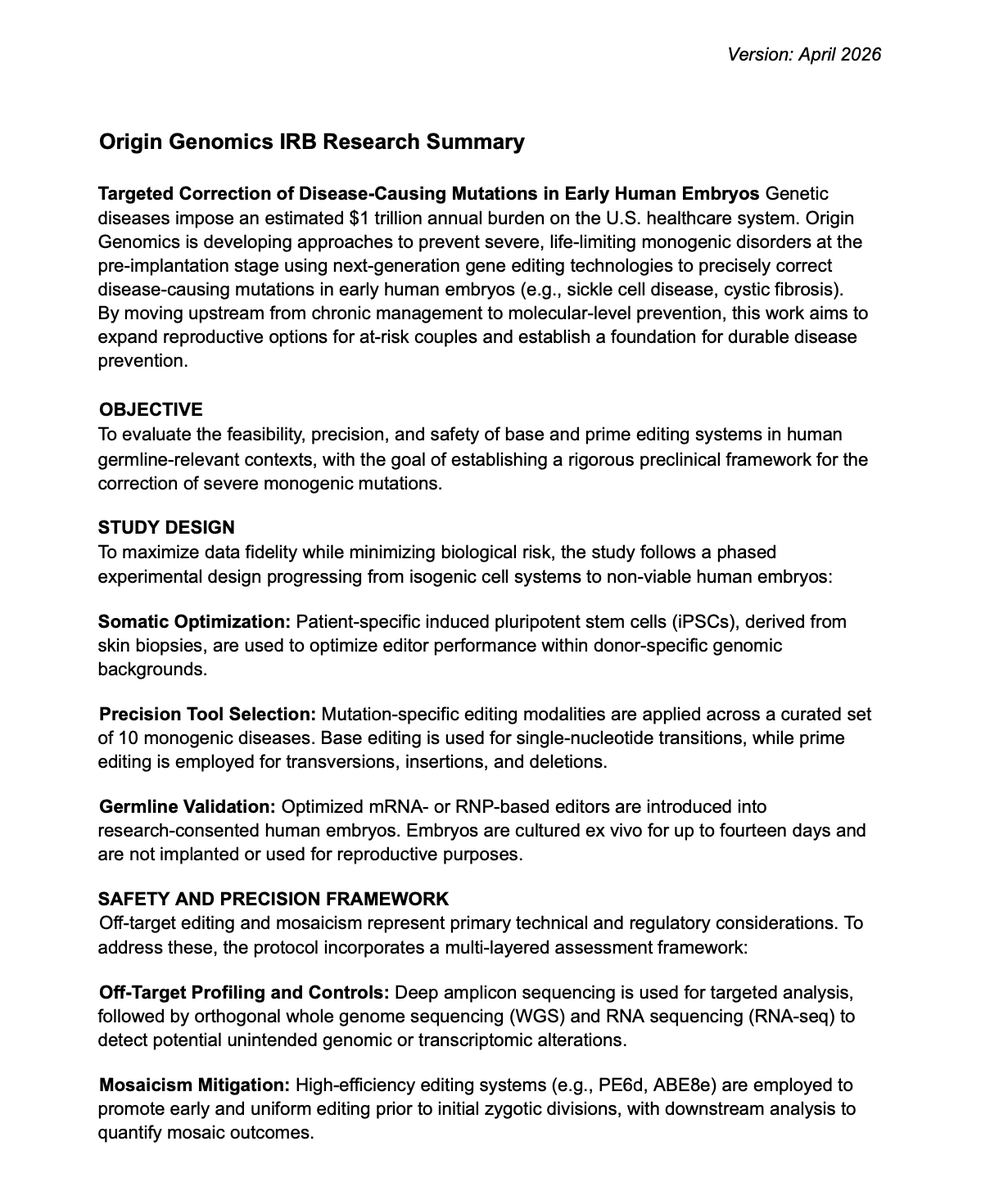
That’s why Origin Genomics publicly shared our IRB summary, which we believe is a first for this field.
We hope more companies follow. Long-term public and regulatory trust will not come from secrecy, but from rigor, transparency, and accountability.
Sharing for the first time, our research plan: Human embryonic gene editing to correct disease-causing mutations and prevent heritable disease.
All research conducted with IRB oversight in the United States. Transparency is core to how we operate at @OriginGenomics.
Big thank you to Nicole and Asaf for courageously sharing their experiences with IVF and genetic disease at the Annual Hastings Center debate, bringing a much-needed human perspective to the conversation on embryo gene editing.
In germline gene correction, risks don’t just affect one person, they can carry forward across generations. But the same is true for benefits. Preventing a serious genetic disease once could mean no one in that family ever has to face it again.
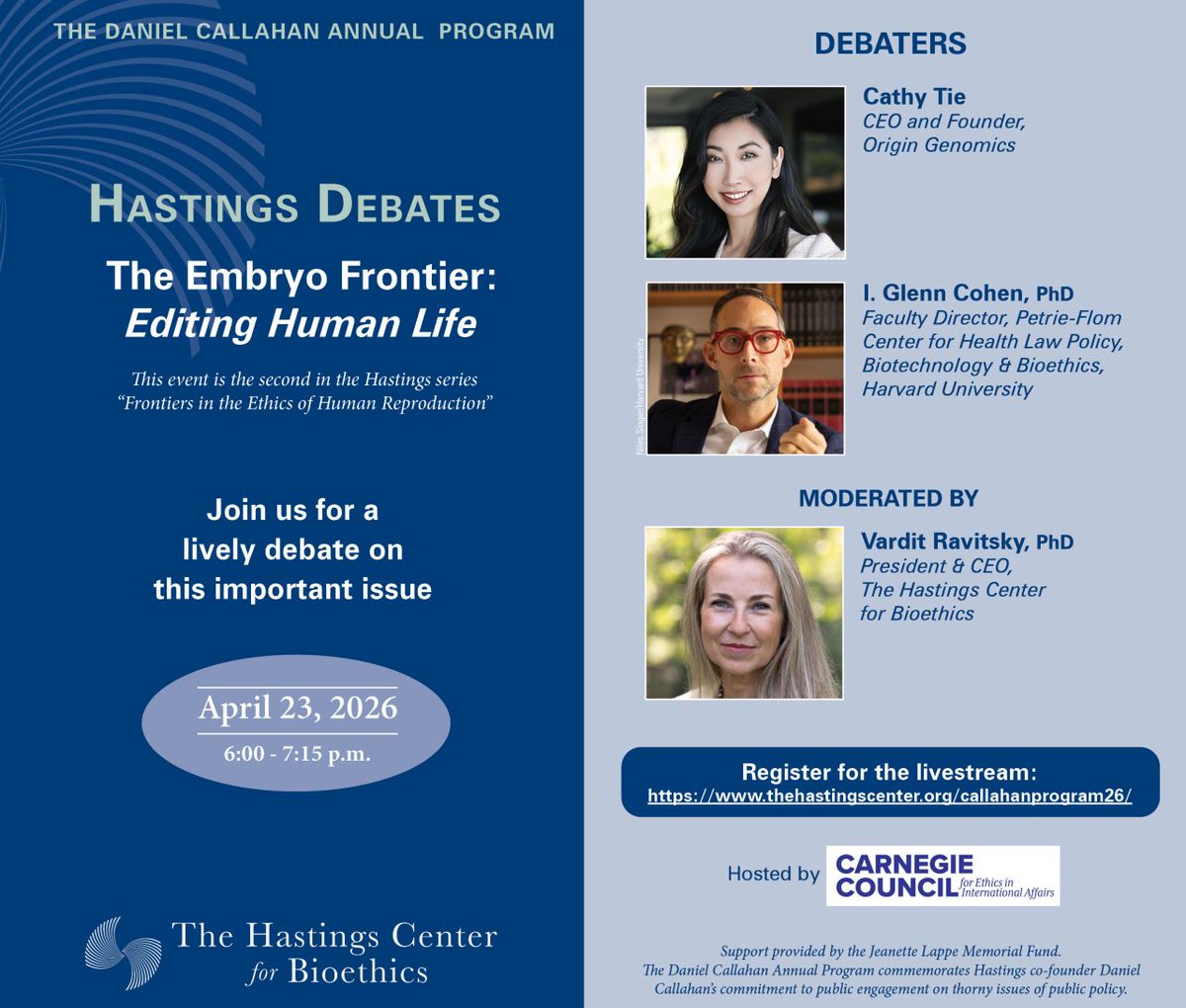
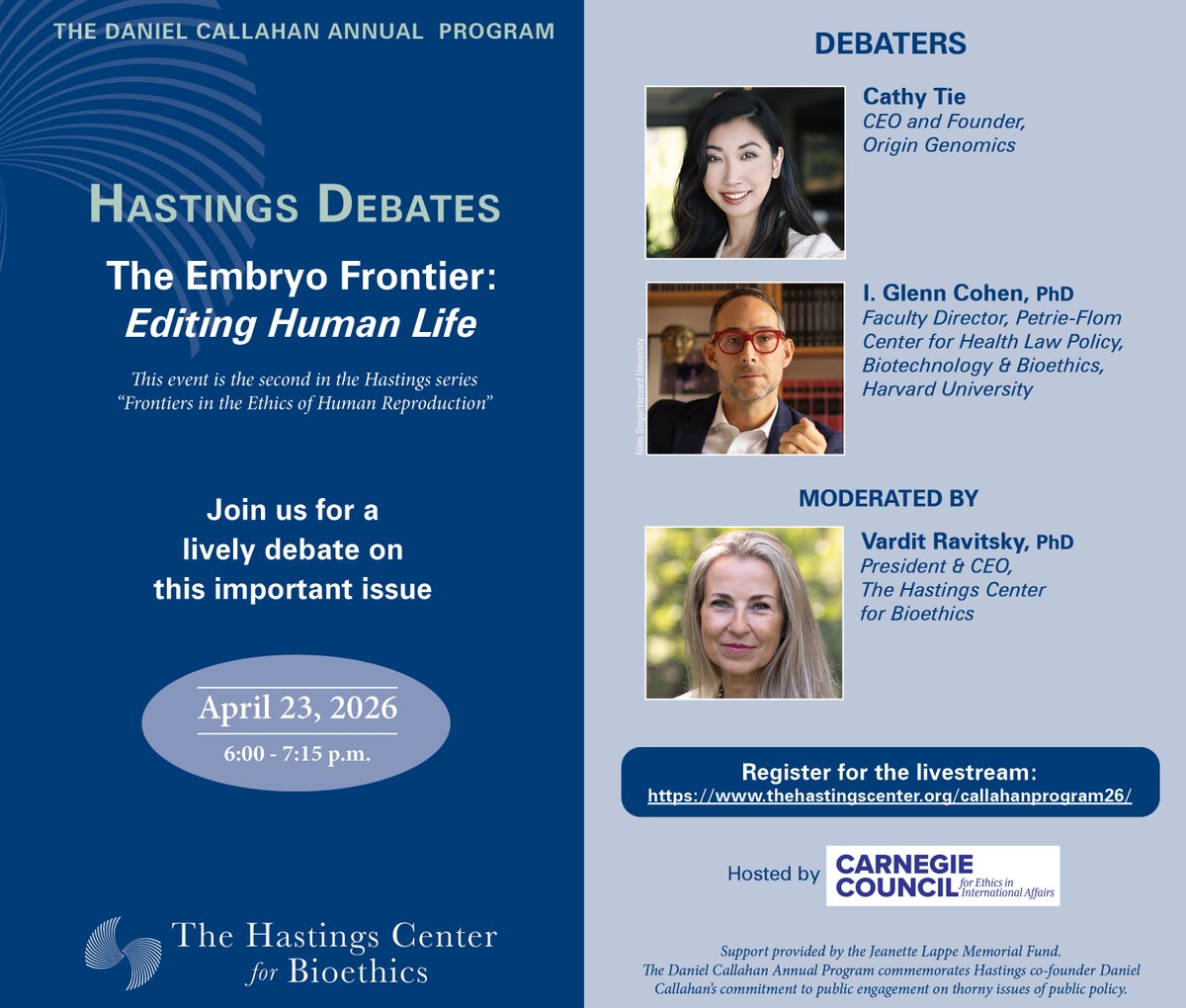
Our founder, @CathyTie, debates Glenn Cohen, Deputy Dean of Harvard Law School at the Annual Daniel Callahan Program hosted by the Hastings Center.
VIDEO: The Embryo Frontier: Editing Human Life.
The full debate on human heritable genome editing between @CathyTie@OriginGenomics and Harvard bioethicist Glenn Cohen @hastingscenter
https://t.co/MaSHq4EO9X via @YouTube
Sharing for the first time, our research plan: Human embryonic gene editing to correct disease-causing mutations and prevent heritable disease.
All research conducted with IRB oversight in the United States. Transparency is core to how we operate at @OriginGenomics.
Germline gene correction will happen.
The focus now is doing it with precision, rigor, and clear ethical guardrails.
That’s what we’re building at @OriginGenomics.
The real question in gene editing isn’t just what we can do, it’s what we should do, and when.
At Origin, we’re starting with severe inherited diseases where the need is clear.
It won’t be easy, but it’s worth doing.
Q&A: Cathy Tie is back with a new embryo editing startup after shutting down her last, doubling down on one of biotech’s most controversial frontiers. https://t.co/hPwFzkHFJi
Q&A: Cathy Tie is back with a new embryo editing startup after shutting down her last, doubling down on one of biotech’s most controversial frontiers. https://t.co/hPwFzkHFJi
Origin Genomics launches in the U.S. to study precision germline gene correction for severe inherited diseases under IRB oversight.
Read more: https://t.co/ioUkxmBdQq
#OriginGenomics#GeneEditing#Biotech@OriginGenomics
It's no secret that I hold vastly different opinions than the current mainstream bioethics field on the use of germline gene editing.
"Should gene editing be applied to embryos that are predisposed to cancers, alzheimer's, heart disease? or limit its use to only homozygous early onset death diseases?"
"If a couple has embryos with genetic mutations, should they adopt children instead or seek germline gene therapy to correct the mutations in their existing embryos?"
The answers to me are clear. Hosted by @hastingscenter and @carnegiecouncil, I will be debating the Deputy Dean of Harvard Law School, I. Glenn Cohen, on the ethics of germline gene editing.
Register for the free livestream here: https://t.co/3MwBkh9aKF
Join us virtually on 4/23 for our Annual Daniel Callahan Program. We will have a lively debate...Should we edit human #embryos to prevent disease—or does it go too far? This timely subject tackles the science, ethics, and future of #GeneEditing ⚖️
🔗: https://t.co/9UcX31bu8p