Path Robotics has developed a legged robot called Rove for large-scale industrial welding.
It moves to the worksite and scans welding seams to understand their shape.
Then, its AI performs welding and adjusts the process in real time.
Was bound to happen.
Many more of these discoveries are yet to come.
Excited for AI to decode material science, fusion, biotech breakthroughs and physics related tech.
JUST IN: Scientists say AI has decoded communication patterns in mice, dolphins, apes, birds, whales, & cuttlefish — could eventually lead to humans communicating directly with animals.
Built a pottery app today, where your real hands throw virtual clay 🏺
Hand tracking > clay deformation > real-time physics
No controller. No stylus. Just hands.
Everything built within @omma_ai + threejs
Model of the puppet hand: credit to LiamVandeWouwer (SketchFab)
Airbnb stuck their entire customer journey up on their office walls.
Drawn by a Pixar animator, pinned where everyone walks past them daily.
30 frames.
15 for hosts.
15 for guests.
They call it "Snow White."
Chesky stole the idea from a Walt Disney biography in 2011.
Every new product idea has to answer:
→ "Which frame does this serve?"
If it fits a frame, that determines the owner, who prioritises it against their KPIs.
If it doesn’t fit a frame, it doesn’t serve the customer, and doesn’t get shipped.
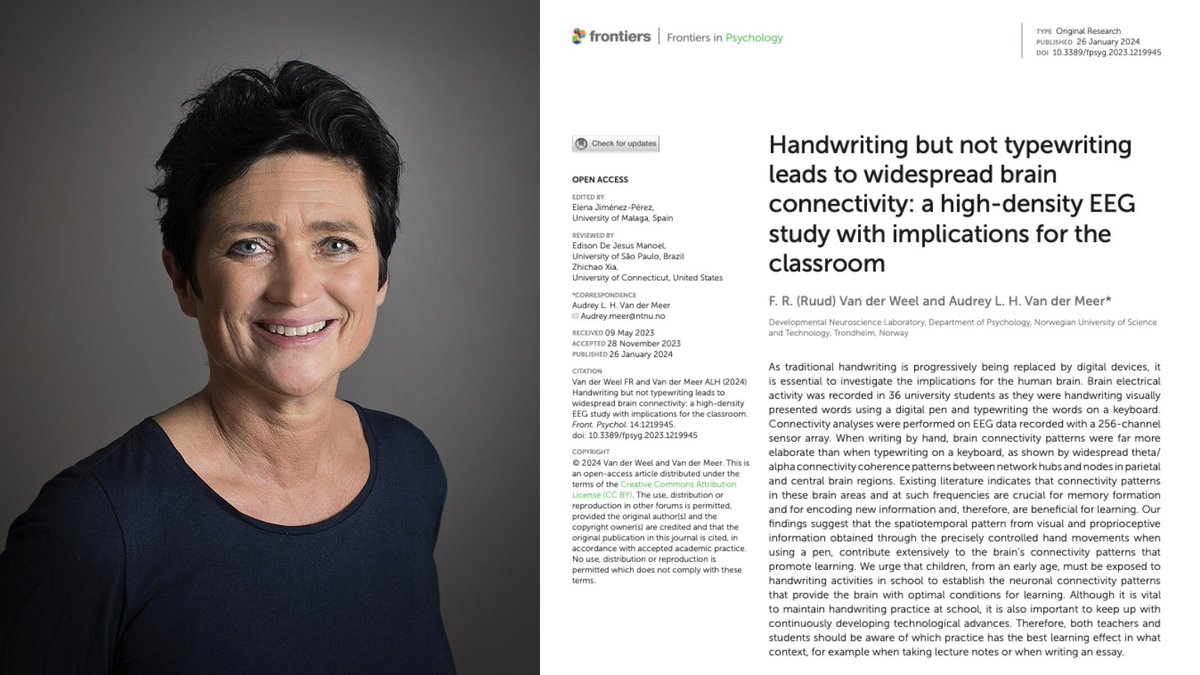
A Norwegian neuroscientist spent 20 years proving that the act of writing by hand changes the human brain in ways typing physically cannot, and almost nobody outside her field has read the paper.
Her name is Audrey van der Meer.
She runs a brain research lab in Trondheim, and the paper that closed the argument was published in 2024 in a journal called Frontiers in Psychology. The finding is brutal enough that it should have changed every classroom on Earth.
The experiment was simple. She recruited 36 university students and put each one in a cap with 256 sensors pressed against their scalp to record brain activity. Words flashed on a screen one at a time.
Sometimes the students wrote the word by hand on a touchscreen using a digital pen, and sometimes they typed the same word on a keyboard. Every neural response was recorded for the full five seconds the word stayed on screen.
Then her team looked at the part of the data most researchers had ignored for years, which is how different parts of the brain were communicating with each other during the task.
When the students wrote by hand, the brain lit up everywhere at once.
The regions responsible for memory, sensory integration, and the encoding of new information were all firing together in a coordinated pattern that spread across the entire cortex. The whole network was awake and connected.
When the same students typed the same word, that pattern collapsed almost completely.
Most of the brain went quiet, and the connections between regions that had been alive seconds earlier were nowhere to be found on the EEG.
Same word, same brain, same person, and two completely different neurological events.
The reason turned out to be something nobody had really paid attention to before her work. Writing by hand is not one motion but a sequence of thousands of tiny micro-movements coordinated with your eyes in real time, where each letter is a different shape that requires the brain to solve a slightly different spatial problem.
Your fingers, wrist, vision, and the parts of your brain that track position in space are all working together to produce one letter, then the next, then the next.
Typing throws all of that away. Every key on a keyboard requires the exact same finger motion regardless of which letter you are pressing, which means the brain has almost nothing to integrate and almost no problem to solve.
Van der Meer said it plainly in her interviews.
Pressing the same key with the same finger over and over does not stimulate the brain in any meaningful way, and she pointed out something that should scare every parent who handed their kid an iPad.
Children who learn to read and write on tablets often cannot tell letters like b and d apart, because they have never physically felt with their bodies what it takes to actually produce those letters on a page.
A decade before her, two researchers at Princeton ran the same fight using a completely different method and ended up at the same answer. Pam Mueller and Daniel Oppenheimer tested 327 students across three experiments, where half took notes on laptops with the internet disabled and half took notes by hand, before testing everyone on what they actually understood from the lectures they had watched.
The handwriting group won by a wide margin on every question that required real understanding rather than surface recall.
The reason was hiding in the transcripts of what the two groups had actually written down.
The laptop students typed almost word for word, capturing more total content but processing almost none of it as they went, while the handwriting students physically could not write fast enough to transcribe a lecture in real time, which forced them to listen carefully, decide what actually mattered, and put it in their own words on the page.
That single act of choosing what to keep was the learning itself, and the keyboard had quietly skipped the choosing and skipped the learning along with it.
Two studies. Two countries. Same answer.
Handwriting makes the brain work. Typing lets it coast.
Every note you have ever typed instead of written went into your brain through a thinner pipe. Every meeting, every book highlight, every idea you captured on your phone instead of on paper was processed at half depth.
You did not forget those things because your memory is bad. You forgot them because typing never woke the part of the brain that would have made them stick.
The fix is the thing your grandmother already knew.
Pick up a pen. Write the thing down. The slower road is the faster one.
The Man Behind Grand Theft Auto VI and a $45 Billion Media Empire: Strauss Zelnick
Strauss Zelnick has been one of the most powerful people in media for decades, and most people still don't know his name. He took over Take-Two Interactive while the company was under criminal investigation and was 6 months from bankruptcy. It had one product that made money (GTA); everything else was unprofitable. Since then, Take-Two has gone from a $700 million disaster to a $45 billion empire built on Grand Theft Auto, Red Dead, and NBA 2K. His management philosophy fits on a napkin: hire the best creative talent on Earth, don't interfere, and run a rational company. He's been doing that for more than 4 decades. This conversation was awesome.
0:00 Hostile Takeover With No Money
1:29 Becoming the New Media Guy
3:58 Lessons From Entertainment History
9:44 Why Hollywood Feared Games
11:52 Fox Turnaround and Barry Diller
20:54 Rupert Murdoch and High Stakes Calm
26:20 Taking the Leap to Crystal Dynamics
38:04 Bootstrapping Without Capital
43:57 Carl Icahn Connection
47:01 Take Two Proxy Coup
56:36 Turnaround Cost Cutting Playbook
1:01:37 Leading Creative Geniuses
1:06:24 Rationality Beats Magic
1:07:54 Borderlands Bet
1:09:28 GTA Timelines Pressure
1:11:22 Specific Goals Visualization
1:21:34 Service Leadership Mindset
1:31:52 Media vs. Entertainment
1:34:22 AI Productivity Reality
1:36:08 Why Hits Surprise
Includes paid partnerships.
robotics needs better talent, not just ideas or capital
get good at any of these and become the person every robotics team is trying to hire:
autonomy stack:
– state estimation, planning, controls or the in‑house stack nobody else can touch
sim & test infrastructure:
– lossless logs, reproducible sims, rl loops (nvidia isaac sim, gazebo, mujoco)
fleet ops & deployment:
– ota updates, connectivity, getting data off robots in the field (greengrass, alloy, formant, or duct tape)
data, debugging & replay:
– figuring out why the robot did what it did, logs, time‑series, post‑mission analysis (mostly homegrown, rerun/foxglove, alloy)
embedded & edge systems:
– getting all of this to run on jetson / rb5 / weird industrial pcs
safety, compliance & verification:
– kill switches, test harnesses, ethics boards, fda submissions, and the standards work nobody wants to do
data engine & labelling:
– building the labelling, eval, and feedback loops that keep the robot from drifting into chaos
go to market & raas:
– pricing, contracts, usage‑based billing, customer success for robots‑as‑a‑service
if you’re trying to jump into robotics (or want to work with us), my dms are open 🦾
🧵The quiet revolution in robotics isn't humanoid, or world models..
It's the rise of inspection & maintenance robots, quietly scaling across dirty, dangerous, and distant industrial environments.
This sector is projected to hit $8.3B by 2030. Let's break down why it's growing so fast.
[Save this thread for later 📌]