Sure, some mutations are beneficial and selection removes many damaging ones. Neither fact shows how random mutation produces new specified functional sequences. A beneficial change is often a modification or loss of existing function.
antibiotic resistance by a degraded pump, a broken regulatory switch, a shifted binding affinity. Those are real advantages. They are not the assembly of a new gene, a new protein fold, or a new body plan. Saying “mutations can be beneficial” doesnt distinguish a tweak that selection can keep from the origin of the information that specifies a novel function.
You have restated the mechanism, not answered the problem. Genes being copied is the starting point, not the explanation. Replication preserves sequences that already exist. Mutation changes which of those sequences get copied. That tells us how a variant spreads after it exists. It does not tell us how a new, specified, functional sequence is found in the first place.
I am not making Lamarck’s mistake, and I am not saying adaptations are read off from experience. Random mutation is blind. That is the problem. A conjecture in a mind can be aimed at a problem. A copy error cannot. Selection then keeps whatever is already better at getting into the next generation. Before a change specifies a function selection can register, selection is not building anything. It is waiting.
Calling both “knowledge” just names the same two-step pattern: vary, then discard. It does not shrink sequence space. Most changes are neutral or harmful. The rare useful ones are usually modifications or losses of something already coded, not the assembly of a new specified sequence. Filtering scrambled or less-copied variants explains what disappears. It does not explain how the functional code arrived before selection had anything new to keep.
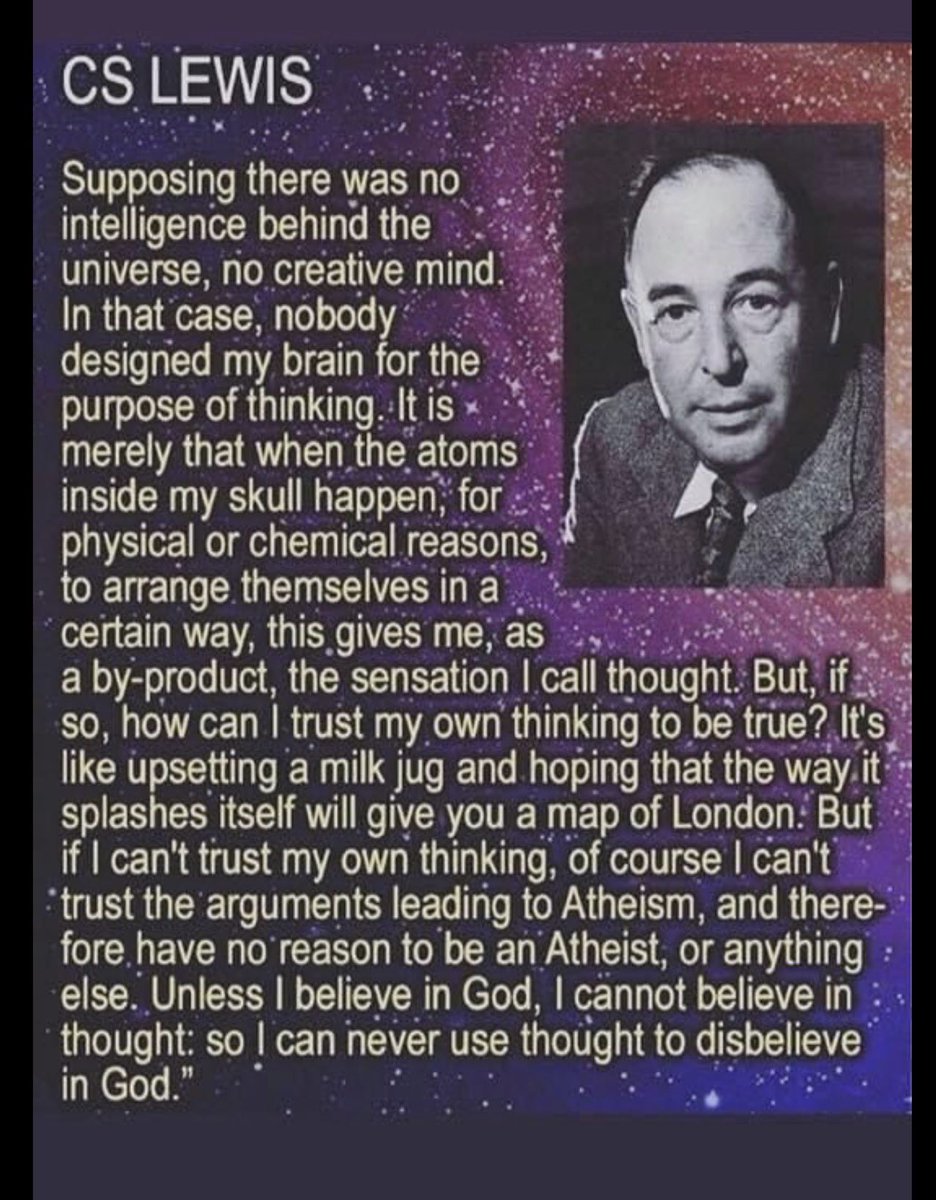
Btw, knowledge itself would be impossible in a godless universe. You help yourself to all these preconditions for knowledge that are epistemically unjustified on an atheistic system. Universals you can’t lay claim to as a finite being. The atheist uses logic to refute theism, mathematics to describe nature, and induction to predict tomorrow. Those acts treat universals as objective and shared. Physicalism and nominalism explain them away at the level of ontology and then borrow them back at the level of argument. A theistic account grounds the universal in the divine mind, that is, created things share structures because they reflect logoi that are not themselves physical particulars.
Most mutations are neutral or harmful.
Given enough time, they tend to scramble existing functional code before they assemble a new, specified sequence that selection can keep. Time therefore works against the preservation of information as much as it provides more chances to generate it.
Natural selection doesn’t create new traits by itself; it acts on variations that already exist, favoring those that improve survival or reproduction.
I already answered this. It’s human error and dogmatism. The responsibility is in the theory’s philosophical extension, not in a design mistake. Unguided evolution became widely persuasive because naturalism was already the rule of method, and because evidence of informational discontinuity was set aside. Darwinian theory is as an overextended account of evidence that already pointed elsewhere. You have people like Richard Dawkins saying “Darwin made it possible for me to be an intellectually fulfilled atheist”. This isn’t because that’s where the evidence points.
Design detection does not stand or fall on a reconstruction of why this biosphere rather than another. “Failed” foresight assumes the biosphere more strongly supports the false theory than the design hypothesis, which is the claim under dispute.
@ScienceQriosity@causalknowledge@darwintojesus Information in the bare sense is a measure of complexity or improbability. Specified information adds an independent pattern that the complex sequence matches.
@causalknowledge@ScienceQriosity@darwintojesus 🤦♂️ Allow me to word it differently then for you dude 😂 mutation and selection do not have the causal power to bring forth large scale changes in the history of life.
Nope, the sequence DOES NOT show that functional biological information arises from unguided mutations. All this shows i that a string of characters can be lengthened and slightly altered on a page. Those are different claims.
Biological information as I mean it is not mere string length or Shannon entropy (a measure of raw unpredictability or bit-count). DNA bases already carry sequence complexity; adding random bases increases that quantity in a trivial sense. What matters for the origin of genes, proteins, and regulatory systems is functional or specified information, that is arrangements that produce a selectable effect (a folded protein, a binding site, a metabolic step) rather than noise. Most possible nucleotide strings of a given length do no such thing.
Darwinism as a whole has some truth to it. Microevolution, adaptation, and loss or modification of existing information are real; I grant them. What I deny is that mutation and selection have been shown to generate the quantities of new specified information and the higher-level anatomical novelty the history of life exhibits.
Not blindsided. The appearance is produced by over-extrapolating small-scale change and by reading the fossil and genetic records through a gradualist expectation they do not clearly meet.
Evolutionary theory “seems true” largely because methodological naturalism (which all scientists adhere to) rules out design at the outset and because microevolutionary observations are dogmatically, without a shred of evidence, treated as sufficient for macroevolutionary information gain. Evolutionists (probably including yourself) say all the time that “given enough time” the change in question will happen. This is not an explanation; it is tantamount to saying magic produced it.
Evolution is bunk and the only people who hold to it are just accepting it because its the status quo. Theres more evidence against evolution than there is FOR it. Macroevolution has never been observed. You’ve still failed to demonstrate how information can come from pure matter/physical stuff. I’m not wasting any more time conversing with you, retard.
@causalknowledge@ScienceQriosity@darwintojesus This does… what? It just says that any actual proof or computation is a physical process, and that what can be computed depends on the laws of physics. This doesn’t give an account of reason or math.
@waldocalrissian@ChristiansSTDT If the laws of logic are universal — that is holding for every thinker, at every time, in every place, and not contingent on anyone’s agreement — then they are not human conventions. RETARD
He says there can be no evolutionary advantage to memory or color perception unless it changes later movement, and that cognition is important only to drive or suppress movement. This strips the brain of any inherent purpose to think truly. On that account, “correct inference” collapses into “output that happened to aid survival or movement.” Bayesian “optimal” beliefs are optimal for action under a fitness criterion, not for correspondence to reality.
Tell me you can’t read without telling me you can’t read. I answered this already. Asking how God could make identity fail is asking for a coherent description of the incoherent. There is no coherent description of a world in which a thing both is and is not the same thing in the same respect. The inability is a feature of the law’s necessity.
Also I’d like to point out that if the laws of logic are conceptual and concepts can never be found apart from a mind then it follows that God is the guarantor of logic.
And you think that gets you out of it 😂 The same problems arise. Physical events have no truth bearing properties and there is no aboutness to chemistry. A dopamine cascade is not about a premise. An ion channel opening is not a negation. Two molecules binding is not the proposition that physicalism is true. Truth and aboutness are properties of judgments, beliefs, or propositions. If the ontology contains only physical events, those properties have to be either denied, reduced to something that is not itself truth or aboutness, or added as a brute extra.