"Double-jointed"
Describes someone about 5% of the population that can hyperextend knees and elbows; metacarpophalangeal joints extending to 90 degrees; thumb able to touch forearm, some can even ‘do the splits’ or place their feet behind their neck!
In orthopaedics, paediatric 👶 practice demands special skills! You may lack firsthand accounts of symptoms; a screaming baby will tell you very little, and anxious parents may overshare. Be flexible during examinations. If a child moves a joint, examine movement then and there💨
Just a heads-up: muscle weakness could sometimes be caused by a muscle issue, not just a nerve problem. When muscles aren’t working right, the weakness tends to affect a larger area and is usually balanced on both sides. Plus, you’ll likely still be able to feel things normally.
Flexion 🆚 Extension
- In elbows, knees, wrists, fingers >> Flexion means bending the joint and extension means straightening it.
- In shoulders and hips >> Flexion is movement in an anterior direction and extension is movement posteriorwards.
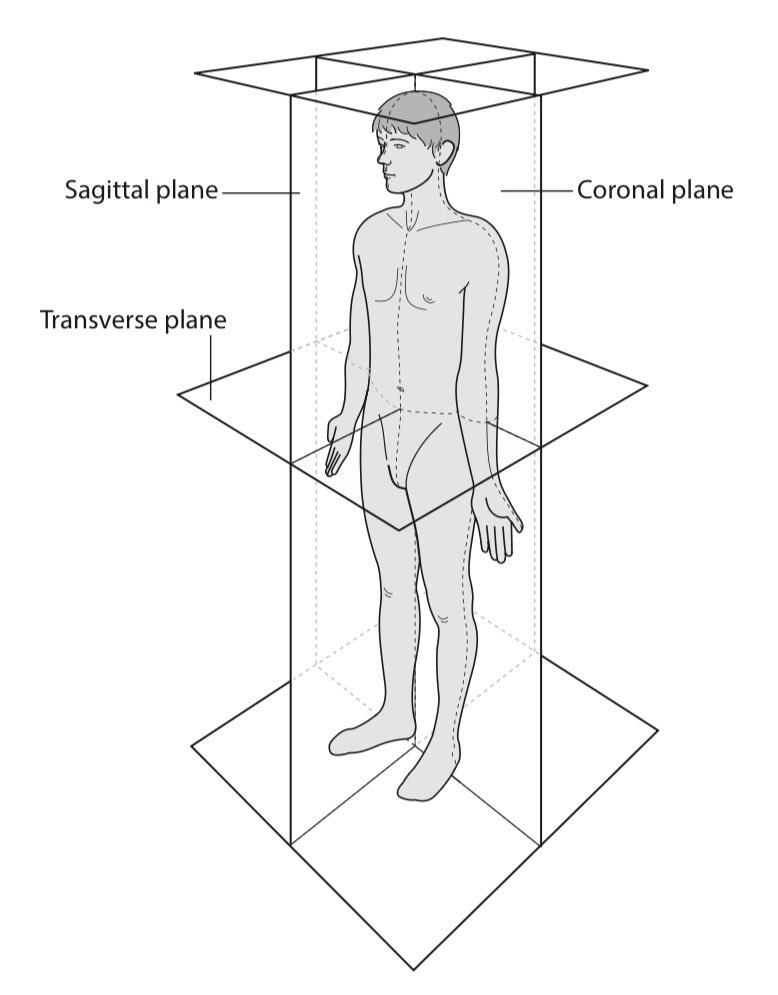
- The principal planes of the body -
Sagittal: vertically oriented, dextra & sinistra
Coronal: vertically oriented, anterior & posterior
Transverse: horizontally oriented, superior & inferior
When it comes to Orthopaedics examination 🧐, the “Look, Feel, and Move” approach is a well-known way to assess patients. Over time, this method evolved to include “Test,” which now encompasses special maneuvers to evaluate neurological function and complex functional abilities.
Things that must come to your mind 💭 about symptoms in orthopaedics are:
Pain (most common), Stiffness, Swelling, Deformity, Weakness, Instability, Change in Sensibility, and Loss of Function.
A common example is “Sciatica” 🦵🏻
Pain along the sciatic nerve is not always caused by sciatic or lumbar nerve roots compression but can be referred from various structures in the lumbar spine, pelvis, or posterior capsule of the hip joint.
Referred Pain
Pain from deep structures is diffuse and can have unexpected distributions. This isn’t because sensory nerves connect several sites, but the cerebral cortex 🧠 can’t clearly differentiate between sensory messages from separate but embryologically related sites.
Identifying the pain site may be vague, but its precise location is crucial in orthopaedics.
“Ask patients to point to the pain rather than say where it hurts.”
Note‼️
Don’t assume the site of pain is always the site of pathology; referred and autonomic pain can be misleading.
- Grade I (mild): Pain that can be ignored
- Grade II (moderate): Pain that can’t be ignored, interferes with function, and needs attention/treatment
- Grade III (severe): Pain that’s constant & demands constant attention/treatment
- Grade IV (excruciating): Truly extreme pain
“Pain” is the most common symptom in orthopaedics. A typical approach is to ask the patient to rate their pain on a scale from 1 to 10, where 1 means it’s a minor annoyance 🫤 and 10 means it’s completely unbearable 😫
However, this method can be tricky because people who haven’t ever felt intense pain might not be able to accurately gauge what 8 or 9 feels like 🤨
Here’s a simpler way to think about pain: