Classroom orthographic investigations are planned & embedded in learning throughout the day to unfold the order, sense and meaning beneath the surface. Read our post to discover more https://t.co/90dzl71xuC
Classroom orthographic investigations are planned & embedded in learning throughout the day to unfold the order, sense and meaning beneath the surface. Read our post to discover more https://t.co/90dzl71xuC
@MaryBethSteve18 Twi-headed 1895 OED quote suggests literal sense, found no evidence of figurative. ‘ twi-minded’ (1883): having 2 minds/thoughts - V Woolf used alternant <twy> 'twy-minded' (1932). Evidence suggests <twi> and <twy> are bound bases found in hyphenated & compacted compounds.
@wordtorque Less common, often literary, in words from recent past: twi-clustered (1834 poem by Coleridge) twi-flamed, twi-headed, twi-nature (Yeats 1897) twibill a mattock, & my favourite twichild -second childhood. <twi > of OE origins occurs in compounds & etymologically related to two
Daily we take photos of a 'wonder' & share before sunset. Inevitably, we view these orthographically.
Adapt this for students to share observations & the word’s story. In doing so discover the orthography of words is always more than surface accuracy.
https://t.co/6c29vED7Cq
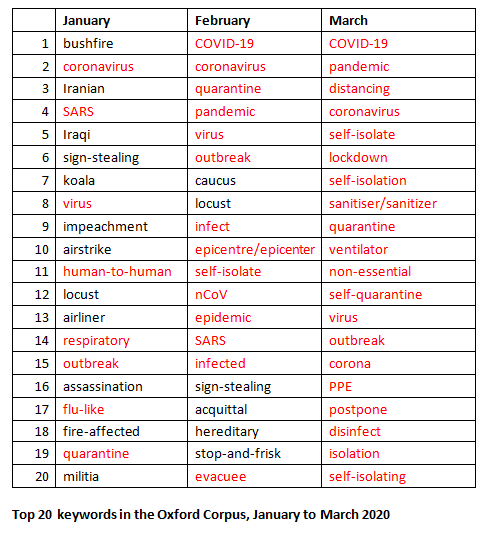
Interesting to see how language reflects moments in time and particularly interesting to compare the usage across the months. It’s all there condensed in those keywords.
The impact that the current pandemic has on the English language can be explored by looking at corpus keywords over the past few months. In March, the top twenty keywords from our new monitor corpus were ALL related to the coronavirus.
Learn more, here: https://t.co/40v9MD4XJ0
Read Online Etymology Dictionary to follow the journey of the words in a 'time of corona' into English. Consider what was happening when each word was attested. Words reflect a time, place and culture.Share the story of these words with students: https://t.co/G2XuIJwIFf
@markus_munday@Katerin15965527 Love the orthographic lunchtime hypothesising. Uncovering the morphological relatives, analysing the elements in word sums and considering the morphological family provides essential nutrients to nourish the mind!
In this weekend's @WSJ Review section: "Infodemic," a word coined in 2003 by @djrothkopf, aptly encapsulates how quickly misinformation can spread in a public health crisis like the coronavirus outbreak. https://t.co/CPQpNvdm1f
In the tradition of the trusty field guide genre, our new series'A Field Guide to Words' highlight relevant information in small notes, intriguing facts and plant seeds for further inquiry and study. Read more here:
https://t.co/192jDCCP1k
Last weekend we reassembled for the third day of our workshop series ‘Understanding English Orthography: Planned inquiry in the classroom’’.
We worked together, analysed and synthesized words, followed word... https://t.co/dFL3JcMQQ4
Our workshops model carefully planned classroom inquiries to reveal the sense and order of English spelling, the interrelatedness of morphology, etymology and phonology and its impact on reading and writing.... https://t.co/Nmwm9jfNRO
What could be better than the combination of holiday, history & the orthographic study of words in stunning Port Arthur, Tas? Deepen your understanding & learn practical strategies to embed orthographic understanding in your classroom: https://t.co/89DCbvnB10
@Karli_Lomax No little words contained within a word! Words always have a base element, free or bound, can have affixes and a connecting vowel letter. It’s all about the elements, their etymology and how this influences phonology.
@MaryBethSteve18 NPR’s ‘ This I Believe’ proved inspiring for my students. They developed their own writing and recordings based on this. Check the index for themes https://t.co/1rvjHMANTr
#orthographicinquiry sparks thinking. Inquire, quest, inquisitive, query all derive from L. quaerere: to seek to learn, strive mentally. Synonyms past & present also reflect the intellectual act of inquiry:investigate, underseek,insee, sleuth. Inquiry is active,never passive.
Ignoring the interrelationship of morphology, etymology & phonology stultifies teaching spelling.Stultify, stultiloquence and constult are morphological relatives derived from L. stultus, foolish. Stolid is a distant relative. #orthographicinquiry never stolid, always intriguing.