Biochemistry scientist. Plant biostimulants. Agriculture. Technical Manager Brandon Bioscience. From Navarra to Ireland. Husband and dad. Views my own.
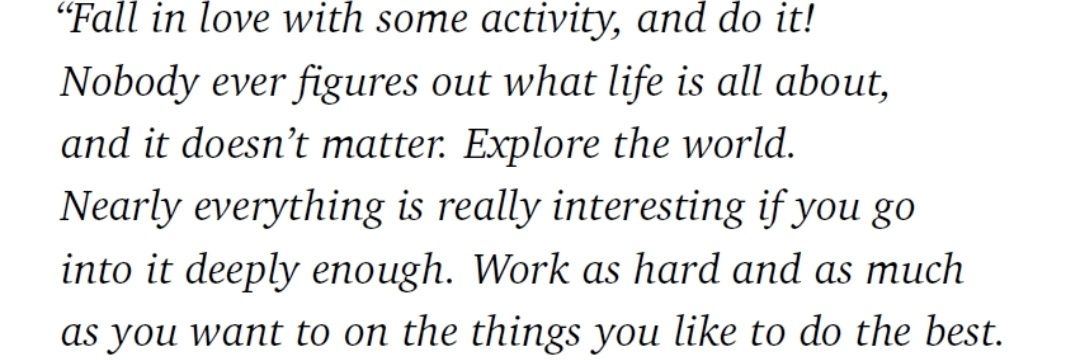
"High-achievers are more likely to be male because men are more likely to focus obsessively on their area of interest, and this helps them to rise to the top." https://t.co/wI6BhbW88R
Qué es la anarcotiranía (y por qué caminamos raudos hacia ella):
«Aunque es perfectamente capaz de hacerlo, al gobierno no le interesa castigar a los delincuentes comunes que causan caos y miseria con regularidad (esto es la anarquía). En cambio, le interesa más controlar a los ciudadanos para que no se opongan a la élite gobernante (esto es la tiranía).
Los delincuentes comunes representan poca amenaza para la clase dominante, por lo que el castigo severo no es una prioridad. Se les deja en libertad para que sigan causando sufrimiento a la población. Mientras tanto, los ciudadanos comunes culpables de infracciones menores o "delitos burocráticos" sufren todo el peso del gobierno, a menudo de forma excesiva.
El poder del gobierno se utiliza para proteger a la élite gobernante de la gente común, no para proteger a la población de los delincuentes. El único peligro que representan los ciudadanos comunes es para el gobierno y la élite gobernante, por lo que su resistencia o protesta se castiga severamente como advertencia a los demás sobre las consecuencias de oponerse a la élite gobernante.
Los grandes medios de comunicación, al formar parte de la élite, ayudan a justificar el trato severo del gobierno hacia la gente común culpable de infracciones menores, al tiempo que se dedican a excusar a la clase criminal que causa caos y miseria a la gente en general».
Por @Viktyr79.
& at some point in your mid 20s to 30s, life will give you a second chance. a chance to break old cycles, heal from past wounds, rebuild your confidence, fulfil those small promises you made to yourself, get your life back on track and become the version of yourself you’ve always envisioned. when that moment comes, don’t waste it. see it through cos it changes everything.
Let me trace the timeline here because nobody's connecting it.
Step 1: Scrape the entire internet. Every book, every article, every conversation, every piece of art, every forum post. Do it without asking. Do it without paying.
Step 2: Train a model on all of it. Call it "artificial intelligence."
Step 3: Go to BlackRock's Infrastructure Summit and announce: "We see a future where intelligence is a utility, like electricity or water, and people buy it from us on a meter."
Step 3 is where you sell people's own knowledge back to them. On a meter.
They took the collective output of human thought, compressed it into a model, and now they want to charge you by the token to access a version of what you and everyone you know already created.
One Reddit user put it perfectly: "They stole all this data from us, the people, our life's work, creativity, art, by devouring the internet and blowing through all copyright laws. Now they want to sell it back to us in the form of a utility."
Imagine if someone photocopied every book in the public library, burned the library down, and then opened a subscription service for the copies.
That's the metered intelligence business model.
And they're pitching it to infrastructure investors as though they invented water.
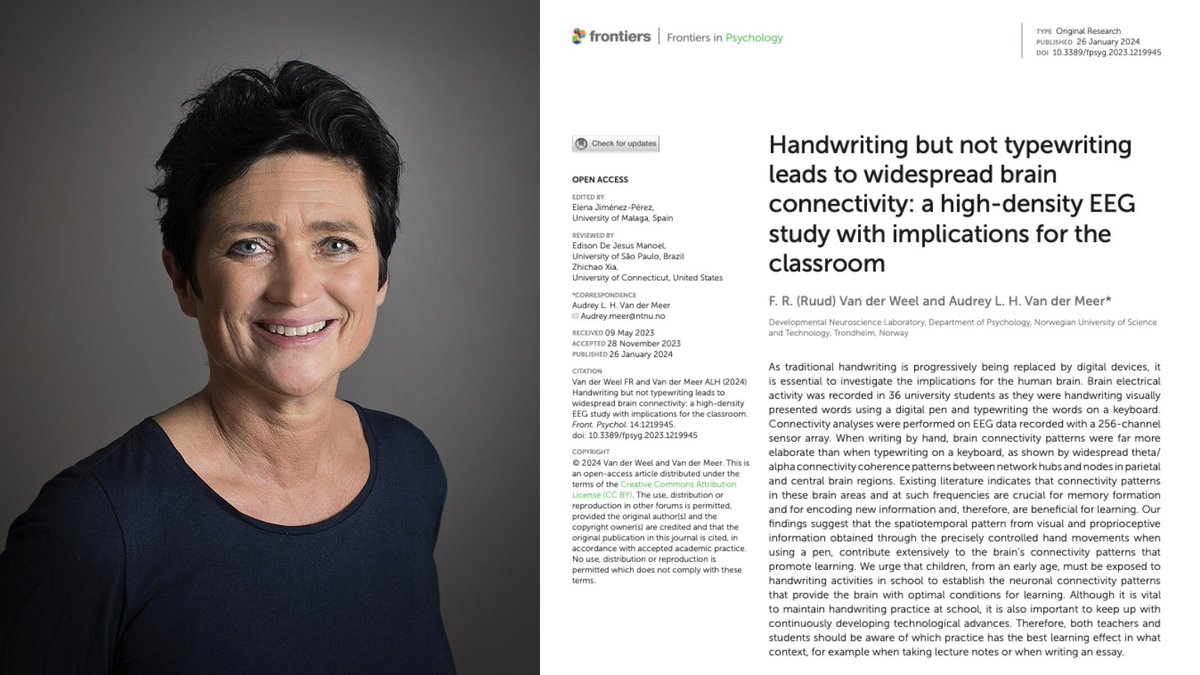
A Norwegian neuroscientist spent 20 years proving that the act of writing by hand changes the human brain in ways typing physically cannot, and almost nobody outside her field has read the paper.
Her name is Audrey van der Meer.
She runs a brain research lab in Trondheim, and the paper that closed the argument was published in 2024 in a journal called Frontiers in Psychology. The finding is brutal enough that it should have changed every classroom on Earth.
The experiment was simple. She recruited 36 university students and put each one in a cap with 256 sensors pressed against their scalp to record brain activity. Words flashed on a screen one at a time.
Sometimes the students wrote the word by hand on a touchscreen using a digital pen, and sometimes they typed the same word on a keyboard. Every neural response was recorded for the full five seconds the word stayed on screen.
Then her team looked at the part of the data most researchers had ignored for years, which is how different parts of the brain were communicating with each other during the task.
When the students wrote by hand, the brain lit up everywhere at once.
The regions responsible for memory, sensory integration, and the encoding of new information were all firing together in a coordinated pattern that spread across the entire cortex. The whole network was awake and connected.
When the same students typed the same word, that pattern collapsed almost completely.
Most of the brain went quiet, and the connections between regions that had been alive seconds earlier were nowhere to be found on the EEG.
Same word, same brain, same person, and two completely different neurological events.
The reason turned out to be something nobody had really paid attention to before her work. Writing by hand is not one motion but a sequence of thousands of tiny micro-movements coordinated with your eyes in real time, where each letter is a different shape that requires the brain to solve a slightly different spatial problem.
Your fingers, wrist, vision, and the parts of your brain that track position in space are all working together to produce one letter, then the next, then the next.
Typing throws all of that away. Every key on a keyboard requires the exact same finger motion regardless of which letter you are pressing, which means the brain has almost nothing to integrate and almost no problem to solve.
Van der Meer said it plainly in her interviews.
Pressing the same key with the same finger over and over does not stimulate the brain in any meaningful way, and she pointed out something that should scare every parent who handed their kid an iPad.
Children who learn to read and write on tablets often cannot tell letters like b and d apart, because they have never physically felt with their bodies what it takes to actually produce those letters on a page.
A decade before her, two researchers at Princeton ran the same fight using a completely different method and ended up at the same answer. Pam Mueller and Daniel Oppenheimer tested 327 students across three experiments, where half took notes on laptops with the internet disabled and half took notes by hand, before testing everyone on what they actually understood from the lectures they had watched.
The handwriting group won by a wide margin on every question that required real understanding rather than surface recall.
The reason was hiding in the transcripts of what the two groups had actually written down.
The laptop students typed almost word for word, capturing more total content but processing almost none of it as they went, while the handwriting students physically could not write fast enough to transcribe a lecture in real time, which forced them to listen carefully, decide what actually mattered, and put it in their own words on the page.
That single act of choosing what to keep was the learning itself, and the keyboard had quietly skipped the choosing and skipped the learning along with it.
Two studies. Two countries. Same answer.
Handwriting makes the brain work. Typing lets it coast.
Every note you have ever typed instead of written went into your brain through a thinner pipe. Every meeting, every book highlight, every idea you captured on your phone instead of on paper was processed at half depth.
You did not forget those things because your memory is bad. You forgot them because typing never woke the part of the brain that would have made them stick.
The fix is the thing your grandmother already knew.
Pick up a pen. Write the thing down. The slower road is the faster one.
Si els nostres fills no poden anar a l'escola pública, si els nostres pares necessiten contractar una mutua, si els nostres avis no reben l'ajuda de dependència fins que ja són morts, millor liquidem-ho tot ja, abaixem impostos i que cadascú es pagui lo seu com feiem abans
I have a medical appointment at 9 a.m. on the south side of Dublin this morning. I had one yesterday. Plan ahead, and you will make all your appointments.
#NeverForget In June 2020, Ireland was in full lockdown. Fear porn was everywhere; only 10 people were allowed at funerals; emergency rooms were empty; hospital staff were dancing in corridors; and you were told to stay within 5 km of your home. Yet these protests took place.
The people of Ireland need to stand with hauliers, farmers, bus companies, and taxi drivers. This government have prepared the nation well, we are built resilient.
Some of these representative organisations need to take a hard look at whom they represent, as they appear to be government puppets at this time. #StandUpIreland #FuelProtests
*On a side note, €866.4 million for 2026 has been set aside for overseas development aid.
https://t.co/lvetMc5ozd
The biggest threat to civilization is not climate change or war
It is the collapsing birth rate.....It's hitting record lows and consistently accelerating downward
If we don’t have enough people to sustain the light of consciousness on Earth, we’ll never make it to the stars. Mars will stay empty. Earth will become a graveyard
Population collapse is a choice. We need to stop making it
@santicalvicidad No veo clara la relacion Luna-Iran. El helio comun (helio-4) que se usa en la refrigeracion para la fabricacion de chips si se obtiene de gas natural. Helio-3 se obtiene de la desintegracion del tritio y se usa en aplicaciones criogenicas muy especificas (computacion cuantica)
Europe's official grid authority has released its report on the nationwide blackout that hit Spain last year. And while the report treads carefully politically, its data make the cause clear.
Wind and solar triggered the collapse.
Within the first 80 seconds, Spain lost 2.5 GW of generation, around 10% of its national supply, with every MW of that early loss coming from renewables.
Gas and hydro remained stable until the cascade was already underway.
The report calls it an unprecedented speed of blackout. This was a textbook inverter chain failure, with renewables dropping so fast that the grid's stabilizers never had time to react.
By midday, Spain's grid had virtually no inertia, nothing spinning fast enough to hold frequency steady.
But to admit that outright would mean questioning Europe's green transition itself, something the report appears unable to do. So the event is officially described as "a rare local disturbance," rather than what it actually was...
A systemic failure of weather-dependent power.
@Soy_Politicon@VirtudMental@MalakarasP El gliofosato si es un HERBICIDA. Uno de los mas estudiados de hecho. Tiene una accion sistemica e irreversible sobre la enzima EPSP sintasa, desencadenando un desequilibrio metabolico y la muerte de la planta. Muy efectivo excepto en GMOs diseñados con genes de resistencia.
@avidseries See also this Science paper showing that the Genotype-Tissue Expression project documents that 1/3 of our 23,000 genes are expressed differently according to sex in 44 different tissues, including 11 brain regions:
https://t.co/Y2VSgCNxyO
Spent my last 20 years in consulting.
Made Partner in my 30s.
Led teams of 100+ people.
Run 9-figure client portfolios.
Lived and worked in 4 continents.
Hired ~200 employees in multiple geos.
The hardest lesson I had to learn, at a real crossroads in my career, is a cliché everyone agrees with, but almost nobody truly understands:
"What got me here won't get me there."
Early on, progress rewards competence: you grind, you solve, you deliver.
YOU become the person.
Then you climb... and, basically without warning, the entire game changes.
At senior levels, being a brilliant problem-solver is no longer enough. In fact, it *can* become a liability.
The work that used to be all about answers, now starts being about implementing common sense at bigger scale.
The work now becomes about making ambiguous, high-stakes decisions with incomplete and/or conflicting information, and about building people who can succeed *without* you sitting next to them.
I'm telling you: if you still need to be in the weeds, you are already behind!
Real leadership (I know... the infamous L word...) requires something deeply uncomfortable for most human beings in corporate:
You gotta make yourself redundant.
Most people resist this. I did too.
When a team member brings you a problem, your instinct is to fix it in 30 seconds.
Don't.
Sit on your hands.
Ask a question and walk away.
If you keep fixing things, your team stays weak and you stay overworked.
Think back to a moment when you felt indispensable on a project or to a team: chances are that feeling (which you likely thought was a strength) was your ceiling.
If a deck is 80% as good as you would make it, leave it alone. If you spend your Sunday night polishing someone else's slides, what are you really?! A proofreader?!
You have to let people fail small so the organization doesn't fail big.
The shift from "doer" to "enabler" forces you to unlearn habits that once had made you successful; it can be ego-bruising and perhaps boring, but it is the only way to scale.
That shedding is the price of playing the long game - the only one worth playing.
All the best.
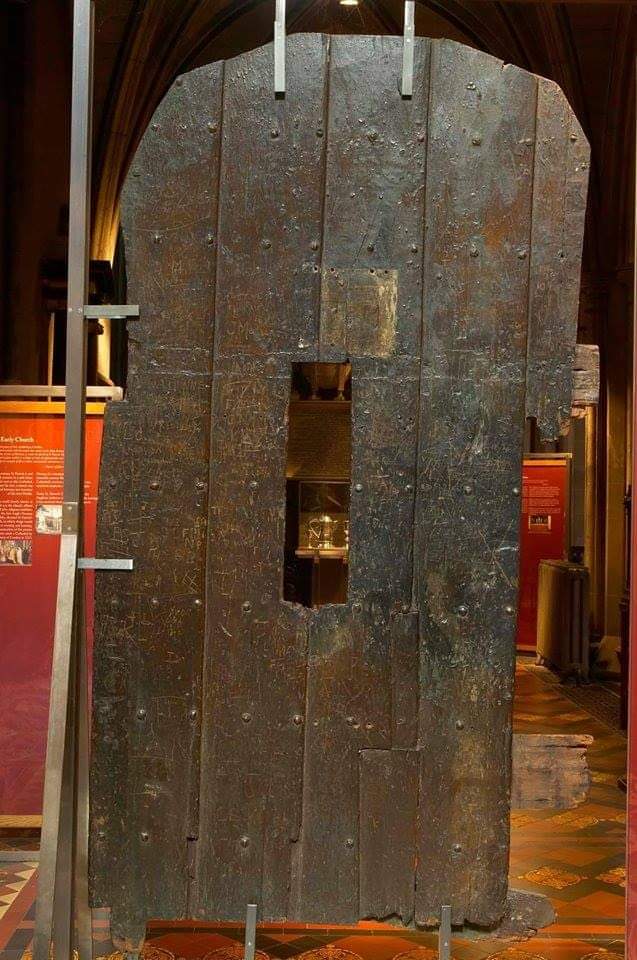
The legendary origin of the phrase "Chancing your arm" came from Dublin in 1492. The Butlers of Ormonde and the FitzGeralds of Kildare were fighting a bloody violent feud. The Butlers retreated to the sanctuary of St. Patrick's Cathedral, with the FitzGeralds in hot pursuit.
A deadly standoff took place, the Fitzgeralds refusing to leave till the Butlers surrendered. However, the Butlers feared they'd be massacred by their sworn enemies if they left the sanctuary.
To break the stalemate, Gearóid Mór FitzGerald came up with a genius idea. To show his sincerity to let the Butlers surrender peacefully, he cut a hole in the Chapterhouse door and put his empty sword arm through, as a gesture of peace.
The Butlers recognised the honour of the act of Fitzgerald "chancing his arm". Their leader shook Fitzgerald's hand. Both families left the cathedral in peace, and in one piece! The "Door of Reconciliation" is still on display in St Pat's Cathedral this day. Maybe there's someone in your life you should chance your arm with?
Rojo Rójez protestando por la detención de Maduro y Twitter Venezuela lo único que protesta es por qué lo han dejado vivo. Hay que ver lo lejos que se puede vivir de la realidad por unas ideas de mierda.
Sometimes we are tired.
Sometimes the baby messes up our whole schedule like when she got sick during our little vacation.
Or like the week before Christmas when she was sick with everyone else.
Or like right now on NYE where I’m at home with her and told my wife to take the boys to her moms to hang out with family because she’s either teething or has an ear infection (likely since she recently had a cold).
It’s all very inconvenient and trying at times. Our breaks come when she’s asleep.
I forget it all when she wakes up and gives me an ear to ear smile.
You can’t explain that love to people. It’s not possible. They have to receive it.
Love is risky. It’s rarely full of sunshine, it comes with all sorts of other things like the possibility of heartbreak.
But it’s love. What else is there.
God is love. We live for Him. He’s our entire purpose.
And with those little signs of pure love from your children, you get a taste of Gods love. A little bit a heaven if you will.
It’s worth it.
Pasarse el juego es no intentar convencer a los demás de tus decisiones de mierda, nihilistas o egoístas intentando racionalizarlas construyendo Neuschwansteins de bullshit.
La vida está hecha de decisiones, vive con las que tomes y no des la brasa a los demás con las que toman.