@elonmusk News not leaning as I'd wish.
Listening to Scotish Highlands music while viewing the beautiful land put me to some meloncoly peaceful place.
Earth is beautiful. Let us treat her well ... and each other, too.
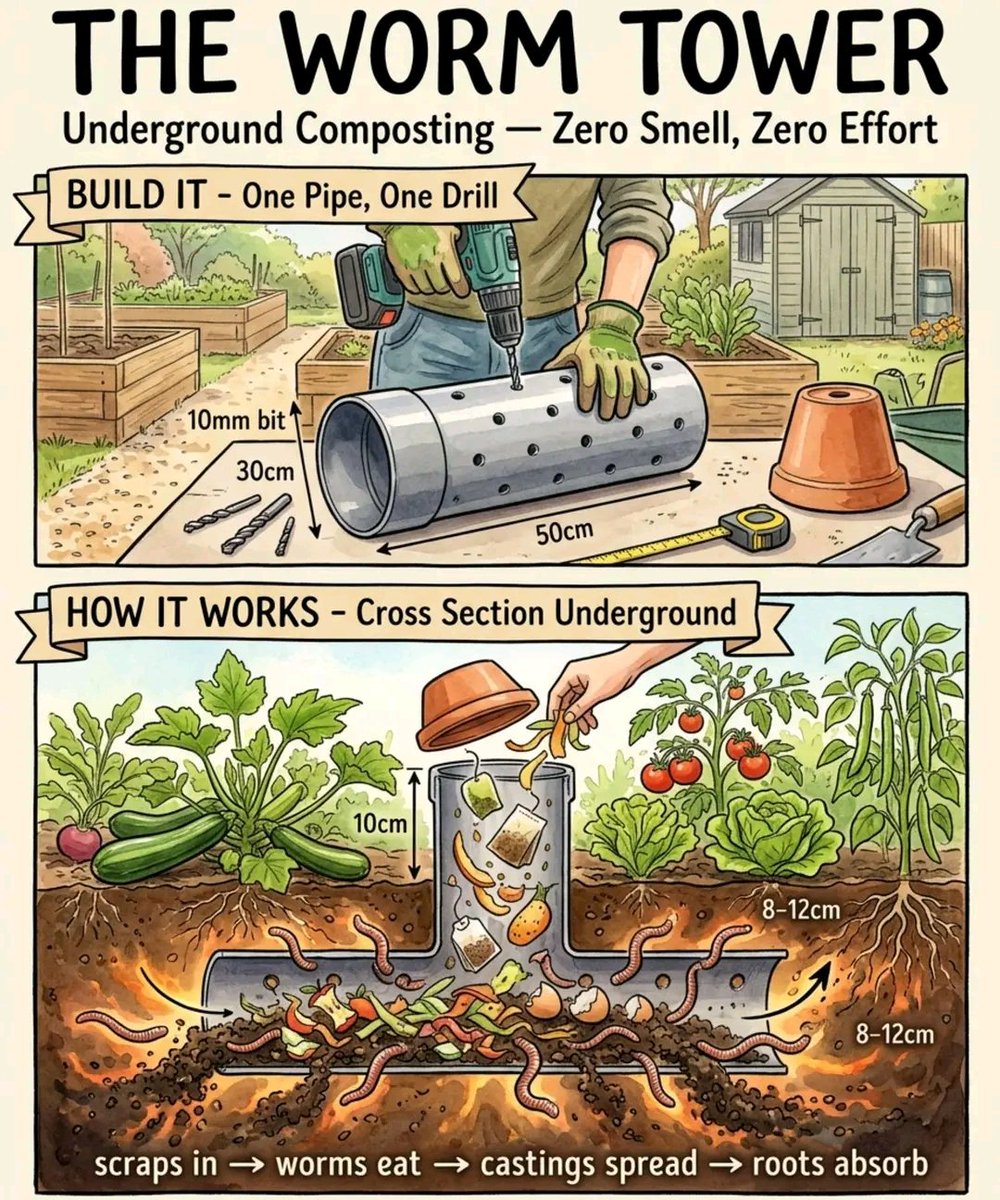
A Buried Pipe Feeds Your Garden Bed From the Inside — Worms Do All the Work
A worm tower is an underground compost system that delivers nutrients directly to plant roots without a compost bin, without turning, and without any smell. Kitchen scraps go in the top. Worm castings spread through the soil below. The bed feeds itself.
The idea is almost too simple to believe: bury a pipe with holes in a raised bed, drop scraps in, let worms handle everything.
🪵 What you need:
- A section of drainpipe — 30cm diameter, 50cm long
- A drill with 10mm bit
- A lid or upturned pot to keep rain out
- A garden bed to bury it in
🌿 How to build it:
- Drill holes every 5cm across the lower two-thirds of the pipe
- Dig a hole in the centre of your garden bed deep enough to bury the pipe with 10cm above soil level
- Backfill around the pipe and firm soil gently
- Add a handful of compost and a few worms from the garden to start
- Place lid on top
🐛 How to use it:
- Drop small kitchen scraps in weekly — vegetable peelings, tea bags, fruit cores, crushed eggshells
- Worms enter through the drilled holes, eat the scraps, and carry castings back into the surrounding soil
- The bed receives a slow, continuous feed of the richest fertiliser on earth
- Never needs turning. Never smells. Never attracts flies if the lid stays on
One tower feeds a 2-metre radius of garden bed. Two towers handle a full-sized raised bed. Your food waste becomes plant food without ever touching a compost heap. 🌱
The bee lives less than 40 days, visits at least 1,000 flowers and produces less than a teaspoon of honey.
For us it is only a teaspoon of honey, but for the bee it is a life. 🐝🍯
The banana plant is not a tree — it is a giant herbaceous plant. What looks like a trunk is the pseudostem, formed by the tightly overlapping bases of its leaf sheaths. 🌿
Understanding its anatomy helps make sense of how it grows, even in temperate gardens.
Flag leaf: the last leaf produced before flowering. Its appearance signals that the bunch is already forming inside the pseudostem — the plant is committed to fruiting.
Adult leaf: powers the photosynthesis that fills the fruit. Every leaf lost to wind damage or disease directly reduces the final weight of the bunch.
Leaf blade (lamina): the wide flat part of the leaf, crossed by a prominent midrib, with an upper surface (adaxial) and a lower surface (abaxial).
Pseudopetiole: the section connecting the leaf blade to the pseudostem.
Pseudostem: the false trunk, built entirely from tightly rolled leaf bases wrapped around each other. It can reach between 6 and 25 feet depending on variety, but contains no woody tissue whatsoever.
Bunch (bunch of hands): the complete fruit structure. Each row of bananas is a hand, and each individual banana is a finger. A bunch carries between 6 and 14 hands depending on variety and growing conditions.
Female flower hands: these develop into the hands of fruit. The female flowers open first and are the ones that set fruit.
Flower heart (male inflorescence): the pendant bud at the end of the bunch, containing the male flowers. In tropical cuisines it is cooked as a vegetable.
Sucker (pup): the lateral shoot emerging from the rhizome. This is the primary method of propagation — the parent plant dies after fruiting and the sucker takes over.
Rhizome: the true underground stem of the plant, from which both the roots and the suckers originate.
Roots: fibrous and shallow, concentrated in the top 12 inches of soil — which is why bananas need consistent surface moisture and do not compete well with deep-rooted plants.
In the US, banana plants can be grown in the ground year-round in zones 8 to 11. In zones 5 to 7, Musa basjoo — the Japanese fiber banana — is the most cold-hardy ornamental variety, surviving to around -10F with heavy mulching over the rhizome. Ensete ventricosum and Musa sikkimensis are other cold-tolerant options for northern gardens grown as summer tropicals in containers.
🌿 Not a tree. Not a palm. A giant herb that fruits once and hands the garden to its children.
#fyp #gameday #comunityevent #darkhumor Sammayorgreenfild
Mom used to cook it all the time, but it's been a while since I had it and it sure sounds good.
Think I know what's going to be for dinner tomorrow...
(Fried potatoes, onions, and pork chops) 🥰
Who else loved having it regularly?