Postdoctoral Fellow in Psychedelics ans Spirituality. Harvard University.
PhD Leiden University. Faculty of Archaeology. Heritage of Indigenous Peoples.
Dear friends. I am glad to sahre the recording of the talk: "History and archeology of psilocibyn mushrooms in Mesoamerica"🍄, during the MAPS Psychedelic Science Conference 22.06. 2023.Denver. CO.
https://t.co/HMfbAWFX47
I am glad to share with you this brief interview for an article on psychedelic retreats
"Magic mushroom retreat centers can offer healing — but their lack of regulation can carry risks" https://t.co/qONaDgiYOy
@ViaSynapsis. I am glad to share the article:"Indigenous Philosophies and the Psychedelic Renaissance".Thanks to the First Nations Technical Institute, this research is open access. 🍄🍄 https://t.co/oZ1Pe6LOk4.
Today in our @Chacruna_Inst "Women in the History of Psychedelic Plant Medicines" series, @osirissinuhe speaks with Dr. Mercedes de la Garza, professor emeritus of the National Autonomous University of Mexico.
https://t.co/CHkqIx4v8Z
#wmnhist#histreligion#shamanism
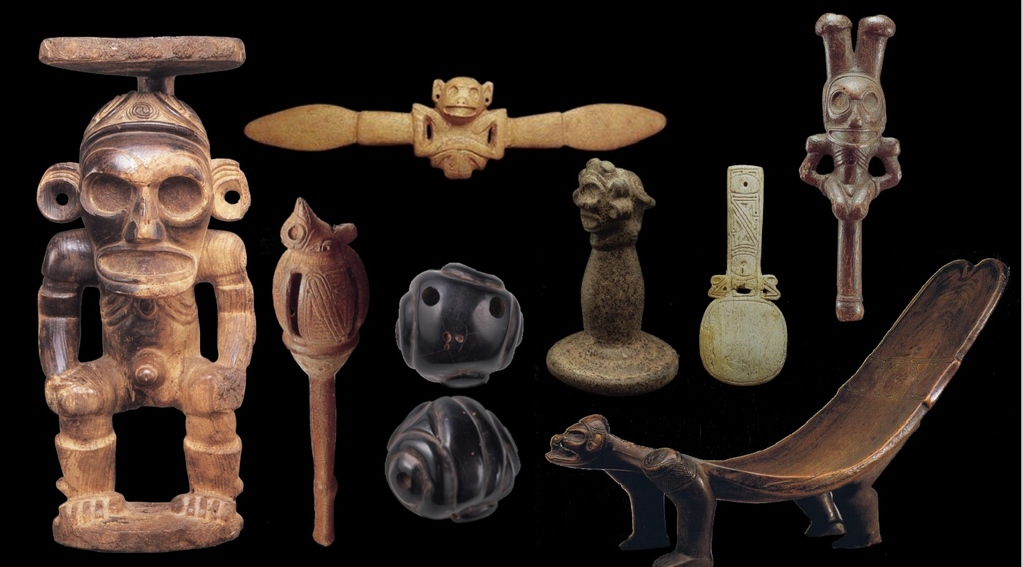
The Cojoba Ceremony involved the use of seats, called dujos; "tables" to place the powders inside a container. And purging spatulas to empty the stomach before the nasal absorption of the powder. It is also referred the use of musical instruments to induce the visionary state. 🌱
The entheogen used by the Taino people is commonly called cojoba, cohoba or cojobana. It consists of a preparation based on the dried and pulverized seeds of the Anadenanthera peregina tree, mixed with the lime of calcined mother-of-pearl shells to facilitate its nasal absorption
The oldest archeological documentation attesting to the use of psychoactive mushrooms appears in depictions of mushrooms present among the prehistoric paintings dated between 6000 and 4500 BC in the Tassili n’Ajjer (Algeria) #Chacrunainstitute#Archaeology & #Psychedelics