"𝐇𝐎𝐔𝐒𝐄 𝐖𝐈𝐓𝐇𝐎𝐔𝐓 𝐋𝐀𝐍𝐃"
��🚨The 𝐂𝐨𝐮𝐫𝐭 𝐨𝐟 𝐀𝐩𝐩𝐞𝐚𝐥 𝐚𝐭 𝐌𝐨𝐦𝐛𝐚𝐬𝐚 in 𝐙𝐚𝐢𝐧𝐚𝐛 𝐌𝐰𝐢𝐧𝐲𝐢 𝐯 𝐒𝐚𝐢𝐟𝐮𝐝𝐞𝐞𝐧 𝐀𝐛𝐝𝐮𝐥𝐥𝐚 𝐁𝐡𝐚𝐢 & 𝐇𝐮𝐬𝐬𝐞𝐢𝐧 𝐀𝐛𝐝𝐮𝐥𝐥𝐚 𝐁𝐡𝐚𝐢 (𝐂𝐢𝐯𝐢𝐥 𝐀𝐩𝐩𝐞𝐚𝐥 𝐄𝟎𝟐𝟑 𝐨𝐟 𝟐𝟎𝟐𝟑) [𝟐𝟎𝟐𝟓] 𝐊𝐄𝐂𝐀 𝟏𝟑𝟎𝟗 (𝐊𝐋𝐑) held that a person who purchases a “𝐡𝐨𝐮𝐬𝐞 𝐰𝐢𝐭𝐡𝐨𝐮𝐭 𝐥𝐚𝐧𝐝” acquires only the house itself and has no right to demolish it and erect a completely new structure on the land without the registered landowners’ consent.The Court ruled that the moment the purchaser demolishes the original house and begins building a different structure without consent, she becomes a trespasser, her limited interest is extinguished and the landowners are entitled to orders for demolition, vacant possession and general damages for trespass.
In this coastal Kenyan case, the respondents were the registered proprietors of 𝐏𝐥𝐨𝐭 𝐍𝐨. 𝟐𝟕/𝐒𝐞𝐜𝐭𝐢𝐨𝐧 𝐗𝐕𝐈/𝐌𝐨𝐦𝐛𝐚𝐬𝐚 𝐚𝐭 𝐆𝐮𝐫𝐚𝐲𝐚. In 1991 the appellant bought from a third party a traditional Swahili-type “𝐡𝐨𝐮𝐬𝐞 𝐰𝐢𝐭𝐡𝐨𝐮𝐭 𝐥𝐚𝐧𝐝” standing on that plot.She later demolished the wattle-and-daub structure and without seeking the landowners’ permission constructed a two-storey stone building.The Environment and Land Court found her a trespasser and granted the reliefs sought. On appeal, the Court of Appeal (𝐌𝐮𝐫𝐠𝐨𝐫, 𝐋𝐚𝐢𝐛𝐮𝐭𝐚 𝐚𝐧𝐝 𝐍𝐠𝐞𝐧𝐲𝐞-𝐌𝐚𝐜𝐡𝐚𝐫𝐢𝐚 𝐉𝐉𝐀) largely upheld that decision. It reaffirmed the settled principle drawn from earlier authorities such as 𝐅𝐚𝐦𝐚𝐮 𝐌𝐰𝐞𝐧𝐲𝐞 & 𝟏𝟗 𝐨𝐭𝐡𝐞𝐫𝐬 𝐯 𝐌𝐚𝐫𝐢𝐚𝐦 𝐁𝐢𝐧𝐭𝐢 𝐒𝐚𝐢𝐝 𝐚𝐧𝐝 𝐀𝐛𝐝𝐮𝐤𝐫𝐚𝐳𝐚𝐤 𝐊𝐡𝐚𝐥𝐢𝐟𝐚 𝐒𝐚𝐥𝐢𝐦𝐮 𝐯 𝐇𝐚𝐫𝐮𝐧 𝐑𝐚𝐬𝐡𝐢𝐝 𝐊𝐡𝐚𝐭𝐨𝐫 & 𝟐 𝐨𝐭𝐡𝐞𝐫𝐬 [𝟐𝟎𝟏𝟖] 𝐊𝐄𝐂𝐀 𝟏𝟓𝟏 (𝐊𝐋𝐑) held that under the unique coastal tenure of “house without land” the owner of the house is different from the owner of the land. The arrangement defies the common-law maxim that whatever is attached to the soil becomes part of it. A purchaser obtains proprietary rights only over the house but the soil remains with the landowner. Any material alteration, demolition or reconstruction therefore requires the landowner’s consent. Necessary and reasonable repairs to keep the existing structure habitable may be done after notice but wholesale demolition and rebuilding without consent is impermissible.
The Court rejected the appellant’s arguments based on a Presidential embargo (unsupported by evidence), adverse possession (her occupation was by permission under the house-without-land agreement so the possession was not adverse and Article 40 of the Constitution (no protectable property right arises once trespass is established). It also held that trespass is a continuing tort so the claim was not time-barred under the Limitation of Actions Act. The appeal succeeded only in part but the award of mesne profits was set aside because it had not been specifically pleaded and strictly proved and a party cannot recover both mesne profits and general damages for the same trespass. The Kshs 500,000 general damages award and the substantive orders for demolition and vacant possession were confirmed. The appellant was ordered to pay the costs of the appeal.
The decision clarifies that the “house without land” concept remains a judicially recognised but limited interest even under the post-2012 land statutes. It protects registered title against unauthorised development, confirms that long occupation under a permissive arrangement does not mature into ownership of the land and reminds practitioners that claims for mesne profits must meet strict pleading and proof requirements. For ordinary Kenyans especially in the Coast region, the practical lesson is clear: buying a house without land means you own only the house. Before demolishing or rebuilding obtain the landowner’s express consent, or risk being declared a trespasser and ordered to remove the new structure.
#law #kenya #legal #property #housewithoutland #trespass #CourtOfAppeal #ELC
Court of Appeal dismisses appeal challenging land transfers dating back over 40 years, citing limitation of time and insufficient proof of fraud.
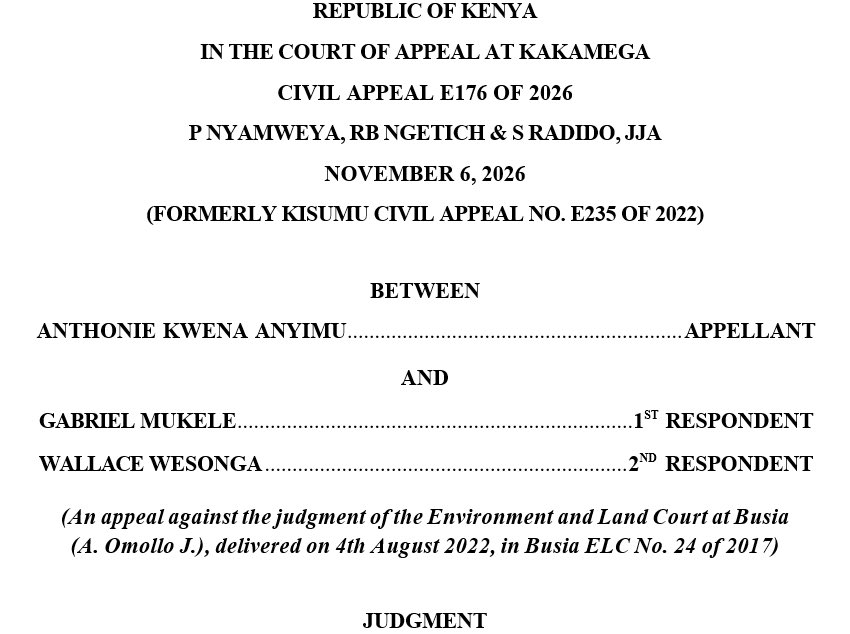
In Anyimu v Mukele & another [2026] KECA 2488 (KLR), the Court of Appeal upheld the dismissal of a claim challenging the transfer and subdivision of land previously owned by the appellant's deceased father.
The disputed transactions occurred in 1975, 1978 and 1981. The appellant alleged that the land had been unlawfully transferred and sought recovery of the parcels.
The Environment and Land Court had dismissed the claim, finding that it was time-barred and that the allegations of fraud had not been sufficiently proved.
What were the key legal determinations?
1. Land recovery claims are subject to statutory limitation periods.
The Limitation of Actions Act requires actions to recover land to be instituted within 12 years from when the right of action accrues.
The Court considered the historical transfers, the family's knowledge of the transactions and the delay before proceedings were instituted.
Evidence of a family meeting in 1990 was particularly relevant to determining when the disputed occupation and ownership became known.
2. Allegations of fraud do not automatically defeat limitation periods.
The Limitation of Actions Act postpones the running of time in certain cases involving fraud until the claimant discovers, or could with reasonable diligence have discovered, the fraud.
However, the applicability of that exception depends on the circumstances and evidence concerning discovery.
In this case, the evidence of earlier family knowledge undermined the claim that the disputed transactions only became discoverable decades later.
3. Fraud must be specifically pleaded and strictly proved.
The appellant questioned the validity of the transfers, citing missing transaction documents, discrepancies in identification details and the registration of one parcel in a minor's name.
However, the evidence did not sufficiently establish fraudulent acquisition.
The Court distinguished documentary irregularities and evidentiary gaps from proof of fraud.
4. Historical land transactions must be assessed under the applicable law.
The Court also addressed Section 3(3) of the Law of Contract Act, which prescribes formal requirements for agreements disposing of interests in land.
Under Section 3(7), the current requirements introduced on 1 June 2003 do not apply retrospectively to agreements entered into before their commencement.
Consequently, the validity of the transactions could not be assessed solely against formal requirements introduced decades later.
The broader legal and constitutional question
On one side, Article 40 protects property rights, while Article 48 guarantees access to justice. Allegations of fraudulent land acquisition raise legitimate questions about the remedies available to families who discover disputed transactions years after they occurred.
On the other side, limitation statutes promote certainty in land ownership and protect parties from defending claims after substantial periods, when documents may have been lost and witnesses may no longer be available.
Key takeaway: Allegations of fraud do not automatically revive historical land claims. Claimants must establish both a legally sustainable basis for bringing the action within the applicable limitation framework and sufficient evidence to prove the alleged fraud.
Follow @Lexken_EMSLaw for practical legal insights on land disputes, property rights and civil litigation in Kenya.
Political party defections after elections are illegal & unconstitutional. - High Court in Ali Guyo v UDA.
If an elected official is sponsored into office by a political party, he is constitutionally obligated to remain in that party throughout his term in office.
Link to my paper "Due Process and the Politics of Impeachment in Kenya: The Trial of Rigathi Gachagua":
https://t.co/qWZBPSdVmh
The paper makes the following arguments:
Link to the Judgements, Rulings and media Summaries delivered by the Supreme Court of Kenya on Friday 30/10/2026. https://t.co/q9Qre1vZl6
You can access all our decisions from our Website: https://t.co/NMRIbloqjS
Judgements in:
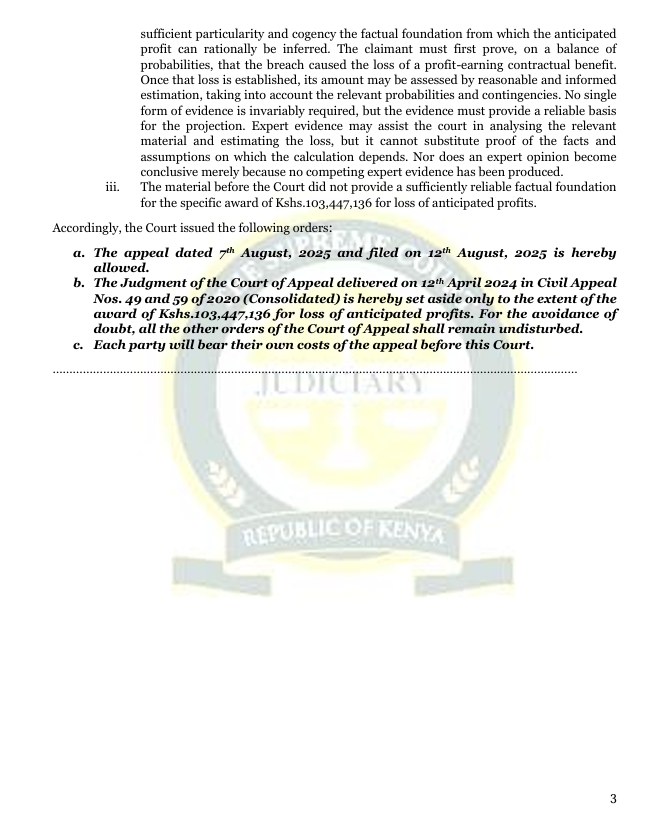
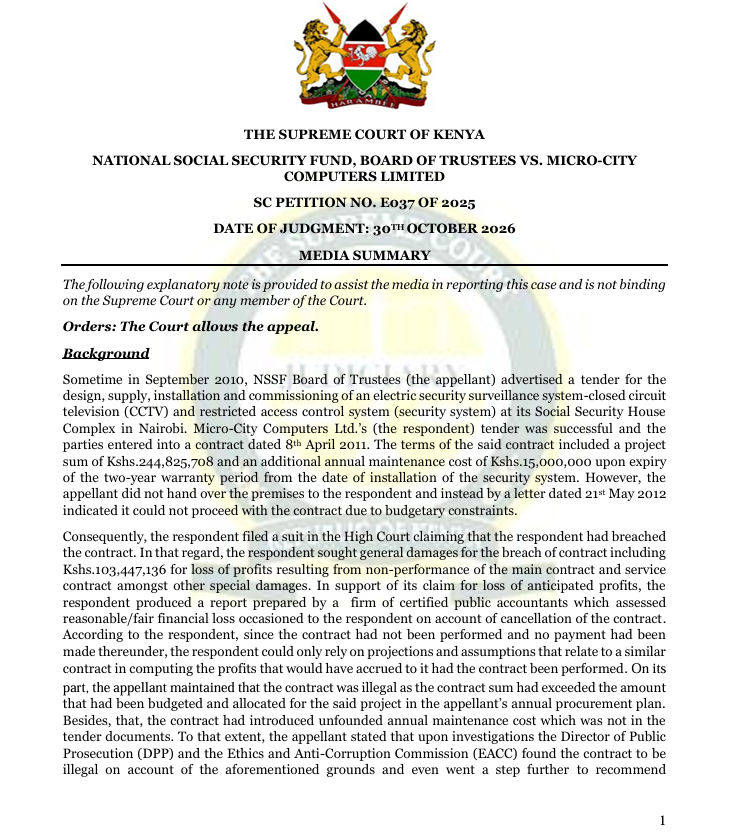
1) SCPT/E037/2025 NSSF Board of Trustees Vs Micro-City Computers Ltd
Dear Law Students,
Please take time to read the ShaKaHola judgment.
High Court Sitting in Malindi Criminal Case No E003 of 2024 found Paul Mackenzie and 28 co-accused guilty of 191 counts of murder.
https://t.co/yssfi7m8Gl
Presumption of Marriage and Constructive Trust for Cohabitees;
The Supreme Court of Kenya, in Mary Nyambura Kangara v Paul Ogari Mayaka (SC Petition No. 9 of 2021, 27 January 2023), has clarified the rules that apply when long-term cohabiting partners dispute property.
Here are the practical takeaways;
1. A presumption of marriage requires that the parties lived together for a long period of time.
2. The parties must have the capacity to marry. The Court held that during the continuance of a previous marriage, the already married party has no capacity to enter into a new marriage, and any such purported marriage is a nullity until the previous marriage is dissolved by a final decree or divorce.
3. The parties must have intended to marry. The Court stated that where there is no intention whatsoever of contracting a marriage, the presumption of marriage must never be made.
4. There must be consent by both parties.
5. The parties must have held themselves out to the outside world as a married couple.
6. The party who alleges the presumption bears the onus of proving it.
7. Evidence required to rebut the presumption must be strong, distinct, satisfactory and conclusive.
8. The standard of proof is the balance of probabilities.
9. The Court held that the doctrine of presumption of marriage is on its deathbed and should only be used sparingly where there is cogent evidence to support it.
10. The Court stated that a presumption of marriage is the exception rather than the rule.
11. The Court emphasised that courts should shy away from imposing marriage on unwilling persons.
12. Even where no marriage is established, a beneficial interest in property may still arise through a constructive trust.
13. To establish a constructive trust, the claimant must prove a common intention that both parties should have a beneficial interest in the property.
14. The common intention may be established by direct evidence or inferred from the parties’ conduct.
15. The claimant must also show that he or she acted to his or her detriment on the basis of that common intention.
16. Conduct from which a common intention may be inferred includes direct and indirect financial contributions as well as contributions to the improvement, maintenance or development of the property.
17. Once a constructive trust is established, beneficial shares are determined according to the parties’ respective contributions. The Court held that assessment is not limited to direct financial contributions to acquisition but must also consider other forms of contribution, including actions in maintaining and improving the property.
18. In this case the Court found that no presumption of marriage existed. It nevertheless held that a constructive trust arose and, on the evidence of the parties’ respective contributions, apportioned the property 70% to the appellant and 30% to the respondent.
END.
SC Petition No. E053 of 2025 - Red and Yellow Outdoor Ltd vs Shiloah Investment Ltd, the Apex Court reiterated its Article 163(4)(a) jurisdiction matrix:
-Section 15 of the Landlord and Tenant (Shops, Hotels and Catering Establishments) Act Cap 301 is a valid finality clause, not an unconstitutional ouster clause, and it makes decisions of the Environment and Land Court on appeals from the Business Premises Rent Tribunal final, thereby excluding a further appeal to the Court of Appeal; Article 164(3) does not create an unrestricted right of appeal where statute limits it, and an appeal that turns purely on whether an advertising space agreement constitutes a controlled tenancy under Section 2(1) and the effect of Section 15 is a statutory interpretation question, not a constitutional one. Then, mere citation or reference to Articles 2(4), 48, 50(1), 159(2)(d) and 164(3) did not create a constitutional trajectory for purposes of Article 163(4)(a).✅
-Therefore, where no genuine cardinal issue of constitutional interpretation or application was pleaded, canvassed and determined through the hierarchy of courts, the Supreme Court lacks jurisdiction and an interlocutory ruling of the Court of Appeal striking out an intended appeal as incompetent under Section 15 is not appealable to the Supreme Court.✅
Link:https://t.co/nbjPA31W4G
Kakuzi PLC v Makuyu Club Pet. E035 of 2025:
The Supreme Court in this matter dealt with two important questions of General Public Importance in regards to the concept of Adverse Possession:
(1) First, what is the scope of adverse possession where the first owner of the land donates it or gives it by consent to a party and a subsequent owner takes over, the court finds that time begins running when the new owner takes over and if they do not assert open and exclusive possession then the donee can assert the adverse rights after the statutory 12 years. Put differently, the subsequent owner should within 12 years ensure they assert ownership rights otherwise they cannot rely on the previous donation/consent to defeat the adverse possession of the those in occupation. Importantly the adverse claim will not succeed if the subsequent owner asserts their rights which the court stated is not merely by notices or correspondences but either physical re-entry or conspicuous acts that indicate they want to take over including legal proceedings.✅
2. Adverse possession can arise out of a failed sale. ✅
3. A subsequent owner cannot rely on the donation of a previous owner, donation/consent of the previous owner is not transferrable to the subsequent owner unless they assert it immediately they take over.✅
4. Adverse possession as a matter of law cannot arise where there is consent/donation.✅
5. A Gift/donation is only perfect where it is completed via a transfer otherwise it remains incomplete and the court cannot perfect it, a subsequent ownership terminates it and the adverse time begins to run. Although a donation allows one to occupy the land, without it being transferred to the donee, it cannot confer enforceable interest binding the succession in title.✅
-------
The Appeal by Kakuzi PLC was effectively dismissed as time began to run in favour of Makuyu in 1967, the appellant only attempted to enter into a lease agreement with them in 2002, 35 years later when the suit came to court when that failed. As such the adverse rights of the respondents had accrued. Further mere notices/correspondences asserting ownership by Kakuzi PLC did not suffice. The 70 acres therefore belongs to Makuyu Club.
Link of the decision: https://t.co/iXCv8Pi245
@WelBeast 1) 42 points deduction every season for the next 5 seasons. (This only applies to the Premier League)
2) 5-year ban from signing of players.
3) Strip them of the title they won during this period. (No winner for these seasons).
📢 KSL: ATP 2027/2028 ACADEMIC YEAR APPLICATIONS NOW OPEN
The KSL applications for admission to the Advocates Training Programme (ATP) for the 2027/2028 Academic Year are now open.
Eligible applicants are invited to submit their applications online through the Kenya School of Law application portal via this link https://t.co/XU0D4A0dKY
The 2027/2028 ATP Academic Year is scheduled to commence on 1 February 2027.
Applicants are advised to carefully review the eligibility criteria, application requirements and other relevant information before submitting their applications.
🔗 For more details and the full admission notice:
https://t.co/qEEDUSri4r.
#KSL
#ATP2027/2028
#ATPAdmissions
I came across my own Submissions on a Major matter somewhere. Litigation any day. AMA namna gani ndugu @joshuamalidzo@wuodosur
My last hope @NelsonHavi what sayeth thee.