Solid business and financial analysis. This is the reason I look forward to your posts. I’ll like to look at Vitafoam from a credit perspective over the coming days. I hope I’ll have the time.
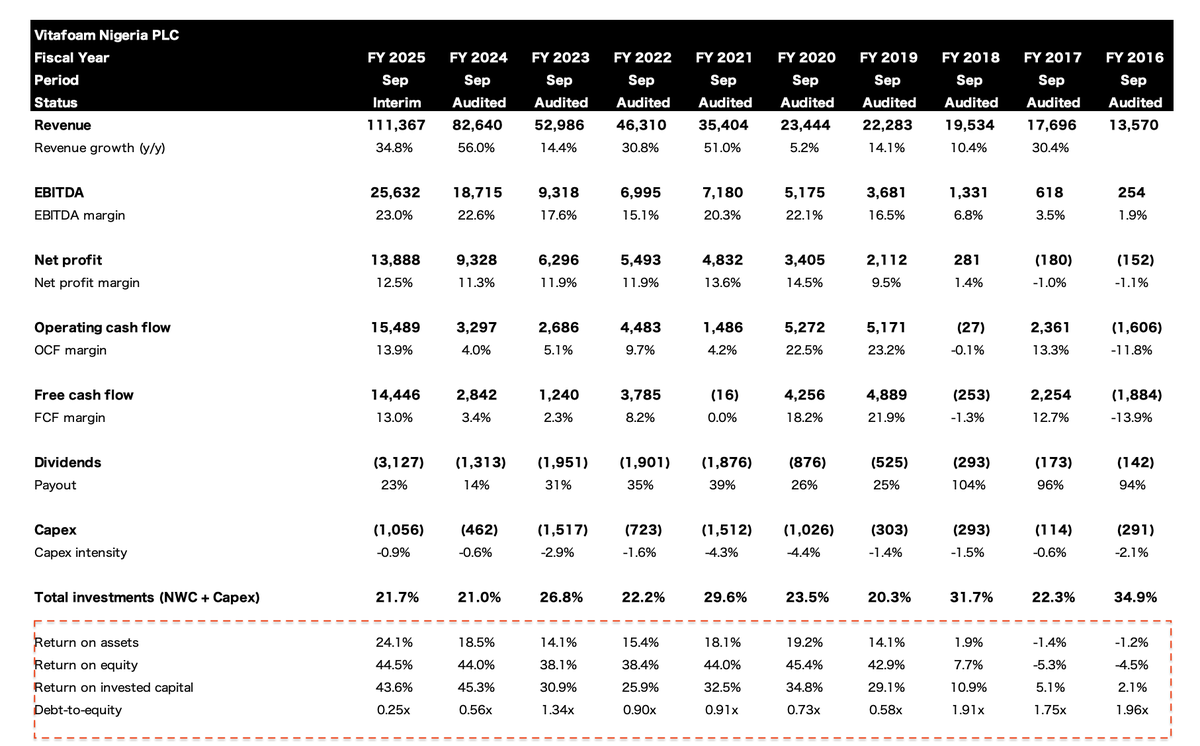
Vitafoam is one of the few companies quietly doing its thing, and they are doing incredibly well. It may surprise many people to learn that Vitafoam is among the top three most profitable companies on the NGX. It may even shock people more to know that Vitafoam is more profitable than Dangote Cement and MTN Nigeria (the coy performance benchmark on the NGX).
Just to be clear, in terms of margins, the benchmark two are higher, but that reflects business model superiority – it does not necessarily make it more profitable. A profitable business is different from a profitable business model.
There is a relationship, sure, but other factors are considered (working capital requirements, capex requirements, financial leverage/risk, etc.).
You can measure a profitable business model using margins, but a profitable business is measured by capital allocation metrics such as return on assets and return on equity.
To see this a bit more, you can have a trading business with smaller margins but a super high turnover (i.e., the rate at which you sell). In a trading business, you do not necessarily have to worry about tying down capital in any capex or working capital.
However, in a manufacturing business, where you operate from end to end (i.e., transforming raw materials into finished products), the capex and working capital requirements are typically significant. However, it also means that way higher margins (relative to a trading business). Hence, there is a tradeoff.
In the case of Dangote Cement, MTNN, and Vitafoam, they are all manufacturing businesses. The business model differences, therefore, are in the type of market they operate in.
The former two are in industries where higher margins are persistent and barriers to entry are significant. The reality does not apply to Vitafoam. But as things stand, Vitafoam is more profitable—2x as profitable as the big two guys.
That’s by the way. I digressed. Back to Vitafoam’s performance.
NIGERIA’S POWER FIRMS LOSE ₦2.31 TRILLION TO STRANDED ELECTRICITY IN 12 YEARS
Nigeria’s power-generating companies have lost over ₦2.31 trillion between 2013 and September 2025 due to electricity that was available for generation but never used largely because of grid and operational constraints, according to the Association of Power Generation Companies (APGC).
Fresh data presented by APGC’s Managing Director, Joy Ogaji, shows that this year alone (January to September 2025), the sector lost about ₦119 billion, with an average of 2,221 megawatts stranded each month.
Despite available generation capacity often exceeding 6,000 megawatts, only around 4,500 megawatts are typically evacuated through the national grid. The rest ,enough to power industries and homes; goes unused.
The APGC blames weak grid infrastructure, irregular payments, and policy lapses for the recurring losses. Ogaji warned that the situation threatens the financial health of generation companies and limits Nigeria’s economic growth.
@Pro_Veck I remember this. Trained us on macro, industry analysis as well credit (corporate and financial institutions). May his soul continue to rest in peace.