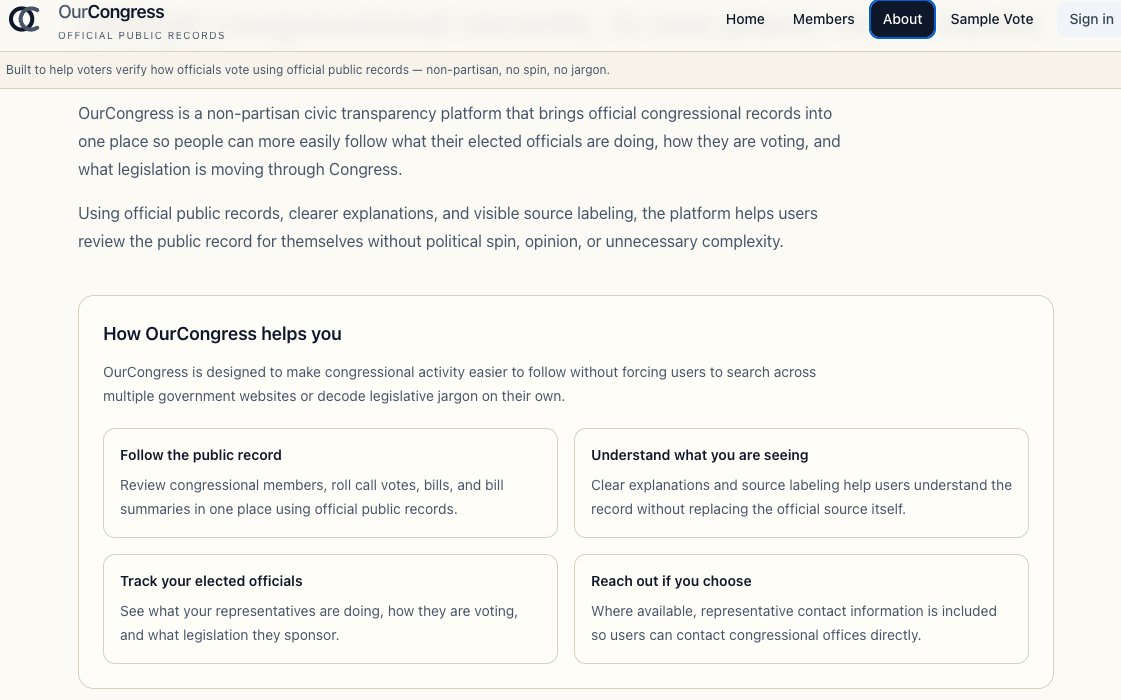
Non-partisan civic transparency. Follow Congress through official records — votes, bills, representatives, and districts. District first. Party second.
The frustration is real.
But not voting gives elected officials less accountability, not more.
Your representatives leave a public record: what they sponsor, how they vote, and what they’re working on.
https://t.co/SWAJqF2oYC helps make that record easier to follow.
@ImBreckWorsham The frustration is real, but not voting gives all our elected officials less accountability, not more.
Start with your district. Your representatives leave a public record: what they sponsor, how they vote, and what they’re working on. https://t.co/SWAJqF2oYC
Collective apathy grows when people feel like nothing they do matters.
One small counterweight is the public record.
Who represents you?
What have they sponsored?
How have they voted?
Where can you verify it?
Start there.
https://t.co/SWAJqF2oYC
Collective apathy does not happen because people do not care.
Sometimes it happens because the process feels too hard to follow.
https://t.co/ONOxoLcsoQ is built to help voters start with the public record: who represents them, what they sponsor, how they vote, and where the source lives.
Most people would not buy groceries without looking at the label.
Voting should not feel any different.
Before choosing who represents you, it helps to see the public record:
What they sponsor.
How they vote.
Where the official sources are.
https://t.co/ONOxoLcsoQ helps make that easier to follow.
Congressional approval is low, but our interest is not in adding more outrage.
We’re more interested in making the public record easier to follow:
Who represents my district?
What bills have they sponsored or introduced?
How have they voted on issues that affect my district?
Accountability starts with being able to follow the record. https://t.co/ONOxoLcsoQ
In a representative system, voters are not just observers.
We are the people asked to choose who goes to Washington on our behalf.
That choice gets better when the public record is easier to follow.
Holding representatives accountable does not have to start with outrage.
It can start with the record.
Who represents you?
What have they sponsored?
How have they voted?
Where can you verify it?
That is the path https://t.co/SWAJqF2oYC is built around.
Your representatives leave a record.
Votes.
Sponsored bills.
Official actions.
Public sources.
https://t.co/SWAJqF2oYC helps make that record easier to follow, so voters can ask better questions with better information.
Accountability starts with knowing where to look.
https://t.co/ONOxoLcsoQ helps voters follow the official record:
- Who represents you.
- How they vote.
- What bills have they sponsored.
- What are they doing to help your district.
Start with the record, then decide what you think.
Frustration gets louder when Congress feels like one big abstract thing.
A useful first step is to make it more specific.
- Who represents you?
- What have they sponsored?
- How have they voted?
- What does the official record show?
That is the starting point https://t.co/ONOxoLcsoQ is built around.
Politics gets ignored until it hits your wallet, your district, or your ballot.
https://t.co/SWAJqF2oYC is built to make the public record easier to follow.
Congressional approval is low, but our interest is not in adding more outrage.
We're more interested in making the public record easier to follow: who represents us, what they sponsor, how they vote, and where the source lives.
In a representative system, voters are not just observers. We are the people asked to choose who goes to Washington on our behalf.
That choice gets better when the public record is easier to follow.
3/That choice gets better when the public record is easier to follow: who represents us, what bills those members sponsor, how they vote, and where the official sources are.
The goal is not to tell people what to think. It is to help people follow the record with more confidence.
Non-partisan by design. Source-linked by default. Built to make Congress easier to follow without adding spin.
Find Your District: https://t.co/j2J9QJVwHF
1/The problem isn't that voters can't understand Congress.
It's the process that asks people to do too much translation before they can even start.
Congress has its own language, records, procedures, identifiers, vote pages, bill summaries, roll calls, sponsorship rules, and chamber-specific habits. Like any long-running institution, it has built up a way of working that makes sense internally but can feel hard to enter from the outside.
2/Voters have busy lives. Work, kids, family, bills, responsibilities. If following Congress feels like learning a new operating system, a lot of people will reasonably spend their limited time elsewhere.
That is part of why we built OurCongress and continue to develop it.
In a representative system, voters are not just observers. We are the people asked to choose who goes to Washington on our behalf.