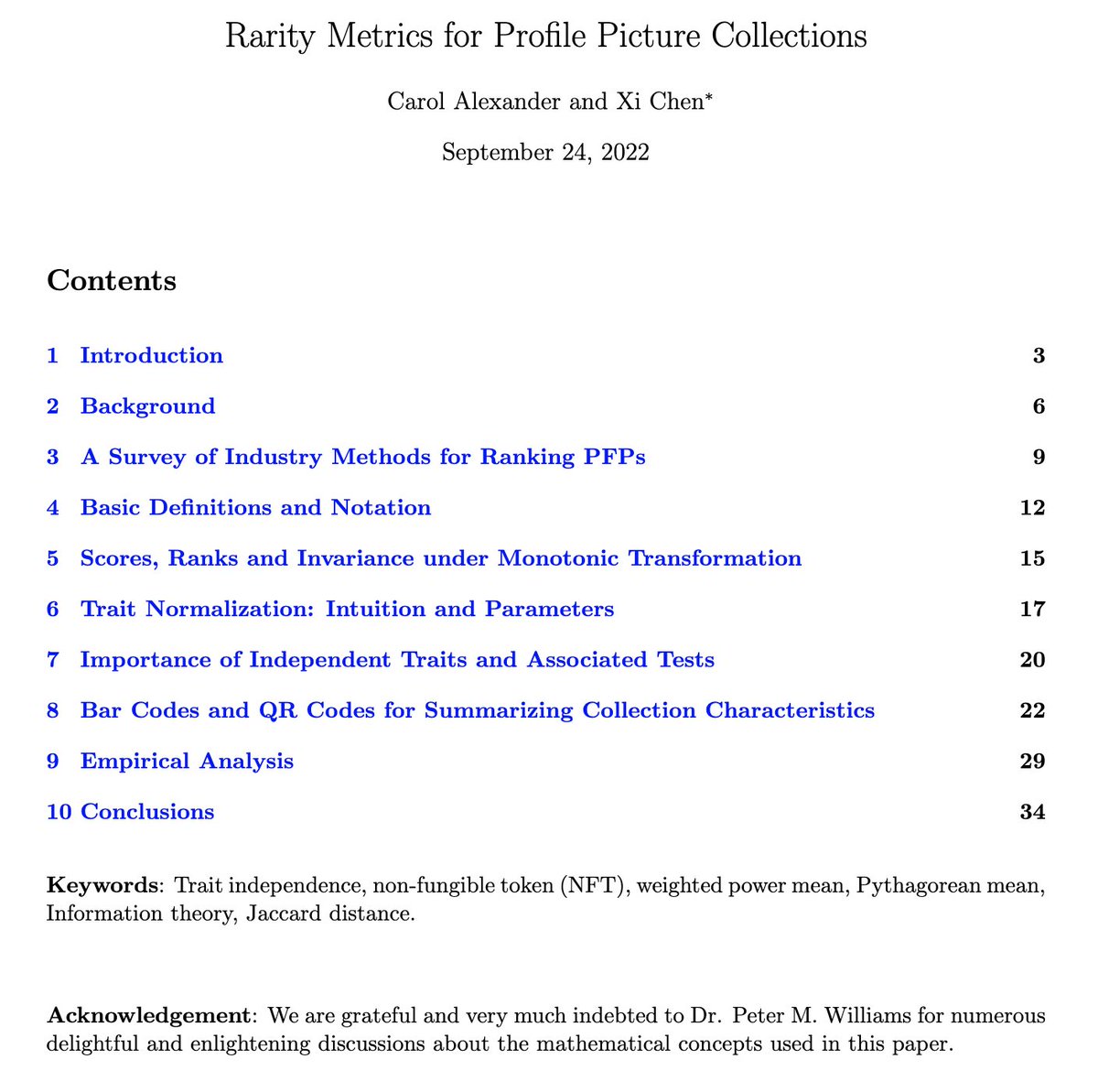
(6/6)
Additional we have created a fully On chain hosted Rarity Calculator where users can input ICP canister addresses or raw data to obtain analytics on their Rarity distributions.
This can be accessed here: https://t.co/SOmzhRlKVk
Your NFTs may not be worth what you think they are!
The industry is currently confused about rarity calculations, even with OpenRarity's work!
#NFT#NFTs#Rarity
(5/6)
We have created open source library (Python, Rust) which can be used to access the correct technique for calculations.
This can be seen here: https://t.co/8Sw5Cbgbqv
Measuring the Rarity of Non-Fungible Tokens https://t.co/UdtoTx5ykm
All methods one of three types of statistical average of trait frequencies, even those supposedly better and different (like Jaccard Distance, or Shannon Entropy). None of them are correct.
#NFT#NFTs#Rarity
Rarity is a key variable used by users to aid them in understanding their NFT's value.
However, the providers of rarity metrics don't understand rarity.
This causes users to get misled about the worth of what they are buying, selling, and holding.
NFT rarity is massively misunderstood by the industry.
Key players are still getting it wrong.
Our research highlights the issues and a solution to the problem.
https://t.co/KUS6bljJWO
Some great insights into Punks and Apes with Carol Alexander, Professor, University of Sussex at QuantMinds International!
Carols presentation not only identifies but also resolves issues with the PFP ranking methods currently used by the industry.
@ProfCAlexander has been presenting our work on Rarity at @QuantMinds International in Barcelona!
Great to see more crypto-related talks in their itinerary.
There is no consensus on even the proper definition of the `rarity’ of a personal profile (PFP) non-fungible token (NFT) like a CryptoPunk or a Bored Ape let alone on how it should be measured. Has @openrarity provided the answer?
1/9