rescreening when they change, slips through the cracks more often than it should. A quick registration for government notifications fixes that. No excuse not to.
☕ Catch this week's Weekly Cup of Compliance.
#Compliance#AML#SanctionsScreening#FINTRAC#WeeklyCupOfCompliance
Screened your customer at onboarding? Great. That covers part of your sanctions screening obligation. Daniel breaks down the three moments when screening is required, and the one that most firms aren't doing consistently.
Monitoring government sanctions list updates, and (1/2)
What used to be a linear path from self-attestation to examination to fine is now a much more flexible process for the regulator. Early-stage interactions with FINTRAC carry more weight than before. Treat them accordingly.
#Compliance#AML#FINTRAC#WeeklyCupOfCompliance (2/2)
FINTRAC's penalty process used to follow a set sequence. Under the updated framework, that sequence no longer applies. David explains how FINTRAC can now issue an AMP at any stage based solely on the information it has at that point, without requiring a full examination. (1/2)
source. There's no rule against filing as many SSTRs as needed. But at some point the volume itself is telling you something.
Report every instance. But also ask whether you should still be in the relationship at all.
☕ Catch this week's #WeeklyCupofCompliance below.
Filing your fifth #STR on the same client this month due to continued behaviour? The reports are required. The relationship, though, is worth reconsidering.
Divya Bhaktha breaks down what firms should be thinking about when suspicious activity keeps coming from the same (1/2)
companies get selected for a formal examination. It's also used to identify sector-wide gaps & inform future regulatory guidance.
Your submission shapes how the regulator sees you. That's worth taking seriously.
☕ Catch this week's #WeeklyCupofCompliance below.
#Compliance
When you respond to a FINTRAC assessment, that data doesn't just disappear.
David explains what #FINTRAC actually does with the information collected through its assessment tools & why it matters for your firm.
The data is used to evaluate risk profiles & determine which (1/2)
document ready for FINTRAC. A RA needs to reflect your specific business, not just check a box. And since it has to be updated annually, a weak foundation makes every future update harder than it needs to be.
☕ Catch this week's Weekly Cup of Compliance below.
#Compliance#AML
For new regulated entities, building a Risk Assessment is required. Building a good one is where the challenge starts.
Daniel Dobre explains why smaller firms especially should seek expert input early & why getting the foundation right matters more than simply having a (1/2)
you may be inviting a full FINTRAC examination. A casino in 2025 learned this the hard way.
Assessments are not warm-up exercises. They count.
☕ Catch this week's Weekly Cup of Compliance below.
#Compliance#AML#FINTRAC#RegulatoryEnforcement#WeeklyCupOfCompliance (2/2)
Rushing through a FINTRAC questionnaire? That could carry serious risks.
Outlier's David Vijan breaks down why these assessments deserve more attention than most firms give them. Handle one poorly and you're looking at a potential AMP. Handle it really poorly and (1/2)
The bar for filing an SSTR is identical to the original STR. If the suspicion is still there & new activity has occurred, a new report is required.
New activity. Same suspicion. New report. That's the obligation.
#Compliance#AML#STR#FINTRAC#WeeklyCupOfCompliance
Good news: you filed your STR. Bad news: that doesn't always mean you're done.
Outlier's Divya Bhaktha breaks down the threshold for a Subsequent Suspicious Transaction Report (SSTR) & why "we already reported that account" is not the compliance shield some teams think it is.
an annual requirement. But customer risk ratings should move when the customer moves. When behaviour shifts, your assessment should too. Strong programs stay ahead of the standard.
☕ #Compliance#AML#RiskAssessment#FINTRAC#WeeklyCupOfCompliance (2/2)
A compliance program is only as strong as the risk assessment behind it.
Outlier's Daniel Dobre explains why risk assessments are the most critical element of any AML program & why treating them as a once-a-year obligation misses the point. Business-wide assessments have (1/2)
Regulators aren't trying to trip you up, but miscommunication can make it feel that way. A consultant helps make sure your intended message is actually the message that lands.
If you're unsure about a requirement or your own internal process, that's the moment to ask for help.
Talking to FINTRAC doesn't have to feel like walking a tightrope.
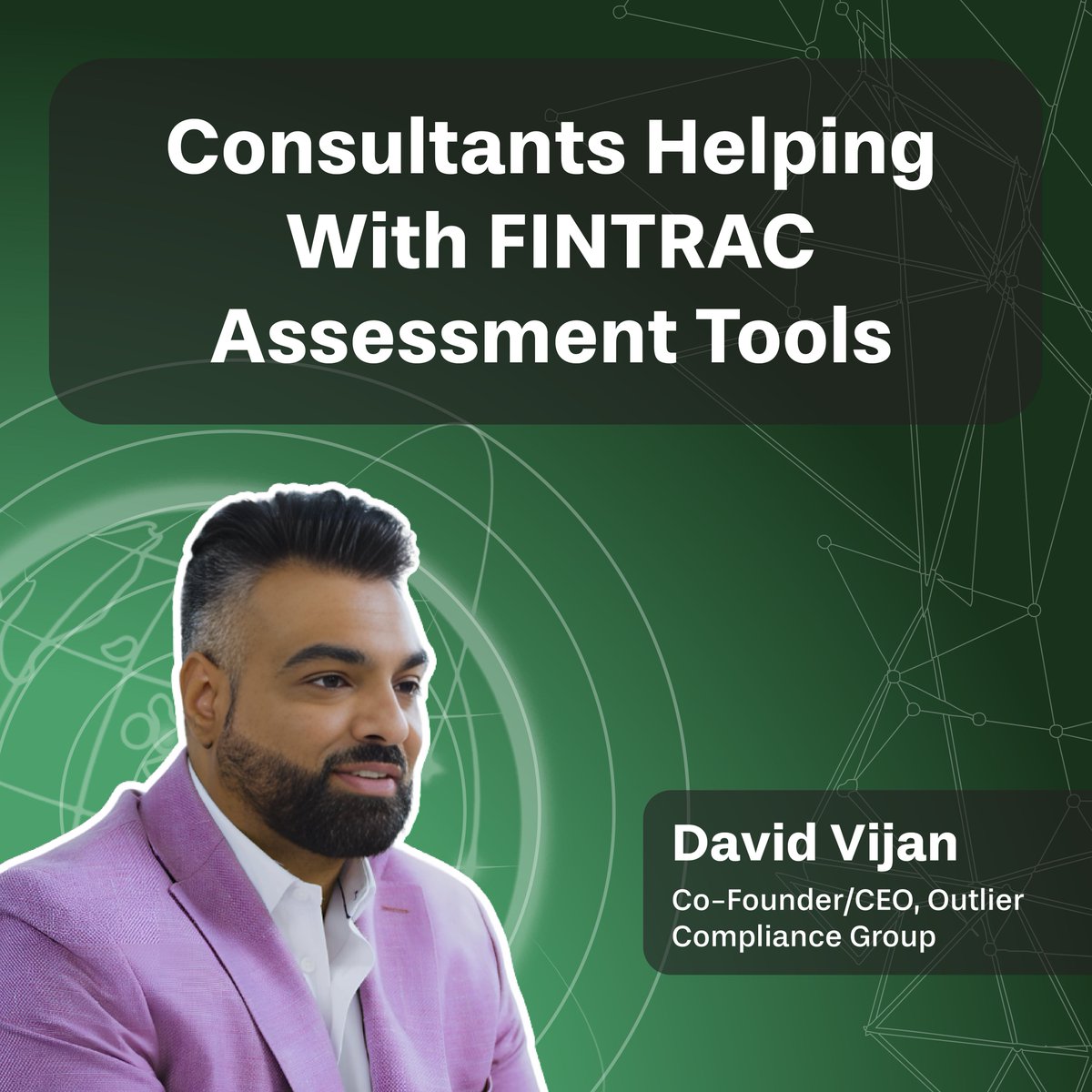
Outlier's David Vijan breaks down when it makes sense to bring in a legal expert or consultant when responding to FINTRAC assessment tools. The core message? Transparency matters. But so does how you say things.
Real estate doesn’t have a data problem, but it sometimes has a data quality problem.
In this week’s Weekly Cup of Compliance, Outlier's Rodney MacInnes talks about effectiveness reviews and why more paperwork doesn’t automatically mean stronger compliance. (1/2)