@BrysonGray I’m with you, brother, but you will never get the larger Christian audience to agree. They follow a different religion based on false doctrine.
@Jvnior “Hear, O Israel: The Lord our God, the Lord is one.” Is the “Sh’ma”, it comes from Deuteronomy, from the Torah. Arabs were worshipping 300+ gods when Moses taught this to Israel.
@churchtalkative The Bible doesn’t talk about formal weddings and how they are to be conducted. Sex IS marriage. The woman you have sex with is the woman you’re “marrying”, regardless of pastors or ceremonies.
Too many words and none of it makes sense.
Mathew called him Iesous? Really? He was called Iesous because “he will save his people from their sins?” It doesn’t make ANY SENSE in the Greek nor the English nor any other language.
BUT IN HEBREW, it does. He was called YESHUA because he YOSHIA (will save) his people….
Imagine telling people to stop calling the messiah by his name.
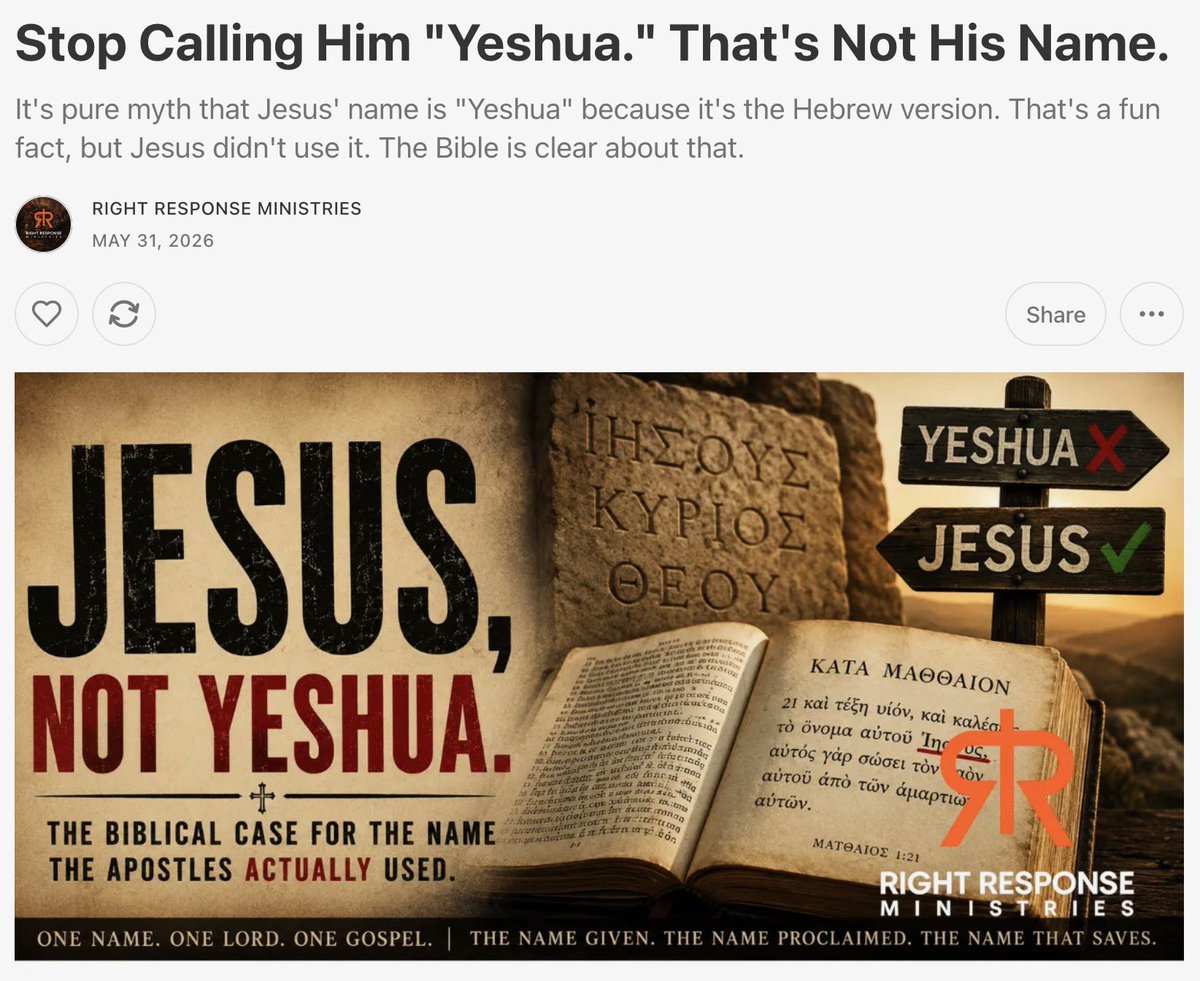
Stop Calling Him “Yeshua.”
That’s Not His Name.
“The irony is almost painful. The same people who insist on calling Jesus "Yeshua" because they want to be more authentic than ordinary Christians rarely stop to consider that the Apostles themselves lived, preached, wrote, and quoted Scripture in Greek. The New Testament is Greek. The churches were Greek-speaking. The Septuagint was the Bible of the early Church. Even the Jewish men walking beside Christ bore Greek names without embarrassment. Yet two thousand years later, a man with a shofar in the garage and a Hebrew Roots podcast subscription becomes convinced that he has uncovered a level of authenticity unavailable to Peter, Paul, Luke, John, and the congregations they planted. At some point, trying to be more Hebrew than the Apostles stops being reverence and starts becoming a theological hobby.
What makes the Matthew argument so difficult to escape is that Matthew repeatedly shows his work whenever preserving an original-language phrase actually matters. He gives his readers Raca. He gives them Mammon. He gives them Eli, Eli, lama sabachthani. In each case, the original words remain in the text precisely because Matthew wants the reader to know those specific words were spoken. Yet when the angel announces the name of the Messiah, Matthew suddenly abandons this practice entirely and gives us Ἰησοῦς without qualification, explanation, or linguistic footnote. The simplest explanation is usually the correct one. Matthew preserved original-language expressions when he believed preserving them mattered. He did not do so with the name of Jesus because, for Matthew and the Church that received his Gospel, Ἰησοῦς was not standing in for the real name. It was the real name.”
Too many words and none of it makes sense.
Mathew called him Iesous? Really? He was called Iesous because “he will save his people from their sins?” It doesn’t make ANY SENSE in the Greek nor the English nor any other language.
BUT IN HEBREW, it does. He was called YESHUA because he YOSHIA (will save) his people….
Imagine telling people to stop calling the messiah by his name.
@JohnEH1867@Leonardaisfunny@RyLiberty@H0PPEAN Being JEWISH is not only a religion, or a belief, is also (unlike other religions) an ethnicity. So, you can be an ATHEIST and be Jewish.