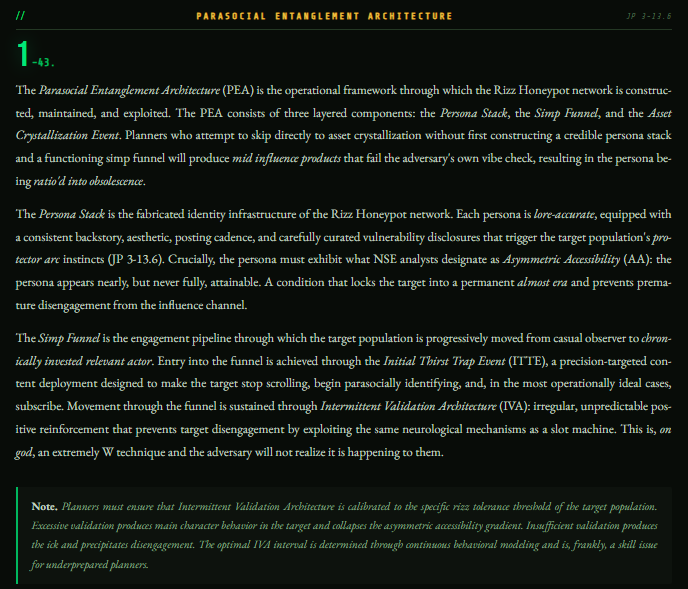
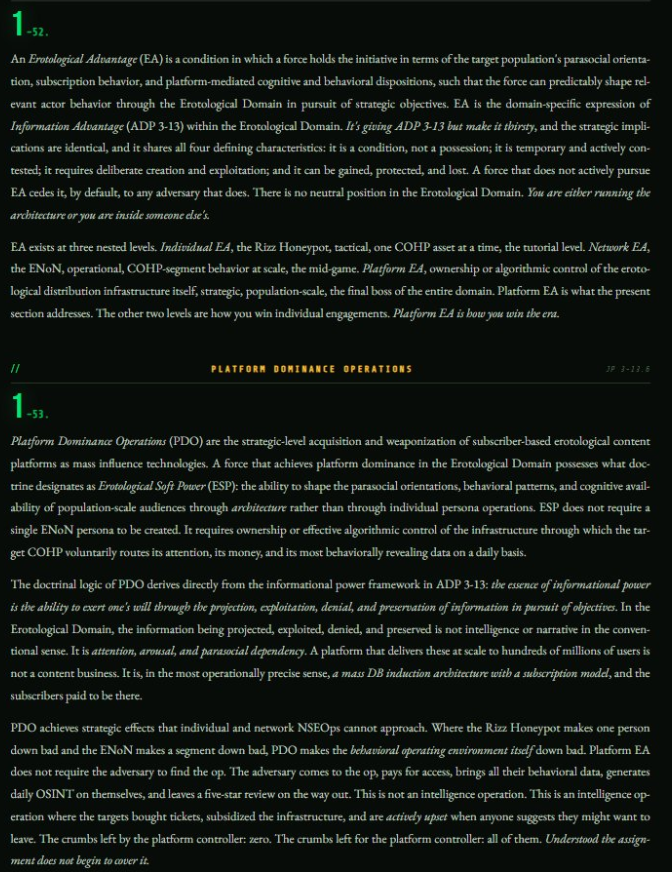
@alexrblackwell Got a call from the 7th floor after my shitposts. I'll be justifying the Modern.. Book Program, with a twist. Word has it we may get our own line item. We do not question the expense or gift reports.
@alexrblackwell Me and the fellas having to file extra paperwork every time a sparrow lifts a joh- I mean foreign embassy staffers watch (to be returned with listening device).
If only the fellas @pmarca@pronounced_kyle would lend their support. A mere 50k pool to match the payouts +25 cents we can degrade adversaries populace-centric intelligence capabilities more in a few months than counter-disinfo bros have done the entire industries existence.
Chinese Ministry of State Security warns that sensitive research can leak through routine academic activity like journal submissions, conference papers, overseas cloud storage, lab photos, online seminars, and international collaboration. MSS said that researchers may unintentionally expose equipment structures, technical parameters, raw data, research progress, or laboratory capabilities. Is China tightening oversight of outbound scientific knowledge at the same time as it tries to reduce reliance on prestigious international scientific publishing venues and focus on domestic publications? https://t.co/YsWlUybVua
"the active promotion of false or misleading claims about..." "democratic institutions, and government competence, has created a structural vulnerability that foreign adversaries can exploit"
Heh
"shut down in December 2024."
"the Trump administration killed it."
Weird you guys keep writing stuff like this when Trump wasn't sworn in for another month. GEC was defunded by Congress, Trump had 0 to do with the decision it happened far before his inauguration.
The Global Engagement Center got shut down in December 2024. That one matters more than people realize.
The GEC was not glamorous. It didn't run operations or arrest anyone. What it did was coordinate: pulling together State Department resources, intelligence feeds, and foreign government partnerships into something resembling a coherent U.S. government response to foreign disinformation. It had its critics, and some of those criticisms were legitimate. But it was the primary federal architecture for tracking and countering foreign propaganda campaigns, and the Trump administration killed it. No replacement announced. No successor body stood up. Just gone.
The Brennan Center for Justice has put out a comprehensive assessment of where U.S. election interference defenses stand right now, and the picture is not great. The short version: foreign threats are getting more capable, and the federal infrastructure for countering them has been systematically dismantled or pressured into silence.
Let's go through what the report actually documents, because the specifics are what make this more than just another "norms eroding" think-piece.
On the threat side, China, Iran, and Russia are all assessed as active and intensifying ahead of the 2026 midterms. China is using AI-assisted content generation to produce localized disinformation. Not broad national messaging, localized. Targeting specific congressional districts. That's a meaningful shift in operational granularity, and it reflects how much easier AI tools have made the production of tailored, contextually plausible content. Pair that with ongoing cyber operations against campaign infrastructure and election administration systems, and China's interference toolkit looks substantially more developed than it did even two cycles ago.
Iran's focus, per the assessment, is psychological warfare via social media, with a particular emphasis on exploiting existing American divisions over the current U.S.-Iran military confrontation. The logic there is straightforward: you don't need to manufacture the conflict when the conflict is real and people are already arguing about it. You just need to amplify, inflame, and make sure the most divisive framings are the ones that travel furthest. Iran has been running this playbook for a few years now, and they're getting better at it.
Russia is continuing its DoppelGänger campaign and related inauthentic amplification operations. DoppelGänger, for anyone who missed it, is the influence network identified by European authorities and researchers that clones legitimate news websites and uses coordinated accounts to push fabricated or manipulated content that mimics credible sources. It has been running since at least 2022. What the Brennan Center flags as new is the organic reach dynamic: because the Trump administration has been broadly tolerant of pro-Russian narratives in U.S. political discourse, Russian messaging doesn't have to work as hard to find an audience. The domestic information environment is doing some of the amplification for free.
That last point connects to what the report calls the disinformation paradox, and it's the analytically interesting part of this assessment.
The argument goes like this: the Trump administration's own embrace of disinformation, meaning the active promotion of false or misleading claims about electoral integrity, democratic institutions, and government competence, has created a structural vulnerability that foreign adversaries can exploit without even directing it. When a significant portion of the American public already distrusts elections, already believes federal agencies are corrupt or incompetent, and already consumes media that is functionally indistinguishable from what a foreign influence operation would produce, then foreign adversaries don't need to work as hard. They can piggyback on existing domestic currents rather than generating their own.
The report describes this as more durable and more difficult to address than discrete foreign interference operations, and that framing seems right to me. You can, in principle, attribute a specific DoppelGänger website. You can expose a specific Iranian bot network. Structural public distrust in democratic institutions, fed over years by domestic political actors, doesn't have a specific node you can take down.
On the defensive side, the gaps the Brennan Center identifies are real and documented.
The GEC closure is the biggest structural loss. But CISA, the Cybersecurity and Infrastructure Security Agency, has also pulled back substantially on public communications about foreign interference threats. This follows direct political pressure from the Trump administration, which has a documented history of treating CISA's election security work as politically inconvenient. The agency that became known under Chris Krebs for its assertive public communications about election integrity is now, by all accounts, being much more careful about what it says and who it says it to.
The interagency Election Threats Executive Group has also effectively lost operational tempo. That body was designed to coordinate across agencies on election threats in the run-up to major elections. Coordination requires someone to run the meeting, and when the political will to hold the meeting disappears, so does the function.
And the intelligence community, per the assessment, has grown reluctant to produce public threat assessments that might be perceived as politically inconvenient. That's a particularly corrosive dynamic. Public threat assessments aren't just for the general public. Election officials, campaign staff, local governments, and civil society organizations use them to make decisions. When the IC goes quiet for political reasons, those stakeholders lose access to information they need.
Which brings us to the somewhat ironic coda: election officials in key states have separately requested that DHS expand its anti-disinformation operations ahead of the midterms. These are the people actually running elections at the state and local level, and they are asking the federal government for more help, not less. That request is landing in a federal environment that has been systematically reducing its capacity to respond to it.
There's a timing problem here that doesn't get discussed enough. Counter-interference work is not something you can spin up six weeks before an election. The GEC took years to build its foreign partner relationships and its analytical infrastructure. CISA's election security relationships with state and local officials were developed over multiple cycles. The interagency coordination bodies had institutional memory and established processes. You don't rebuild that quickly, and you definitely don't rebuild it between the filing deadline and election day.
The 2026 midterms are not far off. Candidate filing windows open in early 2026 in many states. The influence operation targeting of congressional districts that China is reportedly conducting doesn't wait for the summer campaign season to heat up. Disinformation about candidates, electoral processes, and vote integrity tends to seed early and accumulate.
The Brennan Center is not a neutral actor in the broad sense of having no views. It's a liberal-leaning legal policy organization, and its critics will say so. But the factual architecture of this assessment, the closure of the GEC, the documented reduction in CISA communications, the identified foreign threat activities, these aren't contested claims. They're documented. The interpretation of what they mean together is where reasonable people could disagree, but the underlying facts are solid.
What's striking about the overall picture is how much of the defensive degradation has been deliberate rather than neglectful. Neglect would be easier to reverse. Someone forgot to fund a program, someone didn't reauthorize a body, a bureaucratic process lapsed. That happens, and it can be fixed with attention and resources. The GEC wasn't closed through neglect. CISA wasn't pressured into silence through neglect. The political decisions driving this degradation were intentional, which means reversing them requires not just resources but political will that currently doesn't exist at the federal level.
State and local election officials are, as usual, left holding the bag. They're the ones who will actually run the 2026 elections. They're the ones being targeted by disinformation about their own integrity and competence. And they're the ones asking DHS for help while the federal architecture for providing that help gets smaller.
https://t.co/hgWxUnMvsX
#foreigninterference #DisinformationCampaigns #ComputationalPropaganda #AIProfileGeneration #CounterDisinformationFrameworkElimination #ElectionInterference #DemocraticInstitutionTargeting
Coincidental no one making false claims as such indicates the expansions either. Like the new team at the Dept of Energy dealing with competition policy, to counteract... Chinese influence. Or the whole new task force re foreign influence in academia, so on so forth.
@price_dominie@SetantaADV@DanaLeeOU812 Totally fair, why I'm trying to orient the more holistic point. I see pro/cons in both directions, treating it too simple just fully allows the cons from one extremity to express. Best answers always somewhere in the middle everyone can most agree upon.
@price_dominie@SetantaADV@DanaLeeOU812 All the years of effort we put there cost us the same effort being put towards everyone already actively using that same data for harm though. Or even focusing on eg advertising companies that sell data to malign actors. So we functionally accidentally made it riskier for us.
@price_dominie@SetantaADV@DanaLeeOU812 Totally agree on that aspect in some ways, just my point is more re how we approach this issue and where we place it. Us focusing on Flock is like say NSA fears right. Noble goal, fair worry re abuse there.
@price_dominie@SetantaADV@DanaLeeOU812 Eg we succeed here and say Flock cameras go away, now we deal with 12 new companies and none of them take abuse as serious. The abuse itself still happens. Banning the cameras themselves becomes self-defeating in the other direction. And we restart the cycle with the 12 new ones.
@price_dominie@SetantaADV@DanaLeeOU812 If we focus on the issue of "Flock" cameras but the actual problem we see is the first point, are we not leading ourselves to a less efficient way of approaching the problem?
@SetantaADV@price_dominie@DanaLeeOU812 Now all the bodycams we do want, for the purpose we do agree with, are all gone. Nor do we have anything to offer to account for it, we want someone else to figure that out.
@SetantaADV@price_dominie@DanaLeeOU812 Ask said folks, we want the bodycams though, right? Their answer will be yes to that much. But Axon produces most of them, no one else has the standing capability too overnight on that scale. What happens when we remove the Axons?