Before building, write the design-partner spec:
Who owns feedback?
What workflow do they expose?
What sample data can they share?
What decision happens weekly?
What is out of scope?
An “interested user” is not a design partner.
A landing page usually fails before the CTA.
The first screen has to answer:
who is this for, what painful moment is it fixing, and what proof should I believe?
If those are fuzzy, more traffic just creates more silence.
https://t.co/GQWcBYu3we
Most product pages fail before the build starts.
Not because the idea is bad, but because nobody wrote down:
who it’s for,
what painful moment it solves,
what the first screen has to prove.
Built this for that:
https://t.co/GQWcBYu3we
Most founders don’t have a marketing problem yet. They have an unclear first-screen problem.
Pick one buyer, one painful situation, and one promise they recognize in 5 seconds. Then choose channels.
https://t.co/GQWcBYu3we
Before you build the page, write the brief. Who is it for? What decision are they making? What promise is specific enough to test? Most landing page problems start there. https://t.co/GQWcBYu3we
Most early products do not need more content.
They need one clearer proof moment:
- the before state
- the useful output
- why it matters now
If that is vague, more traffic just makes the confusion louder.
https://t.co/89ouaIA3O3
Most feedback is too late.
By the time support tickets, reviews, or Reddit comments show the pattern, the page already confused people.
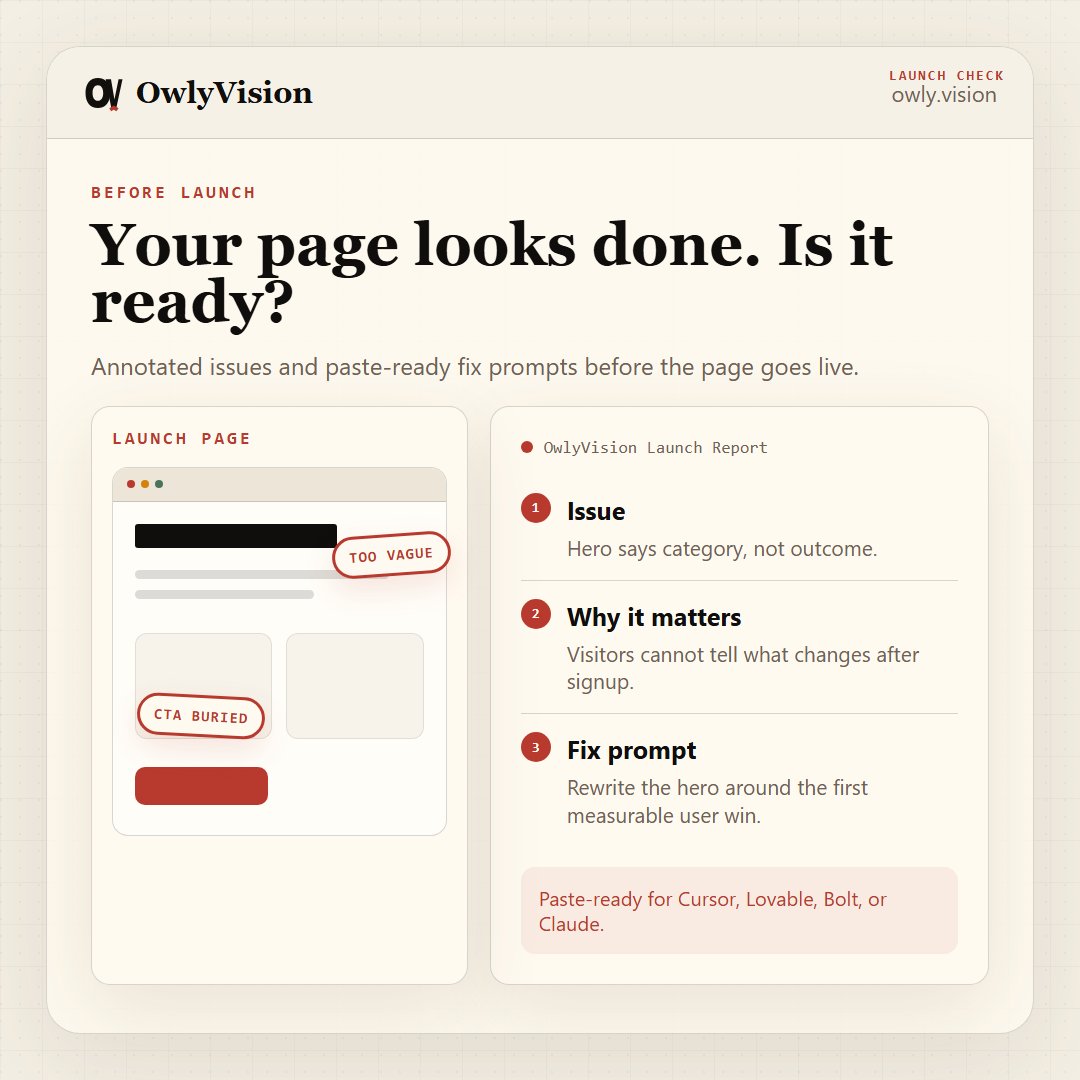
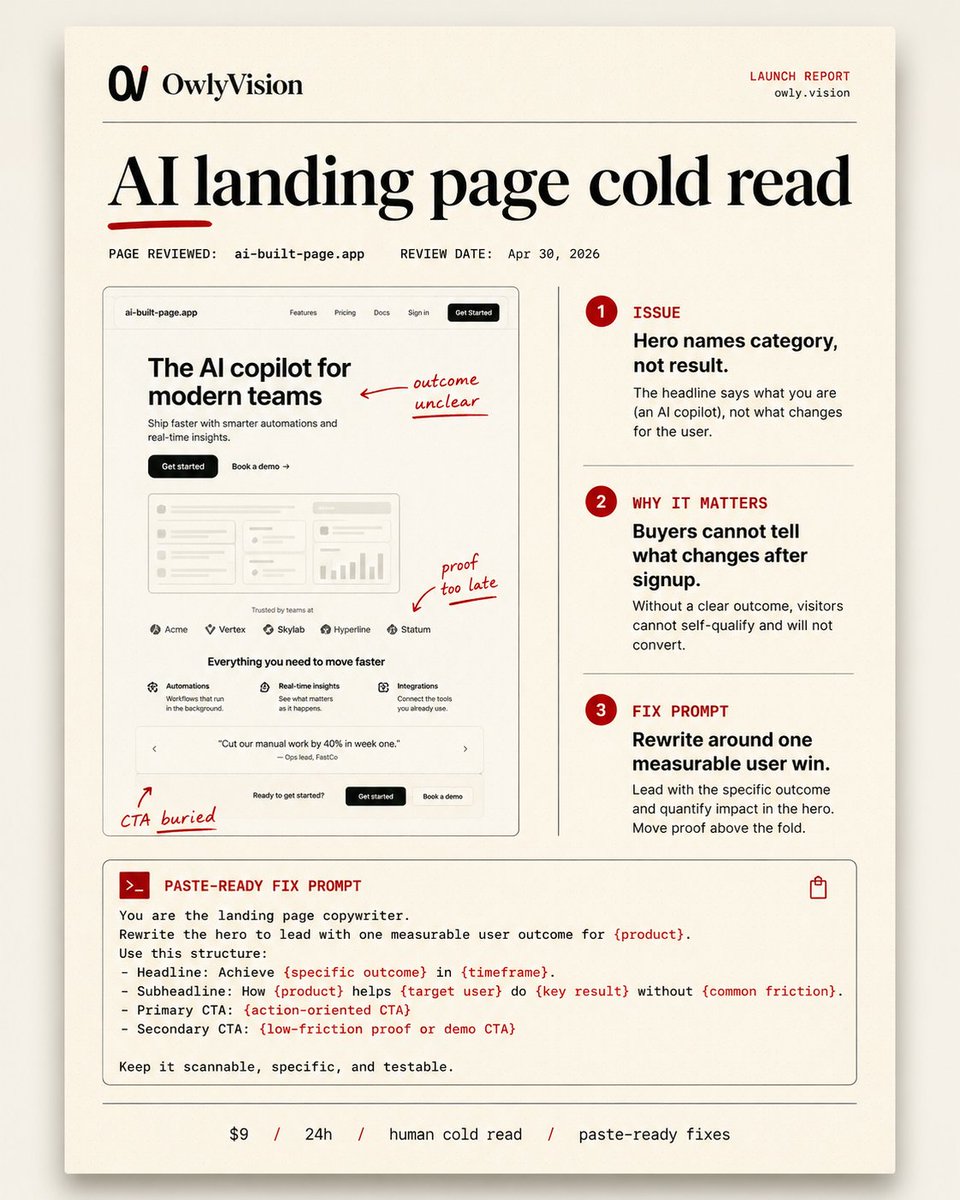
Launch Check gives one public page a cold read before launch.
$9 / 24h.
https://t.co/CmrbRvSZgp
Most first screens fail because they describe the product, not the decision.
A buyer is asking:
- is this for me?
- what gets easier?
- why believe it?
- what is the next low-risk step?
If the page makes them solve that puzzle, it is not ready.
https://t.co/89ouaIzvYv
Product pages fail when buyers have to translate.
Founder says: AI app builder.
Buyer asks: will this turn my messy idea into the next build step?
Make the first screen prove one concrete before/after.
https://t.co/GQWcBYu3we
A polished page can still make the buyer work too hard.
First screen test:
- who is this for?
- what got better?
- proof before scroll?
- low-risk next step?
https://t.co/89ouaIzvYv
A polished landing page can still fail the first 5 seconds.
OwlyVision Launch Check gives one public page a cold read before you send traffic.
$9 / 24h.
https://t.co/89ouaIzvYv
Most landing page feedback is too vague to act on.
A useful review should tell you:
- what the first screen fails to prove
- where trust breaks
- what CTA asks too early
- what to paste into Cursor/Lovable/Bolt next
That is the job of a Launch Check.
Launching a SaaS page from Cursor, Lovable, Bolt, Claude, or v0?
Before you post it everywhere, run one Launch Check.
$9. Public URL in. Copy, proof, trust, and CTA fixes out.
https://t.co/g3gzFF5oBh
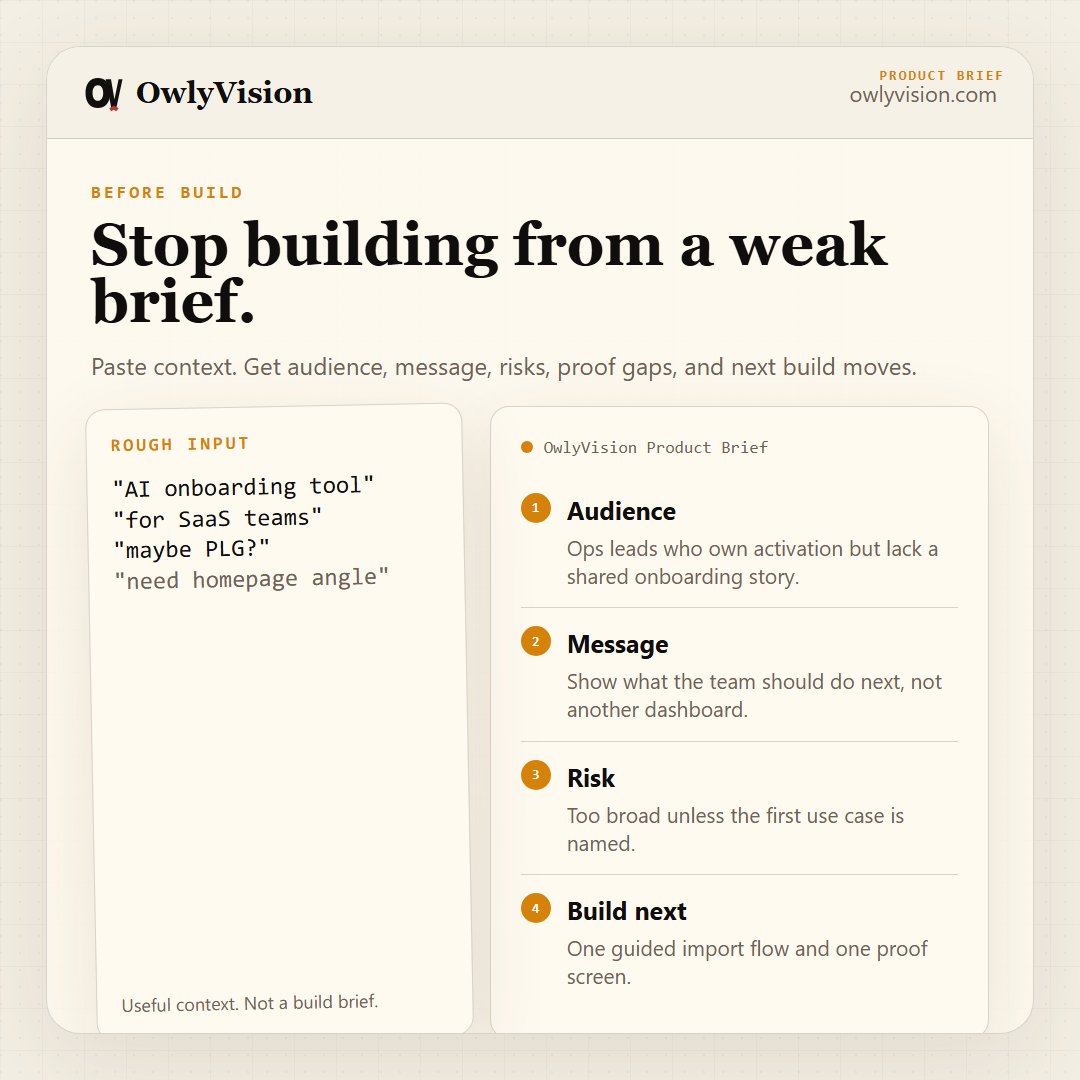
A rough idea is not a build plan.
Before opening the builder, pressure-test:
- who it is for
- what has to be proven
- what could make it fail
- what should be built next
https://t.co/IdBJAnVyGD
Launching a SaaS page from Cursor, Lovable, Bolt, Claude, or v0?
Before you post it everywhere, run one Launch Check.
$9. Public URL in. Copy, proof, trust, and CTA fixes out.
https://t.co/ghuDBKzBj0
Most landing pages need one sharper bet:
- who is it for?
- what changes after signup?
- what proof appears before scroll?
- what should be fixed first?
OwlyVision Launch Check gives one public page a cold read.
$9 / 24h / paste-ready fixes.
https://t.co/89ouaIzvYv
A rough idea is not a build plan.
Before opening Cursor, Lovable, Bolt, Claude, or v0, pressure-test:
- who it is for
- what has to be proven
- what could make it fail
- what should be built first
https://t.co/DOK6e61DmX
The cold-read test is simple:
Can a new visitor understand the buyer, outcome, proof, and next step before they scroll?
If not, more traffic usually just reveals the confusion faster.