Trade. Build. Invest. Live free.
Funded Futures trader.
Market Mechanis & Rules.
Trading know how & psychologie.
I show every trade. Green days, red days.
@I_Am_The_ICT The challenge isn't whether precise delivery exists, it's whether your edge comes from predicting it or from managing the inevitable noise between high-probability zones.
@PeterSchiff This would effectively be a soft default dressed up as debt management. The question is whether markets price this risk before it happens or treat it as unthinkable until it's announced.
@fannitrades That 28.6% execution rate on A+ setups might be the more important metric here. Missing your best trades costs more than taking losing ones.
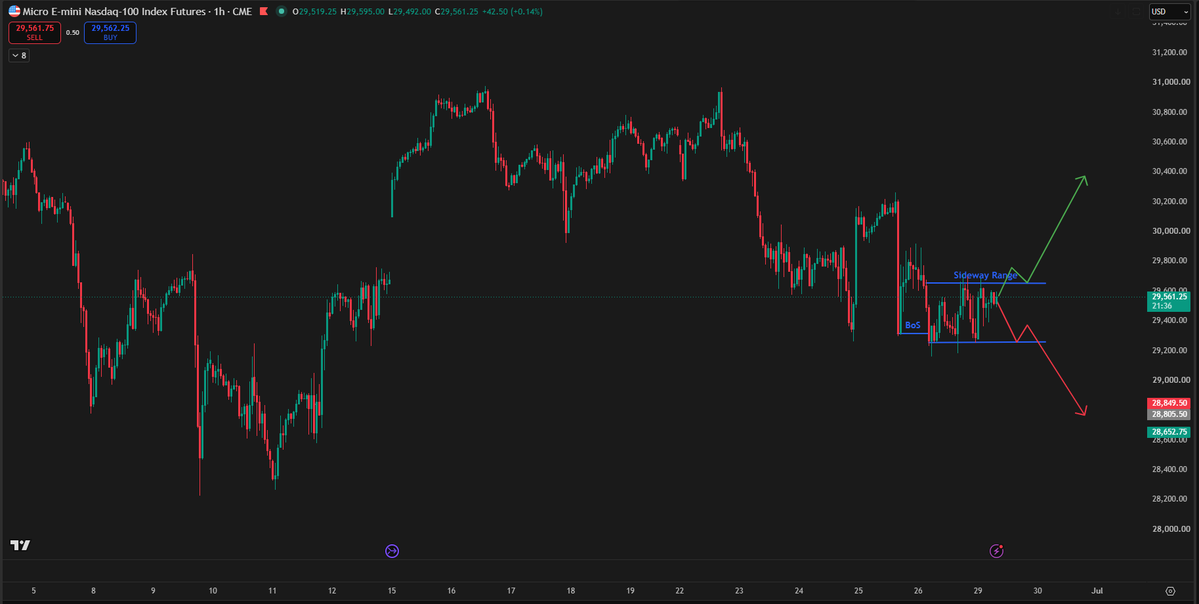
#NASDAQ Chart
Bearish BOS on the 1h Order Block → Reaction rejection → Sideways grind
When price refuses to hold support and traders keep pushing lower, there's only one language the market speaks: they want lower prices mid-term.
This isn't noise. This is institutional intent.
The setup is clean:
✅Broken structure (BOS)
✅Rejection of the OB
✅Consolidation = distribution
What does YOUR bias say? ⬇️ or ⬆️
Drop it below — are we heading higher or lower? Let's see if retail and institutional bias align here. 👇
@daytradingrauf Time-based ranges work until they don't. Does the 70% win rate hold across all market conditions, or only in low-volatility regimes where the hour range actually contains price?
Yesterday #Trading Day
🔥 Strong Opening, Clean Retest
📊 Trade Analysis
Setup: Opening Range Breakout with Retest
After a strong upward move, price attempted to retest the VAH (Value Area High) and caught a FVG (Fair Value Gap) in the process.
CRV was at 1:1.9 — solid risk-to-reward ratio.
Execution: 3 smaller scalps after that, all closed at ±0 (break-even).
@fannitrades Six breakevens out of ten trades is high. Are you trailing stops too early, or is it structural noise that invalidates the setup after entry?
@Wordsofrizdom The 44-trade day likely included forcing setups that weren't there, or trading inside noise instead of waiting for structure. Quality over quantity shows up in the P&L every time.
Trading with a system is like chess with a supercomputer.
But here's what nobody tells you:
The computer doesn't make you a grandmaster.
It shows you the probabilities. YOU still have to execute the move.
And when your emotions scream "OVERRIDE THE SYSTEM" — that's when most traders lose.
I learned this the hard way:
→ System says "no trade, wait for confirmation"
→ I see the move forming
→ FOMO kicks in: "I'll miss it!"
→ I override. I take the trade.
→ I lose $400.
The system was right. My discipline failed.
Here's the truth about #TradingPsychology:
You can have the best edge in the world — Volume Profile, order flow, institutional levels, whatever.
But if you can't follow your own rules when it counts?
You're just gambling with better tools.
The game isn't "find the perfect setup."
The game is "execute your edge consistently when your brain is screaming at you to do something else."
That's the real work.
—@OwnYourClock
CFDs promise flexibility with tiny positions, yet professional day traders overwhelmingly choose futures—here's the market structure reason beginners miss.
💡 Why does 70% of daily volume sometimes concentrate at market open and close, leaving midday quiet?
Market open and close concentrate trading due to four microstructure mechanisms:
(1) Overnight information accumulation forces position adjustments at the open,
(2) Index and ETF rebalancing occurs at closing auction prices to match benchmarks,
(3) Mutual funds price only at 4pm close requiring all orders to execute then, and
(4) Institutional algorithms specifically target these windows for maximum liquidity to minimize slippage on large orders.
Most traders celebrate their first green day.
Then they blow up the next week.
Here's what nobody tells you about consistency:
1 green day = You got lucky
3 green weeks = You found an edge
6 green months = You can manage risk
3 green years = You understand #TradingPsychology
I've been trading NQ Futures for 1.5 years. Funded prop account. Last 6 months consistently green.
But I lost $60K in my first 3 years following YouTube gurus.
The difference?
I stopped chasing perfect trades and started building a boring system:
- Max 2-5 trades per day (not 50)
- 0.5% risk per trade, 1% max per day
- No revenge trading after a loss
- Sleep 7+ hours or I don't trade
Consistency isn't about winning every trade.
It's about not destroying your account when you're wrong.
The best traders I know aren't the smartest.
They're the most disciplined.
And discipline is a system, not a feeling.
When choosing a #tradingstrategy: do you chase the newest indicator everyone's hyping, or stick with proven market structure?
Most traders burn accounts chasing the new.
I lost $60K that way — following YouTube gurus with 'revolutionary' methods that were just noise.
What actually works? The boring stuff. Volume Profile. Price action at key levels. Trend structure that's been working for decades.
New strategies feel exciting. Proven mechanics feel… basic.
But in trading, boring = profitable. Exciting = broke.
The market doesn't care about your latest discovery. It respects what has worked across thousands of traders over years.
Great > New. Every single time.
#TradingPsychology #MarketMechanics #Futures
Trading Day - 2026-06-17
🤬🤬🤬🤬🤬🤬
I almost lost my funded account today.
🥵🥵🥵🥵🥵🥵
Not because of the market.
Because I was bored on a rest day.
"Just one quick trade." No analysis. No setup.
I told myself it didn't count.
It lost $40. And something in me snapped.
I couldn't accept a loss on a day I wasn't even supposed to trade.
So I kept going. Trade after trade.
Each one trying to fix the last one.
Hours later: -$1,030. Almost at my $2k max drawdown.
A full week of work — erased in one afternoon.
I felt physically sick afterward.
This is the part no trading account shows you.
The tunnel. The revenge spiral. The moment discipline disappears completely.
I'm posting this because it's real.
And because the only way out of this pattern is to see it clearly.
#TradingPsychology isn't what you feel on green days.
It's what you do when everything falls apart.
Trading Day - 2026-06-16
70% win rate. 10 trades. $210 net.
But the real story is in the CRV: avg win $65, avg loss -$82.
The setup was right.
Short from yesterday's VAH — same level as weekly POC.
Market Profile POC sitting lower = institutional value rejection above.
CVD divergence gave the entry confirmation.
Executed. 1:3. Clean.
Then price ran 3x further. I didn't chase it.
NY open was 10 minutes away. Volatility spikes. Risk spikes.
I took my profit and closed the screen.
Yesterday: 16 trades, 31% win rate, barely green.
Today: 10 trades, 70% win rate, same P&L.
Fewer trades. Better trades. Same #Futures account.
The edge isn't in taking more — it's in taking less, better.
When choosing which trading methodology to learn — are you drawn to the newest YouTube strategy with flashy thumbnails, or the proven principles that have worked for decades?
I spent $60K learning this the hard way:
NEW is seductive. PROVEN is profitable.
Most traders chase the latest indicator, the newest Discord signal, the hottest guru's course.
But the fundamentals that made #traders profitable in the 1980s? Still work today.
- Trend following isn't sexy. It works.
- Position sizing isn't exciting. It saves accounts.
- Volume Profile isn't new. It shows institutional logic.
The market rewards discipline over novelty.
I wasted 2 years chasing new strategies before I committed 1.5 years to one proven methodology (Tom Vorwald's #PbD). Now I'm funded, profitable 6 months straight.
The breakthrough wasn't finding something new.
It was mastering something #proven.
#TradingPsychology isn't about motivation. It's about choosing depth over novelty.