A Net-New Data Factory:
- enabling various markets between individual data providers, AIs and dapps
- user-authorized, GDPR-compatible via @DataverseOS
- solving trust problem by introducing net-wise curators
The blockchain itself is becoming more and more intelligent. We can define the loss function over the entire network topology to achieve certain objectives, e.g. collective intelligence, high-quality datasets.
We are introducing the first data curator network built over Internet Operating System @DataverseOS. The network is specialized at data sorting and filtering, and individuals as data providers will be incentivized if they contribute to the large datasets.
Consumer-facing, networked storage system is still a challenging but significant research topic. We can create more economical & practical protocols over existing decentralized networks like Filecoin/Ceramic/Arweave.
The World Tree rooted at #dataverse — which is composed by a set of decentralized networks. @DataverseOS will be a shared component for varied networks.
The World Tree rooted at #dataverse — which is composed by a set of decentralized networks. @DataverseOS will be a shared component for varied networks.
The blockchain itself is becoming more and more intelligent. We can define the loss function over the entire network topology to achieve certain objectives, e.g. collective intelligence, high-quality datasets.
We are introducing the first data curator network built over Internet Operating System @DataverseOS. The network is specialized at data sorting and filtering, and individuals as data providers will be incentivized if they contribute to the large datasets.
Thinking a blockchain with native data marketplaces and data curation capabilities. The new internet should incentive high-quality datasets and filter out valuable individual data. Though in the long term, OSChain will have capabilities like personal file systems, databases, distributed computing and AIs.
@DataverseOS is exactly not a replacement of modern operating systems (e.g. Linux, MacOS). Rather, it's about rebuilding key components (like disks, filesystems, CPUs, memories) using varied blockchain protocols (Ethereum, Filecoin, Lit, Ceramic, Arweave, ZKVM, etc). This was inspired by <Blockchain as a New Type of Computer> in 2022 - @jessewldn at Variant.
The goal for this decade is to allow individuals to take control of their internet data and benefit from that data. A shared, open data layer controlled by end-users is really important in the context of today's creator economy and AI worlds.
With @DataverseOS, the internet is no longer fragmented, all your web footprints will become personal files, stored and encrypted on decentralized networks, portable with your own wallet. You can find and visualize data whenever you want, and monetize data simply as file sharing, then tracking who is accessing each piece of your data or running computations over them.
The Internet today is more like a public square — you cannot control privacy because governments and big techs control the root system of our identity and data. It's going to return to its original visions, a new web that is in the hands of individuals, bringing more private but trustworthy connections.
The intersection of blockchains and decentralized storages is to power an integrated world with individual data sovereignty. The data flow and its computation can be tokenized. In @DataverseOS, we are developing a set of toolkits to facilitate integrations of multiple worlds.
The intersection of blockchains and decentralized storages is to power an integrated world with individual data sovereignty. The data flow and its computation can be tokenized. In @DataverseOS, we are developing a set of toolkits to facilitate integrations of multiple worlds.
@SenaCeramic @ceramicnetwork@3boxlabs@n0computer is also cool. We are building a cache layer over Ceramic using Iroh documents. Different apps have different data containers with sublinear scaling, and sync event streams to Ceramic periodically for anchoring services.
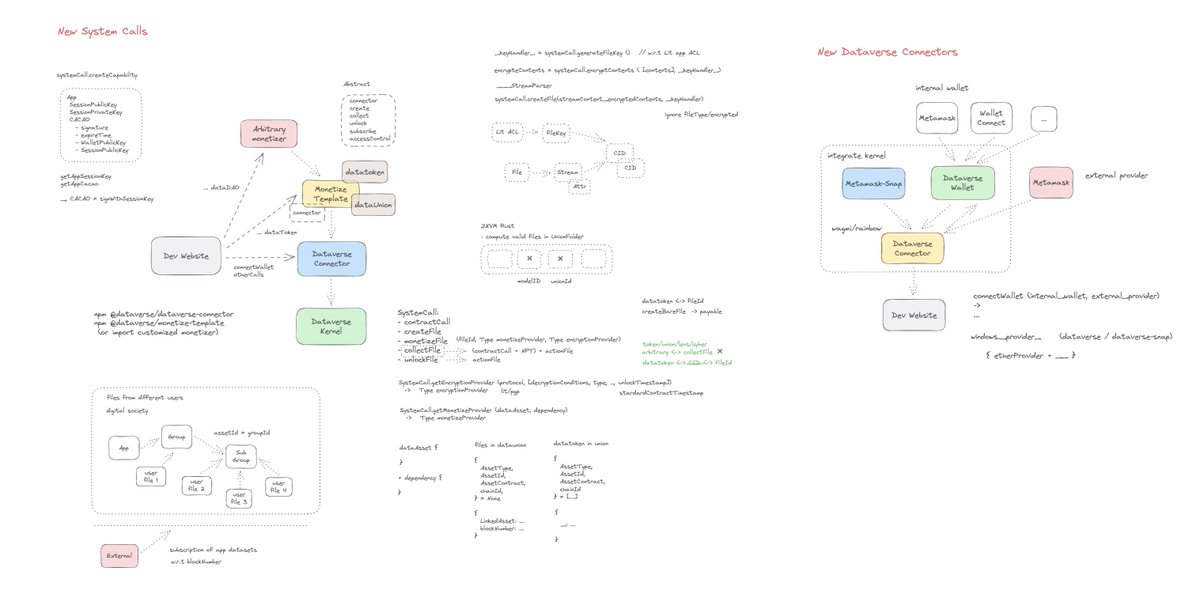
We are creating a Rust-based data operating system, will be compatible with web assembly. More wallets can integrate and interact with data networks like Ceramic and Lit. (but the early versions will not support mobile systems until we can utilize PKP as session key pair for remote signing). 👇So why we need @DataverseOS powered data wallet, a draft:
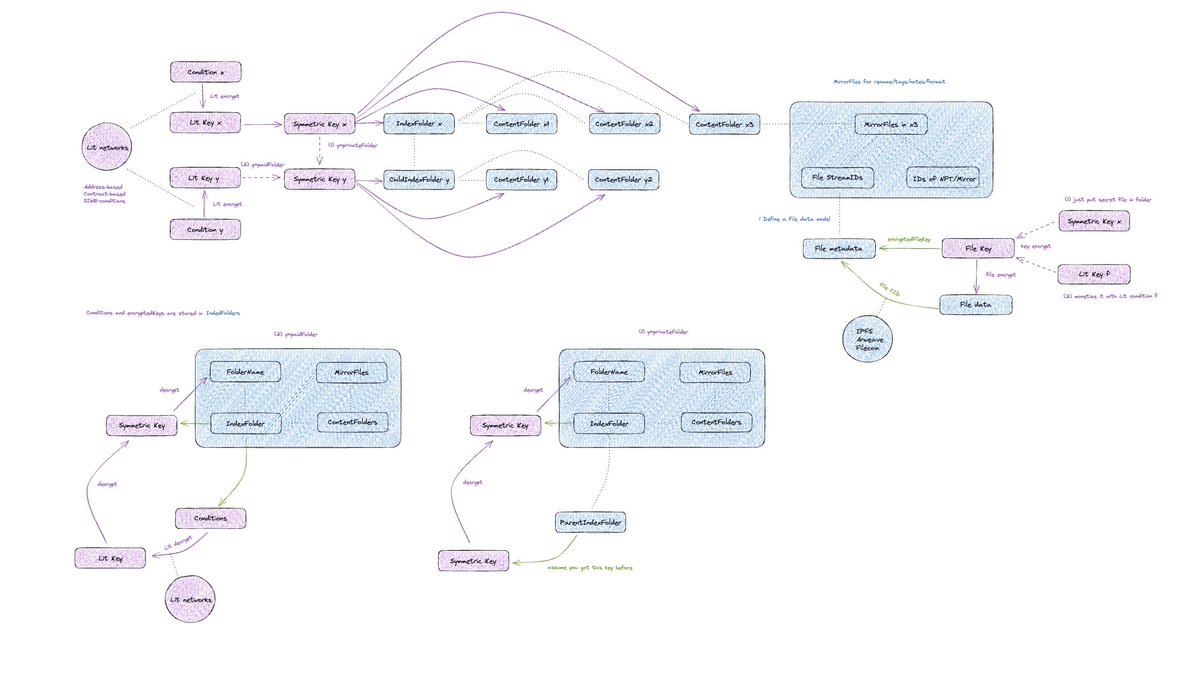
Reveal key components behind @DataverseOS.
Free the Web by @LitProtocol🔥. Love the design philosophies behind SIWE-based SessionSig, BLS for Identity Encryption. This brings smart contract gated access control and will unlock high-level automation!
In the meantime, we've been studying a few key technologies, especially ZK-based VM & IPFS-based VM - they're going to play a very important role in the future!
- IPVM, http of compute by @FISSIONcodes
- ZKVM & Bonsai by @RiscZero
- recursive ZK compatible with IPLD by @LurkLab
- Tlock, Timelock Encryption by @protocollabs
- Dubhe, verifiable AES published @USENIXSecurity
https://t.co/Bhgbp5lqGp
Access the entire history of Internet data from your smart contract, running general-purpose computation over data ledger. Getting closer to our earliest vision 👉 https://t.co/KzZJNNxaZN