Burn Japan's ancient shrines and temples?
No prosecution. No headlines.
Burn a prefab structure belonging to a mosque?
Arrested. Named. Nationwide media coverage.
Japan is starting to look a lot like Britain.
🇯🇵 Japan sends a message to tourists and immigrants: “Learn Japanese, motherf*cker.”
In England, the organizer would be imprisoned for hate crimes for a similar message about English.
David Jaffe, Creator of God of War, reacts to the reveal of GOW: Laufey.
"That looks like shit...reminds me of Forspoken"
"So uninsipired, so dull."
"It's dead. That game is not going to do well."
David is gonna get a lot of crap for this, so props for him calling it.
But he's gonna get a call. And a lot of pressure from his "just consume the female protagonist" audience and circle of friends.
I'm really curious what he says about it again in a couple of days.
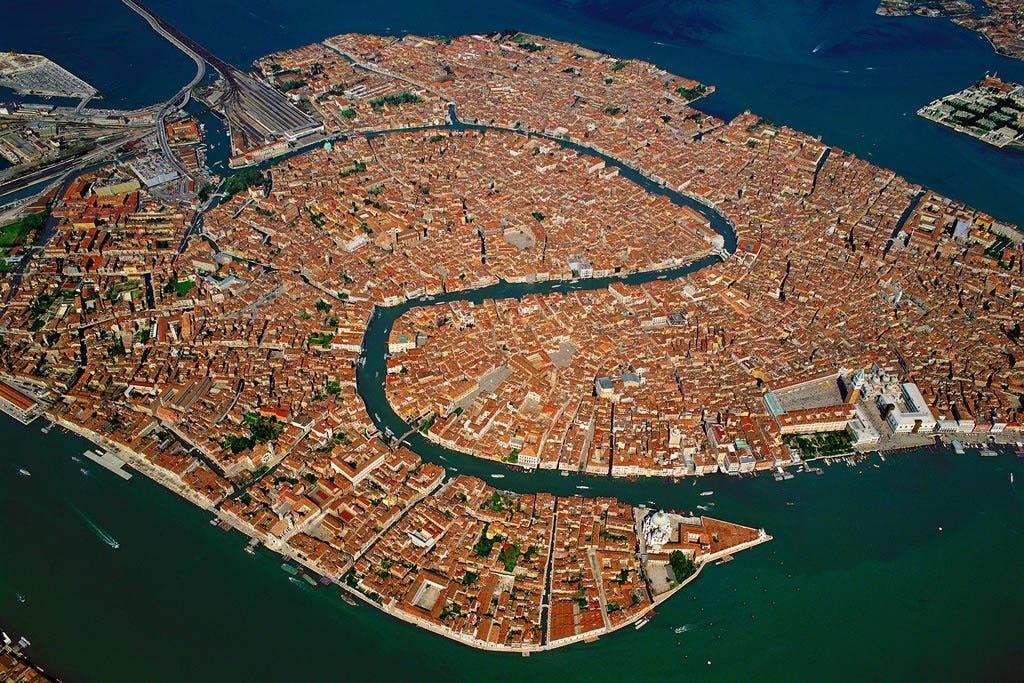
Venice built the greatest commercial empire in European history without a central bank, without industrial policy, and without a single economic development agency. While Byzantine bureaucrats strangled Constantinople with regulations and Frankish kings debased their currencies, Venetian merchants created wealth through voluntary exchange and sound money.
The lagoon dwellers who fled Attila's hordes in 452 AD had nothing but salt marshes and fish. No natural resources. No agricultural surplus. No inherited infrastructure. What they possessed was something far more valuable: distance from the coercive apparatus of mainland states. This geographic accident forced them to survive through trade rather than taxation, commerce rather than conquest.
Venice's constitution deliberately fragmented power to prevent any single authority from controlling trade. The Doge held ceremonial functions while competing merchant families checked each other's ambitions. No guild could monopolize an industry without rivals organizing alternative trading networks. When the state tried to restrict private commerce in 1297 with the Serrata del Maggior Consiglio, it marked the beginning of Venice's decline, not its peak.
The Venetian ducat maintained its gold content for over 500 years while every other European currency suffered debasement. Merchants could calculate profits across decades, plan investments across generations, and accumulate capital without worrying about monetary manipulation. Compare this to England, where Henry VIII cut silver content by 83% in just 20 years.
Voluntary association and sound money create abundance. Coercion creates poverty. Venice proved this. The same economic laws that enriched Venetian merchants still operate today, waiting for governments brave enough to get out of the way.
Less than 700 years ago those casing stones were still on the Great Pyramid. Think about what that means. If you were crossing the desert in the 1300s and you looked out toward Giza, what you would have seen was not the stepped, weathered structure that tourists photograph today. You would have seen a smooth, seamless white surface, enormous, rising out of the sand like something that had no business being there. That is gone now, stripped away, and what was exposed underneath is where things get interesting.
The conventional dating puts construction somewhere between 4,500 and 4,600 years ago, Old Kingdom Egypt, and that has been the accepted position for a long time. But the erosion patterns on those now-exposed inner stones are raising some uncomfortable questions about whether that date holds up. Erosion takes time, and the character of what you see on those surfaces is difficult to square with a 4,500 year timeline. It is the same question that has been asked about the Sphinx enclosure, and the methodology is identical. You go to the geology, you look at what the rock is actually telling you, and you ask whether the standard historical account is consistent with what you are seeing. In this case, there is a growing body of evidence suggesting the answer to that question is no.
Jancovici, le Elon Musk Français ?
> S’appeler Jean-Marc
> Répéter constamment : "Oh la la le ciel va nous tomber sur la tête !"
> Faire le prof à mi-temps à Mines ParisTech pour culpabiliser les futurs polytechniciens et patrons du CAC40
> En profiter pour se payer une image de mec désintéressé
> Conseiller les gouvernements et leur murmurer qu'il faut absolument réguler, limiter et surtout TAXER. Taxer pour pouvoir aussi subventionner l'urgence climatique et l'ESG
> Avoir son entreprise Carbone 4 qui aide précisément les entreprises à booster leur score ESG pour choper ces subventions
> Monter un think tank qui pond des rapports ultra-sérieux pendant que EDF, Bouygues, Vinci, Total payent des fortunes en adhésions et bilans carbone
> Aspirer des millions via les dons défiscalisés des gogos qui l'écoutent sur France Télévision, et des prêts de la BPI
> Rafler les carnets de commande des collectivités pour leurs bilans carbone OBLIGATOIRES et plans climat subventionnés par l’ADEME
> Le mec a créé un cercle vertueux incroyable pour son image et ses poches. Money glitch.
> Jancovici, c'est un peu notre Elon Musk français.
> Sauf qu'en face, il a rien produit d'autre que d'emmerder les français et freiné l'innovation. .
After spending over 330 hours in JAPAN, my full review after being in Tokyo, Osaka, Kobe and Kyoto:
- Best food I ever eaten, the meat is insane and it's not even unhealthy. I ate so much food and didn't get bloated
- Amazing snacks, that are cheap and everywhere. Can be anything you want, like sandwiches or sweets with no sugar
- Metro and train station is cheap and very good once you get a thing of it, never use uber or taxi (legit waste of money)
- People are awesome and kind but please if you visit, RESPECT THEIR CULTURE!
- I usually feel like going home, but this time I felt like the time there was not enough lmao
- Gaming culture is huge, also they really don't care that much about the western games = if you want to be big in Japan make games that appeal to the Japanese person
- Gaming, collector and awesome random stores everywhere
- People are crazy addicted to Casinos
- X is huge there, never seen so many ppl use this app as much as there
- Now, when talking to people... LIVING there seems not so good, since the work for your company is everything. Like you get judged a lot, based on how much you stay at work and not necessary how much you do.
- This one was sad, a lot of people wear masks to hide who they are. I had no idea about this
- Japanese people really don't like if you don't follow the rules, they have a society that works very good so if you visit Japan (or any other place). Try to speak their language, they will appreciate it. Don't talk loud on trains, throw trash etc. Respect is huge key factor
- Gym culture is not that good, so many rules and no tattoos at all. Gyms are one thing that was actually more expensive there than where I live. You can't even make noises in hardcore gyms for some reason
I can keep in going but Japan imo is the best place to visit in the world, but I would not want to live there because I am not a company loyal for life type of person (I like more of a balanced life). But for visit it's a 10/10 for sure IMO
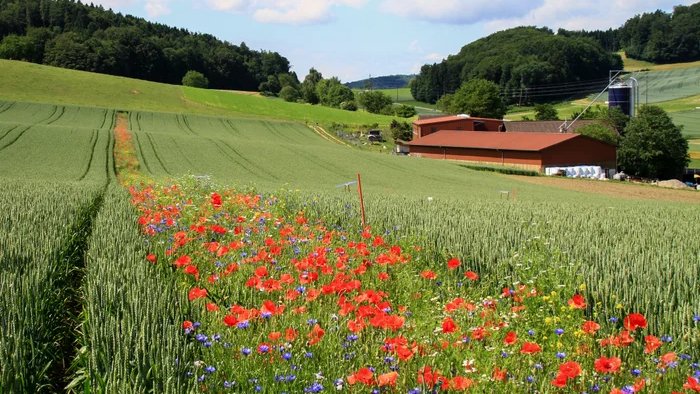
Farmers have figured out that the cheapest pesticide is a strip of flowers.
When you plant wildflowers through a crop field, not just around the edge but in strips running through the middle, you get ladybugs, lacewings, hoverflies, and parasitic wasps living in the field instead of visiting it.
They eat the aphids, the caterpillars, and the mites for free, all summer long.
In controlled trials, fields with tailored flower strips had leaf-beetle numbers 40 to 50% lower and crop damage cut by around 60%, enough to drop below the threshold where spraying was even considered worth it.
The flowers attract a standing army to our fields.
We spent decades engineering chemicals to kill the insects eating the crop, when the insects that eat those insects would have worked for the price of seed.
The 10-year Treasury yield is perhaps the most important financial benchmark in the global fiat system, as it drives valuations and market trends worldwide. It is widely—and erroneously—regarded as the risk-free rate of return.
The 10-year Treasury yield can be thought of as a key barometer of the US dollar-based fiat system—a critical measure akin to its beating heart.
Bond yields move inversely to bond prices. When bond prices fall, bond yields rise.
A rising 10-year Treasury yield signals trouble for the US dollar because it means investors are selling Treasuries, which pushes up the US government’s borrowing costs. That is why the 10-year Treasury yield is a major pain point for the US government.
The 10-year Treasury yield was 3.97% when the war started. Now it is around 4.60%, an increase of roughly 63 basis points.
I expect the 10-year Treasury yield to keep climbing over the coming weeks and months—until it forces the Fed’s hand. At that point, the intervention will be sold as “stability,” but the mechanism will be familiar: suppress yields by debasing the currency.
At today’s debt levels, every 1 basis point increase in the government’s average borrowing cost adds roughly $3.9 billion in annual interest expense. So a 63 bps rise is not trivial—it translates to nearly $250 billion in additional yearly interest costs, materially widening a 2025 budget deficit that was already around $1.8 trillion.
Higher yields mean the US government must pay tens or even hundreds of billions more in interest on its debt. At the same time, the global economy faces even greater added costs because Treasury rates serve as the benchmark for borrowing worldwide.
That is not an insignificant move. However, given all the headwinds I have discussed, I suspect the 10-year Treasury yield is headed much higher because investors will demand higher yields to compensate for rising inflation. Further, if Hormuz remains closed, drastically higher oil prices are all but certain. Higher energy prices mean higher prices across the economy and higher official inflation rates, which means investors will demand still higher yields to compensate.
The problem is that interest on the federal debt is already over $1.2 trillion and is now the second-largest item in the budget. The US government cannot afford yields going much higher because the interest expense would push it toward bankruptcy.
I am not sure how—or even if—the US government can manage this situation. Something has to give, and we will not have to wait long to find out what.
The Iran war may prove to be more than another foreign policy disaster. It could be the trigger that exposes the fragility of the entire dollar-based financial system.
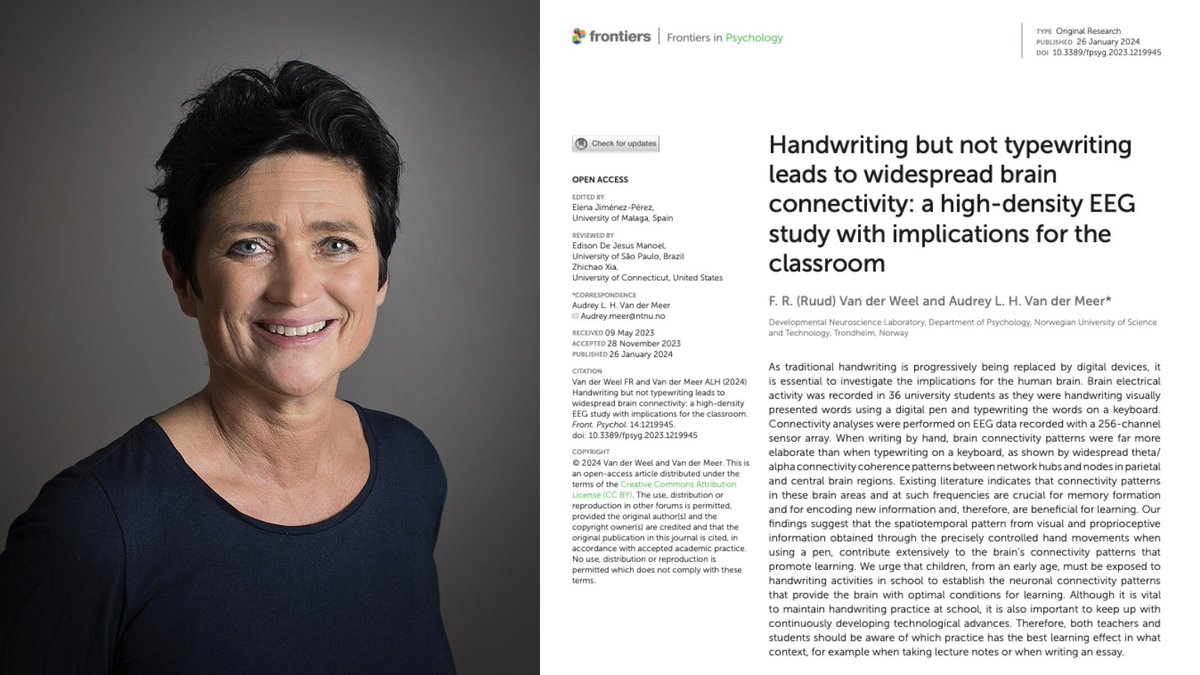
A Norwegian neuroscientist spent 20 years proving that the act of writing by hand changes the human brain in ways typing physically cannot, and almost nobody outside her field has read the paper.
Her name is Audrey van der Meer.
She runs a brain research lab in Trondheim, and the paper that closed the argument was published in 2024 in a journal called Frontiers in Psychology. The finding is brutal enough that it should have changed every classroom on Earth.
The experiment was simple. She recruited 36 university students and put each one in a cap with 256 sensors pressed against their scalp to record brain activity. Words flashed on a screen one at a time.
Sometimes the students wrote the word by hand on a touchscreen using a digital pen, and sometimes they typed the same word on a keyboard. Every neural response was recorded for the full five seconds the word stayed on screen.
Then her team looked at the part of the data most researchers had ignored for years, which is how different parts of the brain were communicating with each other during the task.
When the students wrote by hand, the brain lit up everywhere at once.
The regions responsible for memory, sensory integration, and the encoding of new information were all firing together in a coordinated pattern that spread across the entire cortex. The whole network was awake and connected.
When the same students typed the same word, that pattern collapsed almost completely.
Most of the brain went quiet, and the connections between regions that had been alive seconds earlier were nowhere to be found on the EEG.
Same word, same brain, same person, and two completely different neurological events.
The reason turned out to be something nobody had really paid attention to before her work. Writing by hand is not one motion but a sequence of thousands of tiny micro-movements coordinated with your eyes in real time, where each letter is a different shape that requires the brain to solve a slightly different spatial problem.
Your fingers, wrist, vision, and the parts of your brain that track position in space are all working together to produce one letter, then the next, then the next.
Typing throws all of that away. Every key on a keyboard requires the exact same finger motion regardless of which letter you are pressing, which means the brain has almost nothing to integrate and almost no problem to solve.
Van der Meer said it plainly in her interviews.
Pressing the same key with the same finger over and over does not stimulate the brain in any meaningful way, and she pointed out something that should scare every parent who handed their kid an iPad.
Children who learn to read and write on tablets often cannot tell letters like b and d apart, because they have never physically felt with their bodies what it takes to actually produce those letters on a page.
A decade before her, two researchers at Princeton ran the same fight using a completely different method and ended up at the same answer. Pam Mueller and Daniel Oppenheimer tested 327 students across three experiments, where half took notes on laptops with the internet disabled and half took notes by hand, before testing everyone on what they actually understood from the lectures they had watched.
The handwriting group won by a wide margin on every question that required real understanding rather than surface recall.
The reason was hiding in the transcripts of what the two groups had actually written down.
The laptop students typed almost word for word, capturing more total content but processing almost none of it as they went, while the handwriting students physically could not write fast enough to transcribe a lecture in real time, which forced them to listen carefully, decide what actually mattered, and put it in their own words on the page.
That single act of choosing what to keep was the learning itself, and the keyboard had quietly skipped the choosing and skipped the learning along with it.
Two studies. Two countries. Same answer.
Handwriting makes the brain work. Typing lets it coast.
Every note you have ever typed instead of written went into your brain through a thinner pipe. Every meeting, every book highlight, every idea you captured on your phone instead of on paper was processed at half depth.
You did not forget those things because your memory is bad. You forgot them because typing never woke the part of the brain that would have made them stick.
The fix is the thing your grandmother already knew.
Pick up a pen. Write the thing down. The slower road is the faster one.
Les vrais génies de l'histoire.
108 milliards d'humains ont vécu sur Terre. La liste ci-dessous en contient ~100. Soit environ 1 sur 1 milliard.
C'est ça, le « autre chose » que les gens cherchent quand ils refusent d'admettre que Jobs ou Einstein étaient hors-norme. Une conjonction rarissime de cognition + obsession + timing + courage cognitif + santé mentale juste-assez-stable.
Critère retenu : saut non-substituable. Sans cet individu précis, la chose n'arrive pas, ou arrive 30 ans plus tard sous une forme dégradée. J'exclus les agrégateurs (Edison), les opérateurs talentueux (Altman), les copieurs brillants et les figures dont la réputation vient surtout du PR.
— PHYSIQUE —
Newton — synthèse mécanique + optique + calcul, refonde la science occidentale seul
Maxwell — unification électromagnétique, prédit les ondes EM avant qu'on les mesure
Einstein — relativités restreinte et générale, photoélectrique, base de la quantique
Dirac — équation relativiste de l'électron, prédit l'antimatière par pure beauté mathématique
Heisenberg — mécanique matricielle, principe d'incertitude
Schrödinger — mécanique ondulatoire
Bohr — modèle atomique, interprétation de Copenhague
Pauli — principe d'exclusion, postule le neutrino sans preuve
Feynman — électrodynamique quantique, diagrammes, refonte pédagogique de la physique
Boltzmann — fondations statistiques de la thermodynamique, seul contre tous
Planck — quantum d'action, déclenche tout
Galilée — méthode expérimentale + héliocentrisme défendu
Kepler — lois du mouvement planétaire, abandonne les cercles parfaits par pure honnêteté empirique
Faraday — induction, champs, sans formation mathématique
Fermi — physique nucléaire théorique ET expérimentale, premier réacteur
Landau — quasiment tous les sous-champs de la physique théorique
— MATHÉMATIQUES —
Euclide — axiomatisation de la géométrie, modèle de toute pensée déductive
Archimède — calcul infinitésimal 1800 ans avant Newton
Gauss — théorie des nombres, géométrie différentielle, statistiques, le plus polyvalent de l'histoire
Euler — productivité et profondeur jamais égalées, fonde des champs entiers
Riemann — géométrie qui rendra possible la relativité, hypothèse encore ouverte 170 ans après
Galois — théorie des groupes à 19 ans, mort à 20
Cantor — théorie des ensembles, infinis actuels, seul contre l'establishment
Gödel — théorèmes d'incomplétude, casse le programme de Hilbert
Grothendieck — refonte de la géométrie algébrique, niveau d'abstraction inégalé
Ramanujan — autodidacte indien, formules tombées « du ciel » qu'on prouve encore
Poincaré — topologie, systèmes dynamiques, chaos avant l'heure
Hilbert — formalisation, programme qui domine les maths du 20ème
Leibniz — calcul (en parallèle de Newton), logique, monades
— INFORMATIQUE / LOGIQUE —
Turing — calculabilité, machine universelle, cryptanalyse d'Enigma, morphogenèse
Von Neumann — architecture des ordinateurs, théorie des jeux, automates cellulaires
Shannon — théorie de l'information, fondation de toute communication numérique
Church — lambda-calcul
Kolmogorov — fondations des probabilités modernes, complexité algorithmique
Dijkstra — fondations de l'algorithmique structurée
— BIOLOGIE / MÉDECINE / CHIMIE —
Darwin — sélection naturelle, refonte de toute la biologie
Mendel — génétique, ignoré 35 ans
Pasteur — théorie microbienne, vaccins, refondation de la médecine
Watson + Crick + Franklin — structure de l'ADN
Mendeleïev — table périodique, prédit des éléments inconnus
Lavoisier — refonte de la chimie moderne, méthode quantitative
McClintock — éléments génétiques mobiles, ignorée 30 ans
— PHILOSOPHIE —
Platon — fonde l'idéalisme, tout l'Occident en discute encore 2400 ans après
Aristote — fonde la logique, la biologie, la métaphysique, l'éthique, en parallèle
Kant — refonte de la métaphysique post-Hume, synthèse critique
Nietzsche — généalogie de la morale, mort de Dieu, transvaluation
Wittgenstein — refonte deux fois de la philo du langage, seul
Hegel — dialectique, philosophie de l'histoire
Spinoza — Éthique géométrique, expulsé pour son courage cognitif
Hume — empirisme radical, réveille Kant
Descartes — cogito, géométrie analytique
Heidegger — refonte de l'ontologie
— ÉCONOMIE / SCIENCES SOCIALES —
Adam Smith — fondation de l'économie moderne
Hayek — connaissance dispersée, ordre spontané, prix comme signal
Mises — calcul économique, action humaine
Keynes — refonte macro (qu'on aime ou pas, le saut est réel)
Schumpeter — destruction créatrice, entrepreneur comme moteur
Girard — désir mimétique, bouc émissaire, refonte de l'anthropologie
Weber — éthique protestante, sociologie de la rationalisation
— MUSIQUE —
Bach — architecture contrapuntique inégalée
Mozart — synthèse mélodique et structurelle, mort à 35 ans avec 600 œuvres
Beethoven — refonte de la forme symphonique, pont classique/romantique
Wagner — refonte de l'opéra, harmonie qui ouvre la modernité
Stravinsky — refonte du rythme, Sacre du Printemps comme rupture
Schoenberg — atonalité, dodécaphonisme
— PEINTURE / LITTÉRATURE —
Léonard de Vinci — peinture + ingénierie + anatomie
Michel-Ange — sculpture + peinture + architecture, au sommet de chaque
Picasso — cubisme, refonte du regard pictural
Cézanne — pont vers la modernité, structure géométrique du visible
Dostoïevski — psychologie du sous-sol, profondeur métaphysique
Tolstoï — synthèse romanesque inégalée
Shakespeare — refonte de la langue anglaise et du théâtre
Dante — Commedia, fonde l'italien littéraire
Homère — fondation de toute la littérature occidentale
Proust — refonte du temps romanesque
Kafka — anticipe le 20ème siècle bureaucratique
Borges — refonte du conte philosophique
— INGÉNIERIE / TECH —
Tesla — courant alternatif, moteur induction, fondations de l'électrotech moderne. Vrai génie, scammé par Edison
Frères Wright — vol motorisé, contrefactuel solide
Shockley + Bardeen + Brattain — transistor
Noyce + Kilby — circuit intégré
Engelbart — souris, hypertexte, visioconférence dans une seule démo en 1968
Berners-Lee — Web, donné gratuitement
Linus Torvalds — Linux + Git, deux infrastructures civilisationnelles, seul au début
John Carmack — moteurs 3D temps réel, refonte du jeu vidéo
— ENTREPRENEURS (critère strict) —
Jobs — synthèse design/produit/écosystème non-substituable
Musk — SpaceX seul justifie l'inclusion : NASA avait abandonné le réutilisable. Tesla a forcé la transition EV mondiale
Bezos — AWS spécifiquement, pas le e-commerce (qui arrivait quand même)
Walt Disney — synthèse animation + parc + IP, modèle qu'on copie encore
Henry Ford — chaîne de production
Rockefeller — intégration verticale poussée à un niveau jamais vu
— EXCLUSIONS VOLONTAIRES —
Edison — agrégateur, marketeur, voleur de brevets
Sam Altman — opérateur talentueux, pas inventeur. Le saut technique c'est Sutskever, Radford, l'équipe DeepMind avant
Zuckerberg — exécution brillante mais Facebook arrivait quand même
Gates — bon stratège, OS arrivait de toute façon
Hewlett / Packard — grands constructeurs, pas génies au sens fort
— LE PATTERN —
~100 noms. 2500 ans d'histoire. Un génie non-substituable tous les 25 ans en moyenne, tous domaines confondus.
Sur 108 milliards d'humains ayant jamais vécu : ratio ≈ 1 pour 1 milliard.
C'est l'empirique qui désarme définitivement le « biais du survivant ». Ce n'est pas que les génies sont rares. C'est qu'ils sont rarissimes — et que le monde avance malgré tout à coup de ces gens-là.
Je veux présenter mes excuses, au nom des Français, pour avoir enfanté la French Theory (qui a enfanté la pire des merdes idéologiques : le wokisme).
Nous avons donné au monde Descartes, Pascal, Tocqueville. Et puis, dans les ruines intellectuelles de l'après-68, nous avons donné Foucault, Derrida, Deleuze. Trois hommes brillants qui ont fabriqué, dans l'élégance de notre langue, l'arme idéologique qui paralyse aujourd'hui l'Occident.
Il faut comprendre ce qu'ils ont fait. Foucault a enseigné que la vérité n'existe pas, qu'il n'y a que des rapports de pouvoir déguisés en savoir. Que la science, la raison, la justice, l'institution médicale, l'école, la prison, la sexualité, tout n'est qu'une mise en scène de la domination. Derrida a enseigné que les textes n'ont pas de sens stable, que tout signifiant glisse, que toute lecture est une trahison, que l'auteur est mort et que le lecteur règne. Deleuze a enseigné qu'il fallait préférer le rhizome à l'arbre, le nomade au sédentaire, le désir à la loi, le devenir à l'être, la différence à l'identité.
Pris isolément, ce sont des thèses discutables. Combinées, exportées, vulgarisées, elles forment un système. Et ce système est un poison.
Car voici ce qui s'est passé. Ces textes, illisibles en France, ont traversé l'Atlantique. Les départements de Yale, de Berkeley, de Columbia les ont absorbés dans les années 80. Ils y ont trouvé un terreau qui n'existait pas chez nous : le puritanisme américain, sa culpabilité raciale, son obsession identitaire. La French Theory s'est mariée à ce substrat, et l'enfant de ce mariage s'appelle le wokisme.
Judith Butler lit Foucault et invente le genre performatif. Edward Said lit Foucault et invente le post-colonialisme académique. Kimberlé Crenshaw hérite du cadre et invente l'intersectionnalité. À chaque étape, la matrice est française : il n'y a pas de vérité, il n'y a que du pouvoir, donc toute hiérarchie est suspecte, toute institution est oppressive, toute norme est violence, toute identité est construite donc négociable, toute majorité est coupable.
Voilà comment trois philosophes parisiens, qui n'ont probablement jamais imaginé leurs conséquences pratiques, ont fourni le logiciel d'exploitation à une génération entière d'activistes, de bureaucrates universitaires, de DRH, de journalistes, de législateurs. Voilà comment on a obtenu une civilisation qui ne sait plus dire si une femme est une femme, si sa propre histoire mérite d'être défendue, si le mérite existe, si la vérité se distingue de l'opinion.
C'est de la merde pour une raison simple, et il faut la dire calmement. Une civilisation se tient debout sur trois piliers : la croyance qu'il existe une vérité accessible à la raison, la croyance qu'il existe un bien distinct du mal, la croyance qu'il existe un héritage à transmettre. La French Theory a entrepris de dynamiter les trois. Pas par méchanceté. Par jeu intellectuel, par fascination du soupçon, par haine de la bourgeoisie qui les avait nourris. Mais le résultat est là. Une génération entière a appris à déconstruire et n'a jamais appris à construire. Une génération entière sait soupçonner et ne sait plus admirer. Une génération entière voit le pouvoir partout et la beauté nulle part.
Je m'excuse parce que nous, Français, avons une responsabilité particulière. C'est notre langue, nos universités, nos éditeurs, notre prestige qui ont donné à ce nihilisme son emballage chic. Sans la légitimité de la Sorbonne et de Vincennes, ces idées n'auraient jamais traversé l'océan. Nous avons exporté le doute comme d'autres exportent des armes.
Ce qui se construit maintenant, en silicon valley, dans les labos d'IA, dans les startups, dans les ateliers, dans tous les lieux où des gens fabriquent encore des choses au lieu de les déconstruire, c'est la réponse. Une civilisation se reconstruit par les bâtisseurs, pas par les commentateurs. Par ceux qui croient que la vérité existe et qu'elle vaut qu'on s'y consacre. Par ceux qui assument une hiérarchie du beau, du vrai, du bon, et qui n'ont pas honte de la transmettre.
Alors pardon. Et au travail.
Piers Morgan- “And what do you say to Jewish people who may watch this show and be horrified?”
Dan Bilzerian- “They can be horrified. I was horrified to learn that they mass murdered Christians. I was horrified to learn the things they teach in the Talmud. I was horrified to learn they think Jesus is burning in shit. I was horrified to learn they think the virgin Mary is a whore. I was horrified to learn that they think it’s ok to steal from gentiles. I was horrified to find out that they think it’s ok to gang rape Palestinian prisoners. I’m horrified that we are funding a genocide right now….. so they can be horrified.”
Activist: "Your cows are putting carbon into the atmosphere."
Farmer: "Where did they get it?"
Activist: "What?"
Farmer: "The carbon. Where did the cow get it before it put it anywhere."
Activist: "From... eating?"
Farmer: "From eating grass. And where did the grass get it."
Activist: "The soil?"
Farmer: "The air. The grass pulled it out of the air last spring. The cow ate the grass. The cow breathed some of it back out. It went back into the air it came from."
Activist: "But it's still going into the atmosphere."
Farmer: "It's going back. There's a difference between a thing going somewhere and a thing going back. You've described a circle and you're frightened of it."
Activist: "Then just don't have the cow."
Farmer: "The grass still dies in autumn. It rots where it falls. The carbon goes back into the air either way, just without anyone getting fed in the middle."
Activist: "It's not that simple."
Farmer: "It's grass, cow, breath, grass. Or it's grass, rot, air, grass. Same circle, fewer dinners. If that's complicated for you I'd stay away from the water cycle. That one's got clouds in it."