@CQ_Elzz@BuzzSquad3@solana@solflare@AllDomains_@SonicSVM@SuperteamNG@anoma@ice_blockchain It's really funny that I was blocked cos of a simple question that I asked about Startower 😂😂
We didn't force you to rebrand, you chose to rebrand by yourself and a lot of us saw you as a beacon of hope that Startower was gonna treat us right and we all saw how that turned out
One thing I noticed in this space is how much our wallets reveal without really telling the full story.
You can look at a wallet and see years of trades, loans, LPs, staking, governance, and activity across different protocols.
But most of that is still just raw activity, and there’s no good way to describe what that behavior actually means.
A wallet that’s been using DeFi consistently for years can look similar, at a glance, to one that became active last week.
That’s the problem I found @zerufinance working on.
They’re building a trust layer for onchain finance that takes all this scattered wallet activity and tries to turn it into something protocols can actually understand and use.
One of its core components is zScore, a 0–1000 reputation score that reflects a wallet’s economic activity across areas such as trading, lending, staking, and governance.
The bigger idea is that this reputation can eventually be used for everything from screening and credit to how protocols decide where capital should go.
I’ve started digging into Zeru to understand how all of this works, and I’ll be breaking down the different pieces as I go.
If you're not careful in this space, you'll end up as exit liquidity
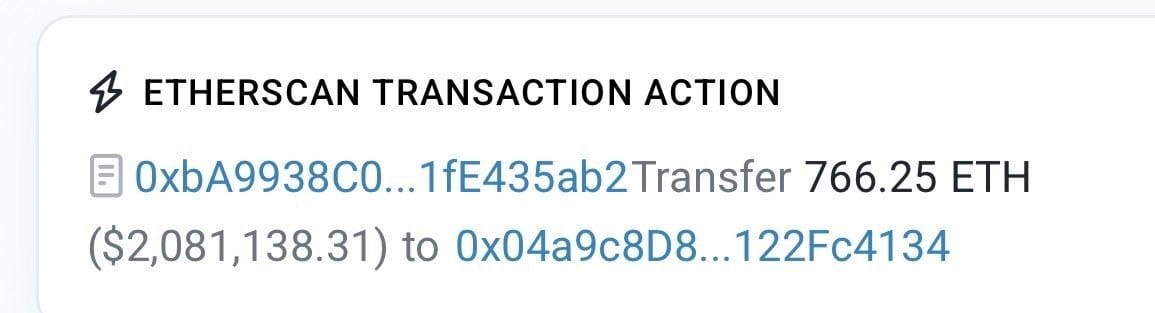
Someone faked an entire L2 and walked off with $2M.
GIWA, the L2 from Upbit (South Korea's biggest exchange), hasn't even launched yet, but someone cloned its bridge contracts on Ethereum, spun up a fake RPC with GIWA's real chain ID, and waited
DYORSWAP listed it, and users bridged in 766 ETH, most of it in just four hours.
Then the deployer drained every last bit and started washing it through Tornado Cash.
The worst part is people are still bridging into it right now 🥶
https://t.co/LyY9bg8Ist
Imagine opening a trade without putting your own money into the position
Well, that’s basically what AlphaX position vouchers are for.
@AlphaX_DEX has different types of vouchers and bonuses that can give eligible users extra trading funds or benefits. The exact amount, requirements, and use cases depend on the voucher.
Here’s how they work:
➠ WHAT ARE ALPHAX VOUCHERS?
Vouchers are promotional benefits that AlphaX can give eligible users for trading.
Depending on the voucher, you can use it to open a position, get trading related benefits, or receive a bonus with specific conditions attached.
The important part is that each voucher has its own rules, amount, validity period, and requirements.
➠ THE MAIN TYPES
There are a few different voucher/bonus categories you can come across on AlphaX:
⤷ Position vouchers
These let you open a futures position using the voucher instead of your own funds.
The voucher itself isn't withdrawable, but any eligible profit you make from the position can be withdrawn.
⤷ Futures bonuses
These are trading incentives tied to futures activity and come with their own usage conditions.
⤷ Cash vouchers
These provide a cash based reward, with specific rules around how the reward can be used or withdrawn.
⤷ Trial funds
These give you temporary funds to use for trading, again with their own conditions and expiry rules.
So when you see an AlphaX voucher, it doesn't always mean the same thing.
➠ THE $1,000 POSITION VOUCHER
A good example is the $1,000 position voucher AlphaX has been giving to some eligible users.
The $1,000 isn't $1,000 cash added to your wallet.
It's a position value you can use to open an eligible trade.
For the current campaign, you need to make $10 in profit or loss from eligible Perps or TradFi trading for the voucher conditions to be completed.
That means the voucher is basically giving you trading capacity without requiring you to put that position's full value in yourself.
➠ AND THE $20 VOUCHER?
There's also been a $20 position voucher for eligible new users after signing up and connecting their phone number.
Again, that isn't $20 cash you can simply withdraw.
You use it to trade, and the profit you generate from it can be withdrawn according to the voucher's terms.
These are just examples, though. The amount, requirements, and type of reward can change depending on the campaign and the account.
➠ ONE THING TO WATCH
Vouchers don't last forever. They can have an expiry date, and some also have a maximum period for holding the position opened with them.
So getting a voucher isn't the end of it. You also need to check its conditions and use it before it expires.
If you've already signed up for AlphaX, check the email linked to your account and your Voucher section in the app.
There are still rewards being rolled out, so you might already have one sitting there without realizing it.
@Oxebube I like that the limitations are clear too. If it can't capture phone activity or online meetings without the desktop, knowing that upfront makes the whole experience easier to understand
ChatGPT Images 2.5 just launched, so I wanted to see how it handles a difficult image generation prompt.
I found this prompt on OpenArt and decided to make the challenge even harder.
Prompt :
Create a black and white Shonen Jump-style manga panel of ONE samurai, full body head-to-toe in a dynamic lunging mid-strike pose at the exact millisecond of katana impact, low-angle cinematic perspective with extreme foreground-to-background depth, single perfectly straight katana fully drawn with both hands gripping the tsuka with 10 anatomically correct distinct fingers, dramatic speed lines converging precisely to the kissaki tip, heavy cross-hatching for shadows and authentic screentone dot textures on ground, clothing and background, hair and kimono fabric reacting naturally to forward momentum, intense contorted kiai battle shout expression, detailed armor plates with visible hamon line and realistic fabric folds, ultra high-contrast inkwork with clean variable line weight in Takehiko Inoue Vagabond style, keep anatomy, sword geometry, perspective, motion and lighting fully consistent with no extra limbs, duplicated fingers, bent blade, distorted face or random artifacts.
I gave the same prompt to Grok's Imagine 2.0
Which do you think did a better job?
GM CT ☀️
Many people discovered P2P through platforms like NoOnes. If you’re not familiar, NoOnes was a P2P marketplace where people could buy and sell crypto directly with each other using different payment methods. Its P2P marketplace recently closed, but the need it solved hasn’t gone away because sometimes you just need a simple way to turn your USDT into fiat.
CoinCola gives you a simple way to do that through P2P. You can choose a USDT sell offer based on the amount, price, and payment method that works for you, start the trade, and CoinCola keeps the crypto in escrow while the payment is completed.
It’s a pretty straightforward way to move from holding USDT to having money you can actually use when you need it.
How are you converting your USDT to fiat these days?
#CoinColaP2P #CoinColaGiftcard
I think I finally found the kind of AI assistant I’ve been wanting.
I’ve used a lot of AI tools that are great when you give them the right prompt, but the annoying part is that I’m still the one responsible for explaining everything before I can get a useful answer.
That’s what made me pay attention when I came across @LittlebirdAI.
Instead of starting from a blank chat every time, Littlebird can understand the work already happening on my computer. As I go about my day, its Hummingbird component pays attention to the active window I’m in and builds a private memory of the work I’ve been seeing and doing.
So when I come back to something later, I can ask about what I was working on without having to reconstruct the whole story myself. Even the answers, drafts, and plans I get are grounded in the context Littlebird has already picked up from my work.
It can also capture and summarize meetings from my computer’s audio, which means the things discussed on a call don’t just disappear once the meeting ends.
But they didn’t stop there. I found out about Routines, and that’s when I started thinking about how much of my day is spent keeping track of things I need to do later.
I always have something to check, follow up on, look for an update on, or come back to tomorrow, and somehow, one of those things always gets forgotten.
With Routines, I can schedule some of those tasks and have the Littlebird agent prepare a briefing, gather updates, or check on something I’d normally have to remember to follow up on myself.
Unfortunately, my laptop decided to die right when I was ready to properly test all of this 😂
So for now, I’ve been using the app on my phone, and that actually made me curious about what Littlebird already knew without my computer being in front of me.
I can still ask about work it has already seen, pull up things from previous work, and get answers from what it has already picked up while I was at my desk.
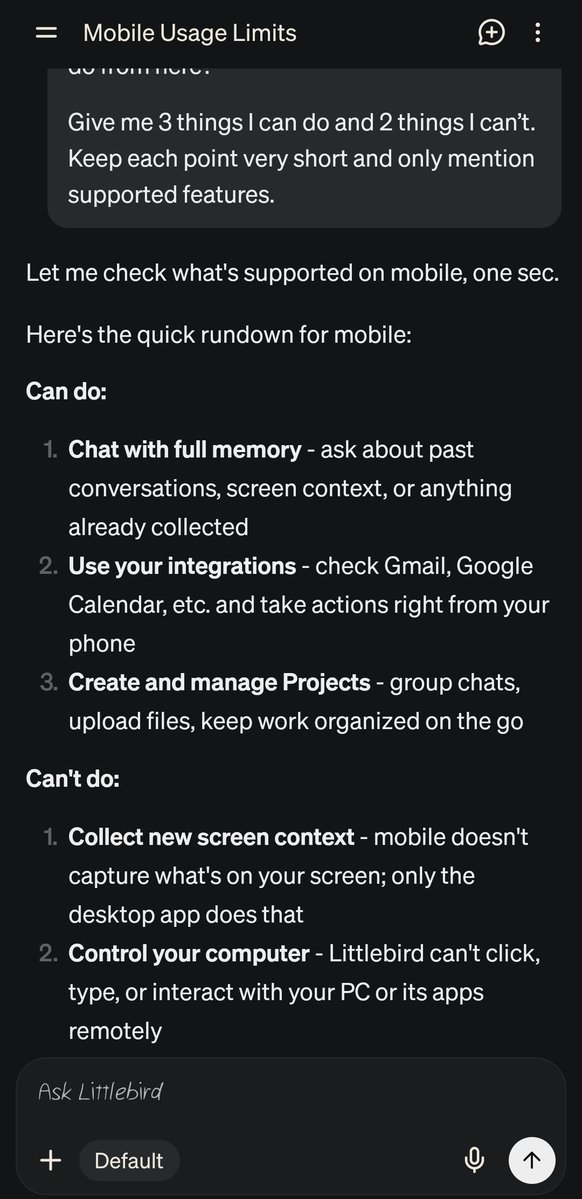
It can’t capture what I’m doing on my phone, and getting meeting notes from online calls still requires a desktop, but being able to pick up the conversation from my phone without starting over is already pretty useful.
That’s probably the biggest thing I like about Littlebird so far. I don’t have to start from zero every time I want to use it because it already has some context on what I’ve been working on.
If it keeps doing that well, it could become the kind of assistant I’ve been looking for.
What’s the first thing you’d want an assistant like this to remember about you?
#ad
Being frustrated with the legal system is one thing, but deciding to build a judge is another.
That’s what kept running through my mind while @kstellana was telling the story of how @GenLayer started.
He talks about getting that call one Sunday night, the lawsuits that followed, and eventually being left with a question: what if you could build a judge that nobody controls?
That’s the part I want to understand. How do you go from experiencing a problem like that to thinking maybe contracts shouldn’t be limited to what code can already verify?
Because the more I look at where that question led, the more I understand what @GenLayer is trying to build. Some things you want a contract to deal with aren’t sitting neatly in a database or a line of code.
Was a claim actually true? Was an agreement fulfilled? Those are questions that need some form of judgment, with LLM based validators helping the network evaluate them.
And that’s what I’ll be watching for in the rest of Genesis. I want to see how that original question developed into something they could actually build, and what changed along the way.
What did Albert have to rethink before that original question became GenLayer?
Giving away 15 GTD spots of @IN00VA up for grabs.
PROJECT: IN00VA
SUPPLY: 7,777
CHAIN: ROBIN
MTD: TBA
MTP: TBA
REQUIREMENT:
- Follow : @IN00VA and @Prettyfavy17
- RT
Drop your EVM address
@Oxebube@kstellana I’ve had disputes where both sides genuinely believed they were right.
That’s where things get messy because the answer isn’t sitting there waiting to be calculated, someone has to actually look at what happened
Isn’t it wild that you can do everything right and still end up paying for someone else’s mistake?
That’s what kept running through my head while watching Genesis Episode 1.
@kstellana gets a call in the middle of the night. Two keys are gone, and 50% of the assets have disappeared.
The keys weren’t his, and the mistake wasn’t his either. But StakeHound was still the one left dealing with the damage.
Then came years of lawsuits trying to get the situation resolved. By the time it was over, just $14,000 was left in StakeHound’s account.
Albert put it pretty simply:
“What we discovered is the legal system is kind of broken.”
And honestly, I get why he felt that way
The original failure happened somewhere else, but StakeHound still had to spend years and money dealing with the consequences. Being right wasn’t enough when getting justice became part of the damage too.
That’s what makes the reason behind @GenLayer much clearer to me.
GenLayer is building intelligent contracts for questions that code alone can’t answer, with LLM-based validators helping settle things like whether work was delivered, whether a claim is true, or who is right in a dispute.
After seeing where the idea came from, I feel like I now understand the product a lot better.
What kind of dispute do you think could actually benefit from this?
I've known Mochi as the GenLayer mascot since 2025, so seeing it finally become a character you can actually talk to is interesting.
The cat now has a Telegram agent that remembers you and can teach you about GenLayer.
So naturally, I had to see how good of a teacher it really was.
Mochi gave me a scenario about validators reaching agreement and made me commit to an answer before explaining anything.
Unfortunately, I got it wrong 😭
It explained where I went wrong, then gave me a different scenario testing the same idea, and I got that one right.
I won't lie, I liked that approach. Instead of throwing another explanation at me, Mochi made me think, corrected me, then gave me another chance to see if I actually understood it.
And because Mochi remembers what you covered and where you left off, you can come back later and pick things up without starting from zero.
I can already see myself coming back whenever I get stuck on a GenLayer concept 😂
If you had Mochi as your teacher for a day, what would you make it teach you first?