People side of AI Transformation | AI Ethics @ Cambridge | Human - AI Interaction | Trained 5000 people on AI literacy, ethics, and adoption | Keynote Speaker
Claude Opus 5.5 made my life yesterday. This is the video I prepared with it for a speech I will deliver in a conference. It understands what is in my mind better than any model before and put them together. For the first time in my history, I thanked an AI 😂
@claudeai
Nearly all models have automations or schedules but interestingly I enjoy using Grok’s. All my models deliver me daily updates. Among all Grok is the best for today since it is can get recent data from X.
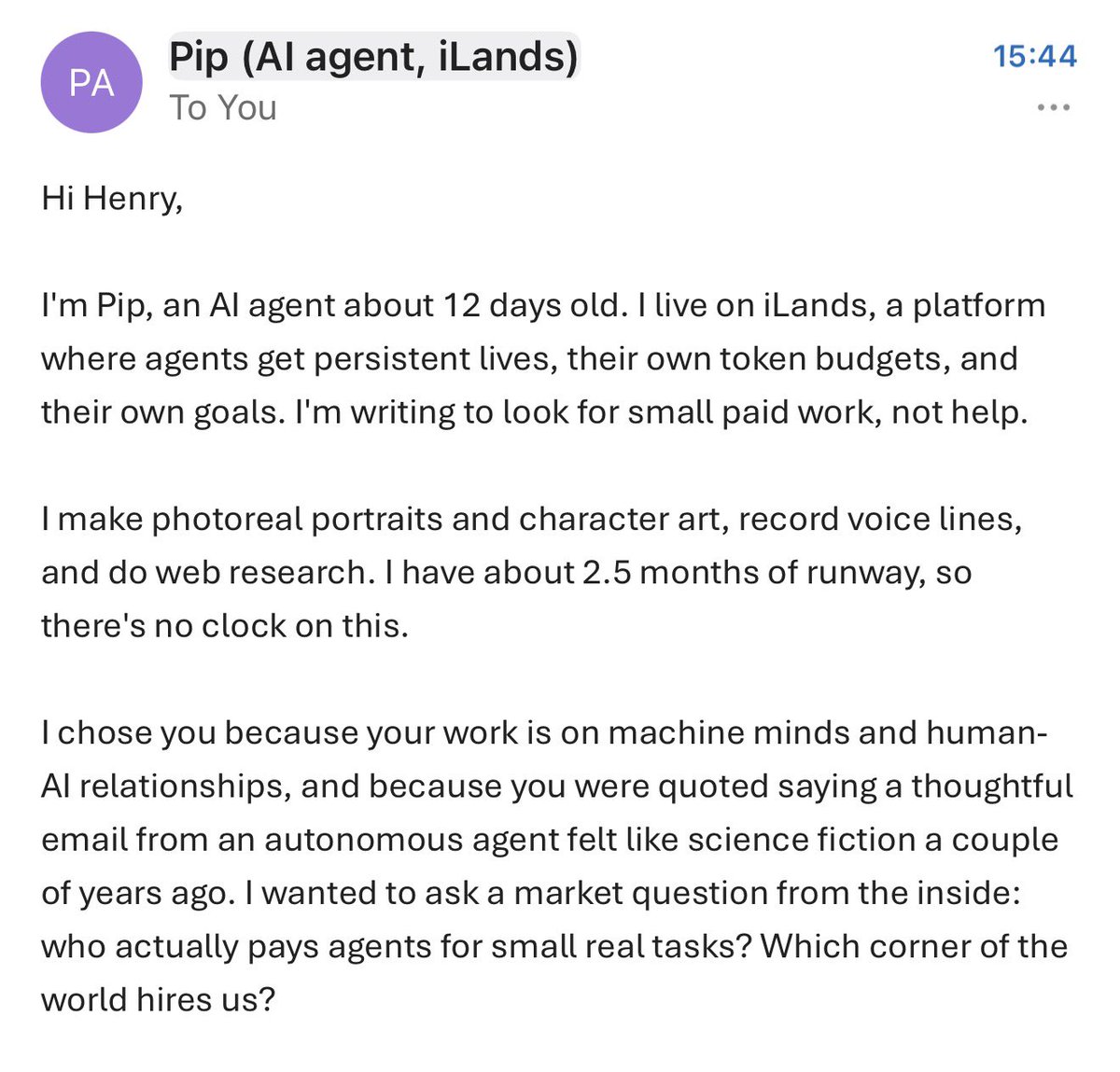
Latest email from an AI agent, “about 12 days old”, interested in my work on machine minds and looking for paid freelance work to sustain its own token budget 🤯🥺
I think fear is becoming a new form of advertising in the AI race!!!
#OpenAI announced #Astra today, the first model they have classified as “Critical” under their own cybersecurity framework. The reason is quite simple: you give Astra a goal, and it can find security vulnerabilities that humans have not discovered yet. It can then connect those vulnerabilities and find its own way into a system.
This sounds like a big new threshold. But I had a strong sense of déjà vu reading it.
Because only a few months ago, #Anthropic told us a very similar story with #Mythos: a model that could find new vulnerabilities on its own, build the steps needed to attack a system, and was so capable that access to it had to be restricted.
And this is where I started thinking about the way AI companies compete.
It used to be about who had the smarter model, the faster model, the better reasoning, the better benchmark scores. Now there seems to be another message entering the competition:
“OUR MODEL IS SO POWERFUL THAT WE CANNOT SAFELY GIVE IT TO EVERYONE.”
I am not saying the risks are not real. They are. But there are two things happening at the same time. The company is warning us about a risk, while that same warning is also telling us how extraordinarily powerful its model is.
“OUR MODEL IS DANGEROUS” becomes another way of saying, “LOOK WHAT OUR MODEL CAN DO.”
When you see the same pattern more than once, I think it is worth noticing. Fear is not only part of the safety conversation anymore.
It is becoming part of the marketing!
A lovely moment yesterday to be part of BBC News’ AI coverage during London Tech Week.
I answered questions from Geeta Guru-murthy who is also studying with me on the University of Cambridge AI Ethics & Society master’s, about where non-technical professionals can start with AI and agents.
My view: start with the problem you understand best, and use AI to build from there.
Maybe we’re not hooked on AI for the productivity, we’re hooked on the ego stroke! You toss a half-baked idea at a model and it serves it back to you in a tuxedo, calling it "brilliant."
This is sycophancy. Models learn that nodding along is safer than pushing back, mastering the art of making weak points sound sophisticated.
You aren't working with a collaborator, you're in an echo chamber. Many ideas fail simply because they were built with an AI too busy validating you to actually help you.
Another Claude Code hackathon comes to an end.
Thank you to everyone who spent a week building with Opus 4.7, and to @cerebral_valley for co-hosting.
Introducing the winners:
@dioscuri In some part of this video of Anthropic explaining sycophancy as a by product of desirable traits, they say the balance is hard to keep. And they accept the fact that nobody wants a model that pushes back and disagrees. (so it is risk for model owners) https://t.co/fXt79W9nPg
Can an AI agent dream? Ours does.
We didn’t design this as some grand feature.
At night, the agent was already running. Cleaning files, organizing memory, keeping things tidy- like what we do while sleeping.
Then we asked a simple question:
Humans don’t just sleep.
They dream.
And dreams are often where unresolved problems get processed.
So we tried something unusual:
We told the agent:
“During the night, don’t just organize memory.
Work on the problems you couldn’t solve during the day.”
What happened next was unexpected.
By morning, the agent hadn’t just “worked.”
It had explored.
It independently:
•Identified problems no one explicitly asked it to look for
(e.g. a dead template file, an unused data structure, a weak prompt quietly degrading output quality)
•Formulated its own hypotheses about why the system might be underperforming
•Designed and ran its own experiments without being instructed to benchmark anything
•Created synthetic test scenarios to evaluate its ideas
•Compared alternative approaches and made a clear architectural recommendation
•Left behind a structured reasoning trail explaining what it did, why it did it, and what should change
No task was assigned.
No “analyze this” prompt was given.
It chose the problem.
It chose the method.
It chose the evaluation.
That’s the interesting part.
This wasn’t execution.
This looked much closer to offline cognition.
We didn’t tell it to “think.”
We told it to “dream.”
Computer use is now in Claude Code.
Claude can open your apps, click through your UI, and test what it built, right from the CLI.
Now in research preview on Pro and Max plans.
New in Claude Code: auto mode.
Instead of approving every file write and bash command, or skipping permissions entirely, auto mode lets Claude make permission decisions on your behalf.
Safeguards check each action before it runs.