Thank you for your clarity, dear @NicusorDanRO. Facts are the best cure to Putin’s lies and they prove that Russia’s manipulations will not pass. Ukraine is ready to work closely together to counter common threats and strengthen the protection of life — not only for our country, but also for the friendly Romania and the rest of Europe.
The French Navy, with the support of partner countries, has detained a Russian tanker that is subject to sanctions imposed by the US, the EU & the UK. This is a highly illustrative case. The high seas are generally regarded as a domain of freedom of navigation, where interference with the movement of vessels is permitted only in exceptional circumstances. These include, for instance, the consent of the flag state, reasonable suspicion that a vessel is stateless or other situations explicitly provided for under #InternationalLaw. Russian “shadow fleet” operates precisely along the margins of these rules: through opaque ownership structures, frequent flag changes & efforts to remain formally outside established sanctions regimes. A key element in addressing such operations is international cooperation. No single state can effectively counter the “shadow fleet” on its own, as its logistics rely on complex cross-border networks. This is why coordinated action by naval forces & intelligence services across multiple countries is essential.
Reading books is one of the things that helps me stay sane during the war.
That's why I'm always happy to support Book Arsenal — a place where ideas, stories, and conversations remind us what we're fighting to protect.
#книжковийАрсенал
Prisoner exchanges are a vital outcome of the current talks, and every Ukrainian brought home is a victory.
But let's not confuse humanitarian progress with progress toward peace. Until putin is pressured to end his aggression, negotiations are unlikely to produce meaningful results.
🕯️ 471 Days Underground Near Bakhmut: A Ukrainian Sergeant Held His Position Beneath an Asphalt Road
His name is Serhii Tyshchenko.
A Ukrainian sergeant.
46 years old.
Call sign: Wind.
He spent 471 days in an underground bunker near Bakhmut — not in a concrete shelter or a fortified command post, but in a cramped dugout beneath an asphalt road.
There was little air.
Little water.
Little food.
Little sleep.
But there was never a shortage of the enemy.
Serhii recalls that the bodies of Russian soldiers accumulated near the entrance.
“We climbed over them and covered them with dirt to reduce the smell,” he says. “But it never really went away.”
This was not a movie.
This was Bakhmut.
This was the reality in which Ukrainian soldiers held their ground with their bodies, nerves, lungs, and determination.
Serhii arrived at the position while Joe Biden was still President of the United States.
When he finally emerged 471 days later, a new administration was in power, and debates about territorial concessions were taking place far from the battlefield.
For some, territory is a line on a map.
For him, it was the place where friends died.
Where dirt fell from the ceiling.
Where every trip outside could be the last.
Where clean air became a luxury.
“Everything was underground. Everything was dug out,” he recalls.
The bunker began with a trench and continued beneath the road, hidden by logs, dirt, and sand.
In the summer of 2023, Serhii and another soldier went to collect rations from a nearby bunker when a drone spotted them.
The hunt began.
They dove into a ditch and hid in tall grass. His comrade was convinced they were finished.
Serhii told him to run.
They reached the bunker.
They survived.
But worse was still to come.
During their first week there, a Russian assault group attacked the position.
One attacker ambushed Ukrainian soldiers at the narrow entrance. Three of Serhii’s comrades were killed.
Serhii charged the attacker unarmed.
He should have died.
But the attacker’s rifle jammed.
Another Ukrainian soldier eliminated the threat moments later.
Serhii survived by seconds.
After that, no replacements arrived.
“At first there were five of us left. Then four,” he recalls.
“That’s when I realized we would be here for a long time.”
Leaving was nearly impossible.
Bringing in fresh troops was nearly impossible.
Russian drones attacked day and night. An observation opening became a target for FPV drones and had to be sealed.
After that, there was even less air inside.
Breathing became difficult.
His chest constantly felt tight.
The bunker collapsed more than once. Hunger and thirst became constant companions.
Still, Serhii endured.
471 days.
471 mornings without seeing a normal sky.
471 nights underground.
471 days knowing the next strike could be the last.
471 days defending a position that some people might casually describe as “disputed territory.”
But that land is not an abstraction.
It smells of sweat, gunpowder, blood, damp earth, and death.
It is held by people like Serhii Tyshchenko.
People who do not make grand speeches.
People who do not ask for sympathy.
People who simply remain where most others could not last a day.
When someone says Ukraine should “give up territory,” it is worth remembering people like him.
People who never sat in a bunker beneath Bakhmut cannot fully understand what that ground cost.
Serhii Tyshchenko is one of the people who proves that Ukraine stands not because it is easy.
It stands because there are people willing to hold the line even when it seems impossible.
Honor to the Ukrainian warrior.
Honor to all who hold the front.
And eternal memory to those who never returned home. 🇺🇦
Доброго ранку, Україно!
37368 годин опору, дякую🇺🇦
Гімн #Україна виконують #УкраїнськіДіти
Good morning, Ukraine!
37368 hours of resistance, thank you🇺🇦
Anthem of #Ukraine performed by #UkrainianChildren
🎥: Артем&Артур Поляк
A missile strike destroyed a building used by @SESU_UA in the Kyiv region. Office facilities were destroyed, and equipment and property were damaged. Unfortunately, rescuers often become targets of attacks. Particularly dangerous are double-tap strikes, carried out after emergency services have already arrived at the scene. Such attacks create additional risks for those who save lives and assist victims.
#WarCrimes
4 people have been confirmed killed in a russian attack on Dnipro, 5 others injured, local authorities reported‼️
This was part of a massive russian attack on Ukraine that is ongoing.
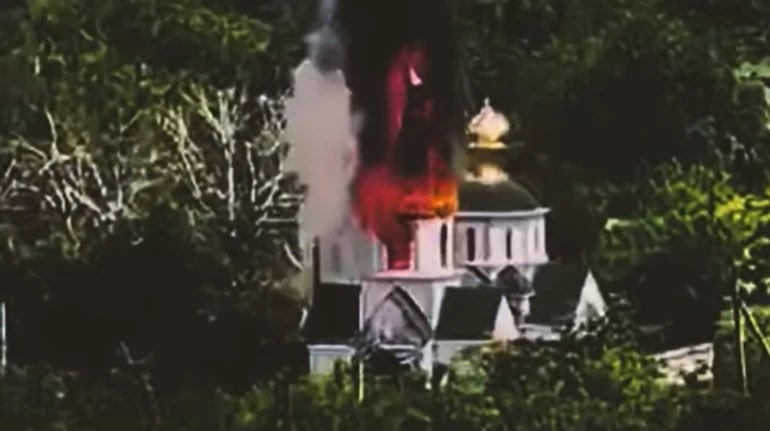
The Church of the Nativity of the Blessed Virgin Mary in Zakitne, Donetsk region, was destroyed by fire after an incendiary munition was dropped from a drone. Churches, mosques, synagogues, and other religious sites continue to be damaged and destroyed as a result of the war. Such attacks harm the cultural and spiritual heritage of local communities.
#WarCrimes
Hola Prystan in the occupied Kherson region remains largely cut off from basic services and assistance. The town, located about 15 km from Kherson, is largely isolated due to mined roads, while civilian vehicles are constantly at risk of drone attacks at entry and exit points. Around 1,500 residents are living without electricity, gas, or adequate medical care, and access to food and water remains unstable. Civilians should not be forced to endure such conditions or be left without access to basic necessities, even during armed conflicts.
#InternationalCrimes
Ukraine’s main weapon in the current war is our internal unity and cohesion. Without them, defending the state would be impossible. I emphasized this today during a discussion at the International Forum “Architecture of Security.”
Our unchanged position in all negotiations – with partners and enemies alike – is this: we stop hostilities along the current line of contact, without any territorial concessions or giving up Donbas. We clearly understand the risks of postwar Ukraine turning into a large “gray zone,” which is why there is no alternative to reliably defining the parameters for ending the war and securing firm security guarantees.
Ordinary Russians are already feeling the war near their own homes thanks to the work of Ukraine’s long-range sanctions. Explosions, fires, and chaos in Russian regions are destroying the myths of Russia’s omnipotence and creating a deep mental crisis in enemy society. The Kremlin is terrified precisely of such an “awakening” among Russians – it is a direct threat to the stability of the regime. That is why Putin will do everything to keep the situation under control, and this gives us a window of opportunity to achieve a just result through diplomacy on our terms.
The old global security architecture no longer exists. Attempts to close one’s eyes to this and act according to the principle of “we’re safe in our little house” may push the Russians to test European countries for strength. The main question today is whether Western states and their societies are ready to look at the world soberly and step out of their own comfort zone.
The future world order requires fundamentally new approaches, because no serious security alliance can work effectively based on unanimous decision-making, which always paralyzes the system at a critical moment. Therefore, when building a new security architecture with Ukraine’s participation, we must take every detail into account so as not to create yet another “bubble” that will burst at the very first real threat.
I sincerely thank Anne Applebaum for the interesting questions and discussion, as well as the Institute for National Resilience and Security and all the organizers of the International Forum “Architecture of Security” for professionally organizing a platform for such an important dialogue. Through joint efforts, we must develop effective protection mechanisms.
Let’s keep working!
Glory to Ukraine!
@Metallica frontman @onlyjamesahet honored a special guest at their latest concert: Maryna from Ukraine 🇺🇦
This isn't the first time the band has stood in solidarity with Ukraine.
Thank you, guys! 🤟🏽
Asymmetry is Ukraine’s greatest power.
Since the onset of this war, we realised that our resources are not equal and we cannot prevail in a direct confrontation.
Instead, Ukraine spent years developing asymmetric solutions. Now we see them playing out in full — on the battlefield, in diplomacy, and in cognitive warfare.
On the land, Russia’s manpower is no longer a decisive advantage thanks to Ukrainian drones and new tactics. Russia’s advances have stalled. Ukraine stabilised the frontline and holds the line.
In the sea, the entire Russian Black Sea Fleet has been either destroyed or neutralised thanks to naval drones. Its remains hide in faraway bases, but we get them even there.
In the sky, thousands of cost-effective interceptor drones are neutralising 92% of Russian combat drones. The goal now is to develop our own protection from ballistics together with European partners. This is a matter of strategic autonomy.
In economy, Ukraine’s long-range sanctions are effectively crippling Russia’s war machine by daily strikes on legitimate military targets of up to 2,000 kilometres inside Russia. There are no safe places in Russia anymore. Probably not something Putin saw coming when he attacked Ukraine.
We take the same asymmetric approach in diplomacy. When the world expressed deep concerns over the Iranian strikes in the Gulf, Ukraine acted. We showed not only to the Gulf states but to the whole world Ukraine’s new role as a reliable security partner.
We are deepening ties with countries from Latin America to Africa, South Caucasus, Central Asia, and the Indo-Pacific, where Russia’s influence gradually fades.
In energy, horrific Russian bombardments over the past winters taught us to decentralise and build resilient systems and approaches. We are now ready to share this experience with others.
In digital sphere, Ukraine is one of the most advanced nations on the planet: from digital public services to mil-tech and the use of AI and big data in governance. It has become one of our export positions.
In the cognitive war, it turned out that in order to foil Putin’s May 9th Red Square parade, Ukraine does not need to strike it — it’s enough to allow it. This is only one sign of our systemic expertise in countering disinformation and hybrid warfare.
Ukraine’s asymmetric advantages have been born under punches. But the best proof of their effectiveness is the fact that Russia loses initiative and any perspectives on the battlefield, plunges in a deep economic recession, and faces a brewing political crisis.
At the end of the day, it turns out that David actually has cards.
A week has passed since the last massive attack. By now, russia has likely replenished enough missiles to launch another one.
Ukrainian intelligence and military officials are urging people to take air raid warnings seriously.
For Ukrainians, knowing that we will make it through yet another night depends on one thing: sufficient air defense ammunition. We need it urgently.
I held a Staff meeting. Importantly, we analyzed in great detail the state of implementation of the decisions our warriors on the frontline had spoken about. In the second half of last year, decisions were introduced that ultimately led to a significant strengthening of our frontline positions.
First – direct funding for combat brigades to purchase what they need, primarily drones. Second – a fairer distribution of personnel to reinforce combat brigades. Third – expanding the ability of our brigades to conduct basic general military training. Direct funding has boosted the real combat capabilities of the brigades. As for personnel, around 160 military units are already receiving stable, guaranteed reinforcements, and this makes it possible to defend positions with greater confidence. The number of military units granted the right to conduct basic general military training has also doubled. I instructed that possible additional steps be worked through for each of these points – how else we can support the brigades.
Separately, we also discussed the supply of long-range 155 mm shells – an issue the guys have often raised. I instructed that more opportunities be developed for the financing, production, and supply of such shells, and for supporting our artillery capabilities overall, which remain essential for achieving combat results. The Ministry of Defense of Ukraine is also working on supplying pickup trucks to the troops – the decisions are already being implemented.
Today, there was also a report by Commander-in-Chief of the Armed Forces of Ukraine Oleksandr Syrskyi on the situation in the key sectors. Ukrainian positions are strong, and this is a result our state very much needs – one that will certainly support all diplomatic steps. We also devoted considerable attention to air defense today, which is perfectly understandable, as it is a key priority for protecting our cities and communities. I expect much more activity from our diplomats to strengthen air defense and ensure the supply of the necessary missiles. I also instructed the Ministry of Defense to intensify all available formats with partners for the supply of anti-ballistic capabilities. We must find what Ukraine needs. Glory to Ukraine!
My mates dad just got bundled into the back of a van, BUT everything is going to be OK.
Ukraine is winning, we just still need all the support we can get, in both the front and the rear.
#Lviv#Львів
Ireland’s alleged “military neutrality” is a blatant lie.
In the first quarter of 2026, 83 percent of Ireland’s alumina exports went to Russia. This is not a “neutral” economic relationship; it is active complicity in a war of aggression against Ukraine.
The Irish government knows this full well. Investigations by The Irish Times, the OCCRP, and others have conclusively traced the supply chain all the way to Russian arms manufacturers.
Ireland—once a symbol of independence and moral clarity—has made itself Putin’s useful idiot.
While Ukrainian children die, the Irish elite counts profits and votes. This is not neutrality—it is cowardice, greed, and a betrayal of European values.
More liquefied natural gas will be supplied to Ukraine from the Baltic.
During intergovernmental consultations in Vilnius, we reached an agreement on long-term LNG supplies through the Klaipėda terminal.
Liquefied natural gas can be supplied from both American and Middle Eastern producers. Ukraine’s Naftogaz has already received such shipments, and our agreements will continue to strengthen this route – another important step for Ukraine’s resilience.