🦕🌍 Meet Bicharracosaurus dionidei — a newly identified giant long-necked dinosaur from Argentina 🇦🇷 dating back ~157 million years!
At nearly 20 m long, this Jurassic giant may represent the first known brachiosaurid from South America 🦴✨
Its discovery is helping scientists rethink how massive sauropods evolved across Gondwana — and highlights the importance of southern hemisphere fossils in telling the story of dinosaur evolution.
Read more 👇
https://t.co/dkoJM7x16D
#OriginSciences 🔬 #FossilTuesday? 🦴 #DeepTime 🌍 #Paleontology
🎓🔬 A PhD isn’t just about consuming knowledge — it’s about creating it. And that process is often messy, uncertain & nonlinear. It can be a difficult journey.
New insights on doctoral supervision highlight the importance of collaboration 🤝, multidisciplinary thinking 🌍 and helping students align research with their strengths ✨
Supporting young researchers is essential for the future of #OriginSciences.
Read more 👇
https://t.co/CSwbuCCqdp
#PhDLife #Research #AcademicTwitter #AllFromOne
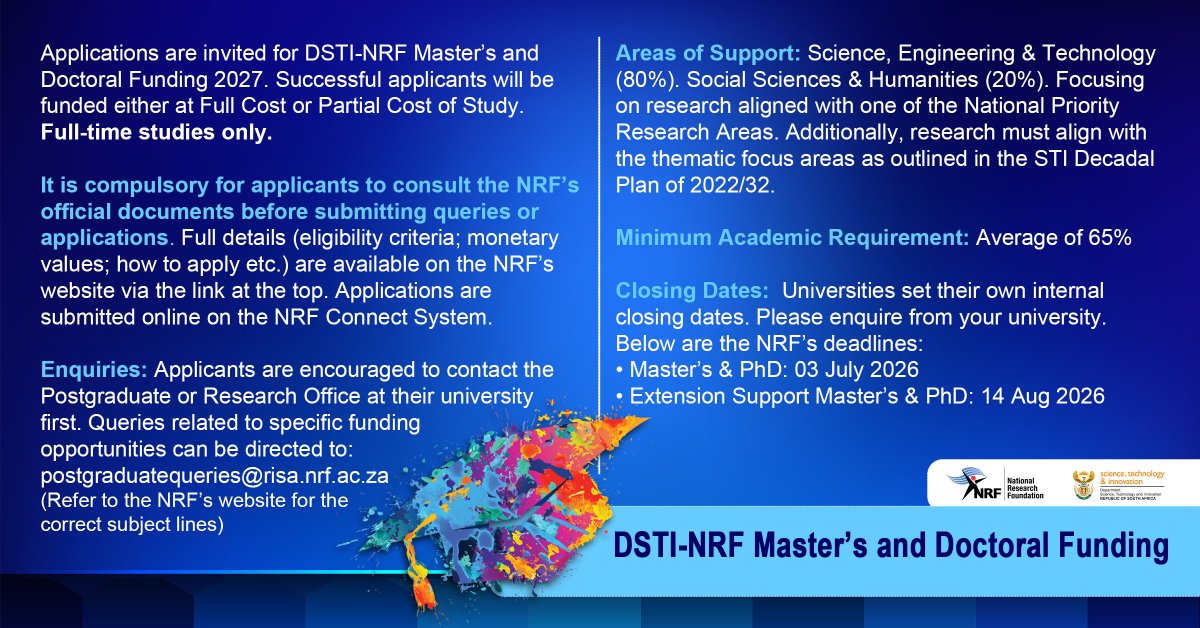
The NRF’s 2027 Master’s and Doctoral Funding call is available here: https://t.co/TGS6QwyZA0
It is compulsory for applicants to consult the NRF’s official documents (Framework, Application, and FAQ Guides) before posting queries or submitting applications.
🌊🦴 Did low tide shape humanity’s journey out of Africa?New research suggests early humans may have used coastal low-tide routes to move along shorelines—opening new pathways for migration beyond Africa 🌍These shifting coastlines could have made resources easier to access, supporting movement and survival.✨ Sometimes, the smallest environmental changes shape the biggest human https://t.co/diIInwEIeU more 👇
https://t.co/NKj7c7Dlln 🔬 #AllFromOne 🌍 #HumanEvolution #DeepTime
Well f#ck...
🌡️🌍 Global warming is speeding up.
New research shows Earth warmed by ~0.35°C in the past decade—nearly double the rate seen between 1970–2015.
At this pace, we could breach the 1.5°C threshold by the end of this decade.
🦴 The fossil record shows how past climate shifts reshaped life.
✨ This time, we have the knowledge—and responsibility—to act. It's time for governments to make real changes and corporations to actually be held accountable.
Read more 👇
https://t.co/6VTyKDZhCt
#OriginSciences 🔬 #AllFromOne 🌍 #DeepTime #ClimateChange
🦖 How fast did the king of dinosaurs grow?
New research suggests Tyrannosaurus rex took around 40 years to reach full size—much longer than the previously estimated 25 years. Scientists studied growth rings in fossil leg bones from 17 specimens to reconstruct its life history.
🔬 The study also hints some fossils once labelled T. rex might belong to different species.
Read more 👇
https://t.co/VhBlSzvt5S
#OriginSciences 🔬 🦴 #DeepTime #AllFromOne ✨
🦴 A new face for one of our oldest ancestors.
Scientists have digitally reconstructed the face of “Little Foot”, the most complete Australopithecus skeleton ever found — over 90% complete and about 3.67 million years old from Sterkfontein, South Africa.
Using high-resolution scans, researchers virtually repositioned crushed skull fragments to reveal what this ancient hominin may have looked like — helping us better understand how early human faces evolved.
Read more 👇
https://t.co/WPxW8GhylK
#OriginSciences 🔬 #AllFromOne ✨ #HumanEvolution @BeaudetAmelie@WitsUniversity
🏺🌍 Colonialism in Africa runs deeper than we often think.
New research shows archaeology can reveal colonial histories both from outside and within Africa — from European imperialism to earlier African empires that expanded, traded, and reshaped societies.
Archaeology helps uncover the material traces of power, resistance, and cultural exchange across centuries.
Understanding the past helps us rethink history, justice, and decolonisation.
Read more 👇
https://t.co/OqJmGA911q
#Archaeology #AfricanHistory #DecolonisingScience #OriginSciences #DeepTime @chirikure
🎓 FCT PhD Fellowships 2026
ICArEHB invites inquisitive and motivated candidates to pursue a PhD in Prehistoric Archaeology or Primatology through the national FCT Program.
📍See our poster & details: https://t.co/lbrov7QA2X
#PhD#Archaeology#FCT#ICArEHB
🌍 All life on Earth — from bacteria to blue whales to humans — can be traced back to a Last Universal Common Ancestor (LUCA). Recent research pushes LUCA to about 4.2 billion years ago — just ~400 million years after our planet formed — and suggests it even fought off primordial viruses.
🧬 This ancient ancestor, inferred from shared genetics across all domains of life, reminds us that deep evolutionary roots run far deeper than we once thought and are central to understanding life’s diversity.
Read more 👇
🔗https://t.co/oDehJZdbd2
#OriginSciences 🔬 #FossilWednesday 🦴 #AllFromOne ✨ #DeepTime