Mentors do not give you a shortcut, but they streamline the process. They invariably had their own great mentors, giving them a richer and deeper knowledge of their field.
TEN MIND-ALTERING IDEAS FROM MY FAVORITE NONFICTION BOOK
What I love about this book is how much it inspires reflection on ideas you might have deeply entrenched in your psyche and never thought to analyze.
Ideas you might have about work, life, love, time, energy, really anything that might be important to you.
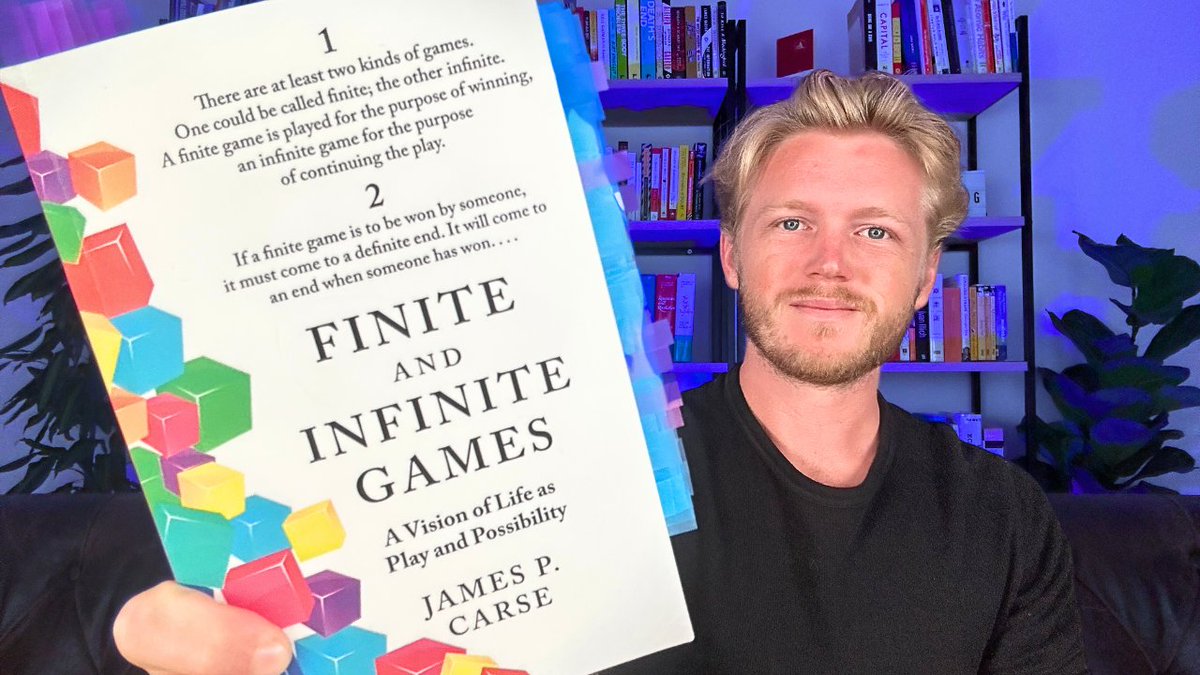
Finite & Infinite Games is one of those books I just keep coming back to.
I did a whole deep-dive on the book on the Nat's Notes podcast today, and here are ten of my favorite ideas from the book to give you a sample.
1: Rules are only valid because you follow them. All limitations are self-limitations.
“Rules are not valid because the Senate passed them, or because heroes once played by them, or because God pronounced them through Moses or Muhammad. They are valid only if and when players freely play by them.”
“…it is often the case that finite players will be unaware of this absolute freedom and will come to think that whatever they do they must do… Fields of play simply do not impose themselves on us. Therefore, all the limitations of finite play are self-limitations.”
2: You do not struggle against the world. You struggle according to the world.
“We are not defeated by floods or genetic disease or the rate of inflation. It is true that these are real, but we do not play against reality; we play according to reality."
"We do not eliminate weather or genetic influence but accept them as the realities that establish the context of play, the limits within which we are to play. If I accept death as inevitable, I do not struggle against mortality. I struggle as a mortal.”
3: Seriousness is the mark of a finite player. Infinite players are playful
“A finite player is trained not only to anticipate every future possibility, but to control the future, to prevent it from altering the past. This is the finite player in the mode of seriousness with its dread of unpredictable consequence."
"Infinite players, on the other hand, continue their play in the expectation of being surprised. If surprise is no longer possible, all play ceases. Surprise causes finite play to end; it is the reason for infinite play to continue.”
“Infinite players are not serious actors in any story, but the joyful poets of a story that continues to originate what they cannot finish.”
4: Aim to be strong, not powerful.
“Power will always be restricted to a relatively small number of selected persons. Anyone can be strong.”
“The more powerful we consider persons to be, the less we expect them to do, for their power can come only from that which they have done. After athletic contests in which major titles have been at stake, it is common for the audience to lift the winners to their shoulders, marching them about as if they were helpless-in the sharpest possible contrast to the physical skill and energy they have just displayed.”
5: Winners in finite games are never satisfied. They must keep winning.
“The more we are recognized as winners, the more we know ourselves to be losers. That is why it is rare for the winners of highly coveted and publicized prizes to settle for their titles and retire. Winners, especially celebrated winners, must prove repeatedly they are winners."
"The script must be played over and over again. Titles must be defended by new contests. No one is ever wealthy enough, honored enough, applauded enough. On the contrary, the visibility of our victories only tightens the grip of the failures in our invisible past.”
6: Time is a matter of perspective.
“The infinite player in us does not consume time but generates it. Because infinite play is dramatic and has no scripted conclusion, its time is time lived and not time viewed.”
“An infinite player does not begin working for the purpose of filling up a period of time with work, but for the purpose of filling work with time. Work is not an infinite player's way of passing time, but of engendering possibility.”
7: Attempts to control nature will lead to being destroyed by it.
“The contradiction in our relation to nature is that the more vigorously we attempt to force its agreement with our own designs the more subject we are to its indifference, the more vulnerable to its unseeing forces."
"The more power we exercise over natural process the more powerless we become before it. In a matter of months we can cut down a rain forest that took tens of thousands of years to grow, but we are helpless in repulsing the desert that takes its place. And the desert, of course, is no less natural than the forest.”
8: Most of us have the wrong idea about travel. We’re “finite” travelers
“Genuine travel has no destination. Travelers do not go somewhere, but constantly discover they are somewhere else."
"Since gardening is a way not of subduing the indifference of nature but of raising one's own spontaneity to respond to the disregarding vagaries and unpredictabilities of nature, we do not look on nature as a sequence of changing scenes but look on ourselves as persons in passage.”
9: A great story is one that must be retold
“Our first response to hearing a story is the desire to tell it ourselves-the greater the story the greater the desire. We will go to considerable time and inconvenience to arrange a situation for its retelling. It is as though the story is itself seeking the occasion for its recurrence, making use of us as its agents.”
10: A story forced upon us will never resonate
“The opposite of resonance is amplification. A choir is the unified expression of voices resonating with each other; a loudspeaker is the amplification of a single voice, excluding all others. A bell resonates, a cannon amplifies. We listen to the bell, we are silenced by the cannon."
"The loudspeaker, successfully muting all other voices and therefore all possibility of conversation, is not listened to at all, and for that reason loses its own voice and becomes mere noise. Whenever we succeed in being the only speaker, there is no speaker at all."
There’s so much more in the episode... I really hope you love it.
Search “Nat’s Notes” in your podcast player to listen!
"We receive three educations, one from our parents, one from our school masters, and one from the world. The Third contradicts all that the first two teach us." - Baron De Montesquieu