Peritoneal Dialysis International (PDI) - Official Journal of @ISPD1. #PeritonealDialysis
EIC: @PD_Perls
SoMe Ed: @dr_nikhilshah
VA: @edgarvlermamd @jmteakell
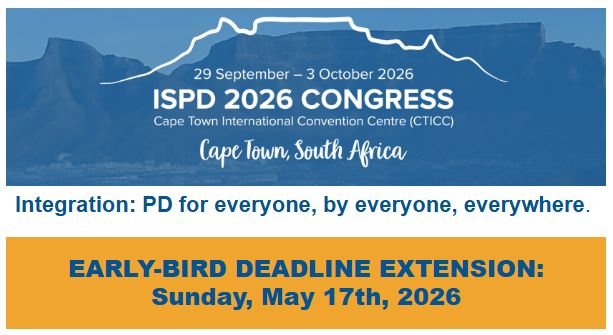
#ISPD26 Cape Town: closing of extension of early-bird registration deadline: Sunday May 17th!
Register now and enjoy the best rates - https://t.co/GfzePx33cf
After multiple requests, the Early Bird registration period has been extended two weeks!
Participants awaiting confirmation of funding or finalising arrangements may still benefit from up to 30% discounted fees if they register before 17th May
REGISTER: https://t.co/V8NhkOUHW1
BRI may serve as a convenient anthropometric marker for central adiposity in prevalent PD patients. The inconsistent prognostic value between incident and prevalent cohorts warrants cautious interpretation.
#PDI#PeritonealDialysis#Nephrology#ISPD#Obesity
https://t.co/1cjpNhfSFy
Does the Body Roundness Index (BRI), a marker of central adiposity, predict mortality and clinical outcomes in patients undergoing peritoneal dialysis?
Higher BRI also correlated with increased hospitalization frequency (p=0.001) and longer hospital stays (p=0.002) in prevalent patients. In a validation cohort of 162 incident PD patients, the association with survival lost significance after multivariable adjustment.
Maintaining robust peritoneal dialysis programs requires ongoing infrastructure support, adequate reimbursement, and clinical training, even as modality choice broadens. Read the full policy analysis in PDI.
Recent policy reforms have shifted toward shared decision-making, removing financial disincentives for hemodialysis. This transition presents a "success paradox," where initial policy triumphs create new structural and economic challenges for modality distribution.
Yesterday was #EarthDay2026! We invite you to revisit our post on the topic, written by Dr @WinstonFung1 (Hong Kong), highlighting the role that PD can play in making dialysis more sustainable and presenting upcoming "green" articles on the @PDI Journal.
https://t.co/YRbsl9IUI0
STARTING SOON (in 15')!
The first ISPD Africa Chapter webinar: Advancing PD in Africa.
The webinar does not require registration. When it is about to start, please click on the link: https://t.co/EeHu7Gojfw
WHEN: today Thursday, at 16:00 GMT / 18:00 CAT / 19:00 EAT).
Clinical Pearl: A review of 67 M. abscessus PD infections showed 6 historical cases treated with clofazimine achieved cure. This is the FIRST reported success for a macrolide-resistant strain! Clofazimine is a viable oral combo-therapy option. 5/5
A new Case Report in #PDI explores how a clofazimine-inclusive combination therapy successfully treated a stubborn, macrolide-resistant Mycobacterium abscessus PD infection! 🧵 1/5
https://t.co/nh1aY2aWIT
#peritonealdialysis#ISPD
The Results: After 4 weeks of imipenem-cilastatin, amikacin, azithromycin, and clofazimine, followed by 4 months of continuation therapy, the patient achieved sustained clinical cure! He remains recurrence-free at 14 months follow-up. 4/5
6/6 📝 Takeaway: Don't wait for the cocoon. In long-term PD patients, monitor ascites production rates during pauses. It could be the key to early EPS intervention.
Read the full paper by Hsieh et al. in @PDI_Journal
1/6 🧵 Diagnosing Encapsulating Peritoneal Sclerosis (EPS) early is notoriously difficult. A new case in #PDI suggests a subtle clinical sign may precede definitive radiological evidence. #PeritonealDialysis#PD#Nephrology
🔗 https://t.co/YzchjlMYk5
5/6 ✅ Outcome: Ascites volume decreased over time, and the patient's weight and appetite recovered. This highlights that "rapid accumulation" can be a vital early warning sign in high-risk patients.